An analytical chemist uses thin-layer chromatography (TLC) and melting point analysis to investigate the purity of three samples of acetylsalicylic acid (aspirin) synthesized in different laboratory runs, labeled A, B, and C.
The chemist compares the three samples with a certified reference sample of pure aspirin. Look at the chromatogram and the melting point data below.
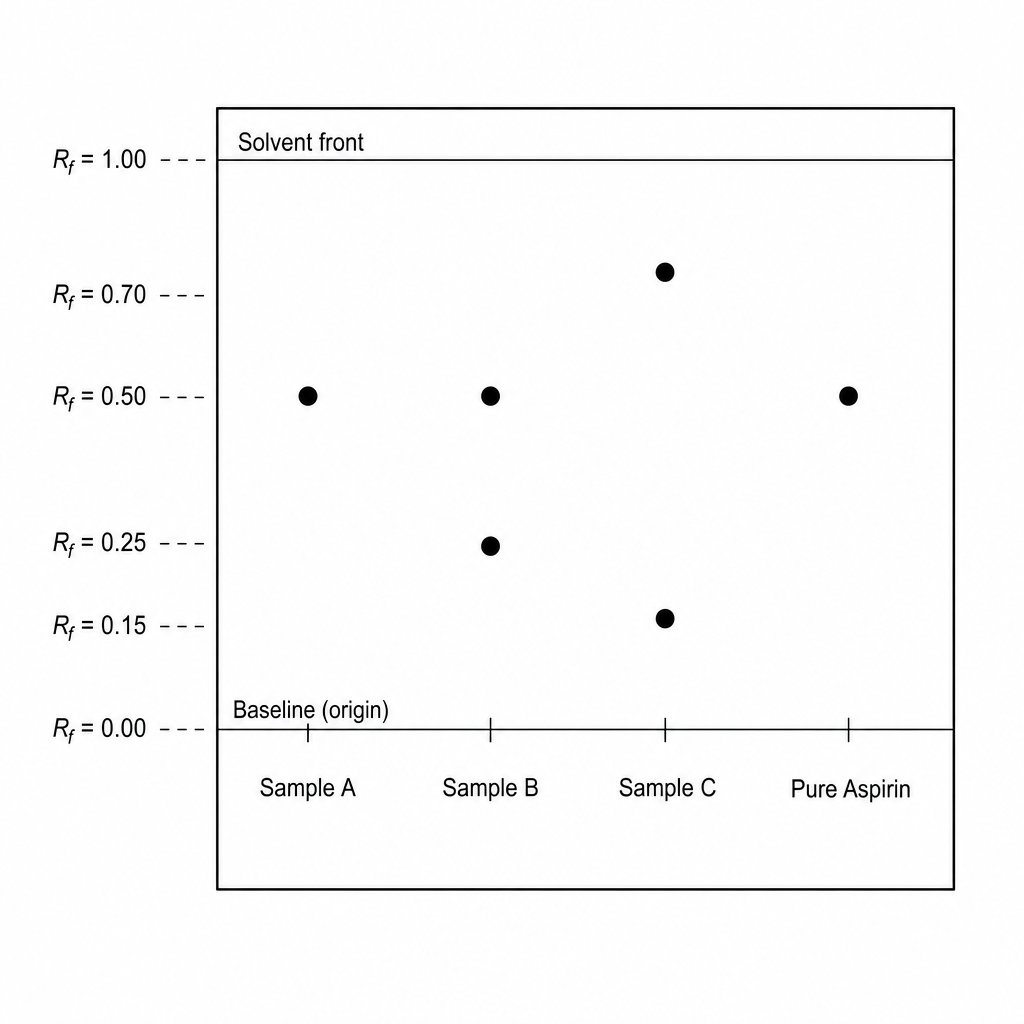
Melting Point Data Table:
- Sample A: 136∘C136^\circ\text{C}136∘C
- Sample B: 128∘C−132∘C128^\circ\text{C} - 132^\circ\text{C}128∘C−132∘C
- Sample C: 110∘C−115∘C110^\circ\text{C} - 115^\circ\text{C}110∘C−115∘C
- Pure aspirin: 136∘C136^\circ\text{C}136∘C
Determine which samples (A, B, and C) are pure, and which samples contain aspirin. Explain your answer using both the chromatogram and melting point data.