Purity and separating mixtures

EasyMediumHard
12345678910111213141516171819202122232425262728293031323334353637383940414243
Question 43
Medium

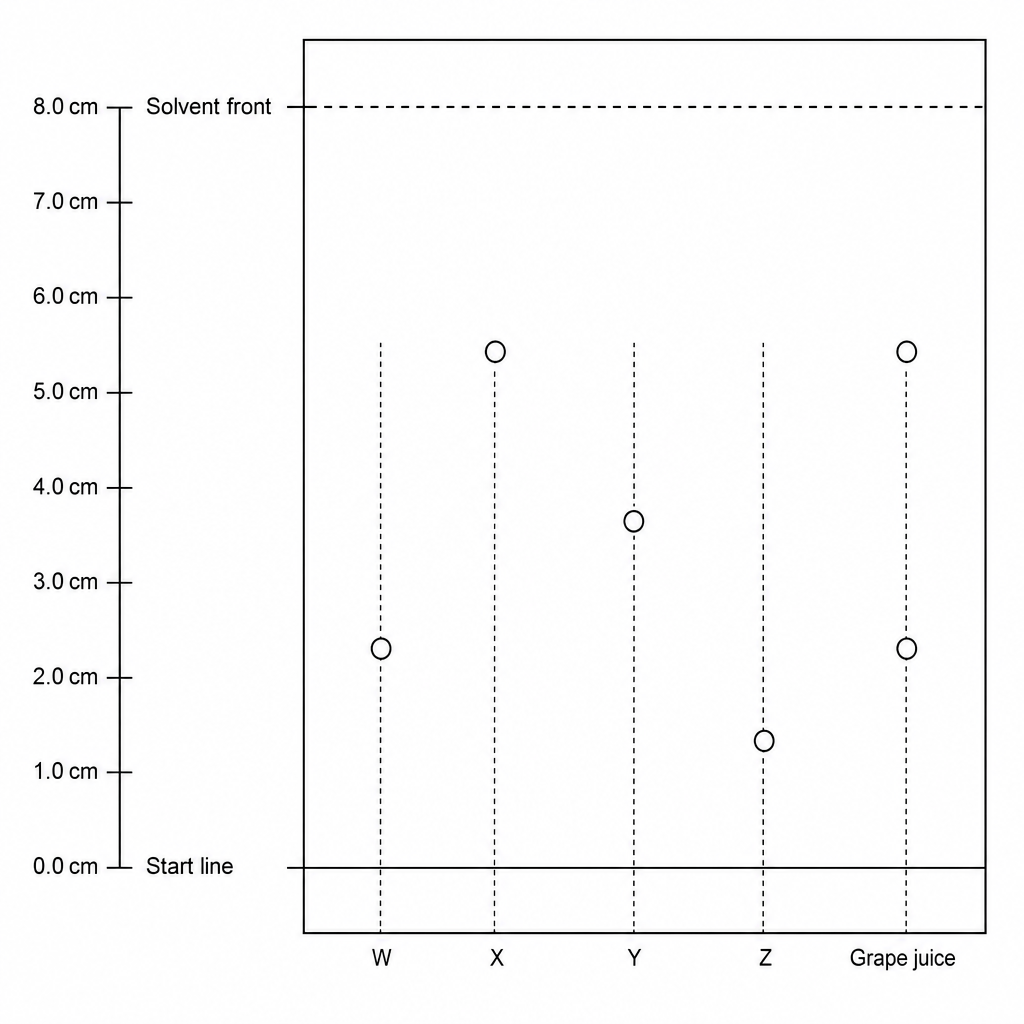
A student analyses a sample of grape juice using thin-layer chromatography (TLC). The grape juice was compared to four known food dyes, W, X, Y, and Z, as shown in the chromatogram below. A chromatogram of a TLC plate with a vertical centimeter scale on the left. The start line is at 0.0 cm. A solvent front is at 8.0 cm. Five lanes are labeled at the bottom: W, X, Y, Z, and 'Grape juice'. Lane W has a single spot centered at 2.2 cm. Lane X has a single spot centered at 5.4 cm. Lane Y has a single spot centered at 3.6 cm. Lane Z has a single spot centered at 1.2 cm. Lane 'Grape juice' has two spots, one centered at 2.2 cm and one centered at 5.4 cm.
a.

Calculate the RfR_{\text{f}}Rf​ value for dye Y. Give your answer to 2 significant figures.

[2]
b.

Which of the dyes are shown to be present in the grape juice?

[1]
c.

Suggest why dye Z has not travelled as far up the plate as dye Y.

[2]
d.

State one similarity and one difference between gas chromatography and thin-layer chromatography.

[2]
e.

Explain why thin-layer chromatography is used instead of gas chromatography to analyse the grape juice.

[2]

Purity and separating mixtures Questions

  1. GCSE
  2. /Chemistry
  3. /Purity and separating mixtures