A rare vintage postage stamp from 1850 is suspected of being a modern counterfeit.
A forensic chemist performs thin-layer chromatography (TLC) on a tiny sample of the ink from the stamp and compares it against authentic 1850 stamp ink and a modern 2010 counterfeit ink.
The chromatograms are shown below:
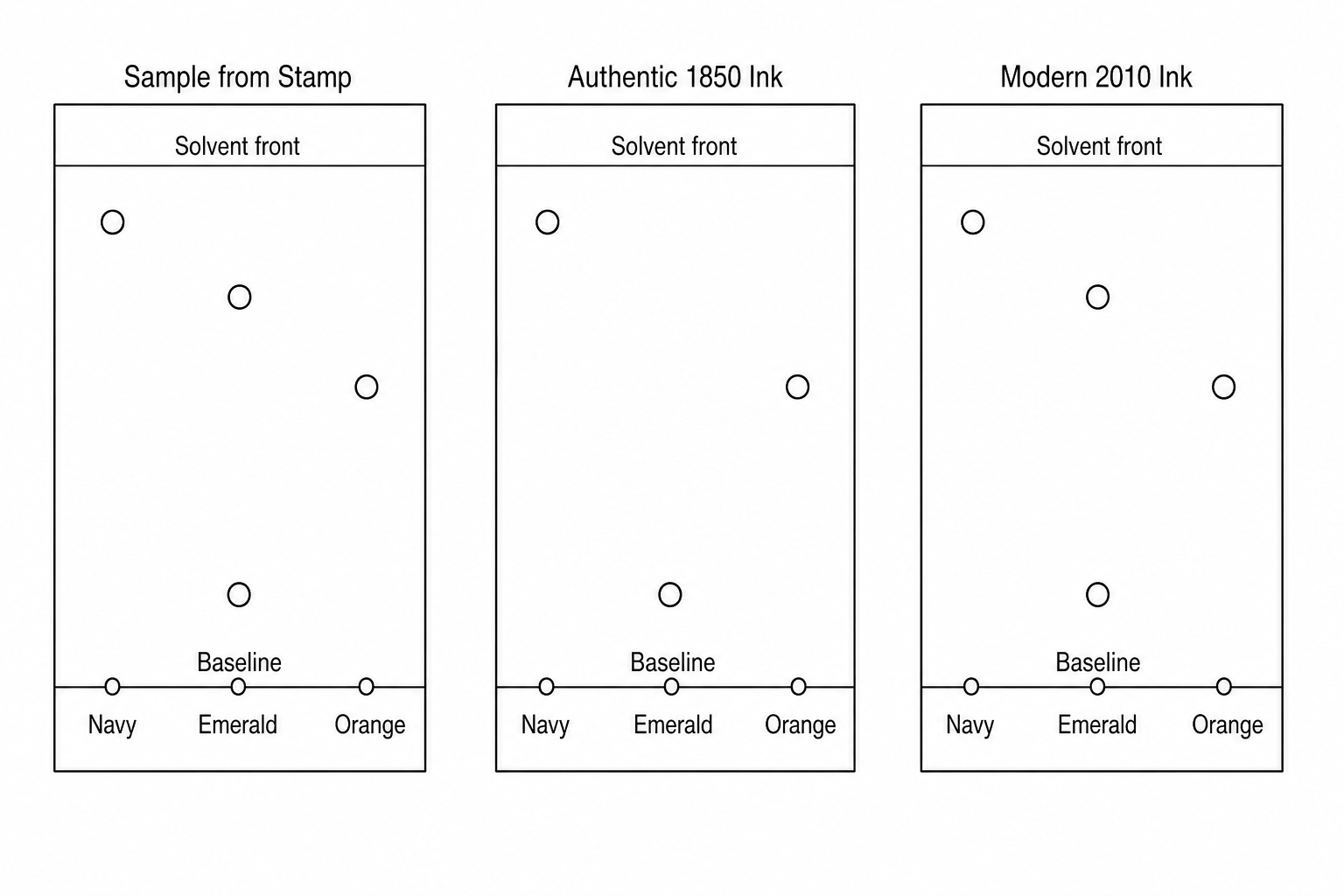
Look at the chromatogram for the sample from the stamp. Which ink colour(s) is/are pure?
The Navy, Emerald, and Orange inks from the stamp are tested with three different solvents, X, Y, and Z. The solubility results are shown below:
| Ink colour | Solvent X | Solvent Y | Solvent Z |
|---|---|---|---|
| Navy | Navy solid left in tube | Clear navy solution | Clear navy solution |
| Emerald | Emerald solid left in tube | Clear emerald solution | Emerald solution with some emerald solid left in tube |
| Orange | Orange solid left in tube | Clear orange solution | Clear orange solution |
Which solvent, X, Y, or Z, should the laboratory use for the thin-layer chromatography? Explain why this solvent is better than the others.
Scientists use RfR_fRf values to compare the different spots on a chromatogram.
Calculate the RfR_fRf value for the top spot of the emerald ink in the sample from the stamp.
- The distance from the baseline to the solvent front is 9.5 cm9.5\text{ cm}9.5 cm.
- The distance from the baseline to the centre of the top spot for the emerald ink is 6.8 cm6.8\text{ cm}6.8 cm.
Use the equation: Rf=distance travelled by the substancedistance travelled by the solventR_f = \frac{\text{distance travelled by the substance}}{\text{distance travelled by the solvent}}Rf=distance travelled by the solventdistance travelled by the substance
Give your answer to 2 significant figures.
A collector claims that the stamp is an authentic original from 1850.
Is the collector correct? Explain your answer.