A student uses the flowchart shown below to separate a mixture of hydrated copper(II) sulfate (CuSO4⋅5H2O\text{CuSO}_4 \cdot 5\text{H}_2\text{O}CuSO4⋅5H2O) and silicon dioxide (SiO2\text{SiO}_2SiO2) to obtain pure, dry copper(II) sulfate crystals.
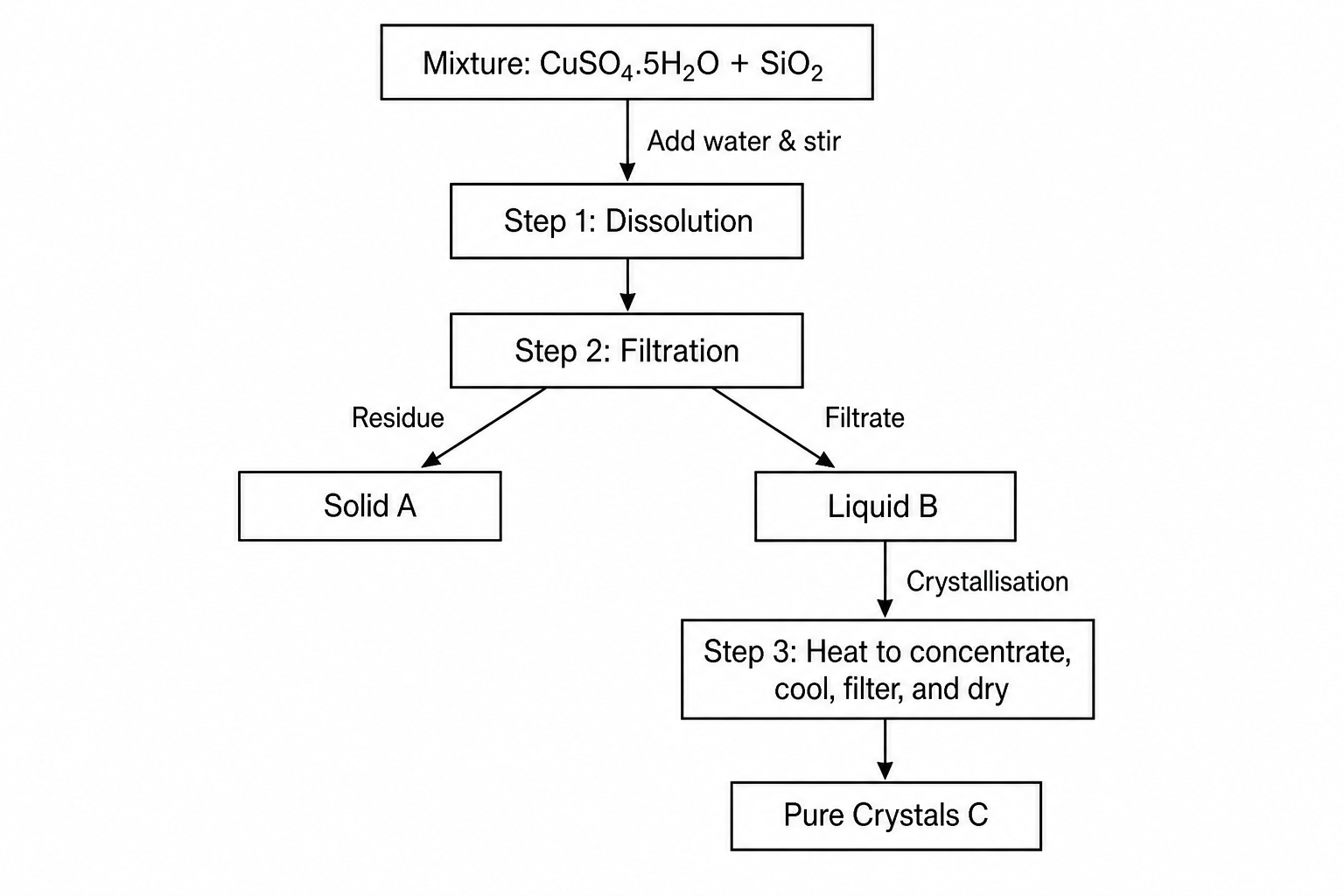
Which row correctly identifies Solid A, Liquid B, and the primary reason why 'evaporation to dryness' is NOT used in Step 3?
- Solid A: CuSO4⋅5H2O\text{CuSO}_4 \cdot 5\text{H}_2\text{O}CuSO4⋅5H2O
- Liquid B: Pure water (H2O\text{H}_2\text{O}H2O)
- Reason: Evaporation to dryness would cause the copper(II) sulfate to sublimate directly into the gas phase.
- Solid A: SiO2\text{SiO}_2SiO2
- Liquid B: Aqueous copper(II) sulfate solution (CuSO4(aq)\text{CuSO}_4\text{(aq)}CuSO4(aq))
- Reason: Evaporation to dryness would reduce the transition metal ions, depositing copper metal onto the basin.
- Solid A: SiO2\text{SiO}_2SiO2
- Liquid B: Aqueous copper(II) sulfate solution (CuSO4(aq)\text{CuSO}_4\text{(aq)}CuSO4(aq))
- Reason: Evaporation to dryness removes the water of crystallisation, forming anhydrous CuSO4\text{CuSO}_4CuSO4 powder, and leaves any soluble impurities in the product.
- Solid A: SiO2\text{SiO}_2SiO2
- Liquid B: Aqueous copper(II) sulfate solution (CuSO4(aq)\text{CuSO}_4\text{(aq)}CuSO4(aq))
- Reason: Evaporation to dryness is too slow and requires a fractionating column to separate the dissolved salt.