Question 16
FA student uses paper chromatography to analyse a mixture, M. The student also runs four dyes, P, Q, R and S, on the same paper using the same solvent.
The diagram shows the chromatogram.
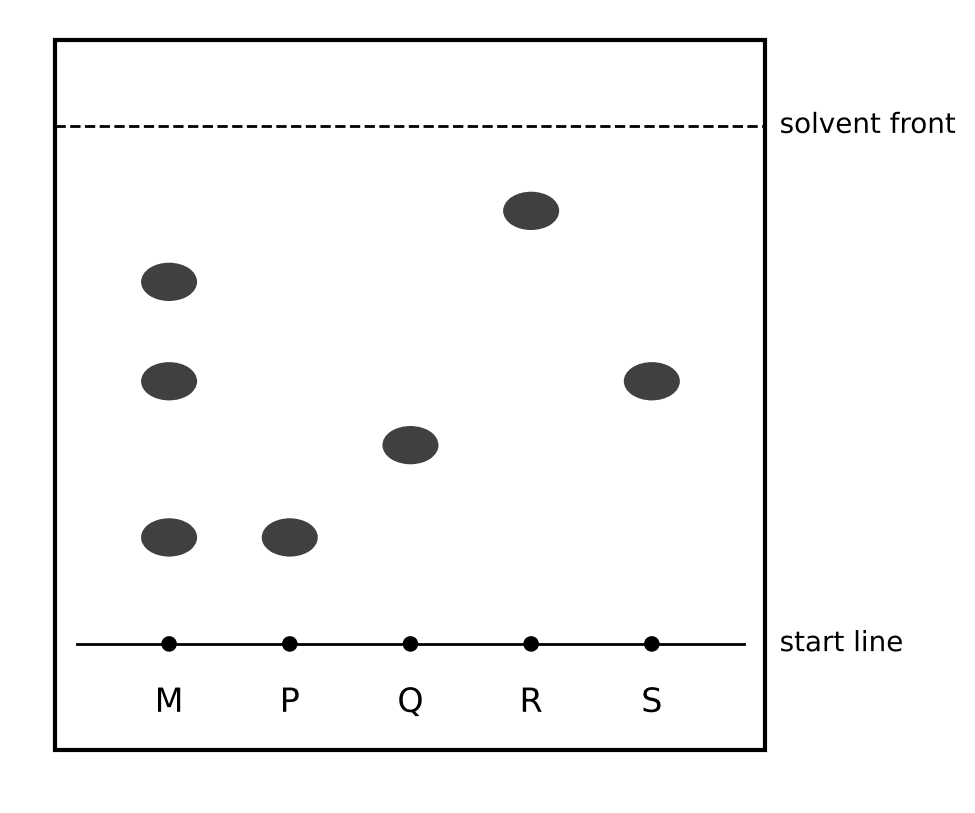
Which conclusion is correct?
M contains P and S only.
M contains P, S and at least one other substance that is not P, Q, R or S.
M contains Q and R, because M gives three spots.
M is a pure substance, because each of its spots is a single substance.
2.1 Purity and separating mixtures Questions
51 exam-style questions on OCR GCSE Chemistry 2.1 Purity and separating mixtures, covering 2.1.1 Pure substances and melting point data, 2.1.2 Relative formula mass and empirical formula, 2.1.3 Formulations as useful mixtures, 2.1.4 Techniques for separating mixtures, and 2.1.5 Chromatography and Rf values. Each one has a worked solution and a mark scheme showing where the marks go.