Wrong Tier GCSE Chinese: What Happens Next?
Wrong tier GCSE Chinese entry? Find out how Foundation and Higher affect grades, when your school can change the entry, and what to do before the exam.
It is easy to treat the letter beside an exam entry as administrative detail. Then you notice an FFF where you expected an HHH, or a teacher mentions a tier you never agreed, and suddenly it feels as though months of revision rest on one database field.
If you discover a wrong tier GCSE Chinese entry, tell your Chinese teacher and exams officer immediately. In most cases, a school or exam centre can amend the tier before the relevant awarding-body deadline. You cannot change it personally, and you should not wait until the examination day. Once a speaking assessment or another component has been taken, resolving the problem becomes more complicated because GCSE Chinese requires the same tier across all four assessments.
This guide explains what the tiers mean, what can still be fixed and what to do if the mistake is discovered late.
Wrong tier GCSE Chinese: the quick checklist
- Confirm whether your entry says Foundation or Higher.
- Check the exam board and specification. GCSE Chinese is offered by AQA as Chinese (Spoken Mandarin), while Pearson Edexcel Chinese includes Mandarin and Cantonese speaking options.
- Ask whether the entry is genuinely incorrect or reflects your teacher's current recommendation.
- Contact your Chinese teacher and the exams officer in writing.
- Ask for confirmation once any amendment has been processed.
- Do not assume you can take different tiers for different papers.
- If an assessment has already started, alert the centre immediately and follow its instructions.
The important distinction is between a clerical error and a tier decision you disagree with. A clerical error can normally be corrected through the entry system. A disagreement needs a calm conversation about evidence, likely grades and the risks attached to each tier.
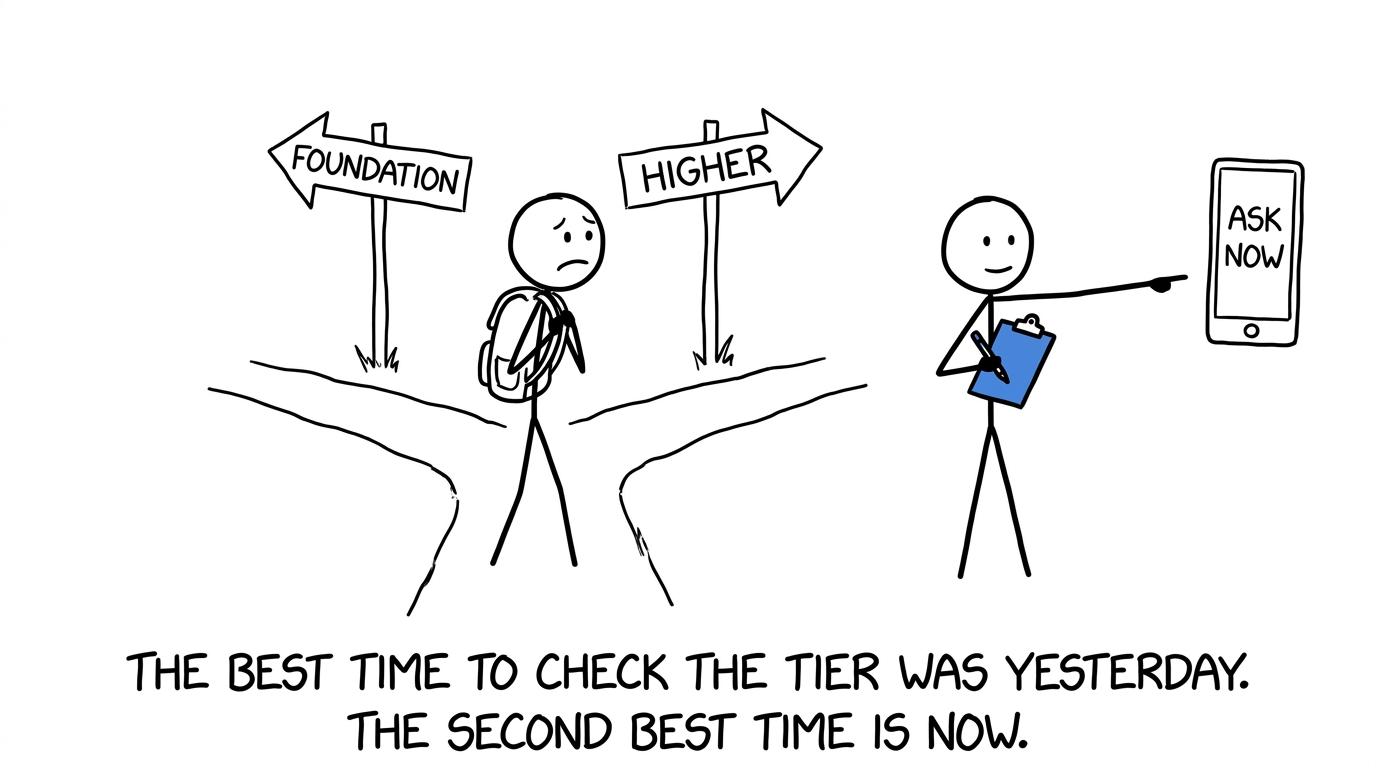 A student choosing between Foundation and Higher asks an exams officer for help
How GCSE Chinese tiers work
For the current AQA and Pearson Edexcel GCSE Chinese specifications, students complete four skill areas:
- listening;
- speaking;
- reading;
- writing.
Each skill contributes 25%25\%25% of the qualification. All four assessments must be taken at one tier: either Foundation or Higher. Mixed-tier entry is not allowed, so you cannot take Foundation listening and Higher writing simply because your strengths differ between skills.
The broad grade ranges are:
| Tier | Grades normally available | Main consequence |
|---|---|---|
| Foundation | 111-555 | The highest possible grade is 555 |
| Higher | 444-999 | A narrowly available grade 333 acts as a safety net below grade 444 |
At Higher tier, the permitted grade 333 is not an automatic fallback. A student whose mark is below the limited safety-net range receives a UUU. At Foundation tier, a student who does not reach grade 111 also receives a UUU.
A grade 444 or 555 has the same value whichever tier produced it. Ofqual also states that the certificate does not show the tier entered. The decision matters because of the questions you face and the grade range available, not because Foundation is printed permanently beside your result.
That principle will feel familiar to maths students. The GCSE Foundation versus Higher Maths guide explores the same trade-off: Foundation provides access up to grade 555, while Higher opens grades above 555 but carries greater risk for a student not yet secure around grade 444.
What happens if the entry is wrong before the exam?
Usually, it can be fixed.
Your school or examination centre controls the official entry. Its exams officer can submit an amendment using the awarding body's entry system. AQA's published procedures explicitly treat changing a tier or option as an entry amendment. Pearson Edexcel also permits centres to amend entry and option codes.
Deadlines and possible fees depend on the awarding body and examination series. Changes made by the amendment deadline may be free, while later changes can attract charges. That financial administration is for the centre to manage; your responsibility is to report the concern quickly and provide clear information.
Do not rely on a verbal comment such as, “It should be fine.” Ask the centre to check the live entry and confirm:
- your full name and candidate details;
- the correct GCSE Chinese specification;
- Foundation or Higher tier;
- the correct speaking-language option where relevant;
- whether the amendment has been accepted.
Pearson's entry options distinguish not only between Foundation and Higher but also between Mandarin and Cantonese speaking routes. A student can therefore be on the wrong option even when the tier itself is correct.
Who should you contact?
Start with your Chinese teacher, then include the exams officer. If you are a private candidate, contact the centre through which you are entered. A parent or carer can help you follow up, but only the registered centre can submit the official change.
A useful message is short and factual: state what your entry currently shows, what you believe it should show and ask the centre to verify it. Avoid accusing anyone of making a mistake before the record has been checked.
What if the speaking assessment has already happened?
This is where timing matters most.
The speaking assessment is one of the four components and is itself tiered. Pearson requires centres to decide the candidate's tier before the speaking assessment. AQA also requires all four assessments to be taken at the same tier in the same examination series.
If you have already completed speaking at one tier, the centre should not casually move the remaining papers to another. Mixed-tier entry is prohibited. The exams officer must contact the awarding body and follow its current instructions.
Where a genuine administrative mistake has occurred, an awarding body may consider an exceptional resolution supported by evidence and an amended entry. That is not guaranteed, and the centre may also need to consider special consideration. The precise response depends on which component was taken, the tier officially recorded and the board's rules.
The safest advice is simple: report the issue on the day you discover it. Do not attempt to solve it by choosing whichever paper appears on your desk later.
What happens if you receive the wrong paper in the exam room?
Check the front of the paper before writing anything. Confirm the subject, paper, tier and candidate details.
If the tier is not what you expected, raise your hand and tell the invigilator quietly. Do not open a different packet, swap with another student or continue in the hope that the school can change the record afterwards.
Pearson's published guidance says that if a candidate starts a wrongly tiered paper and the problem is identified before the examination ends, the centre should secure that paper and provide the paper matching the candidate's entry. The centre may apply for special consideration if the disruption caused disadvantage.
If an entire component has already been completed at the wrong tier, the normal expectation is that the remaining components continue at the official tier of entry. Exceptional administrative-error cases require direct awarding-body involvement. Procedures can vary, so the exams officer must use the current guidance for your board rather than improvising.
 An exam paper in disguise is caught approaching the wrong-tier door
What are the consequences of staying on the wrong tier?
The answer depends on which direction the error goes.
Foundation instead of Higher
You can still earn a valid GCSE grade, but the maximum is grade 555. If your course, sixth form or personal target requires grade 666 or above, Foundation cannot deliver it regardless of how strong your performance is.
That does not make Foundation an inferior qualification. For a student working securely around grades 444 and 555, it may be the sensible entry. The problem arises when it does not match the student's demonstrated level or progression needs.
Higher instead of Foundation
Higher gives access to grades 444-999, with the narrow grade 333 safety net. However, a student who falls below that safety-net threshold receives a UUU. Higher papers also target more demanding language, structures and responses.
This is why “Higher gives me a better grade” is incomplete reasoning. Higher gives access to a wider upper range; it does not award a higher grade merely because you entered it.
Your teacher should consider performance across listening, speaking, reading and writing rather than one unusually good mock. The same evidence-led approach works in maths: use the correct board and tier when selecting GCSE Maths past papers, then look for a stable pattern rather than one result.
How to discuss a tier decision with your school
A tier conversation works best when it is based on evidence rather than pride. Ask:
- What grades have my recent assessments indicated?
- Are my results consistent across all four skills?
- Which Higher-tier demands am I currently meeting?
- What is the risk of a UUU compared with the benefit of access to grades 666-999?
- When is the centre's internal deadline for a final decision?
Schools often set internal deadlines earlier than the awarding body's published deadline so that entries can be checked. Treat the school's date as the practical deadline unless the exams officer tells you otherwise.
For your maths revision, apply the same discipline by checking your board and tier on the GCSE Maths revision hub. The full GCSE Maths topic list by board and tier can help you avoid preparing for the wrong content.
Common mistakes to avoid
Waiting because the exam is still weeks away
Entry systems have deadlines, and speaking assessments can occur before the written papers. A concern that is easy to correct today may become complicated after the first component.
Assuming your timetable proves the tier
A timetable may show a subject code without explaining every option clearly. Ask the exams officer to inspect the official entry record.
Believing different skills can use different tiers
GCSE Chinese requires one tier across listening, speaking, reading and writing. Strength in speaking does not permit a Higher speaking assessment alongside Foundation written papers.
Treating Foundation as a failure
Foundation can award grades 111-555, and a grade 444 or 555 is equivalent to the same grade from Higher. The right tier is the one that gives you the fairest opportunity to show your current attainment.
Revising from materials for the wrong tier
Tier affects vocabulary, grammatical demand, question style and response length. Check every practice paper before using it. In maths, build the same checking habit with Edexcel GCSE Maths mini tests and follow a reliable past-paper review process.
Turn the concern into a useful exam habit
An entry error feels large because it sits outside your direct control. But your next action is entirely within your control: ask, verify and keep the written confirmation.
Then apply that habit to every examination. Check the board. Check the tier. Check the paper code. Revise what you will actually be assessed on.
Once your GCSE Chinese entry is confirmed, return your attention to preparation. For maths, MathsGenie provides free revision lessons, practice questions, mark schemes, video solutions, mini tests, past papers and predicted papers. Start with the GCSE Maths revision area, use past papers to reveal gaps, and revise those gaps one at a time.
A small administrative detail can shape an examination. Fortunately, caught early, it can usually be corrected. Speak to your school today rather than carrying the uncertainty into tomorrow's revision.