

Why Choose GCSE English Language? 7 Benefits
Why choose GCSE English Language? Explore the skills students value, from clearer reasoning and confident writing to stronger maths exam technique.
The hardest maths questions are not always the ones with the hardest calculations. Sometimes the algebra is manageable, but the wording is dense. A single phrase changes what you must find. You understand the topic, yet the question still feels strangely out of reach.
That is one reason why choose GCSE English Language is a useful question for maths students, even though English is normally a core subject rather than an optional extra in England. The course develops careful reading, structured reasoning, accurate writing and confident communication. Those skills matter in English, but they also travel surprisingly well into maths, science, further education and everyday life.
Students who enjoy the subject often value its variety, its practical relevance and the freedom to develop an individual voice. More quietly, they also learn how to slow down, notice what language is doing and explain an idea so another person can follow it.
The short answer: why GCSE English Language feels worthwhile
Here is the overview:
- It improves your ability to understand unfamiliar and complicated texts.
- It teaches you to identify purpose, audience, viewpoint and bias.
- It gives you room to write creatively and persuasively.
- It develops a logical structure for longer answers.
- It helps you communicate ideas in maths, science and other subjects.
- It builds speaking and presentation experience.
- It rewards skills that remain useful beyond GCSE exams.
The exact papers depend on your exam board, whether that is AQA, Pearson Edexcel, OCR or Eduqas. Across specifications, however, GCSE English Language is built around reading, writing and spoken communication rather than memorising a fixed collection of literary quotations.
First, is GCSE English Language actually an option?
For most students in England, not in the usual sense. English is a compulsory national curriculum subject at key stage 4, and most schools enter students for GCSE English Language alongside English Literature. Your school chooses the exam board and usually determines the qualification pathway.
So the more accurate question may be: why take GCSE English Language seriously? In some settings, students may still be comparing qualifications, discussing separate English pathways or deciding which subjects deserve the most revision time. Either way, the benefits are worth understanding.
GCSE English Language is graded from 999 to 111. It is not divided into foundation and higher tiers in the way GCSE maths is. The written assessment is equally divided between reading and writing across the qualification, while the compulsory Spoken Language endorsement is reported separately and does not contribute to the final GCSE grade.
That last detail matters. The presentation is still part of the course, but a Pass, Merit or Distinction in the endorsement does not raise or lower your numbered English Language grade.
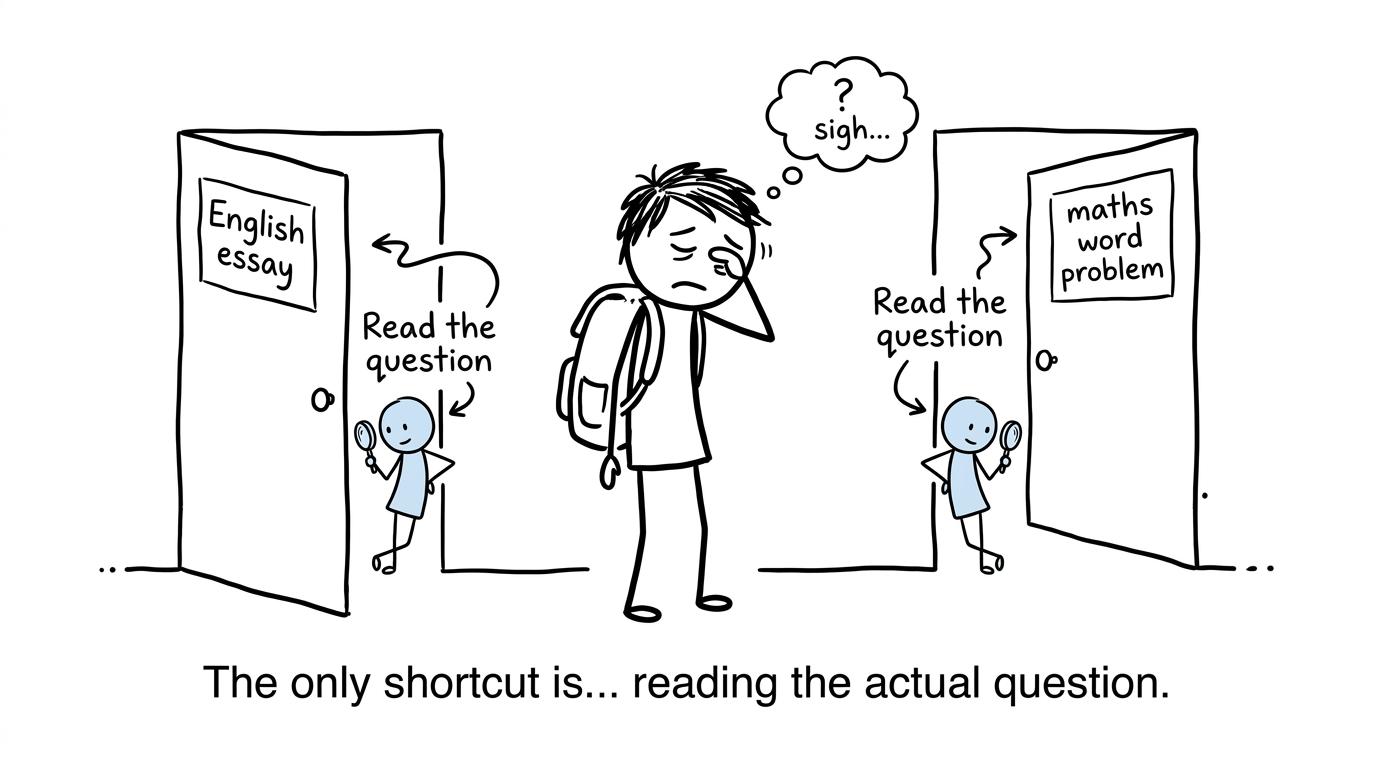 A GCSE student discovers that careful reading unlocks both English essays and maths word problems
Students value learning how to read beneath the surface
A text rarely announces everything directly. Writers imply, suggest, withhold, exaggerate and guide attention. English Language teaches you to distinguish what is stated from what can reasonably be inferred.
That habit has value far beyond an English paper. In a maths problem, you might need to decide which information is relevant, translate a sentence into a mathematical relationship or recognise that the question asks for a comparison rather than a calculation. Reading too quickly can turn known mathematics into lost marks.
English Language makes attentive reading a skill you can practise. You learn to:
- identify explicit and implicit information;
- select evidence rather than copying everything available;
- summarise ideas from more than one source;
- examine how structure changes meaning;
- evaluate whether a claim is convincing;
- notice bias, assumptions and unsupported conclusions.
These are analytical behaviours. The material may be prose rather than algebra, but the mental discipline is familiar: inspect the evidence, choose a method and justify the conclusion.
The course offers genuine variety
Some subjects reward mastery of one particular mode of thinking. English Language changes the task.
Depending on the specification, students encounter unseen fiction, literary non-fiction and other non-fiction from the nineteenth, twentieth and twenty-first centuries. Writing tasks may involve imaginative description, narrative writing or communication for a particular purpose and audience.
That variety is one reason some students find the course refreshing. You are not always being asked to produce the same kind of response. One task may demand close analysis; another may ask you to create a convincing voice. A third may require you to compare perspectives across two texts.
There is also less dependence on recalling one pre-studied text than in English Literature. The examination extracts are unseen, so preparation focuses heavily on transferable reading and writing skills. For students who prefer applying a method to new material, that can make the subject feel purposeful.
If Literature remains the more difficult English subject for you, MathsGenie's guide to finding your weakest GCSE English Literature areas shows how to turn broad worries into specific revision actions.
Creative writing gives students ownership
Exams are full of rules, timings and assessment objectives. Creative writing provides some room within that structure to make decisions of your own.
You can decide what a setting feels like, which details deserve attention and how quickly information should be revealed. You can shape a narrator's voice or build an atmosphere through sentence length and imagery. The task still needs control, but it is not simply a search for one predetermined answer.
Students who enjoy this part often value the balance between imagination and craft. An idea alone is not enough. It must be organised for a reader. That means choosing details deliberately, controlling paragraph movement and checking that technical accuracy supports rather than interrupts the effect.
This is an important lesson in any subject: freedom becomes more useful when it has structure.
Persuasive writing makes everyday communication clearer
A persuasive response is not just a collection of dramatic phrases. Strong writing has a clear purpose, an appropriate tone and a sequence the reader can follow.
GCSE English Language asks students to think about audience. The way you communicate in a formal letter should differ from the way you approach an article or speech. Learning to adapt does not mean pretending to be someone else. It means understanding what the situation requires.
This helps with emails, applications, presentations and written explanations. It can also improve how you ask for help. Compare a vague statement such as “I don't get algebra” with a precise explanation of where your reasoning stops. Clearer communication makes useful feedback more likely.
That principle sits behind MathsGenie's approach to finding your weakest GCSE topics: diagnose the exact gap, describe it clearly and choose a focused next action.
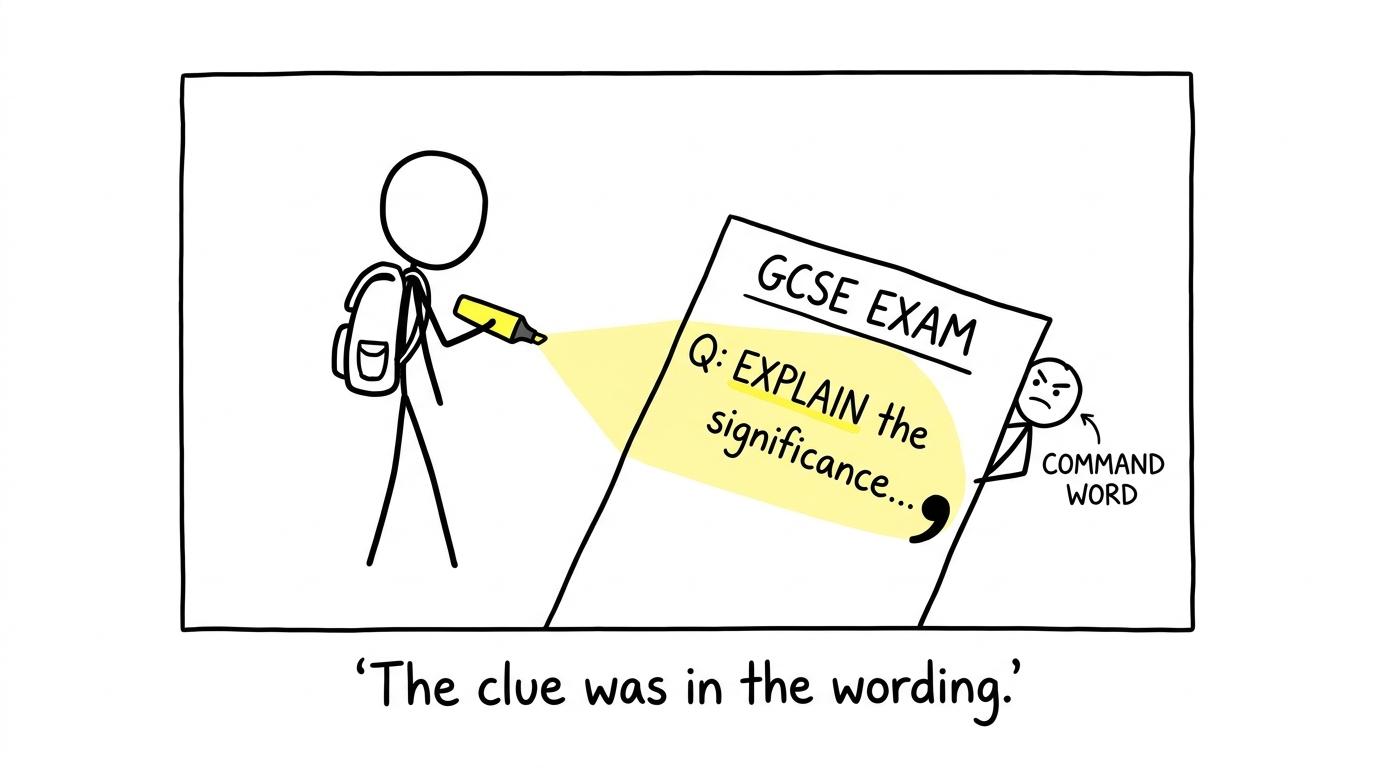 A student uses a detective-style highlighter to uncover the command word hiding in an exam question
English Language can strengthen maths exam technique
English Language does not teach equations, trigonometry or probability. Its value to a maths student is more indirect, and sometimes more important than it first appears.
You notice command words
“Show”, “explain”, “estimate”, “compare” and “prove” do not request identical responses. English revision trains you to pay attention to verbs, purpose and expected form rather than reacting only to familiar topic words.
You organise longer reasoning
Multi-step maths problems require an answer that another person can follow. English encourages a logical sequence: make a point, support it and connect it to the question. In maths, the equivalent is showing the relevant method, keeping working in order and finishing with a clear conclusion.
You become more comfortable with unfamiliar material
Unseen English extracts can initially feel unpredictable. So can an unfamiliar maths problem that combines several familiar topics. Practising calm analysis teaches you not to confuse “I have not seen this exact question” with “I cannot solve it”.
The best way to build that resilience in maths is through unfamiliar exam practice. MathsGenie's GCSE maths revision hub provides board-specific revision resources, while GCSE predicted papers offer another opportunity to apply known methods in a fresh setting.
Speaking can become less intimidating
The Spoken Language endorsement involves a prepared presentation in a formal setting, followed by responses to questions and feedback. It is assessed separately as Pass, Merit, Distinction or Not Classified.
Because it does not contribute to the numbered GCSE grade, students sometimes dismiss it. Yet the experience can be useful precisely because speaking is difficult to improve by reading about it. You improve by planning, delivering and responding.
A presentation asks you to choose an idea, organise it for listeners and continue when attention feels uncomfortable. Those skills can support sixth-form discussions, practical assessments, interviews and future employment. They also help when explaining a mathematical method aloud, one of the simplest ways to discover whether you genuinely understand it.
English and maths revision can support each other
The subjects need different practice, but the underlying revision loop can remain consistent:
- attempt a task without immediately checking notes;
- compare the response with the mark scheme or assessment criteria;
- identify the precise reason marks were lost;
- improve the response;
- return to the same skill later.
For English, that might mean revising paragraph structure or the use of evidence. For maths, it might mean repairing a particular algebraic method. In both cases, rereading feels comfortable but producing an answer creates better evidence.
A busy week does not need two enormous revision programmes. MathsGenie's 20-minute GCSE maths revision routine is designed for short school days, while the one-month GCSE maths revision plan helps organise lessons, questions, mini tests and papers over a longer period.
Common mistakes when deciding whether English matters
Treating it as “just common sense”
Being able to speak English does not automatically mean you can analyse an unfamiliar text, evaluate a writer's choices or produce controlled writing under timed conditions. Those are learned skills.
Assuming there is one perfect interpretation
A valid reading needs evidence and reasoning. The aim is not to guess a secret answer in the examiner's mind, but neither is every unsupported opinion equally convincing.
Confusing English Language with English Literature
Language concentrates on reading unseen material, analysing communication and producing your own writing. Literature centres on studied literary texts and the arguments you build about them. The subjects overlap, but they are not interchangeable.
Ignoring technical accuracy
Spelling, punctuation, grammar and sentence control are not decorative extras. They form a substantial part of the writing assessment and affect how clearly ideas reach the reader.
Revising passively
Reading model answers can help, but it cannot replace planning and writing your own timed responses. The same warning applies to maths. MathsGenie's guide to GCSE revision mistakes that waste time explains why feedback and reattempts matter more than simply counting revision hours.
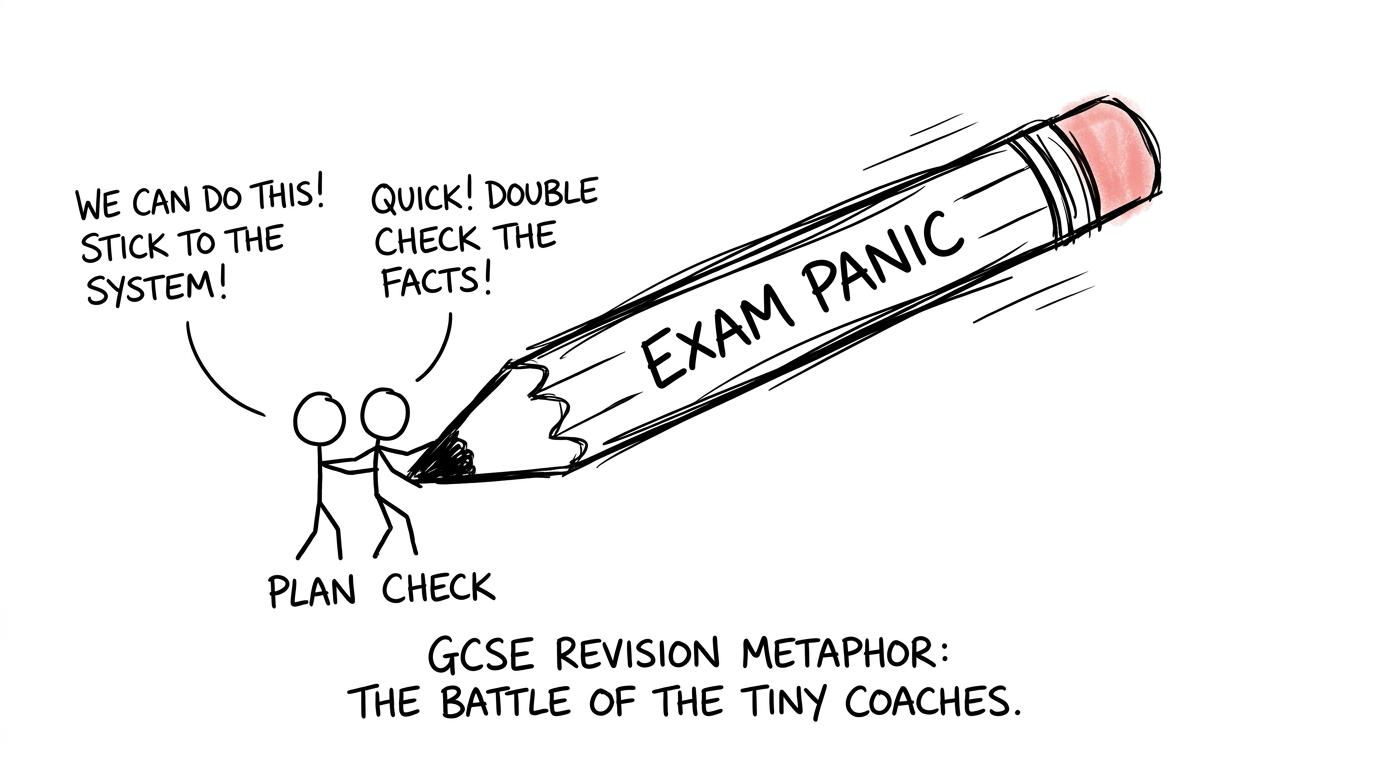 Two tiny revision coaches named Plan and Check try to stop a runaway pencil called Exam panic
Why some students are glad they took it seriously
The most durable benefit of English Language is not knowing the name of every technique. It is becoming more deliberate with information.
You learn to ask what a question actually requires. You learn that evidence needs explanation. You discover that structure can turn a loose idea into a convincing one. You practise writing for someone other than yourself.
Those skills are easy to overlook because they do not belong to one career or one school subject. They sit underneath many of them. A student may enjoy the creativity, the debate or the variety of unseen texts. Later, the lasting advantage may be simpler: they can read carefully, think critically and explain what they mean.
Make both English and maths revision more purposeful
GCSE English Language can make you a more attentive reader and a clearer communicator. To turn those habits into maths marks, apply them to real questions: read every instruction, identify the required outcome, show a logical method and check that your final statement answers the question.
MathsGenie gives you a free structure for doing that. Begin with revision lessons and practice questions, check your understanding with mini tests, then build exam confidence through Edexcel GCSE maths past papers, mark schemes, video solutions and predicted papers. If you are unsure when to move into full-paper practice, use the guide to starting GCSE past papers.
Choose one weak maths topic today. Read the question as carefully as you would read an English extract. Then make every line of your answer easy for an examiner to follow.










