What to Bring to GCSE English Language & Literature
What to bring GCSE English Language and Literature exam checklist: black pens, clear water bottle, permitted stationery and everything you must leave out.
The strangest part of exam morning is how quickly small doubts become large ones. Is a blue pen acceptable? Can you take your poetry anthology? What happens to your phone? By the time you reach school, the contents of your pencil case can feel as important as everything you revised.
Here is the short answer to what to bring GCSE English Language and Literature exam day: take at least two black ballpoint pens in a transparent pencil case and, if you want one, a clear unlabelled bottle of water. Bring any identification your centre has specifically requested. Leave phones, watches, notes, books and other unauthorised material outside the exam room.
The precise instructions on your question paper and from your school always take priority. However, the checklist below reflects the JCQ rules applying to GCSE examinations in England, Wales and Northern Ireland for the 2025/26 academic year.
Your GCSE English exam-day checklist
Pack these items the night before:
- At least two working black ballpoint pens
- A completely transparent pencil case or clear plastic bag
- A standard pencil and eraser for planning or permitted annotation, if useful
- A clear bottle of water with its label removed, if your centre permits drinks
- Your candidate or student identification, but only if requested by your centre
- Any approved access-arrangement equipment organised by your school
Before leaving home, confirm:
- The correct date and start time
- Whether it is English Language or English Literature
- The paper or component you are sitting
- The exam room and your centre's arrival time
- Your transport and a backup plan
Do not assume that your usual classroom, lesson time or seating arrangement will apply. Your school may ask candidates to arrive well before the official start so that bags can be stored and everyone can be seated correctly.
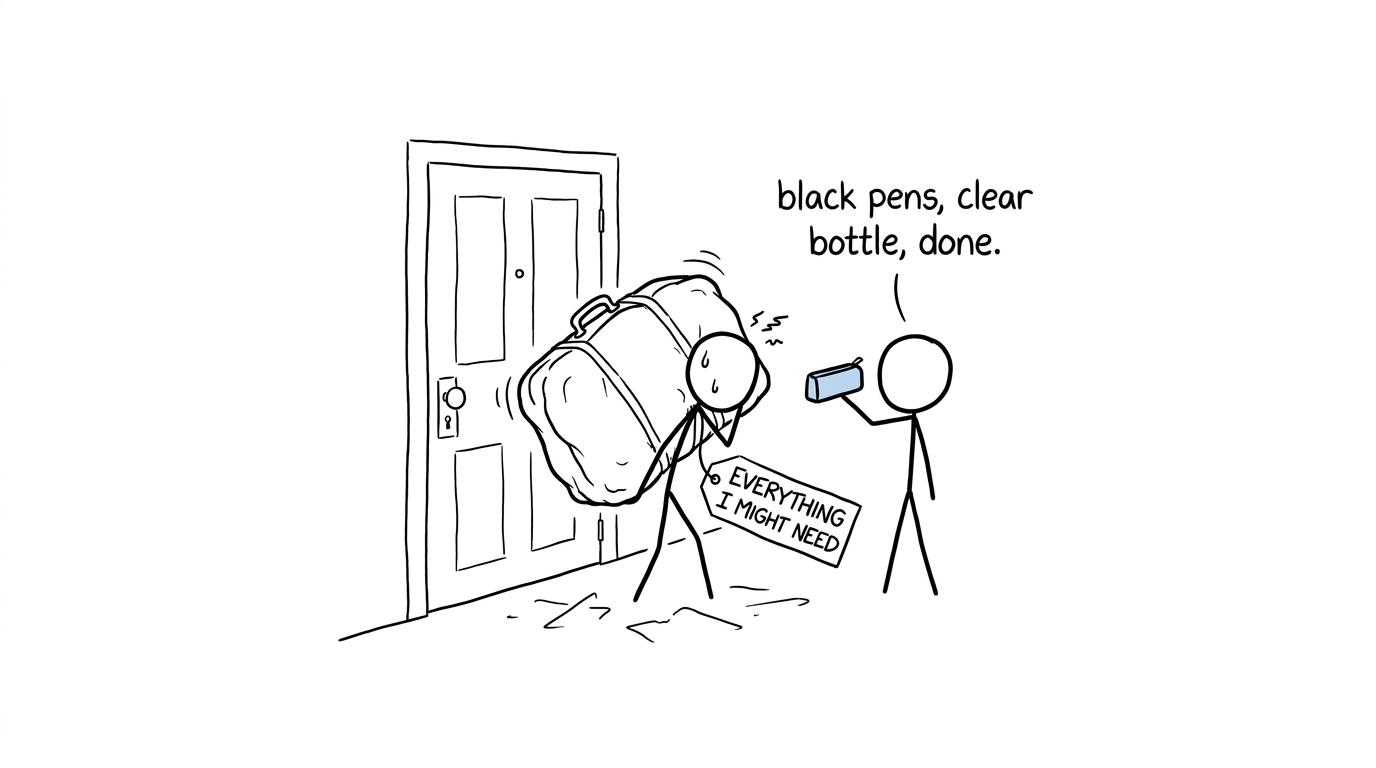 A student discovers that a tiny exam pencil case is more useful than an enormous suitcase
Exactly what you should bring
Two or more black ballpoint pens
JCQ requires candidates to write clearly in black ink unless the paper says otherwise. Black ballpoint pens are the safest choice because completed scripts are commonly scanned for marking.
Bring at least two. A pen rarely fails at a convenient moment, and waiting for a replacement interrupts your concentration. Test each one the previous evening and remove any pens that skip, leak or are nearly empty.
Do not plan to write your answers in blue ink. Avoid gel pens and erasable pens as well. JCQ instructions prohibit their use in answers, alongside correcting fluid, correcting pens and correcting tape.
A transparent pencil case
Any pencil case taken into the room must be see-through. A clear plastic stationery bag is also a simple option if your centre accepts one.
Check every pocket before the exam. Old revision cards, folded paper and handwritten reminders must be removed. Possessing unauthorised material can be treated as breaking the rules even when you did not intend to use it.
A pencil and eraser may be useful for a brief plan or for permitted annotation. Your final written responses should still be completed in black ink. English examinations do not normally require the ruler, protractor, compasses or calculator that you would pack for GCSE maths.
For your next maths paper, use the broader GCSE maths revision hub to check your board, paper type and revision resources before changing the contents of your exam kit.
A clear, unlabelled water bottle
You may normally take water into the exam room in a transparent bottle with the label removed, subject to your centre's arrangements. Choose a bottle that closes securely and place it on the floor if the invigilator instructs you to do so.
Do not bring an opaque reusable bottle, a can or a labelled drinks bottle and assume it will be accepted. Your school may have stricter local rules about drinks, so check beforehand rather than negotiating at the exam-room door.
Identification if your centre requires it
JCQ does not impose one universal rule requiring every school candidate to carry photographic identification. Your own centre may require a student card, candidate card or photographic ID, particularly if you are a private candidate.
Follow the written instructions from your exams officer. If no identification has been requested, do not invent an extra requirement for yourself.
Approved access-arrangement equipment
If you have an approved access arrangement, such as supervised rest breaks, a word processor or coloured overlay, the centre should organise it under the relevant regulations. Confirm the arrangement with your special educational needs coordinator or exams officer before exam day.
Do not bring your own electronic device or reference material without explicit approval. If medication, medical equipment or food is necessary for a health condition, arrange this with the centre in advance.
Can you bring books or an anthology?
For the standard GCSE English Literature qualifications offered by AQA, Pearson Edexcel, OCR and Eduqas, the written examinations are closed book or closed text. You must not take your studied novel, play, poetry anthology, quotation sheet or revision guide into the room.
Where an extract, poem or source is needed, the awarding body supplies it in the question paper or a separate insert. For example, AQA states that its English Literature assessments are closed book, while OCR describes both of its literature components as closed-text examinations. Eduqas also prohibits candidates from taking set texts and its relevant anthology into the examination.
Do not confuse GCSE with International GCSE or A Level arrangements. Some specifications and components at those levels permit prescribed clean texts. That does not change the rules for your GCSE paper. Check your exact qualification and component code with your teacher if there is any uncertainty.
The safest principle is simple: never carry a book into the exam room because you think it might be allowed. Bring it only when your centre has explicitly confirmed that your exact paper requires it.
What must be left outside the exam room?
Under JCQ rules, you must not have unauthorised material in your possession. Leave the following at home or store them exactly as your centre directs:
- Mobile phones, even when switched off
- Analogue, digital and smart watches
- Earphones, earbuds and AirPods
- Music players, tablets and other smart devices
- Smart glasses or any device capable of communication
- Revision notes, quotation cards and loose paper
- Copies of novels, plays and poetry anthologies for closed-book papers
- Dictionaries and electronic spellcheckers unless specifically authorised
- Calculator cases, written instructions or unrelated equipment
- Correction fluid, correction tape and correcting pens
- Erasable pens and gel pens for answers
- Food, unless your centre has approved it for a medical reason
Bags and coats should be stored where your school tells you. Do not keep a phone in a pocket because your bag seems inconveniently far away. After the exam starts, possession of a prohibited device must be reported and may lead to a sanction, whether or not you used it.
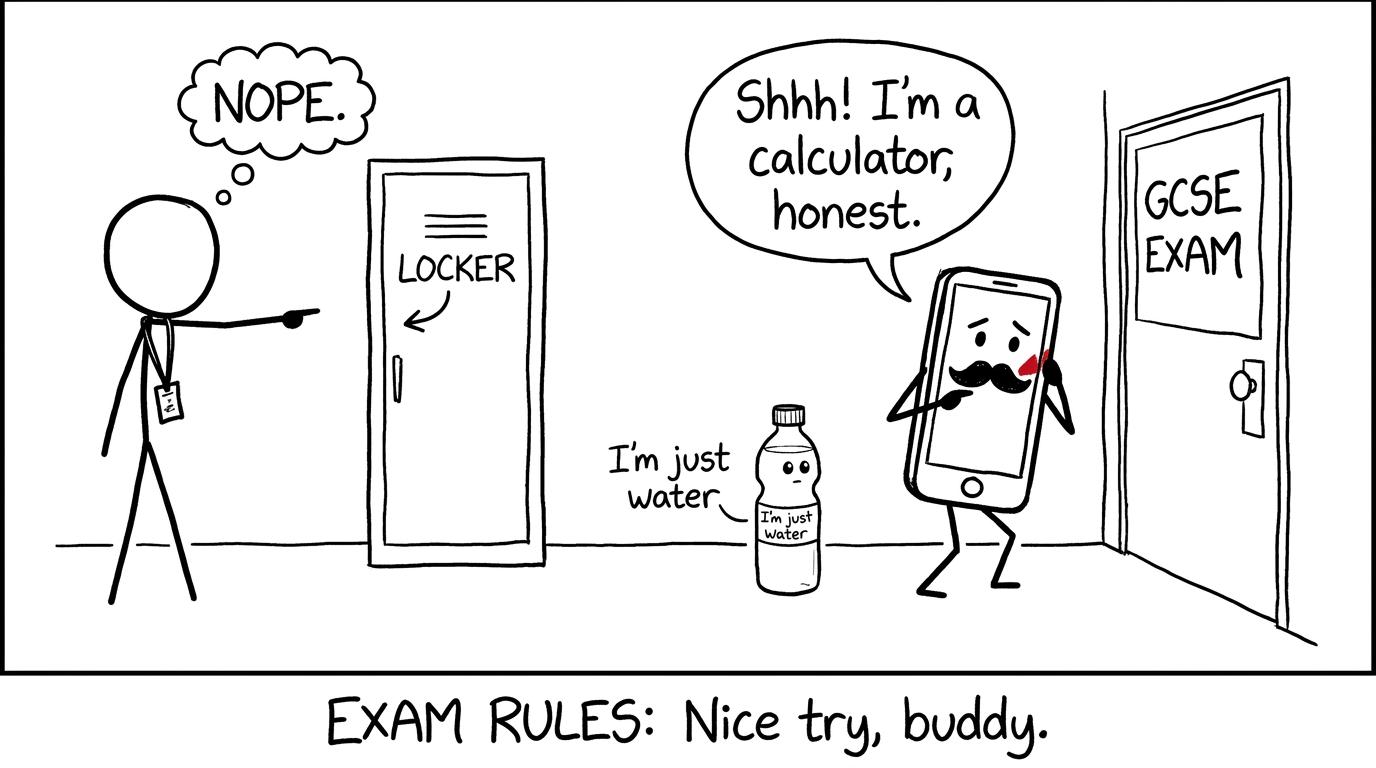 A disguised mobile phone fails to sneak past an exam invigilator
Are highlighters allowed in GCSE English exams?
Highlighters require a careful distinction. JCQ rules allow them for highlighting questions, words or phrases in the question paper, question-and-answer booklet or supplied resource material. They must not be used in your answers.
This means you may be permitted to highlight a key phrase in a source, but you should not highlight quotations or headings in the response being marked. A pencil is often a simpler choice for annotating an extract because you can circle, underline and add brief notes without confusing your final answer.
Never use a highlighter to conceal or correct writing. Cross out unwanted work neatly with a single line instead.
What the exam centre provides
Your centre and awarding body supply the official question paper, answer booklet, permitted inserts and additional answer sheets. You must not bring your own rough paper.
Read the front cover before starting. It tells you which questions to answer, where to write, which materials apply and whether a dictionary is prohibited. Listen to the invigilator too. If the printed instructions and your assumptions differ, follow the printed instructions and ask for clarification by raising your hand.
If you need more paper, a replacement pen, the toilet or medical assistance, remain seated and raise your hand. Do not communicate with another candidate or borrow equipment from them.
At the end, leave all examination stationery behind. Question papers, inserts, rough work and unused answer booklets must not be removed from the room.
A calm routine for the night before
Packing is not revision, but it protects revision from avoidable disruption. Put your transparent pencil case beside your clothes, check your journey and set an alarm. Then stop.
The same discipline is valuable across subjects. MathsGenie's night-before GCSE plan explains how to choose a short, useful revision task without turning the evening into a panicked marathon. If you still have several exams ahead, use the GCSE weakest-topics method rather than revising whatever happens to feel familiar.
Preparation works best when it removes decisions. A packed pencil case means one less decision in the morning. A confirmed timetable means one less doubt on the journey. A phone stored safely outside the room means one serious risk has disappeared.
Common exam-day mistakes
Bringing a phone in because it is switched off
A switched-off phone remains an unauthorised device. Store it according to your centre's instructions before entering the room.
Wearing an ordinary analogue watch
JCQ prohibits all watches, not only smart watches. Exam rooms should display a clock, and invigilators provide time warnings according to centre procedures.
Taking an annotated text just in case
Mainstream GCSE English Literature papers from AQA, Edexcel, OCR and Eduqas are closed book. Notes inside a text make the problem more serious, not less.
Writing answers with a gel or erasable pen
Use black ballpoint pen. Erasable ink, gel pens and correction products are not permitted for answers under JCQ instructions.
Putting a highlighter through the answer
Highlighters may be used on questions or supplied resource material, but not in responses. Keep highlighting away from the work submitted for marking.
Treating every GCSE exam as if the kit were identical
English usually needs little more than black pens. GCSE maths may require geometrical instruments and an approved calculator depending on the paper. Check every subject separately. The MathsGenie guide to starting past papers can help you rehearse with the correct equipment and timing before your maths examinations.
Walk in with fewer things and fewer doubts
The best exam kit is deliberately boring: two reliable black pens, a clear pencil case and, if wanted and permitted, clear unlabelled water. Everything else should have a confirmed purpose.
Check your school's instructions because the exams officer knows your room, centre procedures and individual arrangements. If anything is unclear, ask before exam morning. Rules are easier to resolve in advance than at the exam-room door.
Then turn your attention back to the work that changes marks. For GCSE maths, begin with MathsGenie's free GCSE maths revision resources, using revision lessons and practice questions to repair gaps. Build confidence with mini tests, then move to past papers, predicted papers, mark schemes and video solutions. The aim is not to carry everything into the exam. It is to arrive with exactly what is permitted and with the practice already behind you.