

What Does GCSE Maths Numeracy Actually Test?
What does GCSE maths numeracy actually test? Learn how examiners reward methods, reasoning, interpretation, accuracy and real-world problem-solving.
A calculator can produce an answer in seconds. It cannot decide which information matters, choose a sensible method or explain why the result makes sense. That distinction sits at the heart of GCSE numeracy.
If you are asking what does GCSE maths numeracy actually test?, the short answer is: both mathematical content and the ability to use it. Examiners reward accurate techniques, but they also award marks for selecting methods, interpreting information, reasoning clearly, communicating conclusions and checking whether an answer is realistic.
Knowing the content gets you into the question. Using it intelligently is what completes it.
The quick answer: what examiners are assessing
A GCSE numeracy paper can assess whether you can:
- recall and carry out mathematical methods accurately;
- recognise which method a problem requires;
- extract useful information from words, tables, diagrams and graphs;
- connect topics such as percentages, ratio, measures and statistics;
- organise a multi-step solution;
- explain decisions using correct mathematical language;
- interpret an answer in its original context;
- use suitable units, accuracy and rounding;
- judge whether a result is reasonable.
This is why learning a collection of isolated procedures is not enough. You need the content, but you also need fluency, judgement and problem-solving experience.
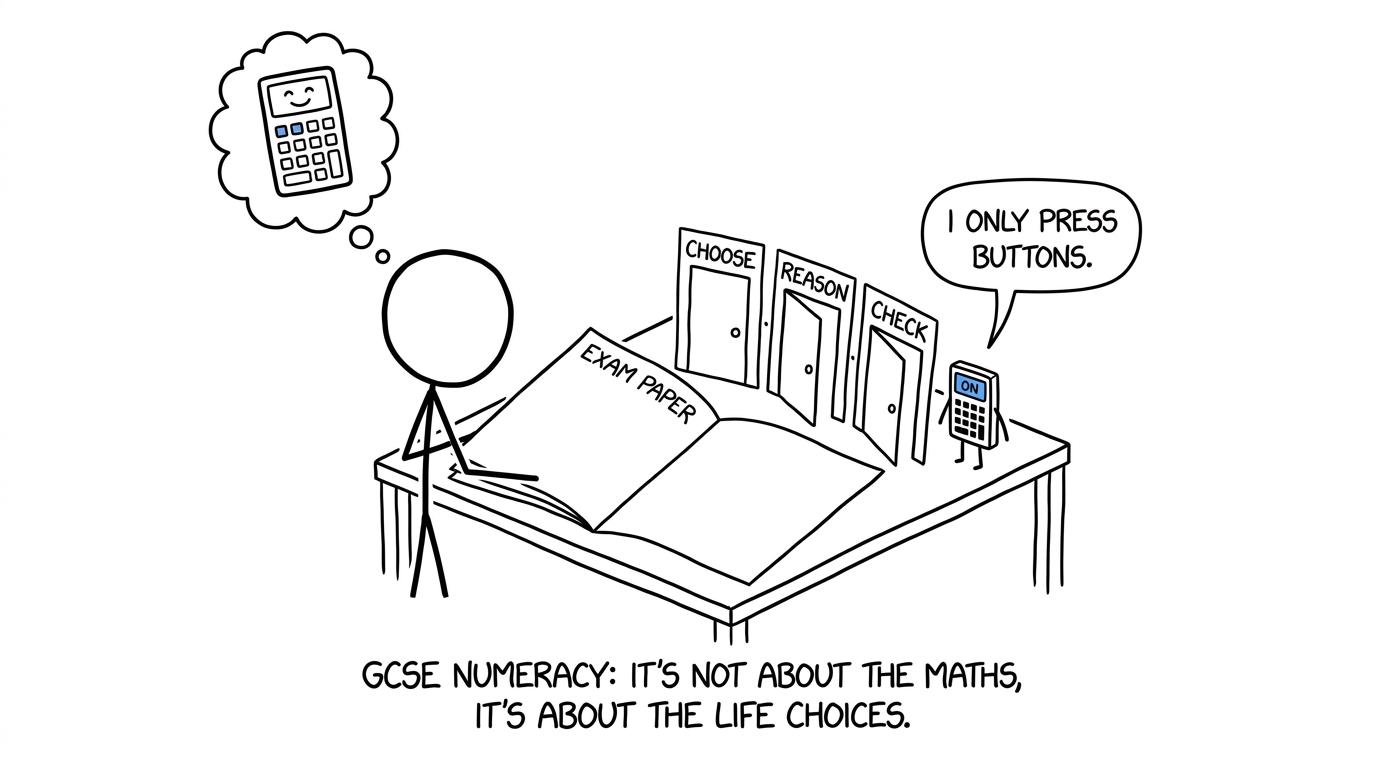 A calculator discovers that GCSE numeracy involves choosing, reasoning and checking
What does GCSE Maths Numeracy mean?
The title needs a little clarification because qualifications differ across the UK.
In Wales, GCSE Mathematics and Numeracy was a specific WJEC qualification focused strongly on applying maths in everyday life, work and wider contexts. Students beginning the reformed Welsh course from September 2025 instead take WJEC GCSE Mathematics and Numeracy (Double Award). Its first full award is due in November 2026.
The new qualification combines mathematics and numeracy rather than treating them as entirely separate subjects. It is assessed through three externally examined units:
| Unit | Weighting | Main emphasis |
|---|---|---|
| Financial Mathematics and Other Applications of Numeracy | 30%30\%30% | Personal and other real-world contexts, with a calculator |
| Non-calculator | 30%30\%30% | Mathematical fluency and reasoning without a calculator |
| Calculator-allowed | 40%40\%40% | A mixture of contextual and context-free mathematics |
The reformed Welsh qualification has foundation and higher tiers. It continues to use grades A* to G rather than England's grades 999 to 111: foundation assessments make grades C to G available, while higher assessments make grades A* to D available.
In England, AQA, Edexcel, OCR and Eduqas GCSE Mathematics do not usually use “Numeracy” as a separate qualification title. However, their exams still assess the same broad capacity to apply mathematics, reason and solve problems. Students can check the relevant content through MathsGenie's GCSE Maths revision hub and the GCSE topics by exam board and tier.
Content knowledge is necessary, but it is not the whole test
You cannot apply a method you do not know. Numeracy therefore includes substantial content knowledge across number, algebra, geometry and measures, statistics and probability.
Frequently used ideas include:
- fractions, decimals and percentages;
- ratio, proportion and rates of change;
- financial calculations and best buys;
- estimation and bounds;
- units and compound measures;
- scale drawings and measurement;
- tables, charts and statistical summaries;
- probability and risk;
- formulae, graphs and relationships between quantities.
The important difference is how that knowledge may be presented. A straightforward content question might identify the required operation. A numeracy problem may place the same operation inside a bill, journey, budget, scale diagram or data set. You must first recognise the mathematics hiding inside the context.
That recognition is an assessed skill. Words are not decoration around the “real maths”; understanding them is part of the mathematics.
Students following WJEC can use the WJEC GCSE Maths worksheets to strengthen individual methods before attempting mixed contextual questions.
How assessment objectives turn skills into marks
Assessment objectives describe what examiners are trying to measure. They offer a clearer picture than a topic list alone.
For the new WJEC Mathematics and Numeracy Double Award, the overall assessment-objective weightings are approximately:
| Assessment objective | What it assesses | Overall weighting |
|---|---|---|
| AO1 | Recall, conceptual understanding and routine procedures | 50%50\%50% |
| AO2 | Selecting and applying methods, making decisions and communicating | 30%30\%30% |
| AO3 | Strategic competence, connections, unfamiliar problems and evaluation | 20%20\%20% |
The specification permits a tolerance of ±5\pm 5±5 percentage points around the overall weightings. A single question can also draw on more than one objective.
For GCSE Mathematics in England, the labels differ slightly. AO1 concerns standard techniques, AO2 concerns reasoning and communication, and AO3 concerns problem-solving. Foundation papers allocate approximately 50%50\%50% to AO1 and 25%25\%25% each to AO2 and AO3. On higher tier, the approximate split is 40%40\%40%, 30%30\%30% and 30%30\%30%.
The larger message is the same: a significant proportion of the marks is deliberately reserved for more than remembering facts.
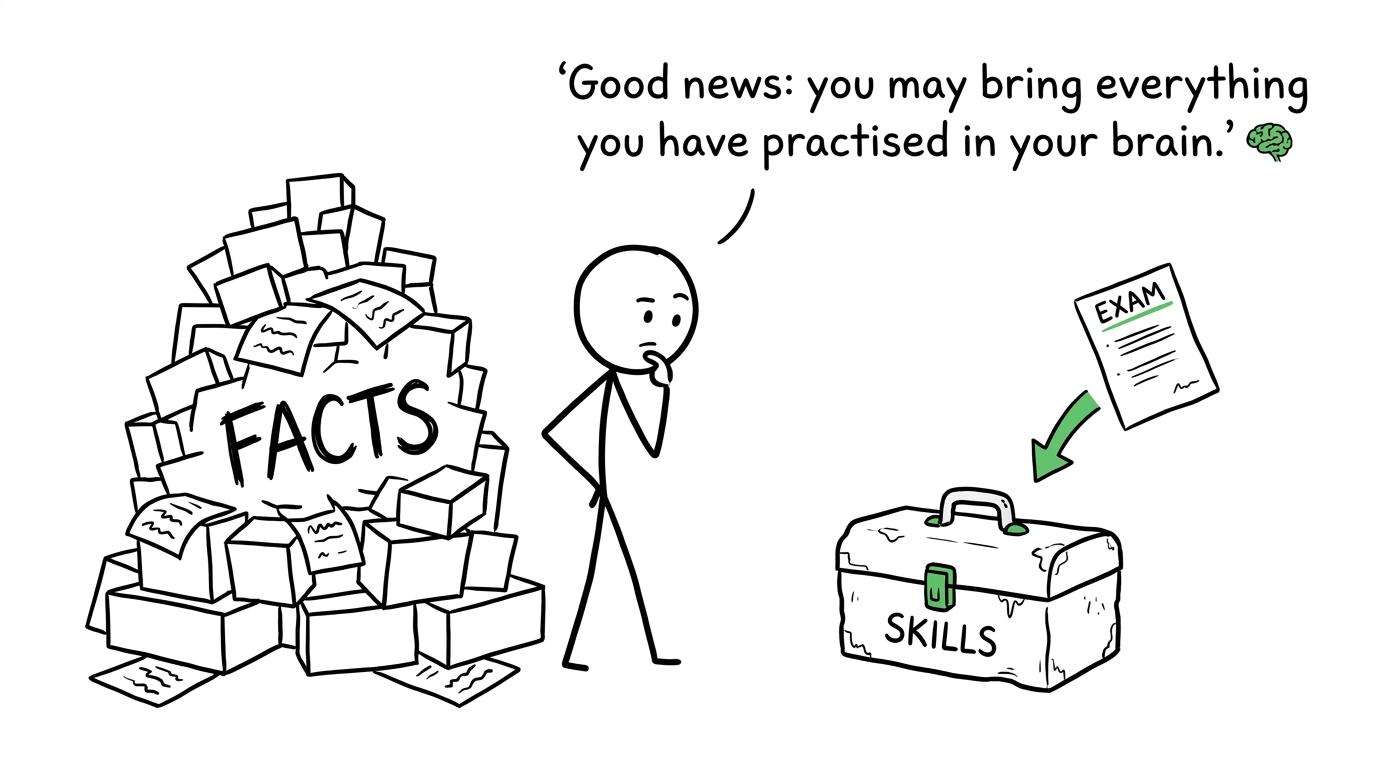 A student discovers that a practised skills toolbox is more useful than a pile of disconnected facts
What examiners reward beyond the final answer
Choosing an appropriate method
Some questions tell you exactly what to calculate. Others provide several pieces of information and leave the route open.
Examiners may therefore reward evidence that you have translated the situation into a valid mathematical process. This could involve identifying relevant values, choosing a percentage multiplier, forming an equation, selecting an appropriate average or deciding how to represent data.
A correct calculation based on the wrong interpretation may not access every mark. Conversely, a sensible method can sometimes gain credit even when a later arithmetic error prevents the correct final answer. The precise award always depends on the published mark scheme.
Showing a coherent process
Method marks are one reason to show your working, but clarity has a deeper purpose: it makes your reasoning visible.
Write down substitutions, intermediate values and important conversions. Keep enough accuracy during the calculation and round at the requested stage. If a question has several steps, organise them in an order another person could follow.
A page crowded with unexplained calculator outputs is harder to assess than a short, connected solution. Clear working also makes it easier for you to spot your own errors.
Interpreting the result
A numerical result is not always the final conclusion. Examiners may expect you to return to the situation and explain what the result means.
That can involve:
- choosing a whole-number answer when items cannot be divided;
- rounding up because enough containers, journeys or materials are required;
- comparing a result with a limit or budget;
- including the correct unit;
- stating whether a claim is supported by data;
- recognising that an estimate is not an exact value.
The context decides how an answer should be expressed. Automatic rounding without considering that context can lose the final mark.
Reasoning and justification
Command words such as explain, show, justify, compare and comment signal that unsupported answers may be insufficient.
A convincing justification links evidence to a conclusion. In a comparison, that may mean using comparable quantities rather than listing two unrelated figures. In statistics, it may require commenting on both a typical value and spread. In geometry, it may require naming the fact that supports a deduction.
Precision matters. “It is bigger” is usually weaker than identifying what is bigger, compared with what, and why that settles the question.
Accuracy and reasonableness
Numeracy includes knowing when not to trust the calculator blindly. Examiners can reward correct estimation, appropriate accuracy and evaluation of results.
Before moving on, ask:
- Is the sign sensible?
- Is the size of the answer plausible?
- Have the units been converted consistently?
- Should the answer be exact, estimated or rounded?
- Does a probability lie between 000 and 111?
- Could the real-world quantity actually take this value?
These checks are quick. They often catch the most expensive mistakes.
Why contextual questions can feel harder
A familiar method becomes less obvious when the topic name disappears. The question may combine percentage change with money, ratio with area, or a graph with a rate of change. Extra information may be present, and the steps may not be stated in order.
This is not a hidden syllabus. It is a test of transfer: can you use familiar mathematics when the surface of the problem changes?
The best preparation is a gradual move from topic practice to mixed questions. MathsGenie's guide to the best order for learning GCSE maths topics helps build the foundations. After that, mixed papers teach you to identify methods without being told the topic.
A revision strategy built around what earns marks
Start by separating your errors into four types:
- Knowledge gap: you did not know the fact or method.
- Selection gap: you knew the method but did not recognise when to use it.
- Execution gap: your plan was sound, but arithmetic, algebra or calculator use failed.
- Communication gap: you omitted working, units, justification or contextual interpretation.
That classification makes revision more precise. A knowledge gap needs a revision lesson. A selection gap needs mixed problem-solving. An execution gap needs deliberate practice and checking. A communication gap needs close comparison with mark schemes.
Use probability revision and questions, topic worksheets and video solutions to rebuild specific skills. Then use GCSE Maths mini tests for shorter mixed practice.
Finally, move into full past papers and predicted papers. The purpose is not merely to collect scores. Mark each attempt, identify why every mark was lost, revisit the relevant lesson and attempt a similar question later. The guide to when to start GCSE past papers can help you sequence this work sensibly.
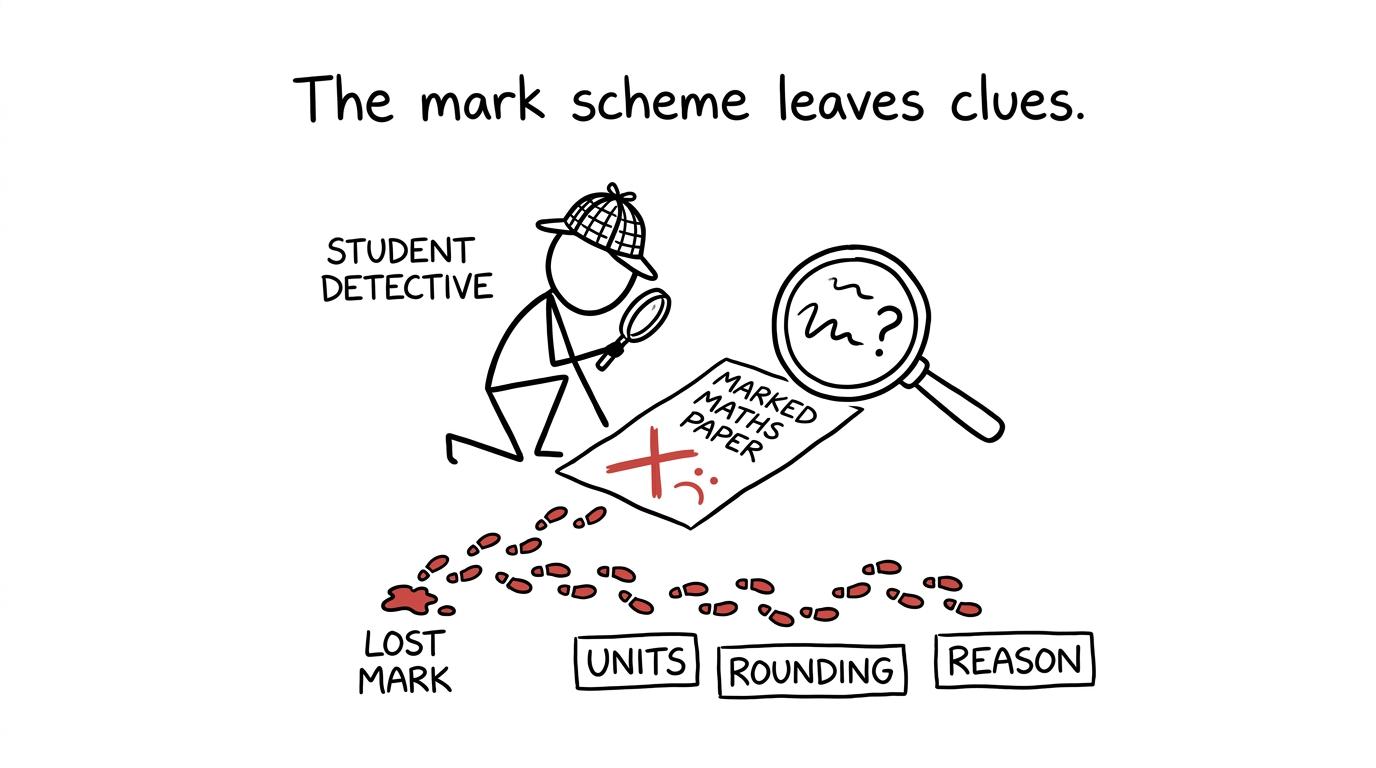 A revision detective follows the clues left by units, rounding and reasoning errors
Common mistakes that lose numeracy marks
Searching for numbers before understanding the question
Some students begin calculating as soon as they see numerical information. Read the whole problem first, identify the required outcome and then select the relevant data.
Treating every value as necessary
Contextual questions may include information that is not needed. Using every number simply because it appears in the question can create an invalid method.
Writing only a calculator answer
An unexplained answer hides the method. Record the calculation or reasoning that produced it, particularly in multi-step questions.
Rounding too early
Premature rounding can change the final result. Keep unrounded calculator values during intermediate steps unless the question instructs otherwise.
Ignoring units or practical constraints
A calculation may be numerically correct but contextually incomplete. Check units, conversions and whether the quantity must be a whole number.
Giving a conclusion without evidence
For questions that ask you to justify, compare or evaluate, show the mathematical evidence behind the statement. The conclusion should follow from your calculation rather than replace it.
Turn content into usable mathematical skill
GCSE numeracy is not a choice between knowledge and skills. Knowledge supplies the tools; numeracy tests whether you can choose, combine and use them with judgement.
That is encouraging because these skills can be practised. Begin with MathsGenie's free revision lessons and practice questions. Check your reasoning against mark schemes and video solutions. Use mini tests to diagnose small gaps, then build confidence and timing with past papers and predicted papers.
Do not merely ask, “Do I remember this topic?” Ask the question the examination is really asking: “Can I recognise and use this mathematics when nobody tells me the method?”
Start at the MathsGenie GCSE revision area, choose your board and tier, and turn the next lost mark into the next skill you improve.











