University GCSE Music Requirement: Does It Matter?
University GCSE music requirement explained: when your result is considered, which courses may value it, and why GCSE Maths often matters more for entry.
A GCSE result can feel permanent when you are waiting for it. One difficult listening paper or composition deadline starts to look as though it could decide your whole future. But the truth about a university GCSE music requirement is more reassuring: universities can see your GCSE Music result, yet most courses do not require a particular grade in it.
It is most likely to matter when you apply for Music, Music Technology, Music Education or another closely related course. Even then, universities often place greater emphasis on Level 3 qualifications, musical ability, theory knowledge, performance standard, portfolios or auditions. For many other degrees, GCSE English Language and GCSE Maths are much more likely to be named entry requirements.
Your Music grade is part of your academic record. It is rarely the whole story.
The short answer
Here is the practical checklist:
- You normally declare all GCSE qualifications, including GCSE Music, on your UCAS application.
- Most non-music courses do not specify a minimum GCSE Music grade.
- Music degrees may consider the grade, particularly as evidence of your academic musical background.
- A-level Music, Music Technology, graded theory, practical ability, auditions and portfolios can be more important.
- Some universities assess your wider GCSE profile, so the result may contribute indirectly.
- GCSE Maths and English Language are more commonly specified across a broad range of degrees.
- Entry requirements change, so always check the course page for your intended year of entry.
There is an important distinction here: a university may see a grade without making that grade a formal condition of entry.
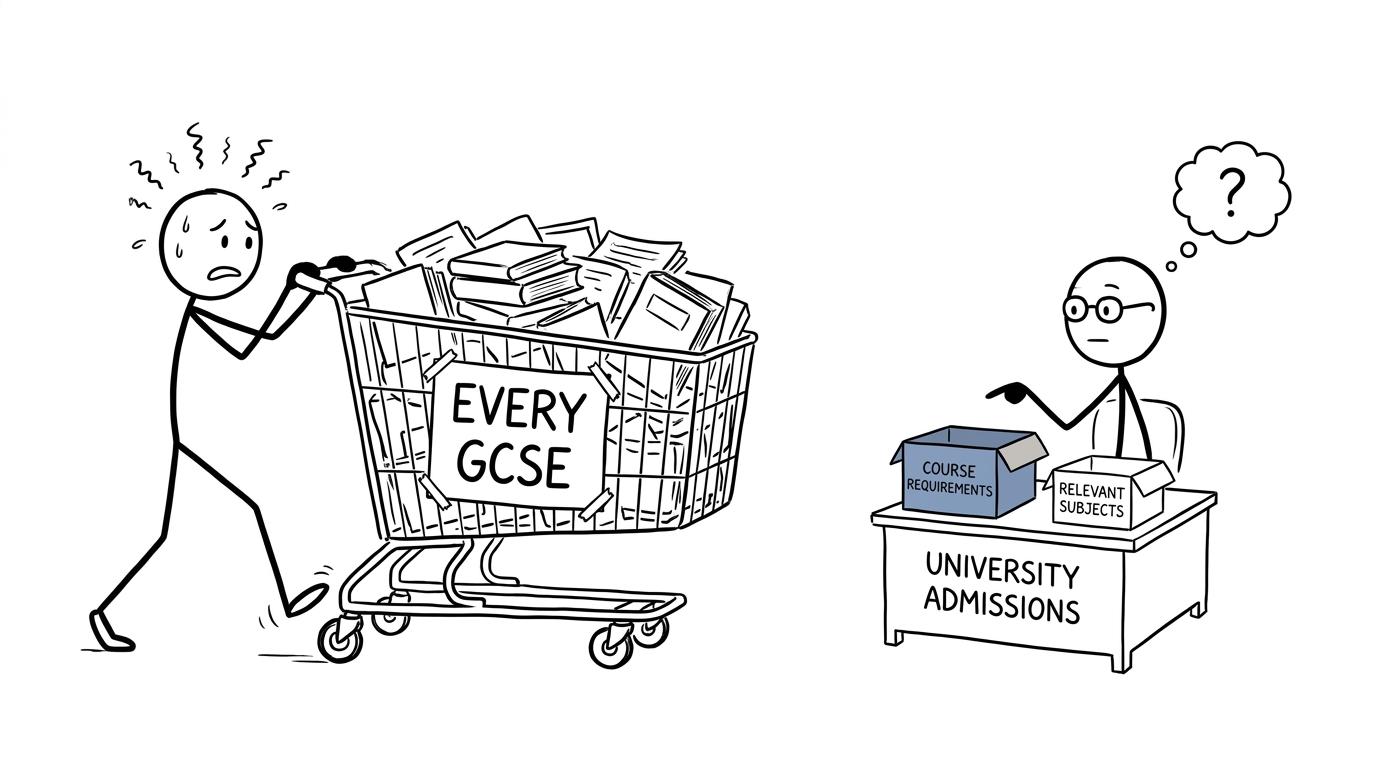 A student carrying every GCSE towards a university admissions desk
Will universities see your GCSE Music grade?
Yes. Current UCAS guidance requires applicants to enter their previous and current qualifications from secondary education onwards. That includes GCSEs, completed qualifications, pending results and resits. Specialist qualifications such as graded music examinations may also need to be declared where applicable.
Consequently, an admissions team can see GCSE Music alongside your other subjects. That does not mean an admissions tutor will isolate it and use it to decide your application. How GCSEs are assessed varies by university and course.
Some courses simply check that applicants have the required grades in English Language and Maths. Others consider the overall GCSE profile, perhaps alongside predicted A-level grades and contextual information. A smaller number publish a formal method for scoring GCSE results.
For example, the University of Bristol's published admissions statement for its 2026 Music courses said that academic applications were weighted using GCSE results and A-level results, with GCSEs forming the smaller part of the calculation. This shows why it is unwise to say that universities never look at GCSEs. Some clearly do, but they may consider the overall record rather than demand one specific Music grade.
When does a university GCSE Music requirement matter?
When you apply for a music-related degree
GCSE Music is most relevant when the subject continues into your degree. Courses in Music, Music Technology, Composition, Production or Music Education may want evidence that you can understand, create or perform music at the required level.
However, current entry requirements demonstrate that there is no single national rule. Universities set their own conditions.
For 2026 entry, Oxford's Music course expected Music at A level or an accepted alternative such as a sufficiently high music theory qualification. Its published requirement did not make GCSE Music the standard subject condition. Southampton's Music degree similarly focused on Level 3 Music and practical performance, while also specifying GCSE English and Maths.
There are exceptions. Royal Holloway published an alternative route in which applicants without the usual A-level Music or theory qualification could use a strong GCSE Music result alongside evidence of performance ability. In that situation, the GCSE grade had a clear purpose: it helped demonstrate enough musical knowledge to begin an intensive theory pathway.
The lesson is not that GCSE Music never matters. It is that it usually matters within a particular admissions route, not as a universal rule.
When your overall GCSE profile is assessed
A university may use several GCSE grades to judge academic consistency, especially for a competitive course. Here, GCSE Music can form one piece of the evidence even when it is not a compulsory subject.
A strong result can support the impression that you handled a broad curriculum successfully. A weaker result may be visible too, but one grade must be viewed alongside your later qualifications, the course requirements and any contextual admissions policy.
This matters because students sometimes imagine admissions as a row of trapdoors: one imperfect grade and the floor disappears. In reality, requirements work more like filters. A course may first check compulsory subjects, then Level 3 grades, and then other evidence relevant to selection.
When it helps explain your musical preparation
GCSE Music can show experience in areas such as listening, composition and performance. It may be useful evidence if you later take A-level Music or apply for a related course.
But GCSE Music is not the same qualification as a graded practical or theory examination. A GCSE grade 7 refers to the result awarded for the GCSE course. Grade 7 piano, singing or music theory refers to a separate graded music qualification. Universities may ask for one, the other or a suitable equivalent.
Read every requirement literally. Similar labels can represent very different evidence.
When is GCSE Music unlikely to matter?
For most unrelated degrees, there is no university GCSE Music requirement. An Engineering course is more likely to focus on Maths and Physics. Medicine may examine specified grades in Maths, English Language and sciences, sometimes alongside the wider GCSE profile. Degrees in subjects such as Economics, Computer Science or Psychology may set their own numeracy requirements.
That does not make Music worthless. It simply means relevance changes with the course.
The more useful question is not, “Will anyone care about this grade?” It is, “Does my intended course name this subject, score all GCSEs, or ask for a broad GCSE profile?” Those are questions you can answer from the official course page and admissions policy.
If you do not yet know what you want to study, protect the options that appear most often. English Language and Maths are common pre-16 requirements across university courses. Building your maths grade is therefore a sensible investment, whether your future involves music, science, business or something you have not discovered yet.
Start by using the GCSE Maths revision hub to select your exam board and work at the correct foundation or higher tier.
What should you do if your GCSE Music grade is lower than expected?
First, check the actual requirements rather than guessing. Look at several universities because two courses with similar names can ask for different qualifications.
If Music is not specified, the grade may have little direct effect. Concentrate on meeting the requirements that are stated.
If you are considering a music degree, investigate what other evidence the course accepts. Depending on the institution, that could include A-level Music, a relevant Level 3 vocational qualification, theory knowledge, practical performance, an audition, a recording or a composition portfolio. Do not assume these are interchangeable; ask the admissions team if the wording is unclear.
Your later progress also matters. A GCSE is evidence from one stage of education. Stronger Level 3 work can show how your knowledge developed after it.
Most importantly, do not allow anxiety about one subject to consume revision time for every other subject. A calm plan is more useful than repeatedly forecasting consequences you cannot yet know.
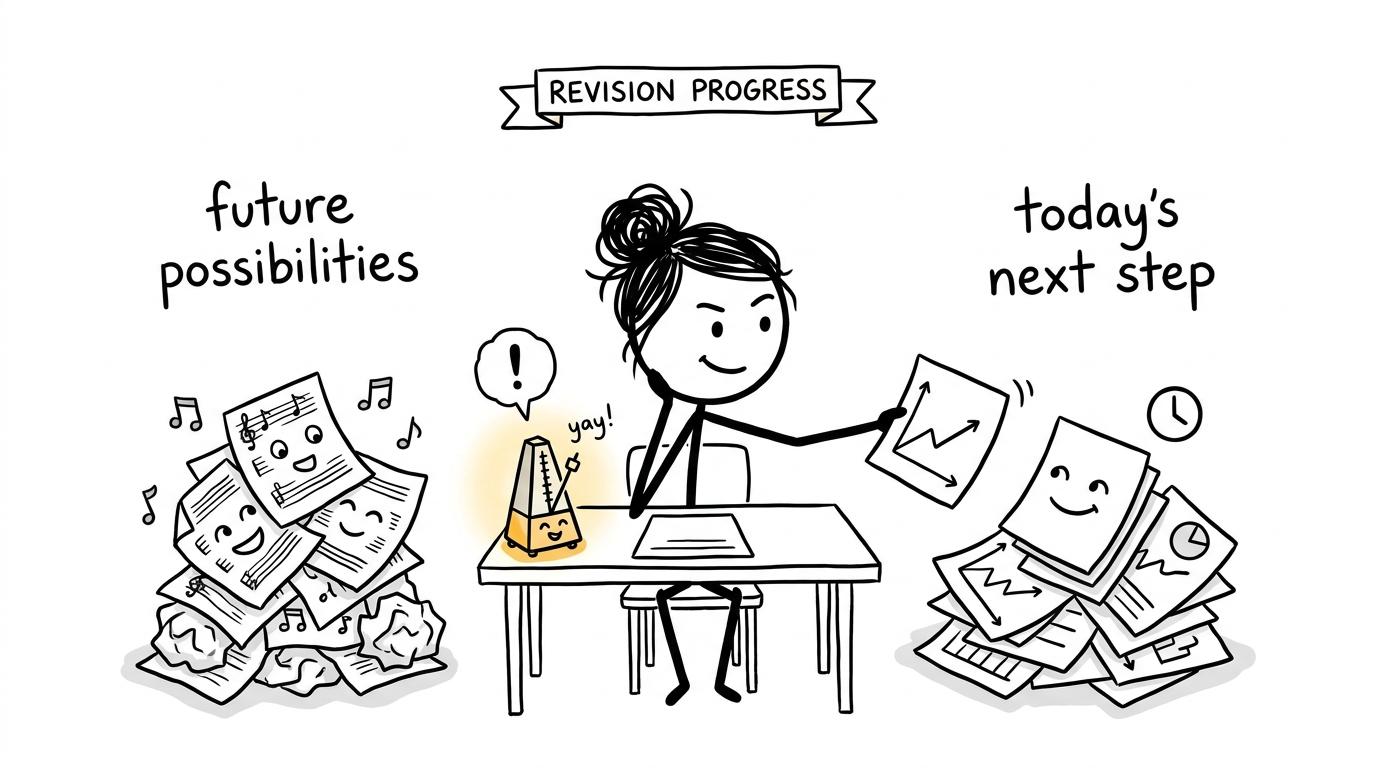 A student balancing future music possibilities with today's maths revision
Why your GCSE Maths grade deserves attention
GCSE Music may be relevant to certain courses, but Maths appears far more frequently as a stated entry requirement. Current university course pages across music, engineering and other subjects regularly specify a minimum grade in GCSE Maths, even where the degree itself is not primarily mathematical.
That gives your revision a clear purpose. The aim is not to revise everything at once. It is to identify where marks are being lost and create a repeatable loop:
- choose one weak topic;
- use a short revision lesson;
- complete practice questions;
- mark them immediately;
- record the exact mistake;
- return to the skill later.
The guide to revising GCSE Maths efficiently explains how to build this feedback loop. If your weeks feel unstructured, use the GCSE maths revision timetable or the one-month maths revision plan to organise manageable sessions.
Topic confidence should come before endless full papers. Then, once you have covered enough of the specification, use papers to test whether the knowledge survives time pressure. MathsGenie's guide to when to start GCSE past papers helps you choose the right stage.
Near the examination, Edexcel GCSE Maths predicted papers can provide fresh exam-style practice. Predicted papers should complement official past papers, not replace them. Mark every attempt, study the mark scheme and use video solutions to repair methods you could not complete.
Common mistakes when thinking about GCSE Music and university
Assuming universities never consider GCSEs
Universities receive your declared qualifications, and some courses assess the wider GCSE profile. The extent varies, so check the admissions policy rather than relying on a general claim.
Assuming every Music degree requires GCSE Music
Many Music courses focus more heavily on Level 3 Music, theory, practical standard, auditions or portfolios. GCSE Music can help, but it is not a universal requirement.
Confusing GCSE Music with graded music examinations
A GCSE result and a practical or theory grade are separate qualifications. If a course asks for Grade 7 theory, GCSE Music grade 7 does not automatically satisfy that condition.
Checking an old course page
Requirements can change between admissions cycles. Check the exact course, university and intended entry year, then confirm unclear alternatives with admissions staff.
Neglecting Maths because you want to study Music
Music degrees themselves often specify GCSE Maths and English Language. Keep those gateway subjects secure while continuing your musical development.
One grade is information, not destiny
Universities do sometimes look back at GCSE Music. They will normally see the result, certain Music courses may value it, and some selection systems consider the complete GCSE record. But for most degrees, there is no specific GCSE Music threshold. Maths and English Language are much more commonly stated.
So keep the question in proportion. Check real course requirements, understand the difference between GCSE Music and graded music qualifications, and put today's energy into the grades you can still improve.
MathsGenie gives you a clear place to begin. Use the free revision lessons and practice questions to rebuild weak topics, mini tests to check recall, and past papers or predicted papers to develop exam technique. Follow the MathsGenie GCSE Maths revision journey, use mark schemes and video solutions honestly, and let your revision planner turn a distant university question into one useful action today.