University GCSE Italian Requirement: Does It Matter?
University GCSE Italian requirement explained: when universities see your result, which courses may care, and why maths and English matter more for entry.
A single GCSE grade can feel strangely permanent. You sit the exam at sixteen, then imagine an admissions tutor examining that result years later with a magnifying glass. If you are worried about a university GCSE Italian requirement, the short answer is reassuring: universities may see your GCSE Italian grade, but most courses do not require a particular result in Italian.
It matters mainly when a course asks for a GCSE in a modern foreign language, considers your overall GCSE profile, or uses previous language learning to decide which teaching route suits you. For most degrees, GCSE English and maths are much more likely to appear as explicit requirements.
The important distinction is this: a university seeing a grade is not the same as a course requiring it.
The answer at a glance
- You will normally include completed qualifications when making a university application, so your Italian result may be visible.
- Most courses do not set a specific GCSE Italian requirement.
- Some language, humanities and joint honours degrees require or prefer previous study of a modern foreign language.
- Italian degrees may offer separate beginner and advanced routes.
- A course could consider your wider GCSE profile without treating Italian as a decisive subject.
- GCSE English and maths are much more commonly named as minimum entry requirements.
- Requirements vary by university, course and application year, so the official course page is always the final authority.
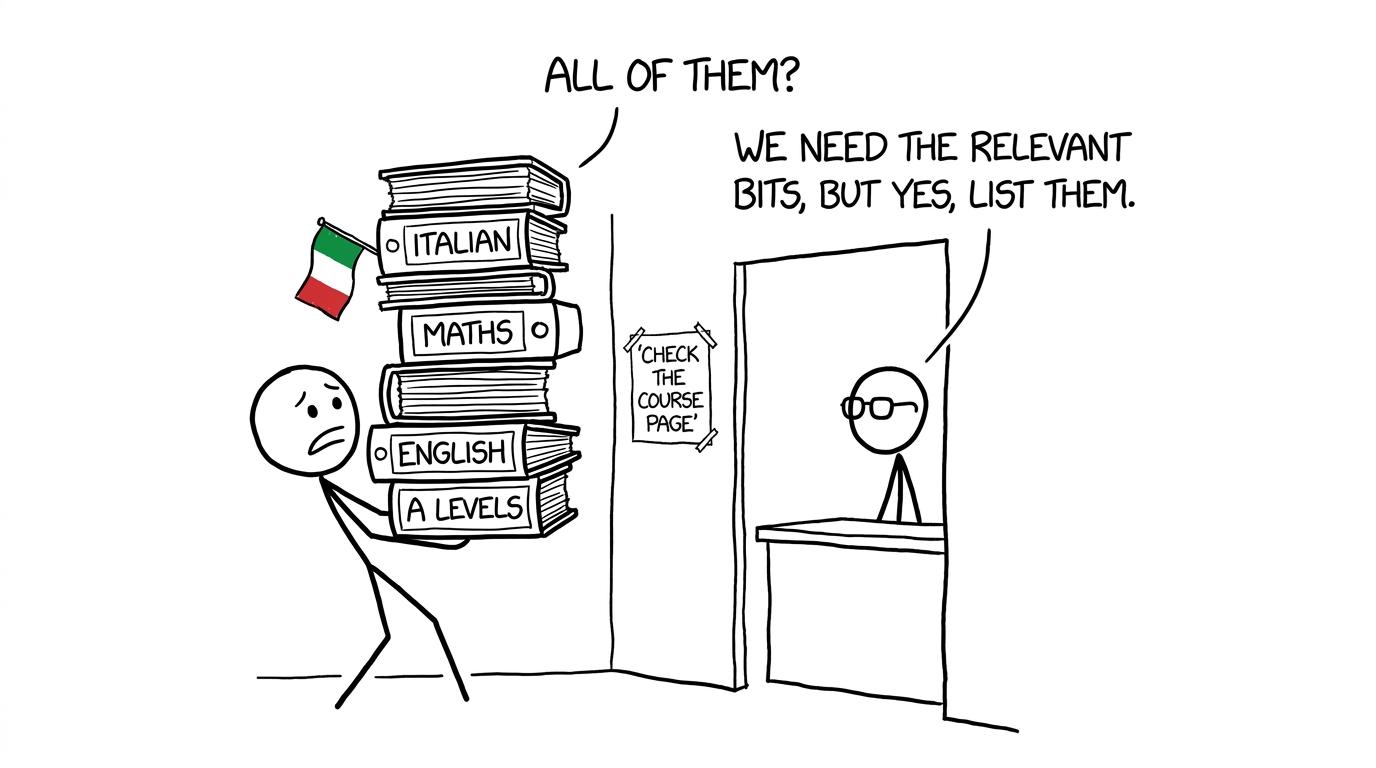 A student carrying every qualification towards a university admissions doorway
Will universities actually see your GCSE Italian grade?
Usually, yes. University applications require details of achieved qualifications as well as qualifications you are currently taking. If GCSE Italian forms part of your qualification history, it should be declared accurately.
That does not mean an admissions tutor will isolate it from everything else. Universities set their own entry requirements, and these vary between institutions and courses. Admissions decisions may involve your Level 3 qualifications, predicted grades, required subjects, GCSE profile, personal statement or application questions, reference, admissions tests, portfolio or interview. Not every course uses every factor.
For a typical degree unrelated to languages, the Italian grade may simply sit within your academic record. It shows that you completed another subject, but it is unlikely to outweigh whether you meet the course's stated Level 3 and GCSE conditions.
This is why reading the wording carefully matters. Look for terms such as:
- required: you must meet the stated condition;
- preferred: the qualification may strengthen preparation, but it is not necessarily compulsory;
- considered: it may contribute to a wider assessment;
- typical offer: this describes the usual offer and may differ from contextual arrangements;
- beginner or advanced route: prior language study may determine your route rather than your eligibility for the whole degree.
When a GCSE Italian grade can matter
There is no universal university GCSE Italian requirement. There are, however, several situations in which the result can become relevant.
A course requires a modern foreign language
Some universities publish a general modern language profile for particular courses. This might ask for a GCSE modern foreign language at a stated grade without demanding Italian specifically.
For example, current official entry information from the University of Bristol includes a standard modern language profile requiring at least grade 444 in a GCSE modern foreign language where that profile applies. Italian could satisfy such a condition if it is an accepted modern foreign language qualification.
Elsewhere, requirements may be higher. Current published information for some language-related programmes asks for a language other than English at GCSE grade 666, while particular beginner routes may accept a strong GCSE in a modern or classical language instead of a Level 3 language qualification.
The exact language and grade must be checked on the individual course page. A requirement for any modern foreign language is not automatically a requirement for Italian.
You apply for Italian or another language degree
It seems natural to assume that an Italian degree must require GCSE Italian. That is not always true.
Some universities teach Italian from beginner level and explicitly state that no previous knowledge is needed. Others offer beginner and post-A Level routes, placing students according to their previous language experience. The University of Manchester, for example, publishes beginner and advanced arrangements for Italian Studies, while the University of Glasgow states that no prior knowledge of Italian is required for its standard Italian programme.
By contrast, a joint degree or a particular language pathway may ask for prior achievement in Italian or another language. Current Warwick information for an Italian and Classics beginner route, for instance, includes an alternative involving a strong GCSE in a modern or classical language. Requirements like this are course-specific rather than rules for every Italian degree.
Your GCSE grade can therefore affect one of three things:
- whether you meet an entry condition;
- whether you join a beginner or advanced language class;
- whether you have evidence of previous language-learning ability.
The university considers your overall GCSE profile
Some institutions consider the number and pattern of GCSE grades achieved, particularly where a course is competitive. In that situation, Italian may form one small part of the profile.
A weaker Italian result is not necessarily fatal. Admissions teams can distinguish between a grade that fails a named requirement and one lower result among an otherwise suitable set of qualifications. The published selection policy and course requirements should tell you how GCSEs are used.
Italian supports the story of your application
A good Italian result may support an application involving languages, European studies, linguistics, international relations or another relevant field. It can demonstrate previous engagement, but relevance is not the same as a formal requirement.
Avoid building an application around the idea that one GCSE proves everything. Universities will normally have more recent evidence by then, including your A Levels or equivalent qualifications. GCSE Italian is one piece of the record, not the whole record.
 A torch labelled course requirements revealing which GCSE folders matter
When GCSE Italian probably will not decide your application
For degrees such as maths, engineering, computing or many sciences, the relevant subject requirements are usually elsewhere. Universities may specify A Level Mathematics, another Level 3 subject, or minimum GCSE grades in English and maths. Italian is unlikely to replace those conditions unless the course page explicitly says otherwise.
This is particularly useful for GCSE students to understand. Anxiety tends to treat every subject as equally decisive. Admissions criteria do not. The weight attached to a qualification depends on its relevance and the published rules.
If your future course requires GCSE Mathematics at grade 444, 555 or 666, achieving that threshold may have a direct effect on eligibility. Your Italian grade may still be visible, but visibility alone does not create an entry condition.
You can strengthen this part of your profile through the free GCSE Maths Revision hub, which brings together exam-board resources for Edexcel, AQA, OCR and Eduqas, alongside other UK boards.
How to check a university's requirements properly
Requirements change, and similarly named courses can have different conditions. Use this process whenever you begin researching universities.
Read the page for the correct course and entry year
Do not rely on a general university reputation or an old discussion online. Open the official page for the exact course, then check:
- the application year;
- standard and contextual offers;
- required Level 3 subjects;
- general GCSE requirements;
- course-specific GCSE requirements;
- English language requirements;
- beginner and advanced routes;
- any test, interview or portfolio conditions.
Separate Italian from Italian qualifications
A page headed “entry requirements for students from Italy” concerns applicants holding Italian national qualifications. That is different from a UK student holding GCSE Italian.
Search the course page for “GCSE”, “modern foreign language”, “Italian”, “language other than English” and “general requirements”. These phrases reveal whether the course cares about the subject, the grade or simply previous language experience.
Ask when the wording is unclear
If a requirement says “a modern foreign language” but does not list accepted subjects, contact the university admissions team. Give the qualification title, exam board and grade achieved or expected. Do not assume that informal advice from another applicant overrides a written admissions decision.
Keep the grade in proportion while revising
University research is useful, but it can become a sophisticated form of procrastination. A student can spend an hour worrying about whether a university might inspect one grade several years from now, while avoiding the revision that could improve next week's paper.
A calmer approach is to divide requirements into three groups:
- non-negotiable conditions, such as a named GCSE grade;
- relevant strengths, which help but are not compulsory;
- background information, which may be visible without driving the decision.
Then revise according to both urgency and importance. If maths is a stated requirement for several courses you may consider, give it consistent attention rather than relying on a final rush.
Start with a short diagnostic. The guide to finding your weakest GCSE topics explains how to turn lost marks into a focused revision list. If you feel stuck around a particular boundary, use the advice on revising when you are stuck at a pass grade.
A reliable cycle is simple:
- learn or review one method;
- answer practice questions;
- mark them accurately;
- record the reason for each lost mark;
- return to the topic after a short gap;
- test it under timed conditions.
When exams approach, GCSE past papers help you practise timing and mixed-topic decisions. One carefully reviewed paper is more valuable than several rushed attempts, as the guide to how many GCSE past papers to complete explains.
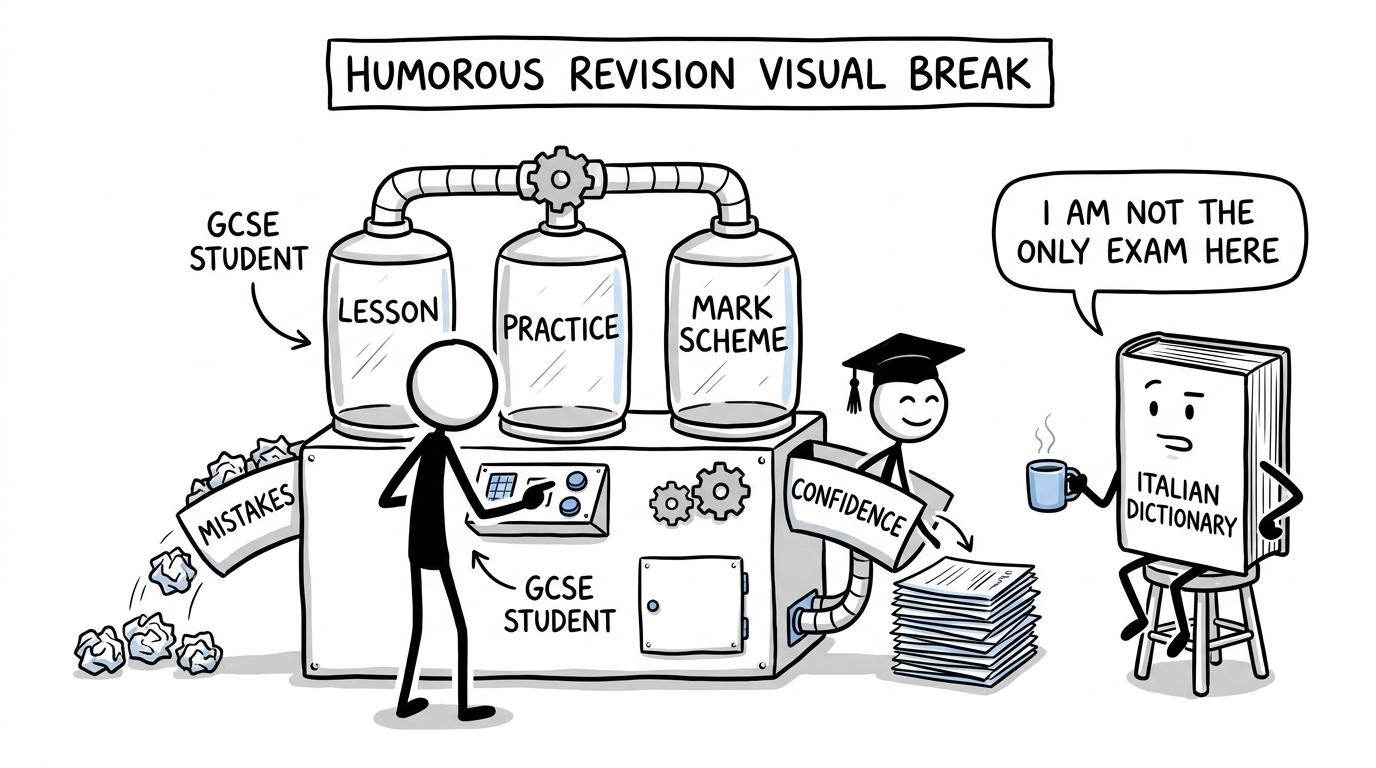 A revision machine turning mistakes into calmer confidence
Common mistakes when judging GCSE requirements
Assuming every visible grade is equally important
Universities can receive your qualification history without setting a minimum grade in every subject. Check which results are actually named in the entry criteria.
Treating all universities as if they share one rule
They do not. Entry requirements are set by individual universities and can vary between two courses at the same institution.
Confusing a preference with a requirement
“Foreign language preferred” is different from “GCSE Italian at grade 666 required”. Read the precise wording and ask admissions if ambiguity remains.
Looking only at the headline A Level offer
A course advertising an offer such as ABB may also set GCSE conditions in English, maths or another subject. Expand every entry-requirements section rather than stopping at the headline.
Using outdated course information
Requirements and course structures can change. Check the correct application cycle and review the page again before submitting an application.
Letting one grade distract from current exams
Concern is useful only when it changes an action. If Italian is required, plan accordingly. If it is not, acknowledge the result and concentrate on qualifications that remain in your control.
Your next step
Universities may look back far enough to see GCSE Italian, but most will not treat it as a special requirement. It matters when the course explicitly requests Italian, accepts a modern foreign language as part of an entry profile, uses it for class placement, or assesses the wider GCSE record. Otherwise, English, maths and relevant Level 3 subjects are usually more prominent.
So check, do not guess. Save the official requirements for courses that interest you, note every compulsory grade, and revisit them when you begin making serious choices.
Then return your attention to the next useful action. Build a plan with MathsGenie's free revision lessons and revision planner, practise focused questions, and use mini tests to check whether a weakness has really improved. Move on to past papers with mark schemes and video solutions, then add predicted papers as fresh practice rather than as a replacement for official papers. If time is short, the one-week GCSE maths revision plan gives you a calm place to begin.