University GCSE Art and Design Requirement Explained
University GCSE Art and Design requirement explained: discover when your grade matters, when it does not, and what art courses consider instead.
A single GCSE grade can feel strangely permanent. You receive it at sixteen, then wonder whether an admissions tutor will uncover it years later and quietly close the door on your preferred course. The short answer to the university GCSE Art and Design requirement question is reassuring: most university courses do not demand a particular GCSE Art and Design grade. However, universities can consider your GCSE results, and the grade can matter for some creative courses, especially when you have not taken an art or design subject at Level 333.
For art, design, architecture and related degrees, a portfolio and your more recent qualifications are often more important. For unrelated degrees, GCSE Art and Design is rarely a subject-specific requirement. GCSE English and maths appear much more frequently in published entry criteria.
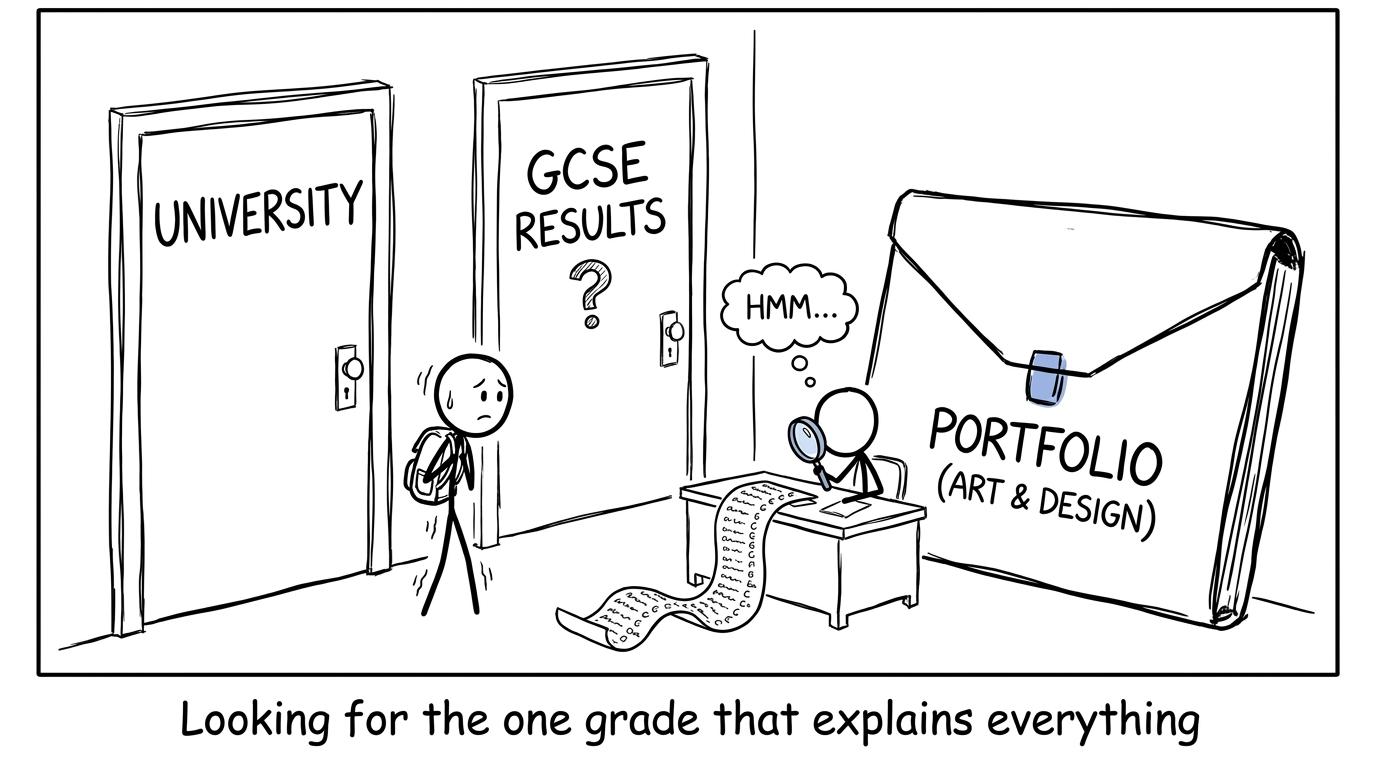 A student wonders whether one GCSE grade explains an entire university application
The quick university application checklist
Before worrying about one result, separate four different questions:
- Can the university see the grade? Your achieved qualifications form part of your educational record, so you should report them accurately when required.
- Is GCSE Art specifically required? Usually not, but always check the exact course page.
- Does the course require a creative Level 333 subject? Some art and design degrees expect A Level Art, a relevant BTEC, a Foundation Diploma or another suitable qualification.
- Is there a portfolio? For many creative courses, this is a central part of selection.
- Are GCSE English and maths required? These are commonly specified, sometimes at grade 444 or above, although requirements vary.
University entry requirements are set by individual institutions and can differ between two courses with similar names. Check the requirements for the year in which you intend to apply, rather than relying on an old prospectus or a general rule shared online.
When does your GCSE Art and Design grade matter?
There is no universal university GCSE Art and Design requirement. Instead, the importance of the grade depends on the course, your later choices and the rest of your application.
When you apply for an art or design degree
A Fine Art, Graphic Design, Fashion, Illustration or related course may look for evidence that you are prepared for creative study. That evidence can come from several places:
- an A Level or equivalent qualification in a relevant subject;
- an Art and Design Foundation Diploma;
- a portfolio showing recent work and the development of ideas;
- your personal statement or written application responses;
- an interview, where required;
- previous creative qualifications, including GCSE Art and Design.
Current published requirements demonstrate why checking each course matters. Some Fine Art degrees specify GCSE English and maths but do not require GCSE Art, relying instead on Level 333 results and a portfolio. Other Art and Design courses say that a strong GCSE Art or Design grade may be considered if an applicant has not studied a related subject at A Level.
That distinction is important. Your GCSE may not be a compulsory gate, yet it can still provide useful evidence when a more recent art qualification is missing.
When GCSE Art affects your next qualification
Sometimes the grade matters indirectly rather than at university itself. A sixth form or college may ask for a particular GCSE Art grade before allowing you to take A Level Art, Photography, Textiles or Graphic Communication. That Level 333 course can then become relevant to a university application.
The chain may look like this:
GCSE Art⟶Level 3 creative course⟶degree application\text{GCSE Art} \longrightarrow \text{Level } 3 \text{ creative course} \longrightarrow \text{degree application}GCSE Art⟶Level 3 creative course⟶degree applicationIn that situation, GCSE Art influenced the route, even though the university did not impose the original GCSE condition. Some colleges permit students without the specified GCSE to present a portfolio, but this is a local admissions decision rather than a national entitlement.
When you do not have A Level Art or an equivalent
If you later decide that you want a creative degree without having taken a relevant Level 333 subject, your GCSE grade may become more interesting. It shows earlier formal engagement with the subject, but it is unlikely to replace every other requirement by itself.
Universities may ask for a current portfolio because it reveals what one old grade cannot: how you investigate ideas, experiment, respond to feedback and develop work over time. A portfolio also shows what you can do now, rather than only what you achieved several years earlier.
When is the grade unlikely to matter?
For a degree unrelated to art or design, such as Mathematics, Economics, Biology or History, GCSE Art and Design is rarely listed as a specific entry requirement. The admissions team may still receive your wider academic record, but attention is generally directed towards:
- required A Levels or equivalent qualifications;
- predicted or achieved Level 333 grades;
- relevant GCSE subjects;
- admissions tests or interviews, where applicable;
- any additional course-specific conditions.
A Mathematics degree, for example, is much more likely to focus on A Level Mathematics and, for some courses, Further Mathematics. GCSE Art would not normally indicate whether you are ready for advanced algebra, calculus or proof.
This does not mean the GCSE was pointless. Creative subjects can develop observation, planning, refinement and the ability to complete extended work. It simply means that a useful educational experience is not always a formal admissions condition.
Why GCSE maths may appear in creative course requirements
One surprising feature of published art-course requirements is how often GCSE maths appears while GCSE Art does not. Universities may set a general minimum in GCSE English and maths across many programmes. Some creative courses publish a requirement of grade 444 or above in both, while others require English only or accept approved equivalents.
Maths also remains useful beyond the admissions page. Scale, proportion, measurement, budgeting and spatial reasoning appear in architecture, product design, fashion, animation and technical creative work. The connection is not always obvious while revising, but subjects continue to overlap long after the timetable separates them.
If your maths grade could affect your next step, begin with a realistic plan rather than revising everything at once. The GCSE maths revision timetable guide explains how to identify gaps and organise weekly practice. If exams are close, use the one-month GCSE maths revision plan to prioritise active practice.
Portfolio, qualifications and potential
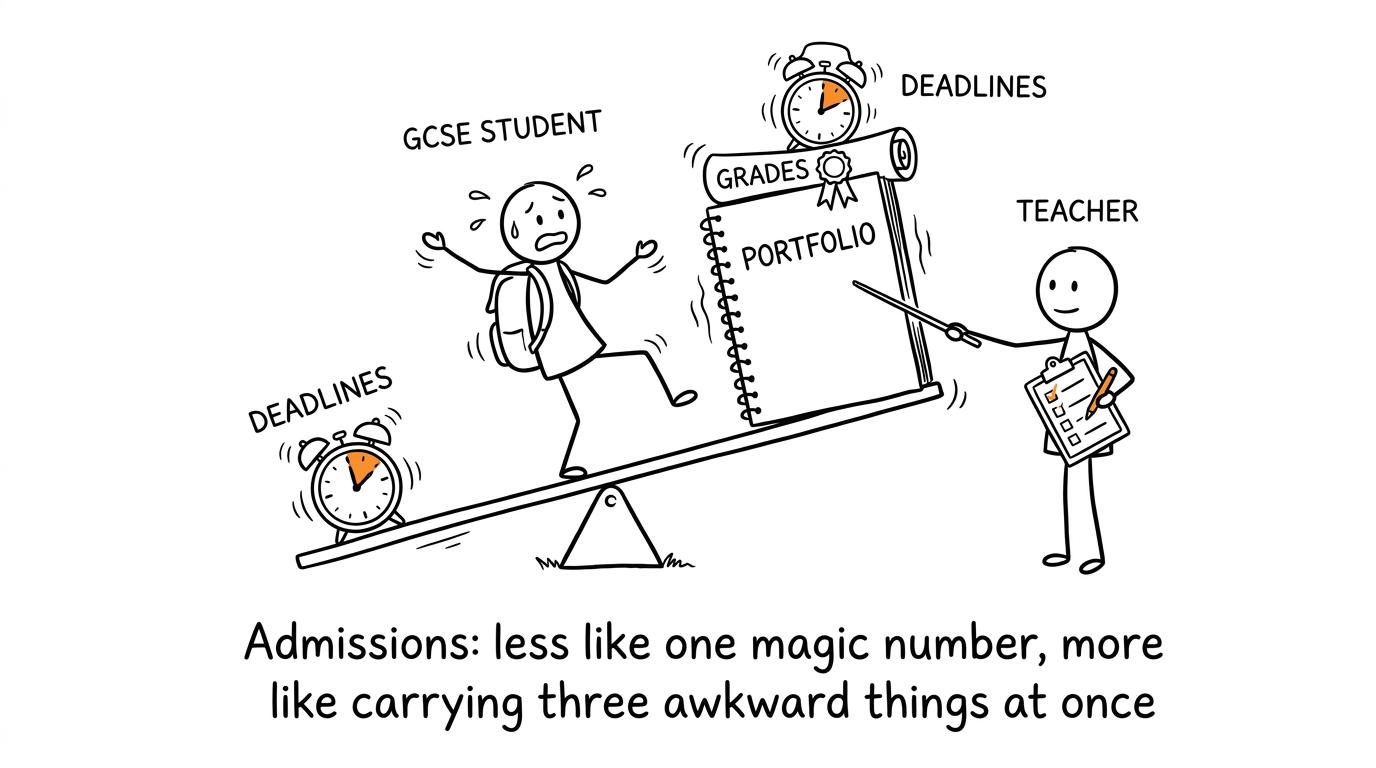 A student balances a portfolio, grades and application deadlines
Creative admissions rarely reduce neatly to one number. A portfolio may show finished pieces, but universities often also want to see research, experiments, sketchbooks, work in progress and the decisions behind an outcome. Exact formats, page limits and submission systems vary by institution.
Think of the application as a collection of evidence:
- Qualifications show performance within assessed courses.
- A portfolio shows creative process, judgement and current potential.
- Level 333 subjects show preparation for degree-level work.
- The written application explains your interests and suitability.
- An interview, if used, allows the course team to explore your thinking.
A lower GCSE Art grade does not automatically erase later improvement. Equally, a high grade does not guarantee admission if the course requires a portfolio or another qualification. Read every condition literally and contact the university admissions team when the wording is unclear.
What should you do if your grade is lower than expected?
First, do not assume that your university plan has ended. Find the official course page and identify whether GCSE Art is:
- an essential requirement;
- one possible way to demonstrate preparation;
- part of a broader number of required GCSE passes; or
- not mentioned at all.
Next, look at the requirements you can still influence. These may include your A Level or vocational grades, the strength of your portfolio, an art foundation route, and GCSE English or maths.
For maths, use evidence rather than guesswork. Complete a suitable paper, mark it carefully and list the topics costing you marks. MathsGenie's guide to starting GCSE past papers helps you choose the right stage to begin timed practice. If you need fresh exam-style material nearer the exams, use the free Edexcel GCSE Maths predicted papers alongside official past papers rather than as a replacement for them.
Common mistakes when checking university requirements
Treating every creative course as identical
Fine Art, Architecture, Graphic Design and Creative Technologies can have very different academic and portfolio conditions. Check the precise course, campus and entry year.
Confusing a preferred subject with a compulsory one
“Preferred”, “recommended” and “required” do not mean the same thing. A course may welcome GCSE or A Level Art without making it mandatory.
Looking only at the headline A Level offer
The large grade range at the top of a page is not the whole entry requirement. Read the GCSE, portfolio, interview, English-language and subject-specific sections as well.
Assuming a portfolio fixes every missing qualification
Some universities allow flexibility for a strong portfolio; others still require named qualifications or grades. Never assume that creative work automatically overrides an academic condition.
Neglecting maths because the intended degree is creative
GCSE maths may still be part of the published minimum. Use GCSE predicted topics guidance to focus on recurring skills without trying to guess an exact paper. When using full papers, the guide to how many GCSE past papers to complete explains why reviewing mistakes matters more than collecting totals.
Keep one grade in perspective
Yes, universities can look back at GCSE results, and GCSE Art and Design occasionally matters. It is most relevant when a creative course names it, when it supports an application without Level 333 Art, or when it was needed to access your next creative qualification. For many art degrees, however, a current portfolio and later qualifications carry more direct relevance. For unrelated degrees, a specific Art and Design grade is seldom the deciding requirement.
Your best response is practical: check the official course criteria, ask admissions staff about genuine ambiguity and strengthen the parts of your application that remain under your control.
Meanwhile, protect the GCSE subjects that frequently appear in entry requirements. Start with MathsGenie's free revision lessons and practice questions, then use mini tests to find weaknesses. Move on to past papers, mark schemes and video solutions, before adding predicted papers closer to the exam. If results have already created a detour, the GCSE maths resit revision plan gives you a clear route back into purposeful practice.
One GCSE grade is part of your record. It is not the whole story. Build the next part deliberately.