

Tracking Revision Progress for GCSE Biblical Hebrew
Tracking revision progress for GCSE Biblical Hebrew helps when it drives retrieval, feedback and next steps, not when logging replaces real practice.
Revision can produce a strange kind of comfort. You colour a spreadsheet, update three percentages and watch a progress bar move. It feels organised. Yet nothing has been retrieved from memory, translated or marked.
So, does tracking revision progress GCSE Biblical Hebrew work actually improve outcomes? It can help, but only indirectly. A spreadsheet or app is useful when it shows what you can recall, where marks are being lost and what to practise next. It becomes false productivity when maintaining the system replaces vocabulary retrieval, unseen translation, set-text analysis or exam questions.
That distinction matters for maths students too. Whether you are balancing Biblical Hebrew with GCSE maths or simply wondering if detailed tracking is worthwhile, the principle is the same: the tracker should direct the work, not become the work.
The short answer: use a small evidence-based tracker
A useful revision tracker should help you:
- separate topics into specific, assessable skills;
- record performance rather than time alone;
- identify recurring errors;
- schedule another attempt after a gap;
- choose the next revision task quickly;
- compare confidence with actual marked performance.
It should take moments to update. If formatting, formulas and graphs take longer than reviewing your mistakes, the system has become too elaborate.
For maths, you can pair this approach with the GCSE Maths revision hub, where lessons, practice questions and board-specific resources make the next action clear.
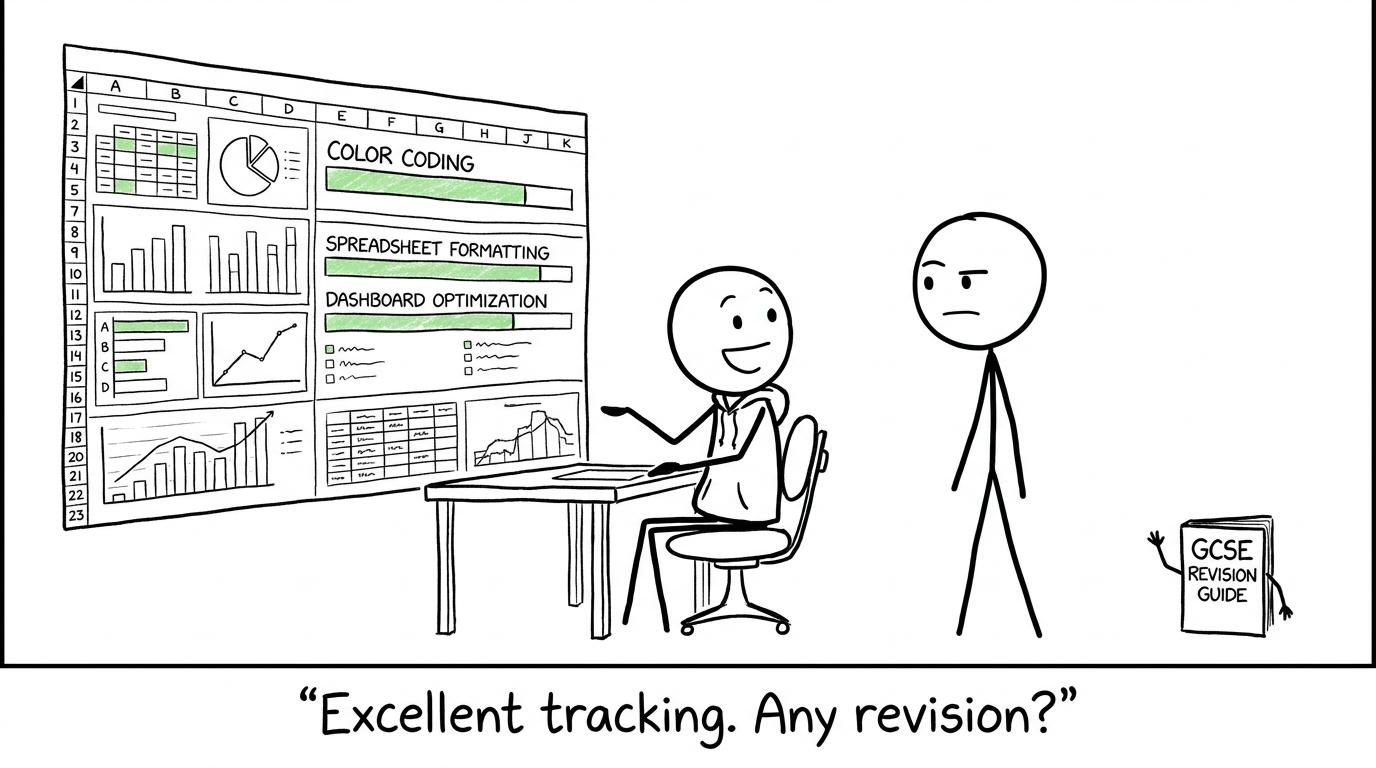 A student proudly presents an elaborate revision dashboard while an unopened book asks whether any revision happened
What GCSE Biblical Hebrew actually requires
Tracking is only useful if its categories reflect the examination. The current Pearson Edexcel GCSE in Biblical Hebrew has two externally examined components: Language and Literature. Each contributes 50%50\%50% of the qualification.
The Language component assesses understanding of unseen Biblical Hebrew, translation into English and either grammatical understanding or translation into pointed Biblical Hebrew. The Literature component assesses knowledge, translation, literary features, analysis and comparison of the prescribed texts.
Across the qualification, the assessment objectives are weighted as follows:
- AO1, knowledge and understanding of language: 50%50\%50%;
- AO2, knowledge and understanding of literature: 25%25\%25%;
- AO3, analysis, evaluation and response: 25%25\%25%.
For examinations from 202620262026 to 202820282028, the prescribed material covers passages from Genesis concerning Joseph's rise to power and passages from Kings concerning the miracles of Elisha. Students should always confirm the applicable set texts and specification with their teacher, particularly when preparing for a later examination series.
This structure tells you why a single entry called “Hebrew revision” is almost meaningless. It hides several different performances. You might recall vocabulary confidently but struggle to parse a verb. You might know the narrative but lose marks when analysing a literary feature. A useful tracker keeps those differences visible.
The same logic applies to maths. “Algebra” is too broad to guide tomorrow's session. Solving linear equations, factorising quadratics and rearranging formulae need separate evidence. The GCSE maths topics by exam board and tier guide can help you break maths into trackable skills appropriate to Edexcel, AQA, OCR or Eduqas.
What should go in the spreadsheet?
A compact tracker needs only a few fields.
Topic or skill
Use a precise description such as unseen comprehension, weak verbs, set-text translation, literary analysis or comparison. For maths, use a named skill rather than a whole curriculum area.
Last retrieval date
Record when you last attempted to produce an answer without looking at notes. Reading a vocabulary list is exposure; recalling meanings before checking is retrieval. Watching a maths solution is explanation; attempting the question independently is evidence.
Marked result
Where possible, record marks earned and marks available. Percentage accuracy can be calculated using:
accuracy=marks earnedmarks available×100%.\text{accuracy}=\frac{\text{marks earned}}{\text{marks available}}\times 100\%.accuracy=marks availablemarks earned×100%.Do not compare percentages from tasks of wildly different difficulty as though they mean the same thing. A short vocabulary quiz and a timed translation reveal different things.
Error category
Use a short label: knowledge, interpretation, grammar, method, accuracy, timing or incomplete answer. The purpose is not to catalogue every imperfection. It is to notice patterns that deserve action.
Next action and review date
“Revise again” is too vague. A stronger action might be to retrieve a vocabulary group, reattempt a translation passage, plan an analysis response or complete a fresh set of questions. Give it a future date so that the tracker supports spaced practice rather than endless work on one comfortable topic.
Why tracking can genuinely help
Research on metacognition and self-regulated learning supports teaching students to plan, monitor and evaluate their learning. A tracker can provide the structure for those behaviours. It can also make the results of retrieval practice visible over time.
But the spreadsheet is not the learning mechanism. Retrieval, feedback, correction and later reattempts are doing the educational work.
It corrects unreliable confidence
Familiarity is persuasive. A passage can look recognisable after several readings, just as a maths solution can look obvious while it is on screen. Recognition is not the same as independent recall.
Recording the result of a closed-book attempt creates better evidence. A red or amber rating should come from performance, not from how comfortable the page feels.
It supports spacing
Students naturally return to favourite or recently revised material. A review-date column can bring older topics back before they disappear completely from memory.
Spacing does not require a complicated algorithm. The important habit is to revisit material after a delay and attempt retrieval again. Maths students can explore this further in MathsGenie's guide to stopping GCSE maths content from being forgotten.
It turns mistakes into decisions
A mark on its own describes the past. A next-action field changes the future.
For Biblical Hebrew, an inaccurate translation might reveal a vocabulary gap, an incorrectly identified form or a failure to use the surrounding context. Those causes require different responses. In maths, a lost mark might come from missing knowledge, an unsuitable method, an arithmetic slip or poor time management.
The tracker helps only when each diagnosis leads to targeted practice.
When tracking merely feels productive
Spreadsheets become dangerous when their neatness hides weak revision. A beautifully designed dashboard can create the emotional reward of progress before the difficult learning has happened.
Warning signs include:
- logging every minute but recording no marked result;
- choosing colours more carefully than revision tasks;
- marking a topic complete after reading notes once;
- copying scores without reviewing errors;
- repeatedly changing apps or templates;
- tracking so many fields that updates are postponed;
- treating a streak as more important than understanding.
Time is useful for checking whether your plan is realistic, but it is not proof of learning. Two students can each record an hour. One retrieves vocabulary, completes a translation, checks feedback and schedules a reattempt. The other reorganises notes. Their logged time is identical; their learning activity is not.
Apps do not escape this problem. Notifications and automatic streaks may reduce the effort of planning, but they can also reward opening the app rather than thinking hard. Choose a spreadsheet, paper checklist or app according to friction: use whichever gets you into meaningful practice fastest.
A revision loop that works across Hebrew and maths
A simple loop is more valuable than an elaborate dashboard:
- Choose: select one weak, specific skill from recent evidence.
- Retrieve: attempt a question, translation or recall task without immediate help.
- Check: use reliable feedback, a teacher's guidance or an appropriate mark scheme.
- Diagnose: identify the exact reason for lost marks.
- Repair: complete focused practice on that weakness.
- Return: reattempt it after a gap.
For maths, the Edexcel GCSE Maths mini tests provide short diagnostic tasks, while GCSE past papers for different exam boards reveal how well skills survive in a mixed, timed setting.
A revision planner should reserve space for both focused repair and exam practice. MathsGenie's GCSE revision timetable guide explains how to combine topic sessions, marking and timed papers without creating a plan too large to follow.
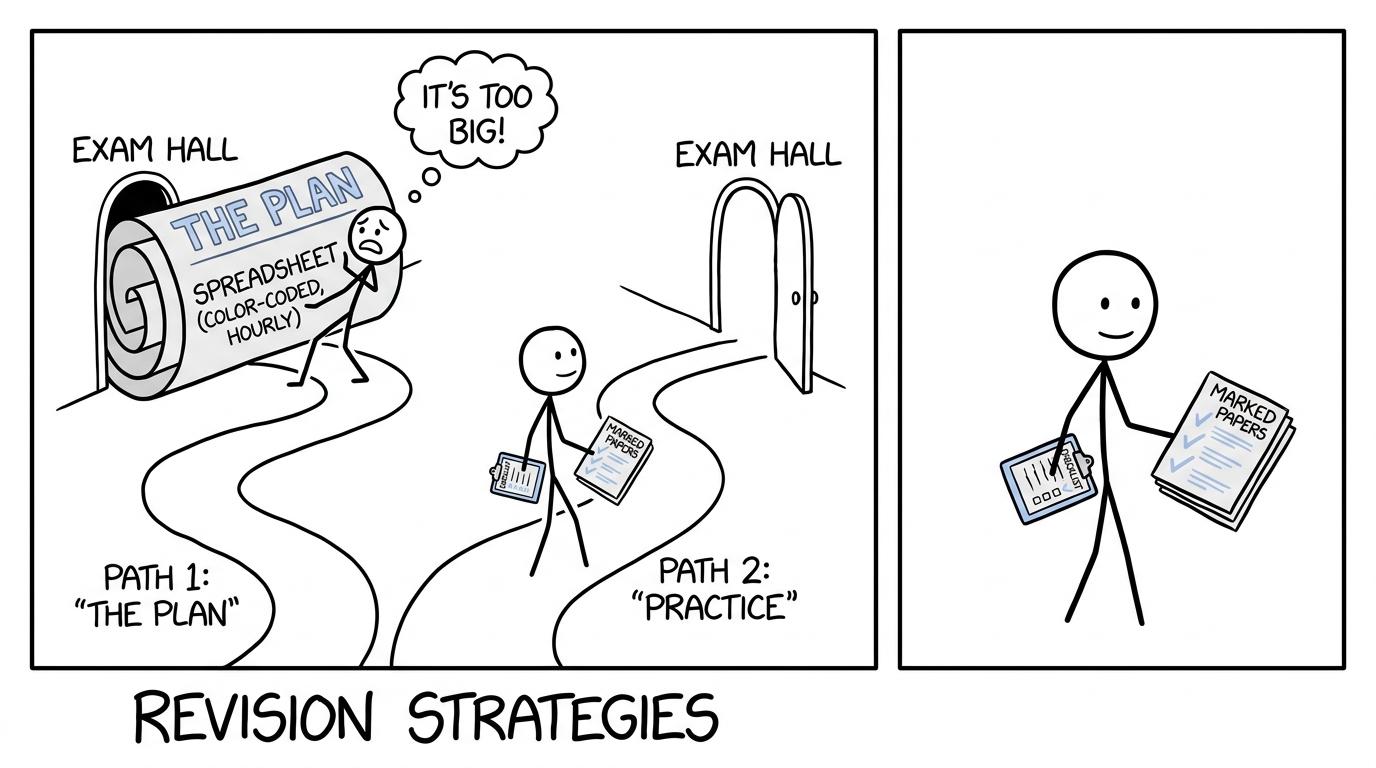 One student tries to carry a giant revision spreadsheet into an exam while another arrives with a checklist and marked papers
How to keep tracking proportionate
Set a strict rule: updating the tracker should take no more than a small fraction of the session. Most of your time should be spent recalling, applying, checking and correcting.
Review the whole sheet once a week. Ask:
- Which skills repeatedly lose marks?
- Which have not been tested recently?
- Does confidence match performance?
- Are mistakes changing, or merely repeating?
- What are the few highest-value tasks for next week?
Archive unnecessary columns. A system that becomes simpler as you learn what matters is usually healthier than one that expands continuously.
For maths paper practice, Edexcel GCSE Maths past papers place papers and mark schemes together. Nearer the examination, Edexcel GCSE Maths predicted papers can provide fresh exam-style evidence. Predicted papers should guide final practice, not replace broad specification coverage.
Common mistakes when tracking revision progress
Tracking completion instead of capability
A tick means that an activity happened. It does not show that the knowledge can be recalled later. Record an assessed result or specific observation alongside completion.
Using confidence as the only measure
Confidence matters because it affects what you choose. It is not a substitute for marks. Compare the two: high confidence with weak performance is particularly useful information.
Recording weak areas without scheduling action
A long red list can become discouraging. Give each priority a small next step and a date. Limit the active list so it remains workable.
Measuring Hebrew and maths identically
The overall loop transfers, but the evidence differs. Biblical Hebrew may require vocabulary recall, parsing, translation and literary response. Maths requires selecting and applying methods, communicating working and checking accuracy. Track the performance demanded by each specification.
Never testing under exam conditions
Topic-level scores can hide problems with timing, switching between tasks and interpreting unfamiliar questions. Include periodic timed work, then use its results to choose focused revision.
Let the tracker point towards real practice
Tracking revision progress for GCSE Biblical Hebrew can help because it makes planning, monitoring and evaluation more deliberate. It cannot produce knowledge by itself. The useful spreadsheet is not the one with the most formulas; it is the one that repeatedly sends you towards retrieval, feedback and correction.
Use the same discipline for GCSE maths. Begin with a revision lesson, attempt practice questions without copying, mark them honestly and record the precise gap. Then use mini tests, past papers, predicted papers, mark schemes and video solutions to test whether the repair has held.
Open the MathsGenie GCSE Maths revision area, choose one weak skill and generate one honest piece of evidence today. Update the tracker afterwards. That order is the whole point.










