

Teach Back Method GCSE Arabic: Does It Work?
Teach back method GCSE Arabic: learn how explaining aloud exposes weak recall, improves speaking confidence and supports smarter GCSE maths revision too.
A page of vocabulary can feel familiar without being retrievable. You recognise the words, nod at the grammar and assume the knowledge is secure. Then someone asks you to explain it without your notes, and the silence reveals something useful.
The teach back method GCSE Arabic approach is a good revision method because explaining a small topic aloud forces you to retrieve language, organise ideas and notice gaps that quiet rereading can hide. It is especially helpful for speaking confidence and active recall. But it should complement listening, reading, writing and exam-question practice rather than replace them.
The same principle matters for students preparing for GCSE maths. Knowing a method when it is open in front of you is not the same as being able to choose and apply it independently in an exam.
The short answer: is teaching GCSE Arabic effective?
Yes, provided you genuinely explain from memory rather than read your notes aloud.
A useful teach-back session should include:
- one narrow topic, such as describing school or explaining how a tense works
- an initial explanation with notes closed
- questions from the listener
- a written record of hesitations, errors and missing vocabulary
- checking against reliable course material
- another attempt after a delay
- separate practice in the format used by your examination
Educational research on self-explanation, retrieval practice and learning by teaching supports the underlying idea. Generating an explanation can strengthen understanding and reveal missing connections. Interactive teaching may be particularly useful because another person can ask the questions you would not think to ask yourself.
The evidence does not mean that every casual conversation produces learning. The quality of the retrieval, explanation and feedback matters.
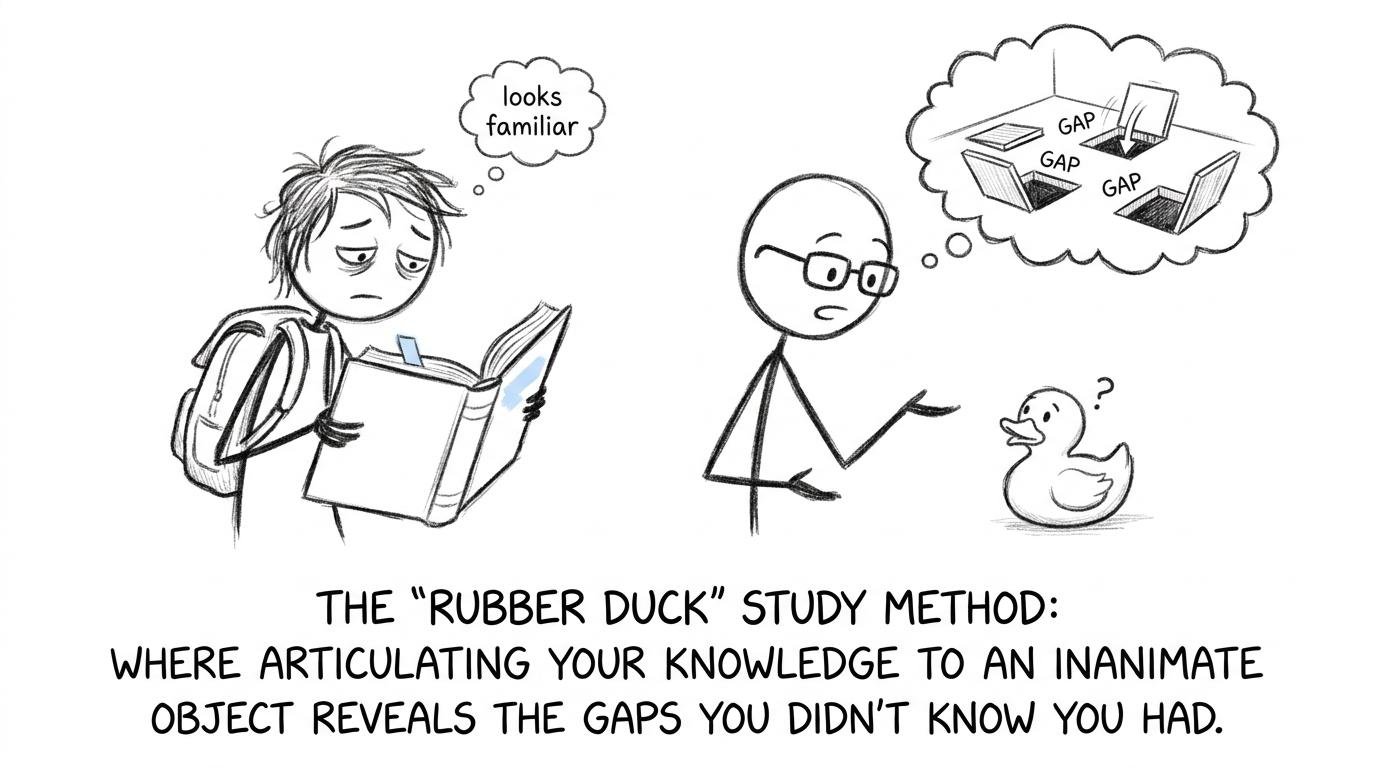 A student discovers that a rubber duck is surprisingly good at finding revision gaps
Why explaining aloud exposes hidden gaps
Quiet revision is comfortable because the page supplies clues. A heading suggests the topic. The first word prompts the second. A model sentence provides the structure. This creates familiarity, but familiarity can be mistaken for independent recall.
Teaching removes some of those supports. You must decide where to begin, which vocabulary matters and how one idea connects to the next. A gap becomes visible when you:
- pause because you cannot recall a word
- know a phrase but cannot adapt it
- use a grammatical structure without knowing why it is correct
- give an explanation that works only in English
- cannot answer a simple follow-up question
- contradict something you said earlier
These moments are not evidence that the session failed. They are the useful part. A revision gap found at home is one you still have time to repair.
Retrieval is different from recognition
Recognition asks, “Have I seen this before?” Retrieval asks, “Can I produce it now?”
GCSE examinations require retrieval under constraints. For students taking the current Pearson Edexcel GCSE Arabic qualification, listening, speaking, reading and writing are assessed as separate papers, each contributing 25%25\%25% of the qualification. Teaching aloud is particularly relevant to spontaneous language production, but it does not recreate every demand of those four papers.
That distinction carries directly into maths. Watching a solution can make algebra appear obvious. Closing the video and explaining why each step is valid is harder. Attempting a fresh question is harder again, and closer to what the examination requires.
How to use the teach back method for GCSE Arabic
Choose a topic small enough to explain
Do not begin with “teach the whole course”. Choose one manageable target: a theme, a grammar point, a group of useful opinions or a way of extending answers.
A narrow target makes the result diagnostic. If the explanation becomes difficult, you know what to revisit. A broad target produces a vague feeling of struggle without identifying the cause.
Prepare with the expectation of teaching
Review the relevant material while knowing that you will shortly explain it. Look for relationships rather than isolated facts:
- how vocabulary fits a particular context
- why a structure changes
- how an answer moves between time frames
- which details make communication clearer
- which errors could alter the meaning
Preparing to teach encourages organisation. Instead of collecting disconnected phrases, you build a route through the topic.
Close the notes and explain aloud
Speak to a classmate, family member or study partner. The listener does not need to know Arabic, although someone familiar with the subject can provide more informed feedback.
If nobody is available, record a short voice note. An empty chair or a patient rubber duck cannot correct you, but it can still expose where your explanation stops flowing.
Keep the first attempt short. The aim is not to deliver a polished lecture. It is to discover what your memory can currently produce without prompts.
Invite questions rather than giving a monologue
Ask the listener to interrupt with questions such as:
- What does that mean?
- Why does it change there?
- Could you say it another way?
- How would that work in a different context?
- Which part are you least certain about?
Questions create productive pressure. They force you to clarify assumptions that can remain hidden during private revision.
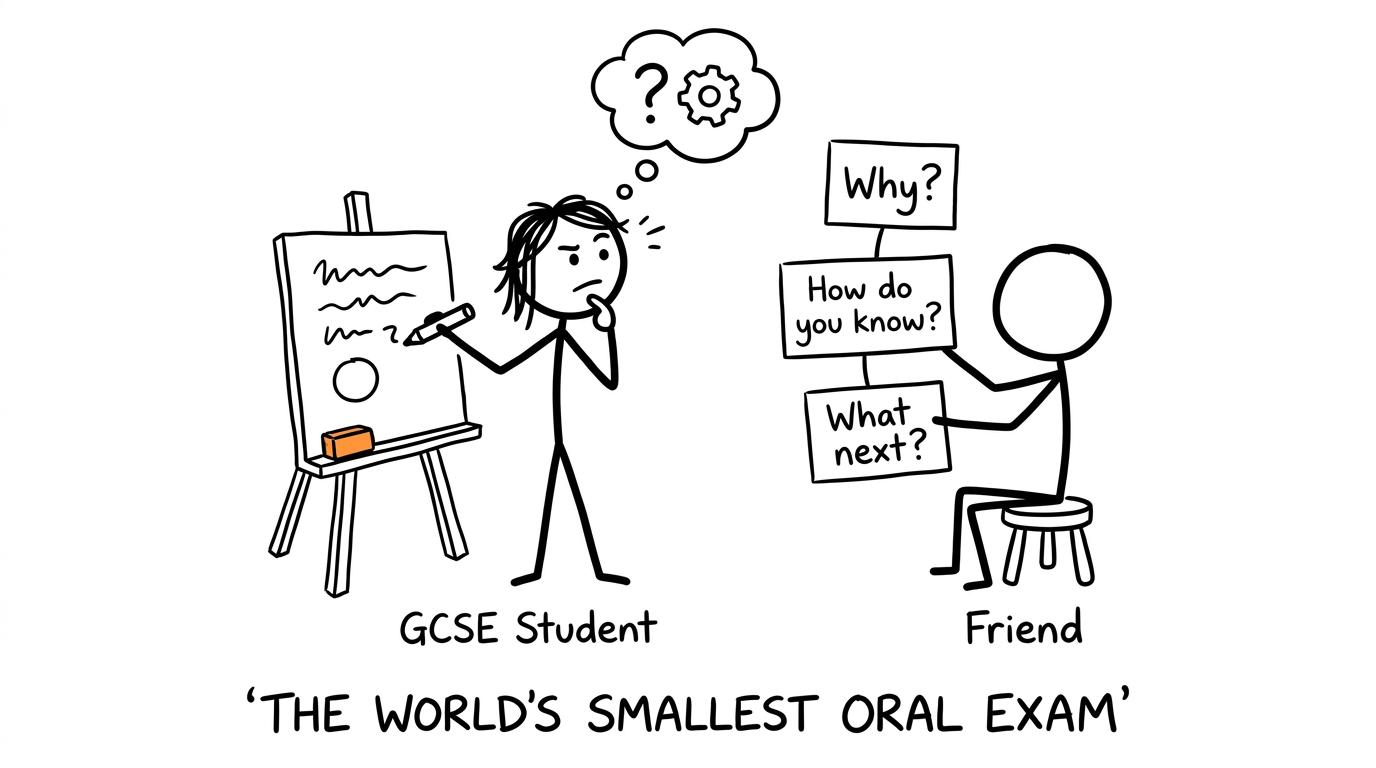 A very small audience asks a suspiciously large number of useful questions
Check accuracy after the explanation
Teach-back can strengthen an error if nobody checks it. Compare your explanation with your specification materials, class notes, textbook or teacher feedback. Correct pronunciation, meaning and grammar rather than rewarding confidence alone.
Create a brief gap log with three categories:
- Recall gap: you knew the content when prompted but could not retrieve it
- Understanding gap: you could repeat a rule but could not explain it
- Accuracy gap: you communicated an idea using incorrect language
The category tells you what to do next. Recall gaps need retrieval. Understanding gaps need a clearer explanation. Accuracy gaps need correction followed by fresh practice.
Return to the topic later
An immediate second attempt can show that you understood the correction, but delayed retrieval tests whether it lasted. Revisit the same material on another day and explain it again without opening your notes first.
Change the audience question or context so you are not merely memorising one speech. Flexible knowledge is more useful than a single rehearsed performance.
How teach-back can improve GCSE maths revision
The subject is different, but the revision problem is familiar. Students often watch a maths video, follow every line and conclude that the topic is finished. The real test is whether they can reconstruct the reasoning and apply it to an unseen question.
Begin with the free GCSE Maths revision hub. Choose one weak topic, use the revision lesson, then close it and explain:
- what clues identify the method
- why the method is appropriate
- which steps must be shown
- what common error could lose marks
- how you would check whether an answer is sensible
Do not stop at the explanation. Complete practice questions immediately afterwards. In maths, performance on fresh questions is the final test of whether your explanation represents usable knowledge.
You can find board-aligned material through the OCR GCSE Maths revision hub and Eduqas GCSE Maths revision hub. For paper practice, use the Edexcel GCSE Maths past papers or AQA GCSE Maths past papers, matching the paper to your exam board and foundation or higher tier.
Use explanation as one stage of a revision loop
A strong maths loop looks like this:
- learn or revisit the method
- explain it aloud without prompts
- attempt fresh questions
- check the mark scheme and video solution
- identify the precise gap
- explain the corrected method
- retest it later
Short assessments such as Edexcel GCSE Maths mini tests are useful here. They reveal whether an explanation survives contact with an unfamiliar question.
For longer practice, follow MathsGenie’s guide to using GCSE past papers properly. A paper gives you evidence; teaching back the methods you missed helps you interpret that evidence.
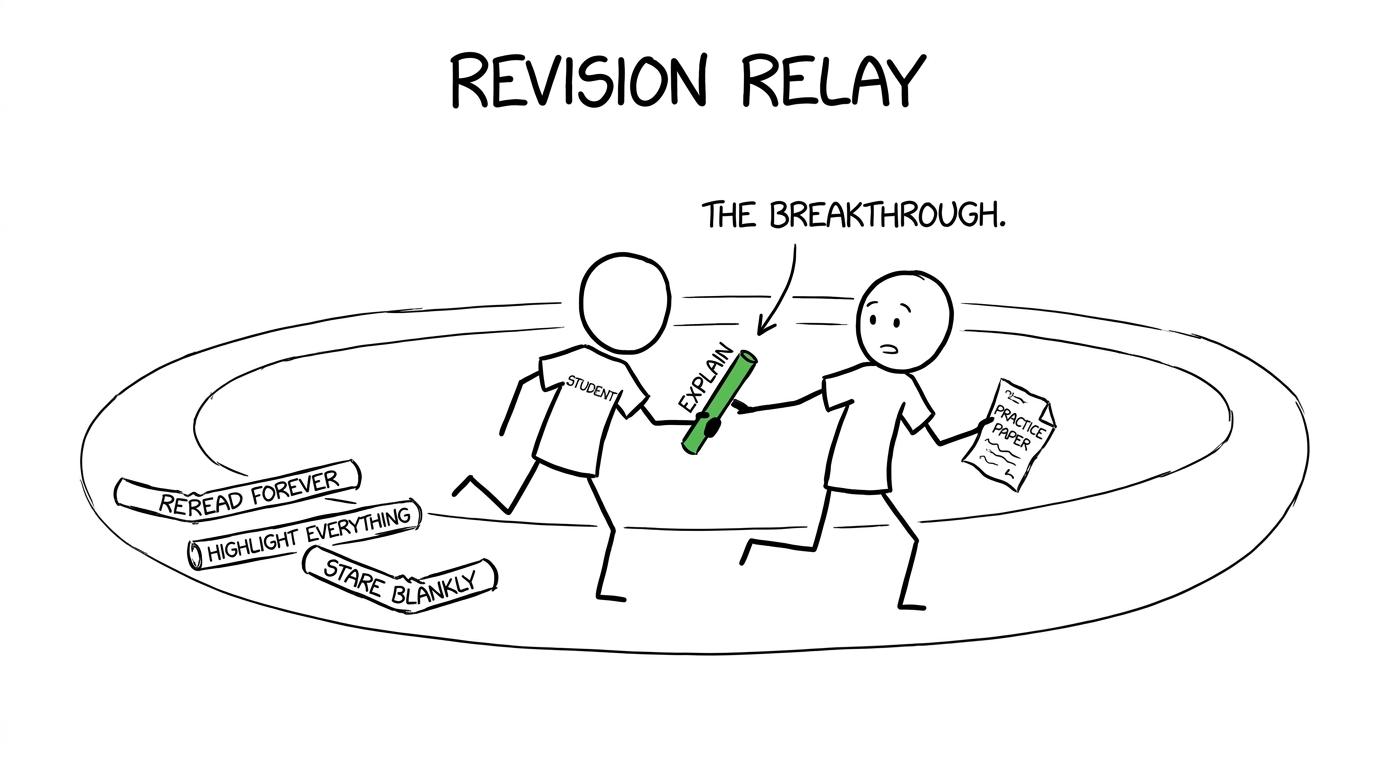 Revision passes the baton from explanation to independent exam practice
When teach-back is not enough
Teaching is a revision tool, not a complete revision plan.
For GCSE Arabic, you still need direct listening practice, reading under time pressure, accurate writing and tasks matched to your specification. A fluent explanation in English does not prove that you can communicate accurately in Arabic.
For GCSE maths, you must still write complete solutions, select methods independently and work under timed conditions. Explaining ratio or trigonometry confidently does not guarantee marks if you cannot answer the associated questions.
Balance teach-back with the habits in a realistic GCSE maths revision timetable: targeted lessons, practice questions, mini tests, marking and timed papers. If you do not know what to teach first, use the process in MathsGenie’s guide to finding weak GCSE topics.
Common mistakes with the teach back method
Reading notes aloud
Reading is not retrieval. Put your notes out of sight and try before checking them. Some difficulty is useful because it shows where support is still needed.
Choosing a topic that is too broad
“GCSE Arabic” or “GCSE algebra” is not a practical session target. Choose one skill that can be explained, checked and retested.
Prioritising confidence over accuracy
A confident explanation can still be wrong. Verify Arabic against reliable course material and verify maths against mark schemes or full solutions.
Letting the listener supply every answer
Hints can rescue the conversation while hiding weak recall. Ask the listener to record each hesitation, then allow you time to retrieve before prompting.
Treating explanation as exam practice
Teach-back diagnoses and strengthens understanding. It does not reproduce a listening paper, a written response or a timed maths examination. Move from explanation into the exact task you will be assessed on.
Never revisiting the gap
A correction can feel obvious immediately after you see it. Retest on another day to find out whether the knowledge is now available independently.
Make your explanation earn its place
The value of teaching someone else is not that it makes revision look active. It is that it makes uncertainty difficult to hide.
Use the teach back method for GCSE Arabic to retrieve vocabulary, clarify grammar and practise organising spoken ideas. Then check carefully and complete listening, reading, speaking and writing tasks. Use the same discipline in maths: explain a method, answer fresh questions, mark them and return to the gaps.
MathsGenie gives you the free revision lessons, practice questions, mini tests, past papers, predicted papers, mark schemes and video solutions needed to complete that loop. Choose one weak GCSE maths topic today. Learn it, teach it back, test it properly, and let the questions show you what to do next.











