Switch GCSE French to Spanish Mid-Year: A Guide
Switch GCSE French to Spanish mid-year with clarity. Learn what schools check, what you must catch up and how to protect your wider GCSE revision.
A subject choice can feel permanent until the lessons begin. Perhaps French is not clicking, Spanish feels more natural, or your future plans have changed. So, can you switch GCSE French to Spanish once the course is under way?
The short answer is: possibly, but your school must approve it. There is no national rule giving students an automatic right to change language. Your school will consider its timetable, class capacity, exam board, the work already missed and whether you can realistically catch up. A change early in Year 10 may be manageable; the same request deep into Year 11 is much harder.
The decision should not rest on which language seems easier. It should rest on evidence, timing and a credible catch-up plan that leaves enough room for compulsory subjects such as maths.
Your mid-year switching checklist
Before asking for a change, find clear answers to these questions:
- Does your school offer GCSE Spanish in a compatible timetable block?
- Is there space in the Spanish class?
- Which exam board and specification does the class follow?
- How much vocabulary, grammar and thematic content have you missed?
- Can the Spanish teacher assess your present level?
- Who must approve the change: your subject teachers, head of languages, head of year or options lead?
- Has the school already submitted examination entries?
- Which foundation or higher tier would be appropriate?
- How many catch-up hours can you sustain without weakening maths, English or science?
Do not make the decision from a single difficult French lesson or an enjoyable Spanish app session. Ask for the actual course materials and compare your current knowledge with what the class has completed.
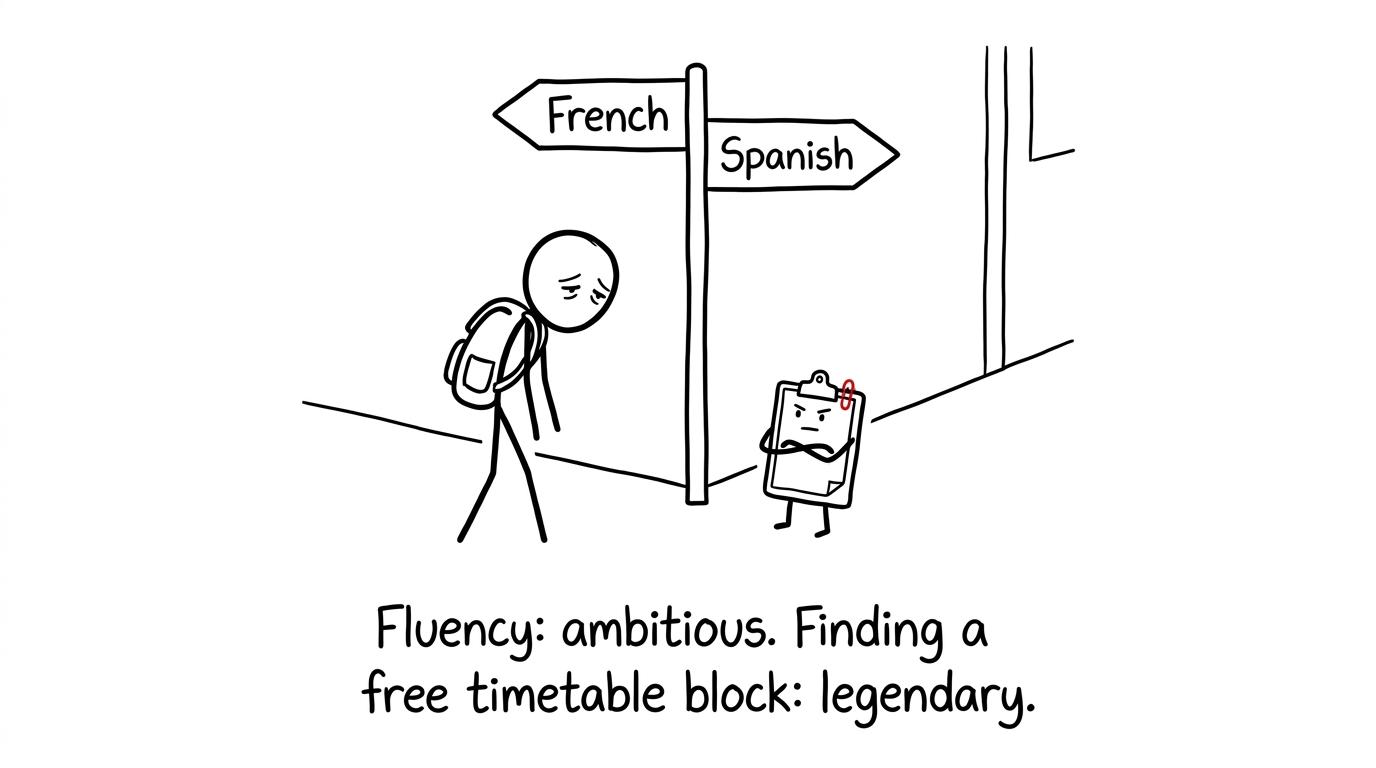 A student discovers that the timetable may be the hardest language to understand
Who decides whether you can change language?
In most schools, changing GCSE options is an internal curriculum decision. The exam board does not place you into a Spanish class, and a student cannot normally change an entry independently. The school must be able to teach, assess and enter you for the correct qualification.
You will usually need to speak to your French teacher, the Spanish teacher and the member of staff responsible for options. Your parent or carer may also need to confirm the request. The examinations officer becomes important if entries have already been prepared or submitted.
A school may refuse even when your reasons are sensible. Common practical barriers include:
- Spanish and another subject occupying the same timetable block
- a full class with no teaching capacity
- too much missed content
- insufficient evidence that you can reach the required standard
- examination-entry or speaking-assessment arrangements
- concern about the effect on your complete GCSE programme
This is not necessarily a judgement about your ability. A timetable is a system of connected choices. Moving one lesson can disturb several others.
What you would need to catch up
French and Spanish are both modern foreign languages, so some learning habits transfer. You may already understand ideas such as verb conjugation, grammatical gender, adjective agreement, tense formation and responding to unfamiliar texts. Knowing how to prepare a speaking answer is useful in either language.
But transferable skills are not the same as completed Spanish content. You still need the correct Spanish vocabulary, pronunciation, spelling patterns and grammar.
Confirm the exact specification
Students taking the reformed GCSE French and Spanish qualifications in England are following specifications introduced for first teaching in September 2024, with first assessments in summer 2026. The precise vocabulary lists, grammar requirements, themes and task formats depend on the exam board and specification.
Ask the Spanish teacher for:
- the exam board and specification code
- the class vocabulary and grammar lists
- a record of units already completed
- recent assessments or sample tasks
- the speaking format used by that specification
- the intended tier of entry
Do not assume that an online Spanish course matches an AQA, Edexcel, OCR or Eduqas course exactly. Resources can help you learn, but the specification defines what your class is preparing to assess.
Prepare for all four language skills
GCSE Spanish assesses listening, speaking, reading and writing. A student who enjoys reading Spanish may still have a large listening or pronunciation gap. Speaking requires particular attention because it must be taught, practised and formally conducted under the relevant assessment arrangements.
For tiered GCSE language specifications in England, students are entered at one tier across the assessments rather than mixing foundation and higher papers. The teacher therefore needs evidence about your overall performance, not just your strongest skill.
Request a short baseline assessment covering all four skills. Its purpose is not to prove that you are already ready. It is to measure the distance you would need to travel.
When is a switch realistically possible?
Early in Year 10
This is normally the most workable point after a course has begun. You may have missed a limited number of units, examination entries are unlikely to be the immediate obstacle, and there is more time to develop listening and speaking.
You will still need structured catch-up. A teacher may ask you to complete holiday work, attend support sessions or reach a specified standard before confirming the move.
Later in Year 10
A switch may remain possible, but the decision becomes more evidence-based. You need to know how much of the Spanish specification has been covered and whether your existing Spanish experience shortens the gap.
This is where enthusiasm must become a weekly plan. Saying that you will work hard is sincere, but schools need something more concrete: available hours, named resources, deadlines and regular teacher checks.
During Year 11
A Year 11 change is unusual and significantly riskier. The class may be preparing for mocks, speaking work and final assessments while you are still acquiring earlier vocabulary and grammar. Examination entries also become time-sensitive, with deadlines, possible late-entry procedures and administrative costs determined through the school and awarding organisation.
Only your examinations officer can confirm the current position for your series. Do not rely on a date found in an old forum post.
A late change may be considered where a student already has substantial Spanish knowledge, but even then the school must be satisfied that teaching and assessment can be completed properly.
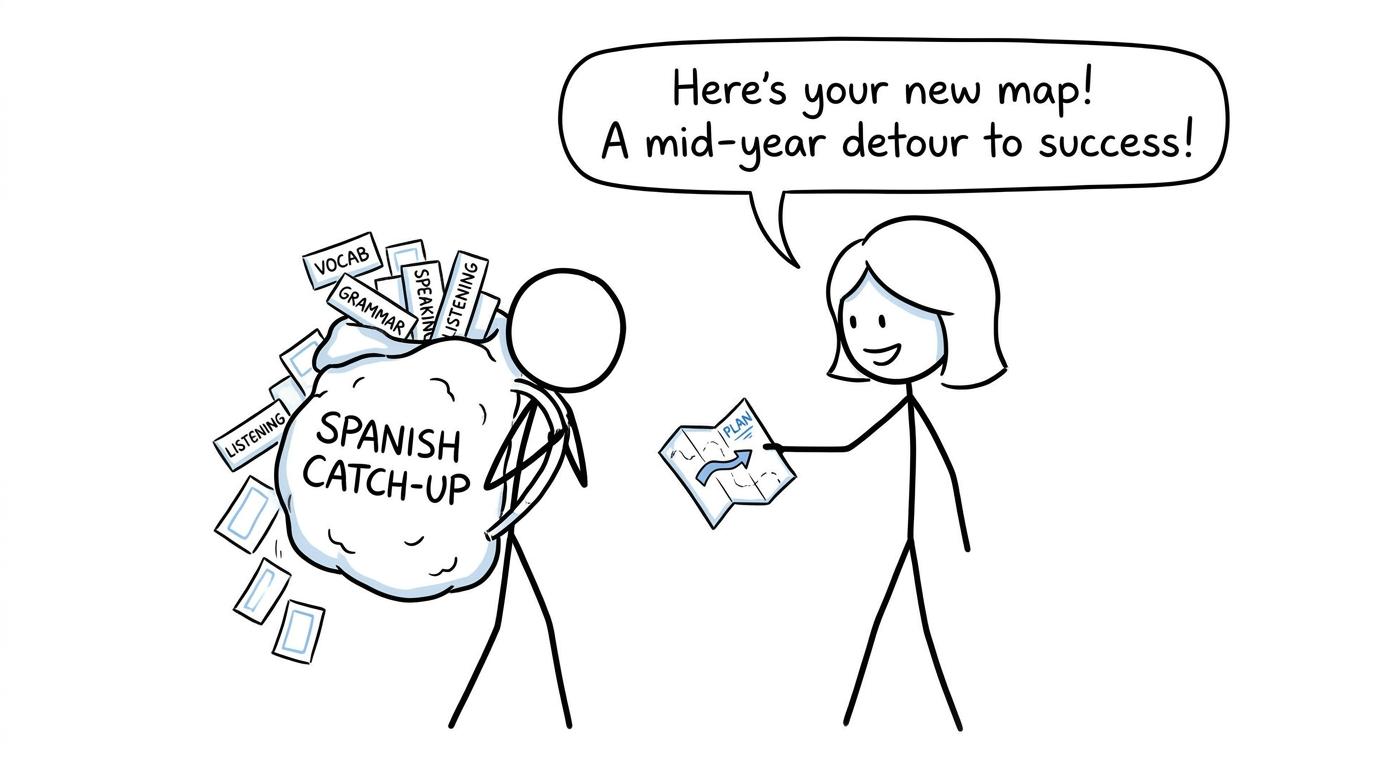 A catch-up plan makes a large Spanish workload easier to carry
Build a catch-up plan your school can trust
A convincing plan is specific. Divide the missed work into vocabulary, grammar, listening, speaking, reading and writing. Then agree weekly targets with the Spanish teacher.
A sensible routine might include:
- frequent vocabulary retrieval rather than occasional cramming
- short listening practice on several days each week
- regular pronunciation and speaking practice with feedback
- one focused grammar block at a time
- timed reading or writing tasks after the underlying content is secure
- a weekly teacher check to identify misconceptions early
Set a review point. For example, the school might allow a trial period before making the move permanent. Agree what success will look like: attendance, completed work, baseline improvement and the ability to participate in the current class unit.
The important word is sustainable. A plan requiring hours of extra language work every evening may collapse or consume time needed elsewhere.
Protect your GCSE maths revision
Changing languages creates an extra workload, but GCSE maths continues to accumulate new content. Treat time as a budget. Every catch-up hour has to come from somewhere.
Begin by mapping fixed commitments and preserving several short maths sessions each week. The GCSE Maths revision hub lets you select your board and move between revision lessons, practice questions and papers without wasting time searching.
If your schedule is crowded, use the 20-minute GCSE maths revision routine to maintain momentum. Short sessions work best when each has a defined purpose: revisit one method, answer questions, mark them and record the error.
You can also check the GCSE maths topics by exam board and tier before planning. This prevents the Spanish catch-up period from quietly becoming a gap in algebra, number or geometry.
As examinations approach, use Edexcel GCSE Maths mini tests for focused timed practice if you follow Edexcel. Move to Edexcel GCSE Maths past papers when you need full-paper evidence. Students on other boards can choose the appropriate section from the main revision hub.
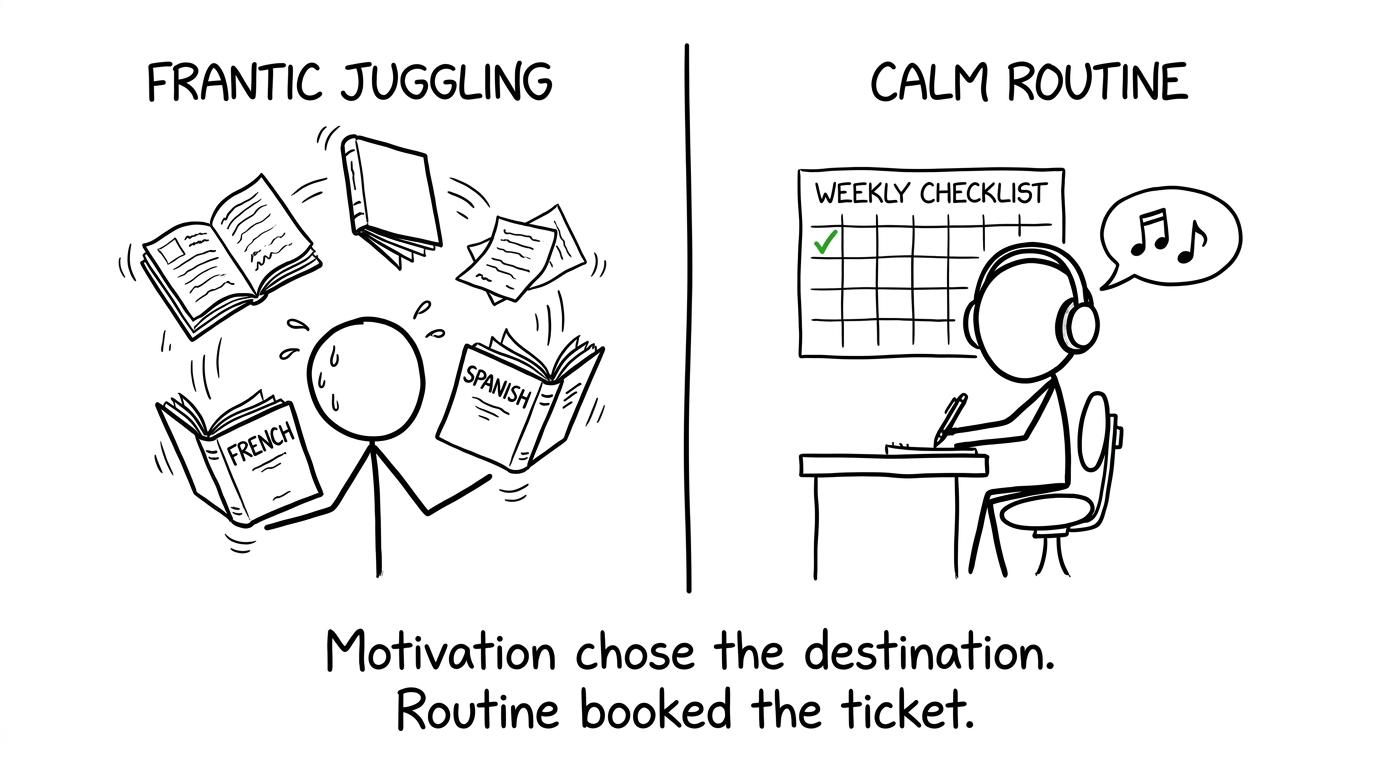 A calm routine outperforms frantic dictionary juggling
Reasons to switch: and reasons to pause
A switch may be reasonable if you have prior Spanish knowledge, a strong long-term interest, a suitable timetable and enough time to close the gap. Persistent difficulties in French may also matter, particularly when teachers agree that Spanish is a better educational fit.
Pause if the decision is mainly based on friendship groups, one disappointing result or the belief that Spanish is automatically easier. Both languages require sustained vocabulary learning, accurate grammar and performance across four skills.
It may also be better to remain in French if the switch would destabilise several subjects. Before deciding, review your wider workload using a realistic structure such as the GCSE one-month maths revision plan. Although designed for maths, its diagnose, practise, mark and revisit cycle is a useful model for judging whether your proposed catch-up hours are credible.
Common mistakes when requesting a switch
Waiting without asking. The longer you wait, the more Spanish content you miss. Ask for information promptly, even if you have not made a final decision.
Treating permission as guaranteed. Interest alone cannot create timetable space, teacher capacity or assessment arrangements.
Ignoring the specification. General Spanish practice is valuable, but it does not replace the vocabulary, grammar and task formats required by your board.
Focusing only on vocabulary. Listening speed, pronunciation, grammatical accuracy and speaking confidence also take time to develop.
Underestimating examination administration. Once entries and speaking arrangements are involved, the examinations officer must check the current rules and deadlines.
Sacrificing compulsory subjects. A successful switch should not lead to preventable gaps in maths. Follow guidance on when to start GCSE past papers so catch-up work does not crowd out exam preparation.
Make the decision from evidence
To switch GCSE French to Spanish mid-year, you need more than preference. You need school approval, timetable compatibility, class capacity, an assessment of your Spanish level, the correct specification, workable examination arrangements and a catch-up plan that protects your other GCSEs.
Start with one meeting and one honest question: What would I have to demonstrate for this change to be educationally realistic? Whether the answer is yes, no or a trial period, clarity is better than months of uncertainty.
Then keep maths steady with MathsGenie. Use free revision lessons and practice questions to repair individual topics, mini tests to preserve speed, and past papers or predicted papers to build exam confidence. Mark your work with the available mark schemes and use video solutions when a method is unclear. Your language choice may change, but your revision routine can remain calm, measurable and consistent.