

Switch Exam Board GCSE Art and Design Mid-Course
Switch exam board GCSE Art and Design mid-course: learn what happens to your portfolio, assessment requirements and revision plan after a school change.
A school announcement can make months of careful portfolio work suddenly feel uncertain: the GCSE Art and Design exam board is changing. Does your existing work still count? Will you have to begin again? And who decides what happens next?
If your school plans to switch exam board GCSE Art and Design mid-course, it may be possible, but it is a decision for the school, its exams officer and the awarding bodies involved. It is not a transfer that an individual student normally arranges. Your school must map completed work against the new specification, confirm that assessment and authentication requirements can be met, and make the correct entry.
The reassuring part is that GCSE Art and Design specifications in England share the same four assessment objectives. The difficult part is that portfolio rules, available titles, mark totals, assessment grids and administrative procedures are not identical.
The short answer and your immediate checklist
A mid-course switch is most manageable when it happens early, before final assessment and before the externally set assignment begins. A late switch may still be considered, but the school will need direct guidance from the new awarding body.
If you are affected, ask for clear answers to these questions:
- Which awarding body and specification title are you leaving?
- Which board and title are you moving to?
- Will all your existing portfolio evidence remain eligible?
- Are any new pieces, annotations or processes required?
- How will your work be assessed under the new mark grid?
- Has the exams officer confirmed entry and moderation arrangements?
- Will project deadlines or the supervised assessment dates change?
- How will the extra workload fit around your other GCSE subjects?
Do not discard, remake or substantially alter work simply because you have heard that the board is changing. Wait for written instructions from your art teacher.
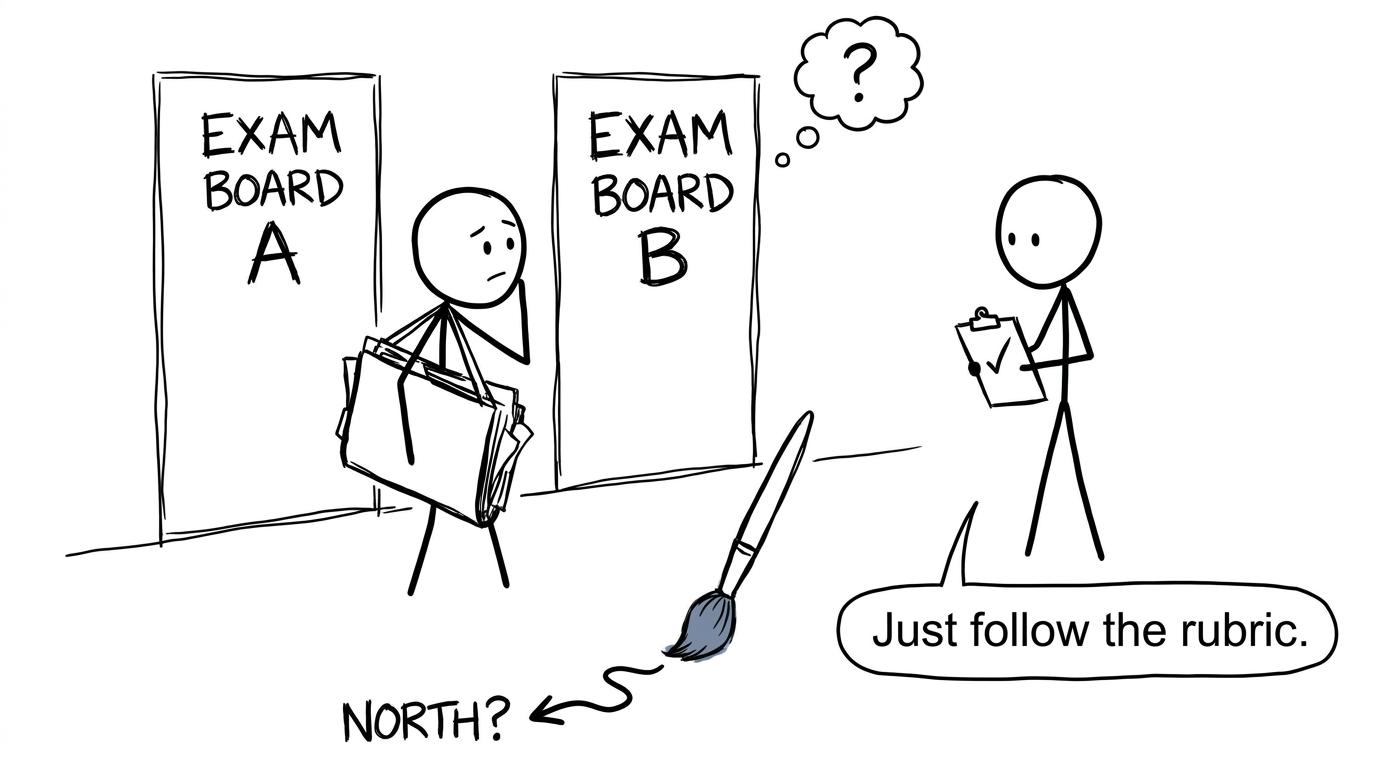 A student caught between two exam-board doors while carrying an enormous art portfolio
Why switching boards is possible but not automatic
Schools choose the specifications they teach. They also make examination entries, conduct non-exam assessment, authenticate students’ work, standardise teachers’ marking and arrange moderation. That means a school can investigate changing from AQA to Pearson Edexcel, OCR or Eduqas, for example, but it must ensure that the new qualification can be delivered correctly.
An exam-board change is not the same as sitting an examination at another centre. JCQ transferred-candidate arrangements generally concern externally assessed, timetabled components; portfolios and other non-examined components are excluded from those ordinary arrangements. A school therefore cannot assume that paperwork designed for transferring an examination venue will automatically move an Art and Design portfolio between boards.
Similarly, rules that allow a non-exam assessment mark to be carried forward after a completed qualification attempt do not usually solve a mid-course change to a different specification. Your work has not yet received a final, moderated mark under the old board, and the new board must be satisfied that its own specification has been met.
The practical answer is simple: the exams officer should contact the awarding body before the school promises students that every piece will transfer unchanged.
What stays broadly consistent across GCSE Art and Design
There is a stable centre beneath the administrative change. The regulated assessment objectives are common across GCSE Art and Design specifications:
- AO1: develop ideas through investigations and show critical understanding of sources.
- AO2: refine work by exploring ideas and experimenting with suitable media, materials, techniques and processes.
- AO3: record ideas, observations and insights as the work develops.
- AO4: present a personal, meaningful response that realises intentions and demonstrates understanding of visual language.
Each objective contributes 25%25\%25% of the overall qualification. Across AQA, Pearson Edexcel, OCR and Eduqas, the portfolio component normally contributes 60%60\%60%, while the externally set component contributes 40%40\%40%.
This shared structure is why existing work may remain useful. A strong investigation of an artist can still provide AO1 evidence. Experiments, revisions and decisions can still support AO2. Drawings, photographs and purposeful annotation can still contribute to AO3. A resolved outcome can still demonstrate AO4.
But “useful” is not the same as “automatically compliant”. That distinction matters.
What can change after the switch
Portfolio composition and required evidence
Boards may describe the portfolio differently and specify different minimum structures. One specification might require a sustained project plus selected further work for a particular examination series, while another may organise evidence in a different way. The accepted breadth of work can also depend on whether you are entered for Fine Art, Photography, Textile Design, Graphic Communication, Three-Dimensional Design or the broader Art, Craft and Design title.
Your teacher should create a mapping document showing where your existing portfolio meets every requirement of the new specification. Any genuine gaps should then become a short, precise action list rather than a demand to restart everything.
Raw marks and assessment grids
The objectives may be shared, but boards use different raw mark totals and marking grids. A piece of work should not simply be given the same numerical mark under the new board. Teachers need to apply the new board’s descriptors and complete internal standardisation using its rules.
This does not mean the quality of your work has disappeared. It means the measuring scale has changed.
Externally set work
The externally set assignment or task is issued by the board for a particular examination series. Themes, starting points, release arrangements and supporting instructions are board-specific. Work prepared for one board’s externally set task should not be presumed valid for another board’s task.
This is one reason a switch becomes more complicated after externally set work has begun. The school must obtain explicit advice rather than improvising a solution.
Administration, authentication and moderation
The new board may require different forms, digital systems, mark submission procedures or moderation arrangements. Your school must also preserve evidence that the work is your own and that any sources or permitted assistance have been acknowledged.
Once coursework has been submitted for final assessment, changing it can create serious assessment problems. Follow your teacher’s instructions about when work is final and what may still be refined.
How to adjust without rebuilding your entire course
The best response is an audit, not panic.
Create a simple portfolio inventory with your teacher. For each project, record the theme, media, artist or contextual research, experiments, observational evidence, development, annotations and final response. Then identify which assessment objectives are already visible and what the new specification still requires.
Your action list might include:
- making the development from source to final response easier to follow;
- adding missing primary observations or photographs;
- explaining why a material or technique was rejected;
- improving source acknowledgements;
- selecting portfolio pages more carefully;
- completing a missing process required by the new title;
- preparing for a different externally set task.
The purpose is not to manufacture pages for appearance. It is to make your creative decisions and progress assessable under the new rules.
Ask your teacher to distinguish between three categories: keep, adapt and new work. That gives you a finite plan. Uncertainty feels limitless; a checklist has an end.
Protecting your maths revision while Art changes
A course change can quietly consume every available evening. Art deadlines expand because there is always another annotation, experiment or refinement that could be made. Meanwhile, GCSE Maths still requires repeated practice.
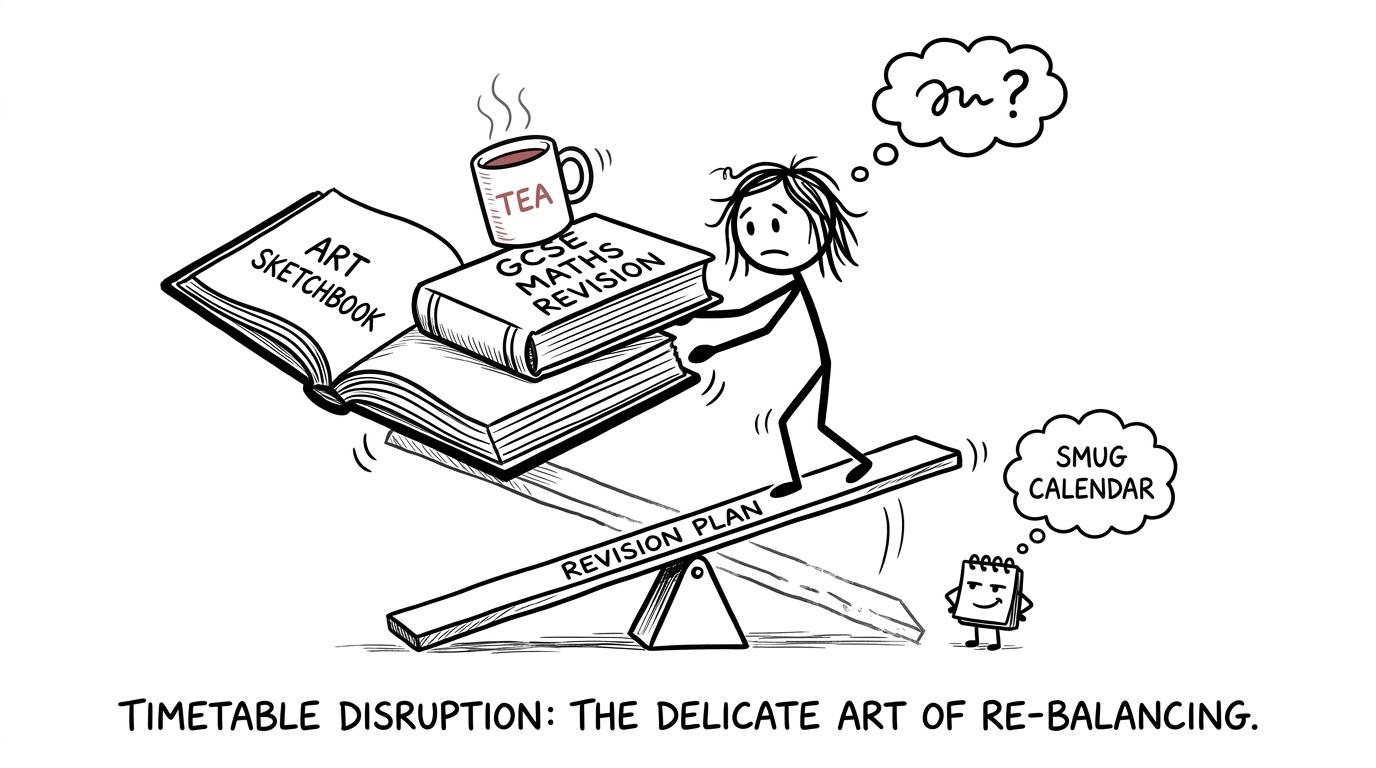 A student balancing an art portfolio, maths revision book and cup of tea on a revision-plan seesaw
Start by placing confirmed Art and Design deadlines into your calendar. Then reserve short, protected maths sessions around them. The GCSE Maths revision hub lets you choose your board and move between revision lessons, practice questions, papers and solutions without spending time searching.
Keep your maths preparation board-specific. Depending on your school’s entry, use the Edexcel GCSE Maths revision resources, OCR GCSE Maths revision hub or Eduqas GCSE Maths revision resources. AQA students can practise with AQA GCSE Maths past papers and mark schemes.
A realistic weekly pattern during the transition is:
- two short maths topic sessions using revision lessons and practice questions;
- one mini test or timed paper section;
- one review session using mark schemes or video solutions;
- protected Art and Design blocks based on the school’s gap analysis.
If you are unsure which maths gaps deserve attention, use the process in how to find your weakest GCSE topics. When examinations are approaching, the guide to when to start GCSE past papers can help you phase paper practice sensibly.
Questions to take to your teacher and exams officer
Students should not be expected to interpret two specifications alone. Ask for a short meeting and take these questions:
- What is my exact new specification code and title?
- Has the new awarding body confirmed how existing work should be handled?
- Which parts of my portfolio already satisfy the new requirements?
- What evidence is missing, and why is it required?
- Will my work be remarked using a new assessment grid?
- Which deadlines are provisional and which are confirmed?
- What happens if the switch cannot be completed compliantly?
- Who should my parent or carer contact if clarification is needed?
Request the answers in writing where possible. This is not confrontational. It prevents different students receiving different versions of the plan.
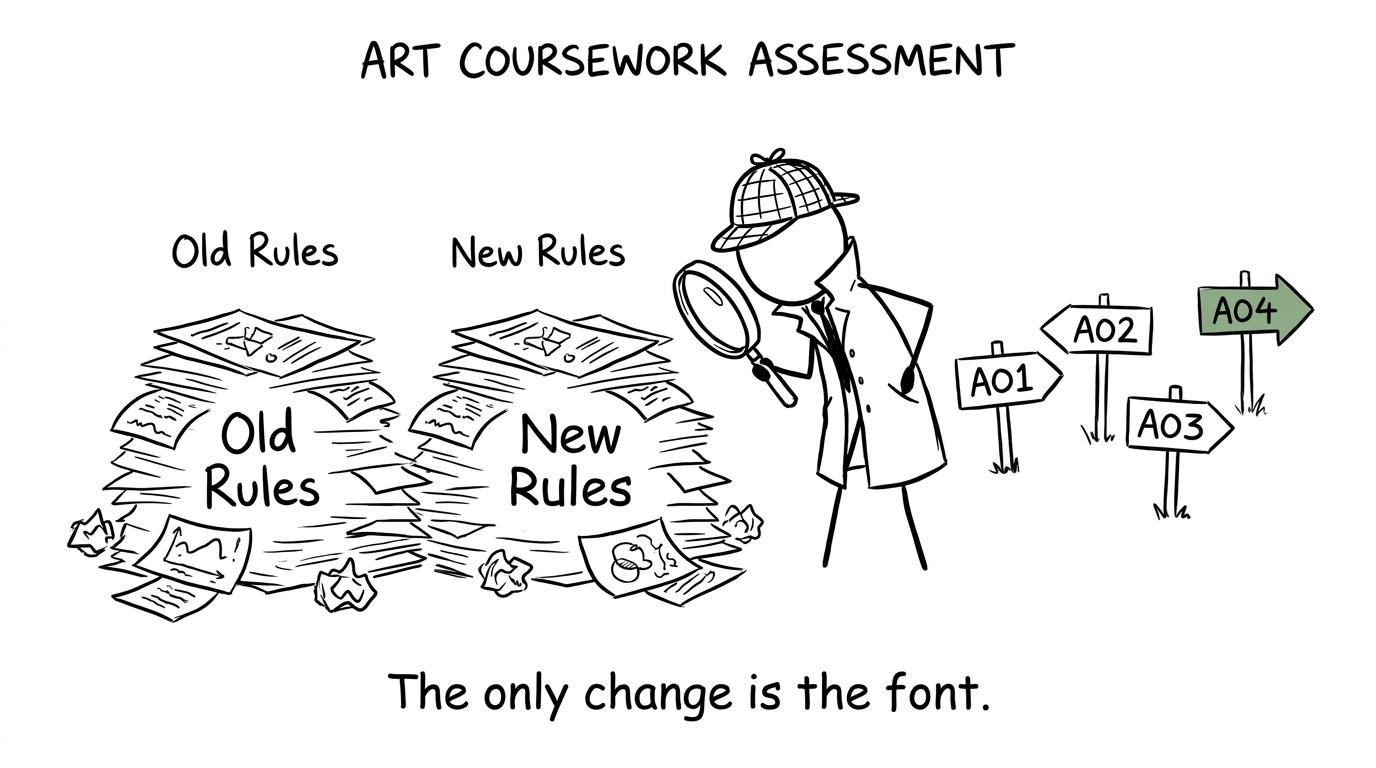 A student detective comparing old and new coursework rules while four assessment-objective signposts point forward
Common mistakes after an exam-board change
Assuming all specifications are interchangeable
The common assessment objectives create overlap, but titles, portfolio requirements, marking grids and administrative rules can differ. Work from the old course needs to be checked, not merely relabelled.
Starting the portfolio again without approval
A complete restart can waste time and remove valuable evidence of development. Preserve everything until your teacher has finished the specification mapping.
Treating rumours as confirmed policy
Classroom conversations often mix together exam-board changes, school transfers and changes of specification title. Ask for the exact board, code, title and examination series.
Adding work after final submission
Once work has been submitted for final assessment, unauthorised additions or removals can breach assessment rules. Check whether the portfolio is still in development before changing it.
Letting the disruption erase revision in other subjects
An urgent Art task can feel more visible than a distant maths paper. Keep a minimum maths routine alive. If time is tight, follow a structured order for learning GCSE Maths topics rather than revising randomly.
Move forward with a written plan
A mid-course exam-board switch is possible only when the school can satisfy the new awarding body’s specification, assessment and administration requirements. Most students should not need to abandon every useful piece of work, because the four assessment objectives provide substantial common ground. But only the school and awarding body can confirm exactly what may be submitted.
Your next step is to obtain the new specification details, preserve your existing portfolio and ask for a clear keep-adapt-create checklist. Then protect the rest of your GCSE preparation.
MathsGenie can keep the maths side steady while school arrangements change. Use free revision lessons to repair weak methods, practice questions and mini tests to build accuracy, past papers to develop timing, and predicted papers, mark schemes and video solutions to guide your final preparation. When one subject becomes uncertain, a dependable routine elsewhere is more valuable than ever.











