

Staying Consistent With GCSE Economics Revision
Staying consistent GCSE Economics revision gets easier with a small routine. Learn how to keep revising through low-motivation weeks and make progress.
Some weeks, revision feels manageable. On others, even opening a textbook seems to require more energy than you have. The answer is not to wait for enthusiasm to return. Staying consistent with GCSE Economics revision means creating a routine that still works when motivation is low: begin with a tiny minimum, practise active recall, answer one focused question and use feedback to decide what comes next.
Motivation is useful, but unreliable. A repeatable system is quieter and more dependable. It removes decisions, makes starting easier and gives every session a clear finish line.
Your low-motivation revision checklist
When you do not feel like revising, follow this short sequence:
- Choose one small Economics topic.
- Set a minimum of ten focused minutes.
- Recall what you know before opening your notes.
- Complete one question or plan one longer response.
- Check the answer against a mark scheme or revision guide.
- Record one gap and schedule a return to it.
- Stop after the minimum if you genuinely need to.
The MathsGenie GCSE Economics revision hub helps reduce the effort of choosing materials. You can select your exam board and move between specification-matched revision guides, questions and past papers rather than searching across unrelated resources.
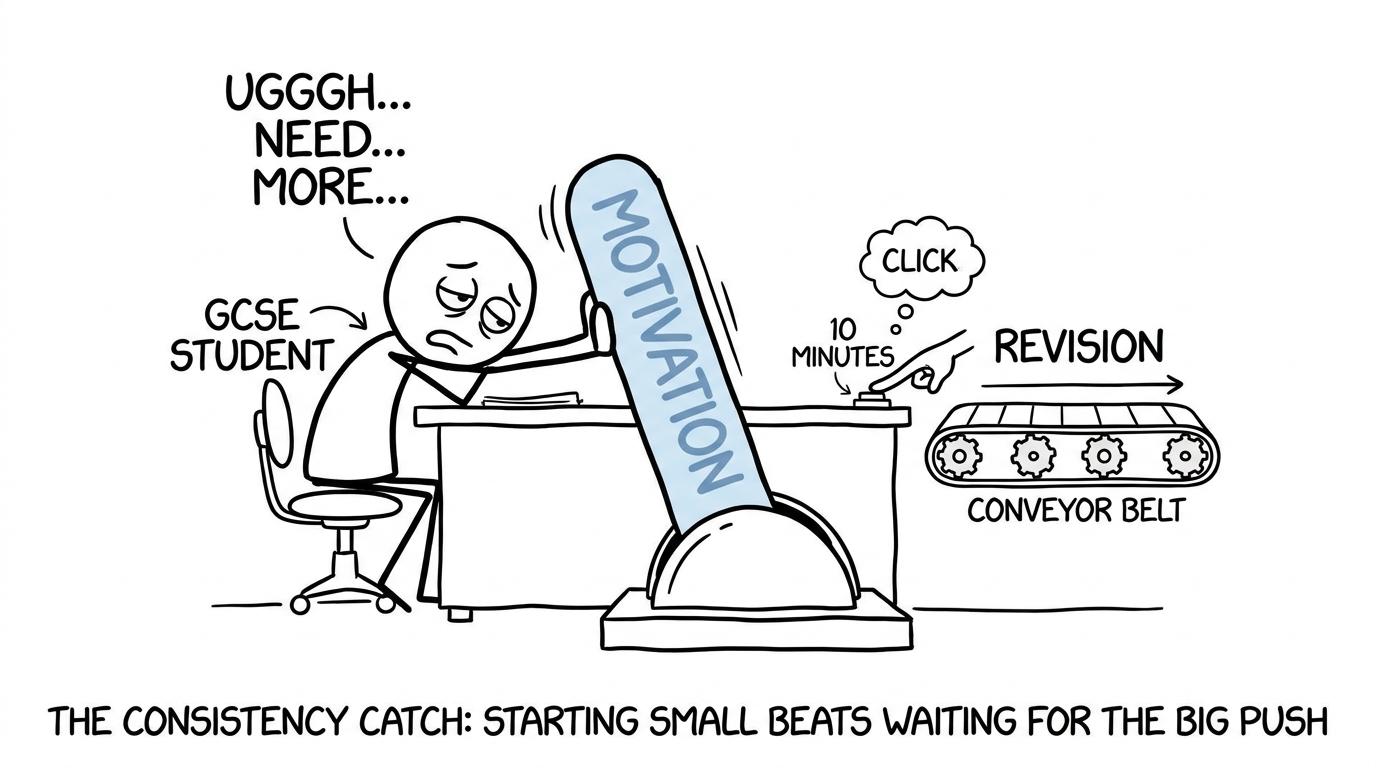 A small revision button succeeds where a giant motivation lever fails
Why motivation cannot carry an entire revision plan
Motivation tends to rise when a goal feels close, progress is visible or a topic is going well. Unfortunately, GCSE preparation also includes ordinary Tuesday evenings, difficult chapters and weeks crowded with maths, English and science.
A plan based on feeling motivated therefore has a hidden weakness: you must negotiate with yourself before every session. Should you revise now? Which unit should you choose? How long should you work? The decisions become another reason to delay.
Consistency replaces negotiation with a default. For example, your rule might be: after dinner on Monday, Wednesday and Friday, complete a short Economics recall-and-question session. The precise days matter less than having a cue that tells you when to begin.
Make the starting action almost effortless. Leave your topic list ready, bookmark the correct resource and put your notebook beside your calculator. On a difficult evening, your job is not to feel inspired. It is simply to follow the first instruction.
Build a minimum that survives a bad week
An ambitious timetable can look impressive while producing very little. If it collapses whenever school becomes busy, it is not really a system.
Instead, create two levels:
- Minimum session: recall one topic, answer one question and check it.
- Bonus session: continue into a longer set, essay plan or timed paper section.
The minimum should be small enough to complete when you are tired. This is not an excuse to avoid serious practice. It preserves the habit until you have the time and energy for more.
Think of weekly consistency as:
weekly progress=small completed sessions+longer practice when possible\text{weekly progress}=\text{small completed sessions}+\text{longer practice when possible}weekly progress=small completed sessions+longer practice when possibleThe minimum protects continuity; the bonus builds depth. Maths students can use the same principle when Economics revision competes with foundation or higher tier maths practice. MathsGenie's twenty-minute GCSE revision routine offers a useful structure that can be adapted across subjects.
Use a fixed revision loop
A vague instruction such as “revise markets” leaves too much room for passive reading. A fixed loop tells you exactly what productive revision looks like.
Retrieve
Close your notes and write down everything you can remember about one narrow area, such as opportunity cost, price elasticity, inflation or fiscal policy. You might recall definitions, causes, consequences, diagram labels and evaluation points.
The attempt matters, including when recall feels difficult. Evidence reviewed by the Education Endowment Foundation supports retrieval practice, particularly when pupils make an active attempt, receive feedback and revisit material after a delay.
Check
Open your notes or a specification-matched guide. Correct missing terminology and misconceptions in a different colour. OCR students can select a precise topic from the OCR GCSE Economics revision guides, while the broader OCR GCSE Economics hub brings revision and examination resources together.
Apply
Answer a question that requires you to use the idea in context. GCSE Economics is not assessed through recall alone. The regulated assessment objectives allocate approximately 35%35\%35% to knowledge and understanding, 35%35\%35% to application and 30%30\%30% to analysis and evaluation. Your routine should therefore include all three, rather than ending once you can repeat a definition.
Review
Mark the response and write one specific correction. “Revise inflation” is too broad. “Explain the chain from higher production costs to cost-push inflation” gives your next session a clear starting point.
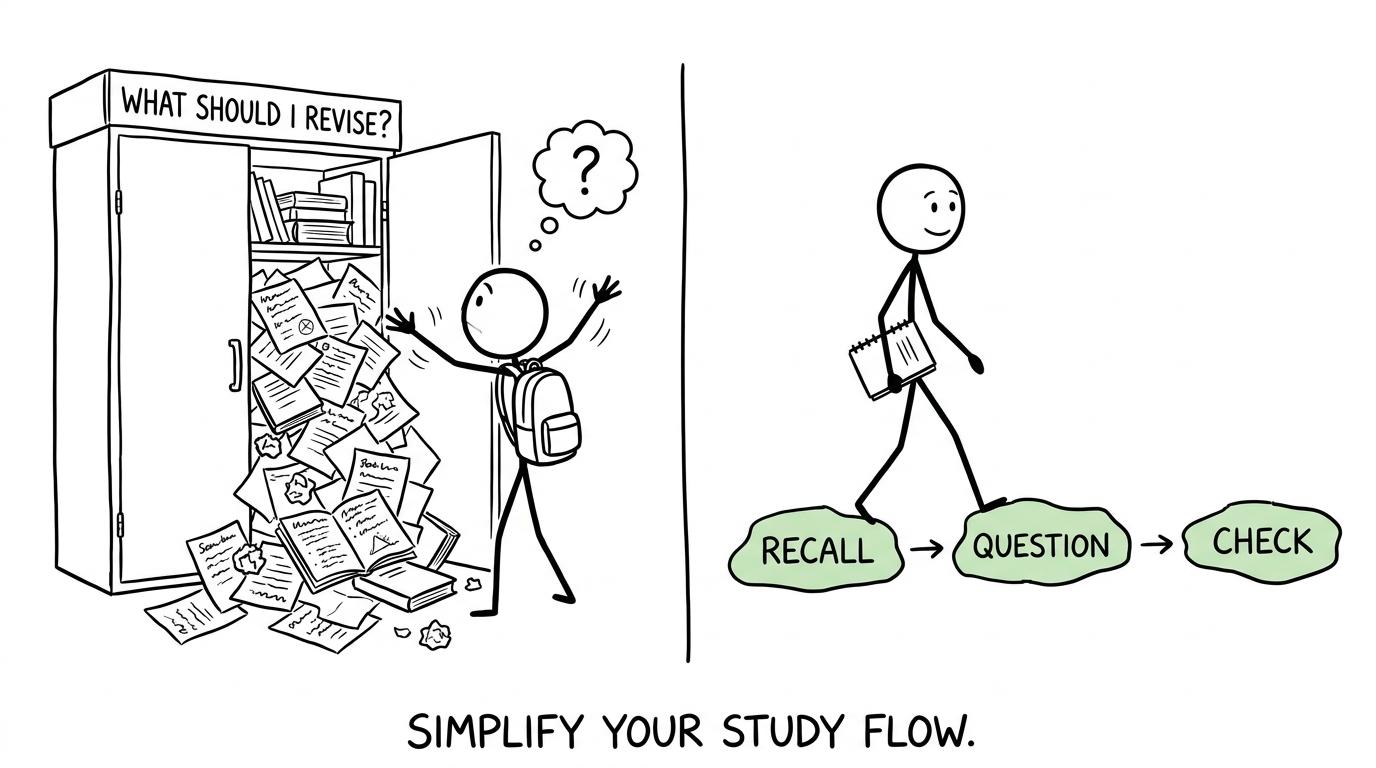 A calm three-step path escapes the cupboard of revision decisions
Match the task to your energy
Consistency does not require identical sessions. It requires useful contact with the subject across different kinds of day.
| Energy level | Suitable revision task |
|---|---|
| Low | Recall five definitions, label a diagram or correct an old response |
| Moderate | Complete focused questions and check the mark scheme |
| High | Write a longer response or complete a timed paper section |
This prevents all-or-nothing thinking. A low-energy session should not become an excuse for meaningless highlighting, but it also need not become a full mock examination.
Keep a prepared menu of tasks. If you are tired, select from the low-energy list without deciding from scratch. If concentration improves after you begin, move to a more demanding task. Starting creates the opportunity; it does not force you into an unrealistic session.
Revise for the marks the examination rewards
Across GCSE Economics specifications, students must know economic concepts, apply them to contexts, analyse consequences and reach supported judgements. A balanced week should therefore contain four kinds of practice:
- Knowledge: accurate definitions, diagrams and economic relationships.
- Application: using information from a case study, chart or extract.
- Analysis: building connected chains of cause and effect.
- Evaluation: considering conditions, different stakeholders, time periods and evidence before reaching a judgement.
Use command words to choose the depth of your response. A definition task is different from an explanation, and an evaluative question requires more than listing advantages and disadvantages. When checking answers, read the mark scheme as a description of what earns marks, not merely as a verdict. The guide to using GCSE mark schemes as a revision coach explains how to turn marking into a useful next action.
Past papers should enter the routine gradually. Begin with individual questions, then timed sections, and finally complete papers. The MathsGenie guide to using GCSE past papers properly sets out the productive cycle: attempt, mark, repair and retest.
Keep quantitative Economics in the routine
Economics includes mathematical skills, so students preparing for maths exams can make some revision serve both subjects. Official GCSE subject content includes percentages, percentage change, averages, revenue, costs, profit, income, graphs and the interpretation of economic data.
Useful relationships to retrieve include:
percentage change=new value−original valueoriginal value×100\text{percentage change}=\frac{\text{new value}-\text{original value}}{\text{original value}}\times 100percentage change=original valuenew value−original value×100 average cost=total costquantity produced\text{average cost}=\frac{\text{total cost}}{\text{quantity produced}}average cost=quantity producedtotal cost profit=total revenue−total cost\text{profit}=\text{total revenue}-\text{total cost}profit=total revenue−total costDo not practise these as disconnected arithmetic. You must also interpret the result economically, use the correct units and connect data to an argument. AQA students can review quantitative skills in GCSE Economics, while OCR students can use the focused GCSE Economics calculations guide.
A short quantitative task is especially valuable on a low-motivation day because it has a visible endpoint. Complete it, check it and add any error to your revision list.
Make progress visible without obsessing over hours
Hours measure attendance, not learning. A student can spend an evening copying notes without finding out what they can recall or apply.
Track completed actions instead:
- topics retrieved without notes;
- questions attempted and marked;
- errors corrected;
- weak areas retested;
- paper sections completed under timed conditions.
Use a simple traffic-light topic list, but award green only after successful recall or question practice. Feeling familiar with a page is not the same as being able to produce an answer.
MathsGenie's revision planner can help you spread Economics alongside maths and other GCSE subjects. Leave catch-up space rather than filling every evening. A plan with no spare capacity turns one missed session into an apparent crisis.
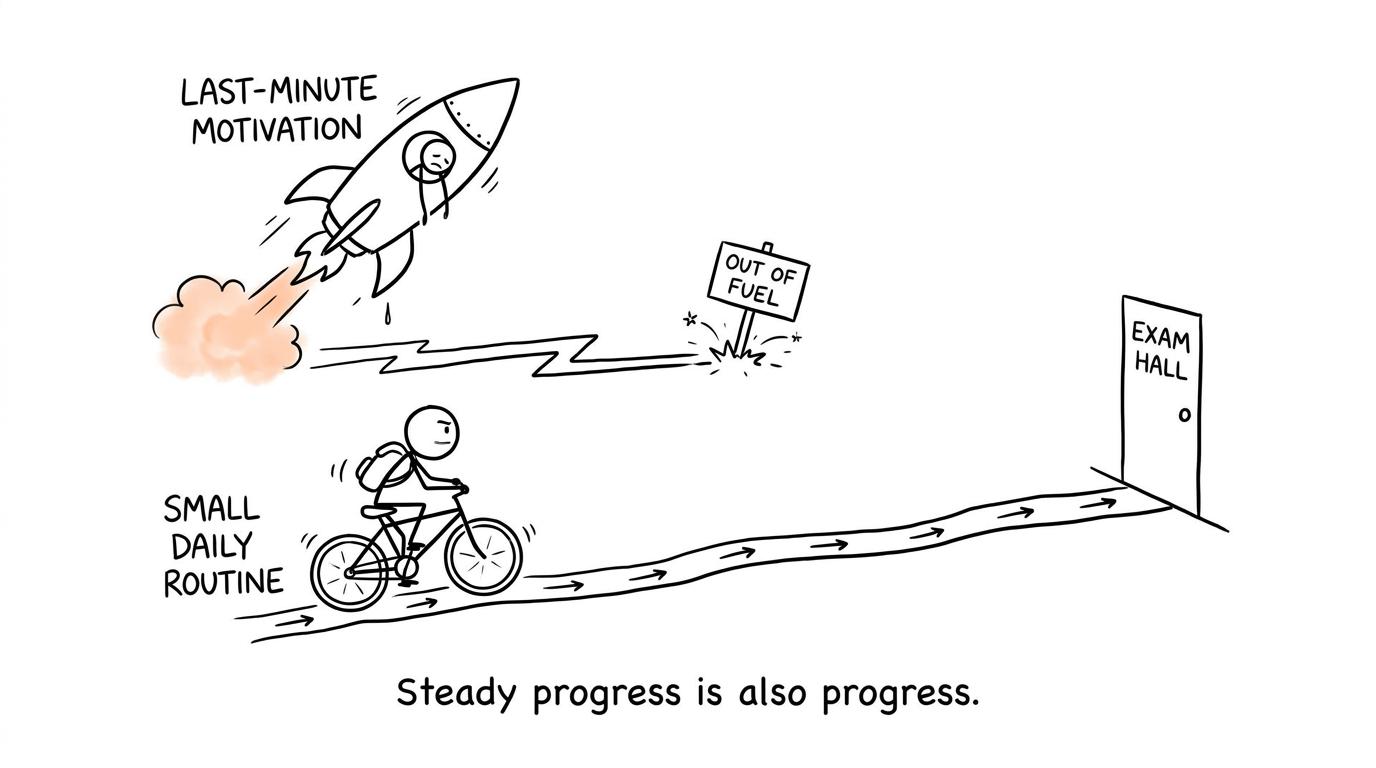 A steady revision bicycle beats a dramatic rocket to the exam hall
What to do after missing several sessions
Do not attempt to repay a missed week with one exhausting evening. That usually makes revision feel like punishment.
Restart with the smallest normal session. Then review your plan:
- Was the minimum still too large?
- Was the cue unclear?
- Were resources difficult to find?
- Did other subjects need more space?
- Were you avoiding a topic because you did not understand it?
Adjust the system rather than judging your character. If a topic is blocking progress, return to a clear revision lesson before attempting more questions. For instance, AQA students revising saving, borrowing and interest can use the guide to the role of money and financial markets.
The rule is simple: never let missing yesterday decide what happens today.
Common mistakes that break consistency
Planning only ideal weeks
A timetable designed around endless energy will fail during homework deadlines, illness or mock examinations. Build a minimum version from the beginning.
Revising topics that already feel comfortable
Familiar material makes revision feel smooth, but it can hide important gaps. Let marked questions and past papers choose part of your timetable.
Reading without retrieval
Reading has a place when learning or repairing understanding. For revision, close the resource and attempt to recall, apply or explain the idea before checking.
Making every session too broad
“Macroeconomics” is not a practical task. “Recall three causes of inflation and plan one evaluation paragraph” is specific and finishable.
Recording marks but not causes
A total mark does not tell you what to do next. Label each loss as a knowledge, application, analysis, evaluation, quantitative or timing problem.
Abandoning the plan after one missed day
Consistency does not mean perfection. It means returning quickly. A plan that survives interruptions is stronger than an unbroken streak that disappears after one difficult week.
Consistency is a system, not a mood
The students who keep revising through difficult weeks are not necessarily more motivated. They have often made the next action obvious, small and useful. They retrieve before rereading, practise questions, check feedback and return to weak material after a delay.
Begin today with one topic on the GCSE Economics revision hub. Complete your minimum session, record one next step and place the next review in your planner. As the examinations approach, build towards MathsGenie's past papers, predicted papers, practice questions, mark schemes, video solutions and mini tests.
You do not need to win the entire revision season tonight. You only need a routine you can return to tomorrow.










