Sleep Before a GCSE English Language and Literature Exam
Sleep before a GCSE English Language and Literature exam: learn how much teenagers need and how rest supports memory, focus and writing.
The temptation is familiar: one more quotation, one more poetry comparison, one more glance at the language question structure. Midnight arrives, but stopping feels like giving up marks.
Yet the best approach to sleep before a GCSE English Language and Literature exam is usually to protect a full night's rest. Current expert guidance recommends that teenagers aged 131313 to 181818 regularly get between 888 and 101010 hours of sleep. Your exact need is individual, but an all-nighter is not a sensible revision strategy.
Sleep does not replace preparation. It helps you use the preparation you have already done by supporting memory, sustained attention and flexible thinking, precisely what a long English paper demands.
The short answer: how much sleep should you get?
Aim for between 888 and 101010 hours of actual sleep, not merely time in bed. If you know that you normally function best with about 999 hours, the night before an exam is not the moment to reduce that to 666.
A practical checklist is:
- Work backwards from the time you must wake up.
- Allow additional time to settle and fall asleep.
- Stop intensive revision at least 303030 to 606060 minutes before bed.
- Prepare your bag, clothes, breakfast and travel arrangements earlier.
- Keep your usual routine rather than attempting an unusually early bedtime.
- Avoid trying to rescue weak preparation with an all-nighter.
One good night cannot completely reverse a week of short sleep. Research into student performance suggests that sleep consistency across the learning period matters, not just what happens immediately before the test. Start protecting your sleep several nights before the exam if you can.
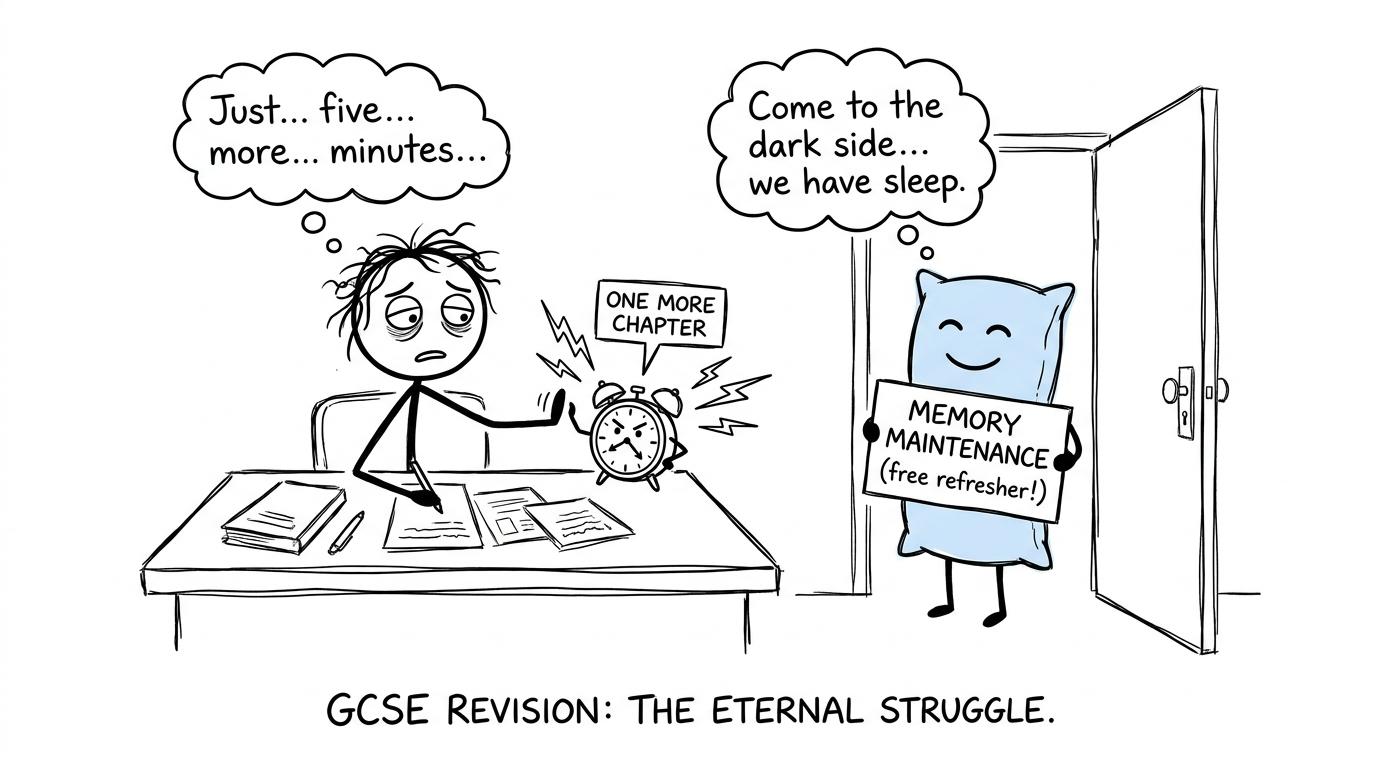 A tired student negotiates with an alarm clock while a pillow offers memory maintenance
What sleep actually does for memory
Revision has at least two parts. First, information has to be learned. Later, it must remain accessible when you need it. Sleep supports this process of memory consolidation, during which recently learned material becomes more stable.
For English Literature, that material might include:
- short, versatile quotations;
- themes and character development;
- relationships between poems;
- relevant context;
- essay structures and analytical methods.
For English Language, there is less value in memorising large amounts of content. However, sleep can still support your recall of question routines, terminology, writing structures and the sequence you use to analyse a text.
This does not mean that reading a quotation once before bed guarantees recall. Sleep strengthens learning; it does not create learning that never happened. Active retrieval earlier in the evening, closing the book and recalling ideas without prompts, is more useful than repeatedly rereading pages.
A calm final review can therefore help, but it should have a stopping point. Once fatigue has made revision passive and error-prone, the extra time may be less valuable than the sleep being sacrificed.
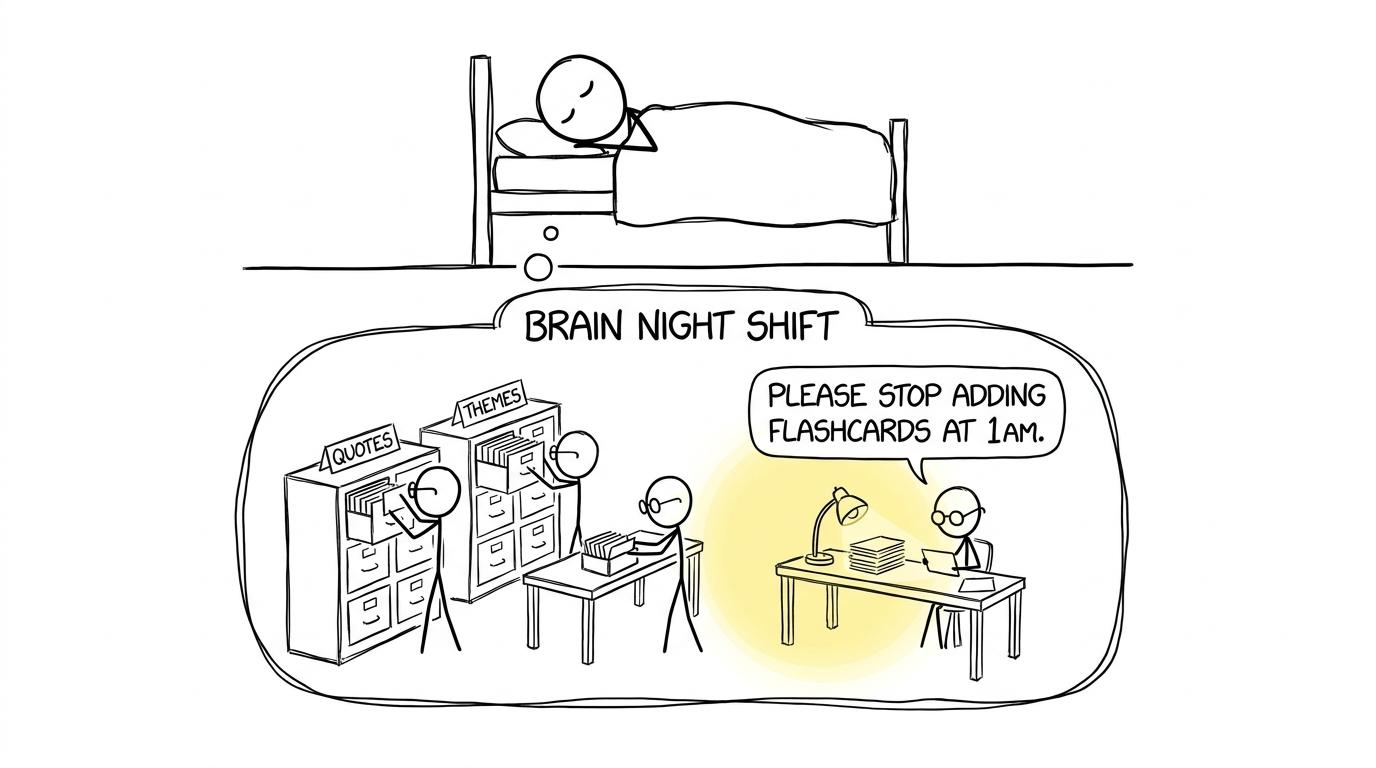 Tiny librarians organise quotes and themes during the brain's night shift
Why sleep matters for focus in an English exam
English examinations require more than remembering facts. You must read unfamiliar material, interpret wording, select evidence, organise an argument and monitor your time. These tasks rely on attention and cognitive flexibility.
Controlled sleep research involving adolescents and young adults has found that restricted sleep can weaken vigilant attention, top-down attentional control and cognitive flexibility. Those effects matter when a paper asks you to move between close analysis, comparison and extended writing.
Reading accurately
A tired reader may reach the bottom of a paragraph without processing it properly. In English Language, that can mean missing a change in tone or answering a slightly different question from the one printed. In Literature, it may lead to a narrow reading of an extract or weak links to the wider text.
Holding an argument together
An essay is a chain of decisions. Each paragraph must answer the question, use evidence and develop an interpretation. When concentration slips, students are more likely to repeat an idea, lose their line of argument or forget to connect analysis to the question.
Managing a long paper
Paper structures differ between AQA, Edexcel, OCR and Eduqas, so check your own specification and timetable. Some Literature papers last more than 222 hours. Sustaining careful thought and legible writing for that length of time is physically and mentally demanding.
Sleep cannot guarantee a particular grade. It can, however, put you in a better position to demonstrate what you know.
A sensible night-before revision plan
The evening before an exam should narrow your attention rather than expand it. It is too late to relearn every text, and trying to do so often creates panic without producing durable knowledge.
Finish demanding work early
If you need a final revision session, use it to retrieve high-value material:
- recall a small selection of adaptable quotations;
- check the structure and timing of your paper;
- outline themes or comparison links from memory;
- review teacher feedback on recurring weaknesses;
- plan briefly how you will respond if you feel stuck.
Avoid completing an entire paper late at night. A short plan or carefully selected question is less likely to leave you mentally activated at bedtime.
Maths students can use the same principle throughout the exam season. The MathsGenie GCSE Maths revision hub brings lessons, questions and papers together, making it easier to choose one focused task rather than opening five unrelated resources. The GCSE maths night-before plan applies the same idea to foundation and higher tier preparation: make a few useful corrections, prepare your equipment and stop at a planned time.
Create a proper stopping routine
A revision deadline removes the nightly argument about whether to continue. After stopping:
- pack the permitted equipment you need;
- confirm the exam time and room arrangements provided by your school;
- set an alarm, with a backup if that reassures you;
- reduce stimulating screen use;
- choose a quiet activity that helps you wind down;
- keep the room comfortable, dark and quiet where possible.
Caffeine can remain active for hours, and sensitivity varies between people. Avoid relying on late coffee or energy drinks to extend revision. They may make it harder to settle when you finally decide to sleep.
Use active revision before the final evening
The real solution to night-before panic begins earlier. Practise retrieving knowledge, apply it under timed conditions, check the result and revisit weaknesses. That cycle is useful across English and maths.
For maths, MathsGenie's guide to finding weak topics explains how to turn lost marks into focused revision. You can then use Edexcel GCSE Maths past papers with mark schemes and available solutions, rather than saving every paper for the last few days. If a full paper feels too large, the GCSE Maths 454545-minute tests offer shorter timed practice.
What if you cannot fall asleep?
Trying to force sleep can make the problem feel larger. If you are awake, remind yourself that quiet rest is still more useful than restarting intense revision or repeatedly checking the time.
Keep the situation ordinary. Put the phone aside, breathe slowly and return your attention to something neutral. Do not begin calculating how many hours remain every few minutes. One imperfect night does not erase months of learning.
If poor sleep is persistent, seriously affects daily life or is linked with significant anxiety, speak to a parent or carer and seek advice from a GP or another appropriate health professional. General revision advice is not a substitute for individual medical support.
How to recover after a short night
If the night has already gone badly, focus on controllable decisions:
- get up with enough time to avoid rushing;
- eat and drink as you normally would before school;
- use daylight and gentle movement to become more alert;
- avoid frantic group revision outside the exam room;
- read every question carefully and underline its key instruction;
- pause briefly between sections to reset your attention.
Do not assume that feeling tired means you will fail. Anxiety often predicts disaster more confidently than evidence allows. Follow your exam routine and take the paper one task at a time.
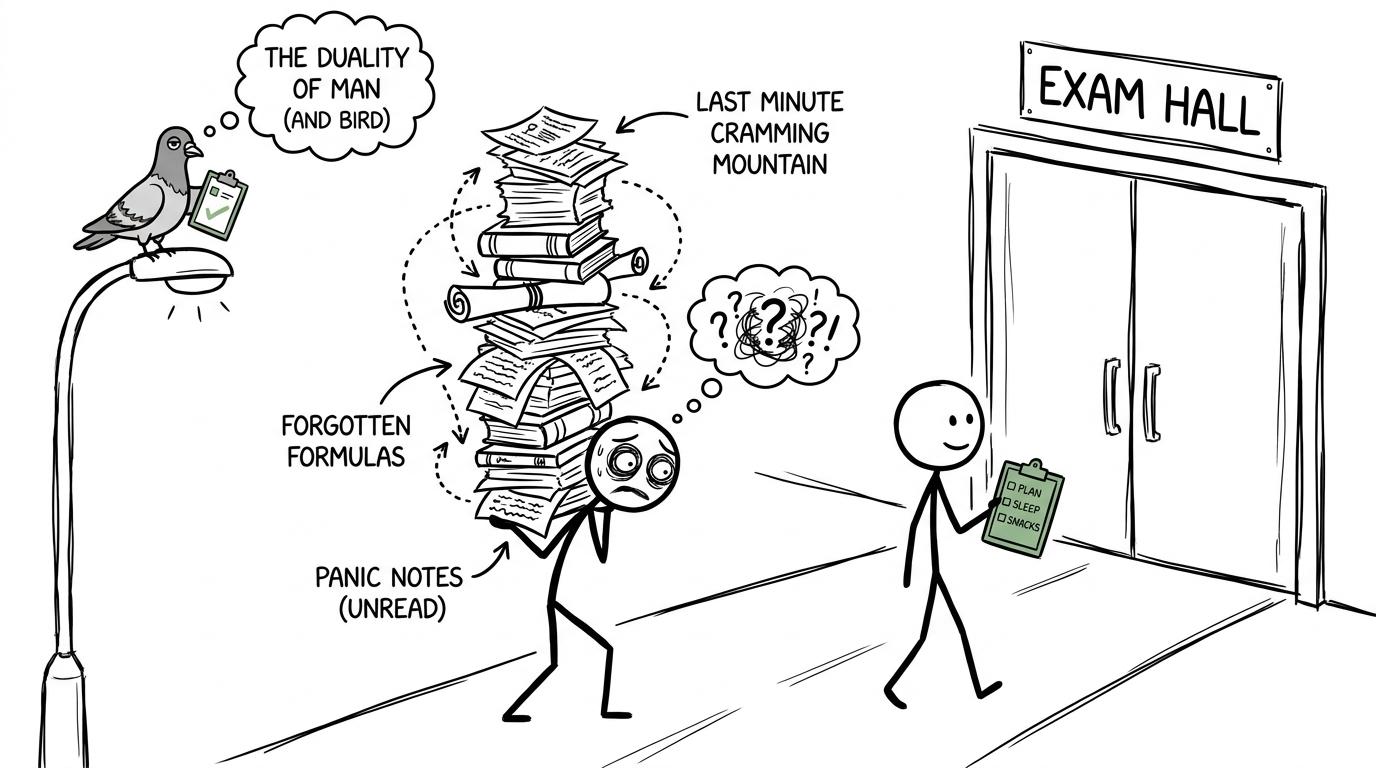 A rested student and an overloaded crammer approach an exam hall under a pigeon's judgement
Common mistakes to avoid
Treating sleep as lost revision time
Sleep is part of the learning process, not empty time stolen from it. The final exhausted hour of rereading is unlikely to be your highest-quality work.
Changing your routine dramatically
Going to bed several hours earlier than usual may simply leave you awake and frustrated. Shift towards a healthier schedule gradually in the days before the exam.
Memorising new material at the last moment
A late attempt to learn dozens of quotations can interfere with the reliable material you already know. Prioritise a smaller bank of flexible evidence and clear analytical thinking.
Using your phone as a calming tool
A quick check can become a long period of messages, videos and timetable discussions. Keep the device away from the bed if possible and use a separate alarm if you have one.
Protecting sleep only before English
GCSE exam season is a series, not a single event. Maths, science and English papers often sit close together. Use the GCSE one-week maths revision plan to distribute practice instead of creating late-night emergencies. The guide on when to start GCSE past papers can also help you build timed work into a longer schedule.
Make sleep part of your revision strategy
The night before an exam often feels important because it is the last chance to do something. But the wisest final action may be to stop.
Aim for the recommended 888 to 101010 hours, protect a calm wind-down period and trust the work completed beforehand. For English Language and Literature, sleep supports your ability to retrieve ideas, notice details and sustain an argument. Those are not side benefits. They are central exam skills.
For the rest of your GCSE timetable, let MathsGenie reduce the number of decisions you have to make. Start with free revision lessons and practice questions, check your work using mark schemes and video solutions, then build stamina with mini tests, past papers and predicted papers. Revise earlier, correct mistakes properly and give sleep the time it deserves.