

Sleep Before GCSE Astronomy Exam: How Much?
Sleep before GCSE Astronomy exam night: learn why most teenagers need 8-10 hours, how sleep supports memory and focus, and when to stop revising calmly.
The night before an astronomy exam, another hour of revision can feel more valuable than another hour in bed. There is always one more definition to check, one more calculation to practise, one more page that suddenly looks unfamiliar.
But the practical answer is clear: most teenagers should aim for 888 to 101010 hours of sleep before a GCSE Astronomy exam. That is the recommended range for young people aged 131313 to 181818, although individual needs vary. Sleep supports memory consolidation, attention and decision-making: precisely the abilities you need when interpreting data, rearranging an equation or checking units under exam pressure.
One short night does not automatically ruin an exam. Still, deliberately trading several hours of sleep for late-night cramming is usually a poor bargain.
Your night-before checklist
Keep the final evening smaller than your anxiety wants it to be:
- Decide your wake-up time and work backwards to allow 888 to 101010 hours of sleep.
- Add time for getting ready for bed and falling asleep.
- Finish demanding revision at least 303030 to 606060 minutes before bed.
- Review only a few high-priority facts, equations or previous errors.
- Pack your calculator, pens, ruler and any permitted equipment.
- Check the examination time and travel arrangements.
- Put your phone somewhere it cannot interrupt your sleep.
- If you cannot sleep immediately, do not treat that as a disaster.
Maths students can adapt the structured GCSE maths night-before plan, which replaces an uncontrolled late session with short practice, careful marking and a firm stopping time.
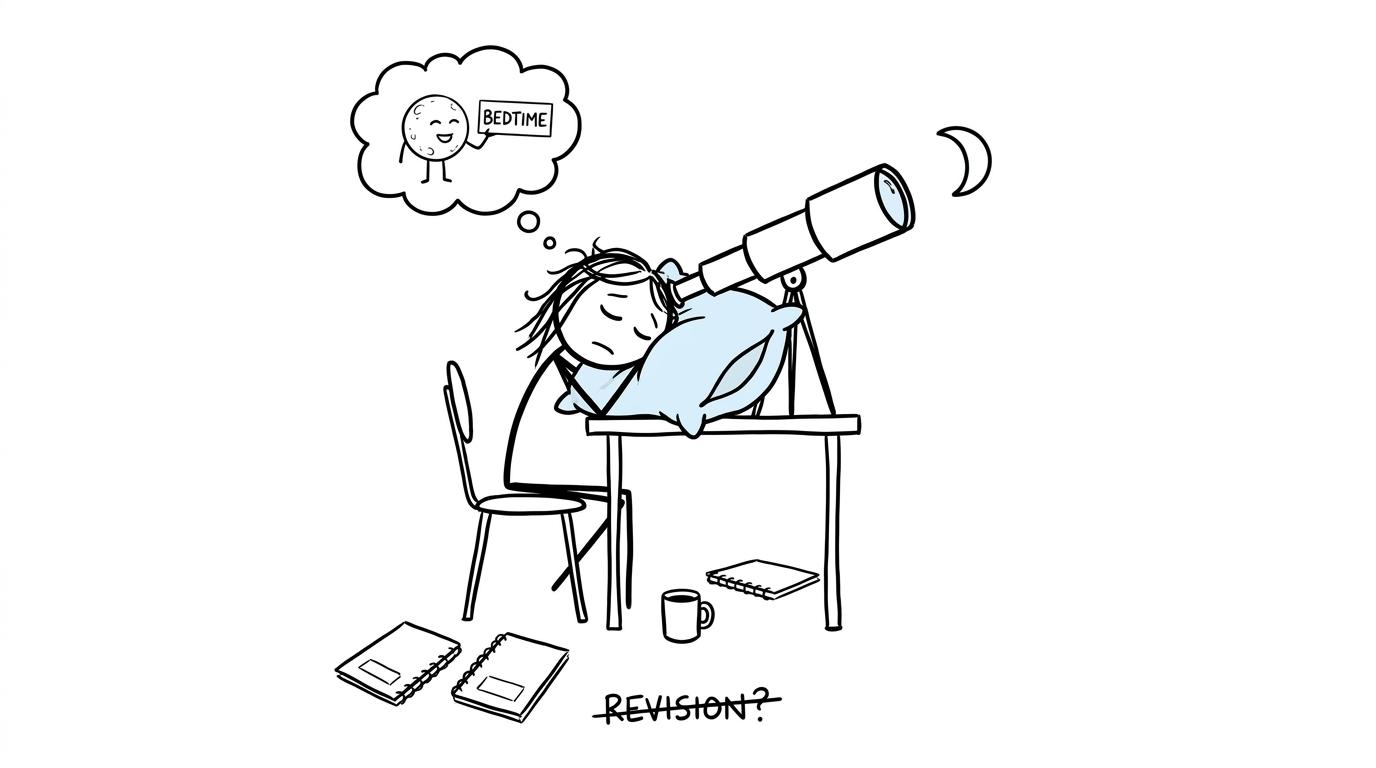 A tired student discovers that a telescope makes a convincing pillow
How much sleep do GCSE students actually need?
Current sleep-health guidance recommends that teenagers aged 131313 to 181818 regularly get around 888 to 101010 hours each night. This is a range, not a magic number. Some students feel properly restored after roughly 888 hours; others function better nearer 999 or 101010.
The word regularly matters. Sleep is not a resource that can always be repaired with one enormous lie-in. A stable routine across the revision period is more useful than sleeping very little for several nights and hoping to recover immediately before the exam.
To choose a bedtime, start with the time you must wake up:
bedtime=wake-up time−sleep target−settling time\text{bedtime}=\text{wake-up time}-\text{sleep target}-\text{settling time}bedtime=wake-up time−sleep target−settling timeSettling time is the period between getting into bed and actually falling asleep. Planning for it is more realistic than assuming sleep begins the moment your head reaches the pillow.
If you are already sleeping less than the recommended range, do not suddenly create a rigid target that makes bedtime stressful. Move towards an earlier, steadier routine over several evenings. The MathsGenie revision planner can help you distribute revision instead of pushing unfinished work into the final night.
What sleep does for memory
Revision has at least two parts. First, information must be encoded while you are learning it. Later, it must become stable enough to retrieve when a question asks for it in an unfamiliar way.
Sleep supports this second process, known as memory consolidation. Research reviews indicate that sleep plays an active role in strengthening and reorganising recently formed memories. Slow-wave sleep and sleep-related brain activity are associated with consolidation, while sleep also prepares the brain to encode new information the following day.
That matters in GCSE Astronomy because the course combines several kinds of knowledge:
- factual knowledge about astronomical objects and processes;
- relationships between quantities;
- observational methods and limitations;
- interpretation of diagrams, graphs and data;
- extended explanations using precise scientific language;
- calculations involving units, formulae and standard form.
Sleep cannot insert knowledge that was never revised. It can, however, support the memories created by effective revision. Staying awake to reread everything may produce a comforting feeling of familiarity, but familiarity is not the same as being able to retrieve and apply information independently.
A better final session uses active recall. Close the notes, write what you remember, check it, and correct only the gaps. Students strengthening the numerical side of astronomy can use MathsGenie’s standard form revision resources to practise handling values written as a×10na\times10^na×10n, where 1≤a<101\leq a<101≤a<10.
What sleep does for focus and exam judgement
An astronomy paper does not merely ask whether you have seen a fact before. You must work out what each question is asking, select relevant information and keep several steps in mind.
These tasks draw on attention, working memory and executive control. Insufficient sleep is particularly associated with reduced vigilance. In an exam, that can appear in ordinary but expensive ways:
- overlooking a command word;
- copying a value incorrectly;
- missing a negative sign or power of 101010;
- mixing units;
- forgetting to return to a skipped question;
- answering the topic you revised rather than the question printed.
Astronomy calculations often depend on the same habits developed in GCSE maths: identify the relationship, substitute carefully, preserve accuracy and check whether the result is sensible. MathsGenie’s speed and density revision guide is useful for practising compound measures and unit awareness, while trigonometry revision reinforces disciplined calculator work.
Being rested does not guarantee a perfect answer. It simply gives your preparation a better chance to appear on the page.
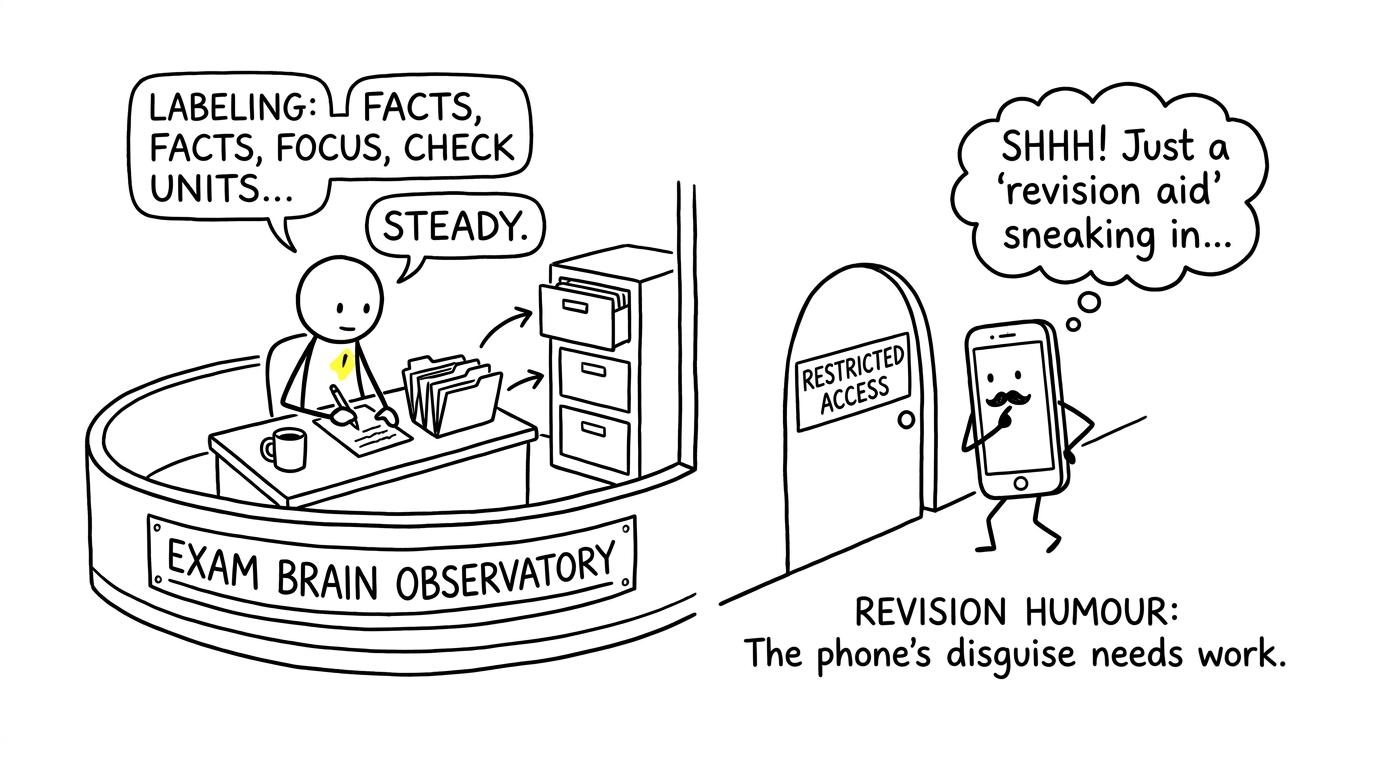 An alert observatory operator protects facts and focus from a disguised phone
A sensible revision cut-off before bed
There is no universal minute at which every student must stop. A useful target is to end demanding work around 303030 to 606060 minutes before bed and use the remaining time to wind down.
The final revision block should be selective:
Check the specification, not everything you own
GCSE Astronomy is currently offered by Pearson Edexcel. Unlike GCSE Maths, it is not split into foundation and higher tiers. Use your teacher’s guidance and the current specification rather than mixing resources from unrelated courses.
Repair a small number of gaps
Choose perhaps three issues from marked work: a confused definition, an unreliable calculation process and one recurring exam-technique error. Avoid opening an entirely new unit unless your teacher has specifically advised it.
For the mathematical skills that support astronomy, the GCSE maths revision hub provides board-specific lessons, question banks, worksheets and videos for Edexcel, AQA, OCR and Eduqas.
Stop while your thinking is still clear
A stopping time protects the next day. Once attention has faded, another page of notes can consume time without producing much retrievable learning. Pack your equipment, write down any remaining worry so that you do not have to hold it in mind, then move into a familiar bedtime routine.
If anxiety stops you sleeping
Trying to force sleep often creates a second problem: you become anxious about being awake. Remember that resting quietly is still better than returning to frantic revision, and one imperfect night does not erase months of preparation.
Keep the room dark, quiet and comfortably cool where possible. Avoid repeatedly checking the clock. Put stimulating messages, videos and revision discussions aside. If worries are circling, write a brief list for the morning: equipment, journey, breakfast and the first action when the paper begins.
Do not experiment with sleeping tablets, supplements or unfamiliar remedies on exam night. If sleep difficulties are persistent, regularly affect daily life or cause significant distress, speak to a parent or carer and seek appropriate advice from a GP or qualified health professional.
The morning of the astronomy exam
The morning is for activation, not rescue. Get up with enough time to eat, drink and travel without rushing. A short check of familiar prompts may help, but avoid trying to absorb an entire topic on the journey.
Use your rested attention deliberately in the paper:
- Read each command word carefully.
- Underline relevant data and units.
- Write down the appropriate equation before substituting.
- Keep calculator values unrounded until the final stage unless instructed otherwise.
- Show working so that available method marks can be awarded.
- Check whether the scale and units make physical sense.
- Move on when stuck and return later.
These habits can be trained through timed practice. Maths students can use Edexcel GCSE Maths past papers with mark schemes and solutions, or follow the phased guidance on when to start GCSE past papers. The subject may differ, but the habits of timing, careful reading and learning from errors transfer well.
Common mistakes the night before
Treating sleep as unused revision time
Sleep is not empty time. It supports memory, attention and emotional regulation. The relevant choice is not simply between sleep and learning; it is between a rested brain using what it knows and a tired brain trying to hold more.
Completing a full paper late at night
A full paper can expose ten new worries when there is no sensible time to repair them. Near bedtime, a short set of targeted questions is usually more useful. Full papers belong earlier in the revision plan, followed by proper marking and correction.
Passively rereading notes
Rereading feels smooth because the information is visible. Retrieval practice is harder but more revealing. Test yourself first, then use notes to correct specific gaps.
Using predicted content as a guarantee
Predicted papers are practice resources, not promises about what will appear. Revise the full specification and use predictions to encounter fresh questions. Maths students can read how to use predicted topics without guessing.
Panicking after one poor night
A difficult night is not proof that the exam will go badly. Get up at the planned time, follow your normal morning routine and focus on the next controllable action rather than calculating how many minutes you lost.
Protect the work you have already done
The night before an exam creates a strange illusion: because time is nearly gone, every remaining minute feels unusually precious. Yet the purpose of revision is not to remain awake for as long as possible. It is to produce knowledge you can retrieve accurately when marks are available.
Aim for 888 to 101010 hours of sleep, choose a realistic revision cut-off and trust the work completed over previous weeks. Then let MathsGenie make future preparation easier: use free revision lessons to understand methods, practice questions and mini tests to build recall, mark schemes and video solutions to correct errors, and past papers or predicted papers to develop exam confidence.
Start with the MathsGenie GCSE revision hub, plan the work early and give sleep its proper place in revision, not as not as time lost, but as part of being ready.










