Sleep Before GCSE Arabic Exam: How Much?
Sleep before GCSE Arabic exam: learn how 8-10 hours supports memory, listening and focus, plus a calm night-before plan for GCSE students.
The night before an exam creates a convincing illusion: every extra minute awake feels like one more fact secured. Yet the bargain is often poor. You gain another page of revision, then arrive with less attention to use it.
For most teenagers, the practical answer on sleep before GCSE Arabic exam day is about 888 to 101010 hours. That is the widely accepted healthy range for teenagers, and NHS exam-stress guidance specifically warns that an all-night revision session is usually less helpful than sleep. Your individual need may vary, but deliberately cutting the night short is not a sensible exam strategy.
Sleep cannot replace revision. It helps your brain preserve, retrieve and use the revision you have already done, from Arabic vocabulary and grammar to the methods required in your next GCSE maths paper.
Your quick exam-night checklist
- Work backwards from the time you must wake up and allow roughly 888 to 101010 hours for sleep.
- Finish demanding revision around an hour before bed.
- Use the final session for brief retrieval, not new content.
- Pack your equipment, confirm the exam time and set your alarm.
- Keep your phone away from the bed if possible.
- Avoid caffeine late in the day.
- If one night goes badly, do not assume the exam is ruined.
The final point matters. Sleep is important, but anxiety about achieving a supposedly perfect night can itself make sleep harder. Aim for a good opportunity to sleep, not a flawless performance.
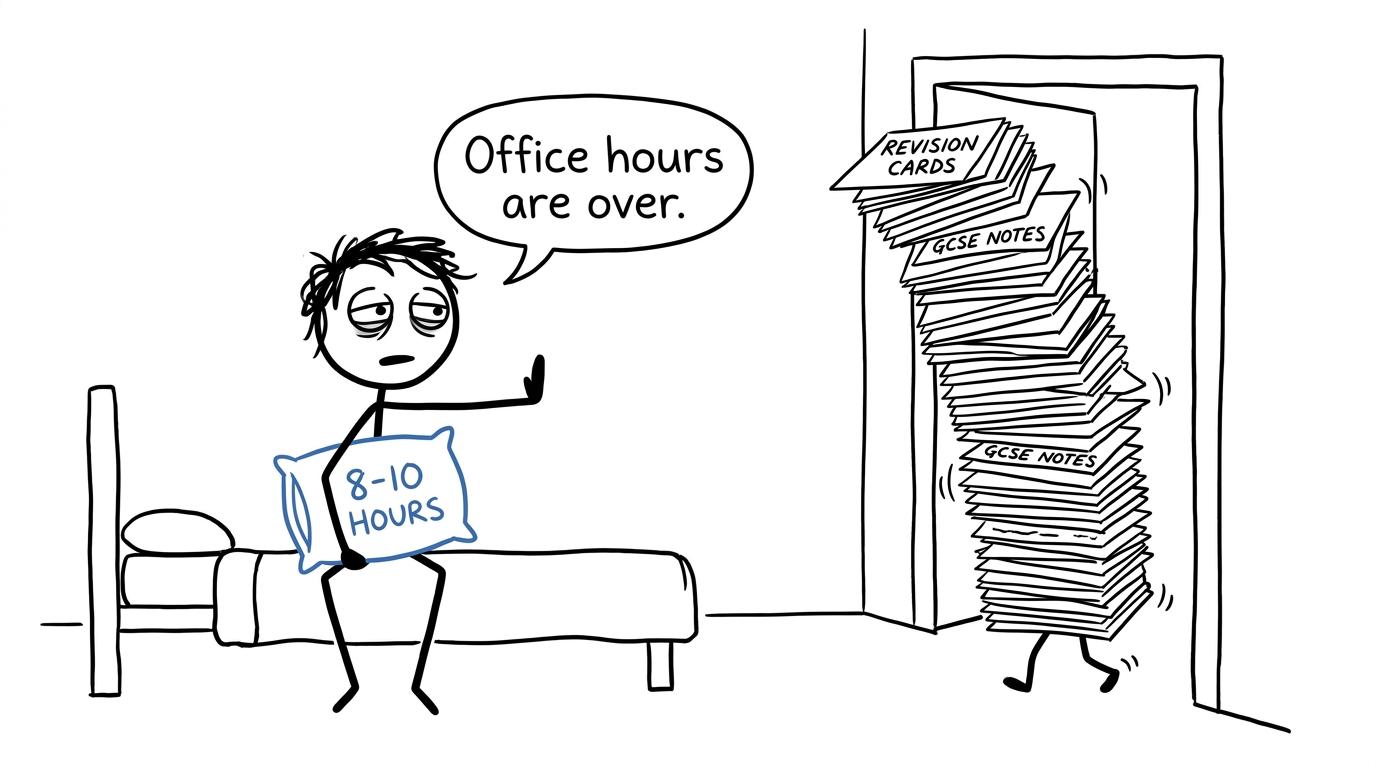 A student protects bedtime from a stack of revision cards
How much sleep do you need before a GCSE Arabic exam?
Teenagers generally need between 888 and 101010 hours each night. Rather than choosing the lowest figure as a target, think about how much sleep normally leaves you alert on a school morning.
Your planned bedtime can be expressed simply as:
bedtime=wake-up time−sleep opportunity−time to settle\text{bedtime}=\text{wake-up time}-\text{sleep opportunity}-\text{time to settle}bedtime=wake-up time−sleep opportunity−time to settleThe phrase sleep opportunity is important. Being in bed for eight hours does not necessarily mean sleeping for eight hours. Leave time to settle, particularly if exam nerves usually keep you awake.
Do not suddenly force an unusually early bedtime if you are not sleepy. A calm, consistent routine over several nights is generally more useful than trying to repair an entire revision season in one evening. If possible, protect your sleep throughout exam week rather than treating the Arabic exam as an isolated event.
That is especially relevant for students sitting several subjects close together. A late Arabic revision session may not only affect Arabic the following morning; it can also disrupt recovery before maths, science or another language paper. MathsGenie's GCSE one-month revision plan can help distribute maths practice earlier, leaving less pressure to choose between revision and sleep during the final week.
What sleep actually does for memory
Revision begins the memory process. Sleep helps continue it.
Sleep supports memory consolidation
When you retrieve an Arabic verb, recognise vocabulary in a listening task or recall how a grammatical structure works, you are drawing on memories formed during earlier practice. During sleep, the brain supports consolidation, the process through which recently learned information becomes more stable and connected to existing knowledge.
Research reviews generally find that sleep benefits declarative memory, which includes facts, words and meanings. That makes sleep directly relevant to language revision. Vocabulary encountered during the day does not become permanent simply because you highlighted it. It needs successful encoding, retrieval practice and time to consolidate.
The same principle applies to maths. Sleep does not solve an equation for you, but it supports your ability to remember the method, hold information in working memory and choose a sensible next step. MathsGenie's guide to stopping GCSE maths content from being forgotten explains how retrieval and spaced practice can be organised before the final night.
Sleep prepares you to learn and retrieve
Sleep is not only about storing yesterday's learning. Adequate sleep also supports attention, working memory and decision-making the next day.
Those functions matter across an Arabic assessment:
- Listening: maintaining attention as the recording continues and identifying key details.
- Reading: holding the meaning of one sentence while interpreting the next.
- Writing: selecting vocabulary, controlling grammar and checking accuracy.
- Speaking: responding, adapting language and recovering when a word does not arrive immediately.
Exact assessment arrangements depend on your exam board and specification, so check the information supplied by your school. In the established GCSE modern foreign language framework, listening, speaking, reading and writing are distinct skills. Each asks for sustained attention rather than simple recognition.
Sleep helps focus feel less fragile
Tiredness does not always feel dramatic. Sometimes it appears as rereading the same line, overlooking a negative word or losing the thread of a question. In maths, it can look like copying a value incorrectly or forgetting to return to a skipped part. In Arabic, it may mean missing a familiar word because attention wandered at the wrong moment.
That is why an extra late-night hour can be deceptive. You measure the visible input, another vocabulary list completed, but not the invisible cost to attention the next morning.
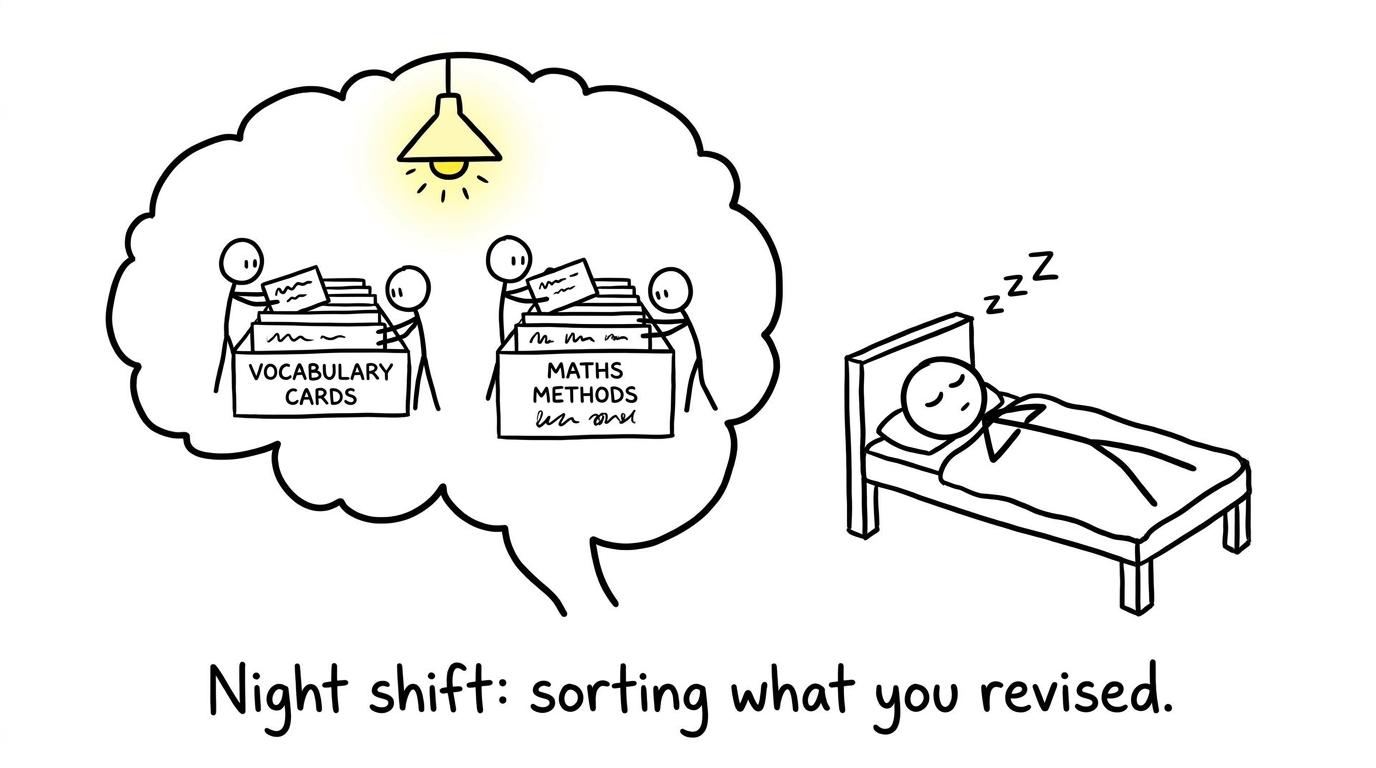 Tiny night-shift clerks file revised knowledge inside a sleeping brain
The best revision to do before bed
The final evening should reduce uncertainty, not attempt to cover the whole specification.
Choose retrieval over rereading
Briefly test yourself on familiar material. That might mean recalling a small set of Arabic vocabulary, reviewing a few high-value structures or mentally planning how you would approach common task types. Check your answers, correct the gaps and stop.
Do not begin a large new topic. New material can expose more gaps than you have time to close, creating anxiety without building dependable knowledge.
Maths students can follow the same rule. If another maths paper is approaching, use a small set of questions rather than a full paper. The MathsGenie GCSE maths revision hub contains topic lessons, practice questions, flashcards, mini tests and paper resources for Edexcel, AQA, OCR and other boards.
Set a firm stopping point
A stopping time turns sleep from an optional reward into part of the plan. Once you reach it:
- close your revision materials;
- pack pens and permitted equipment;
- check travel and exam arrangements;
- set an alarm;
- write down any worry that keeps circling;
- begin a quiet, familiar wind-down routine.
If maths revision is competing for the same evening, use a short, defined task from the GCSE night-before maths plan. A mini test followed by careful marking is more controlled than opening an entire higher or foundation tier paper without a finish time.
Build a routine that makes sleep easier
Good sleep is easier to invite than command. You cannot force yourself unconscious, but you can remove several obstacles.
Keep the evening predictable
Try to keep bedtime and waking time reasonably consistent during the exam period. A regular sequence, finishing revision, preparing for morning, washing, reading and turning the light out, gives the evening a clear ending.
Natural light and activity during the day can support the body clock. Near bedtime, make the room quiet, dark and comfortable where circumstances allow.
Reduce screens and stimulation
Phones cause two separate problems. Light and stimulating content can delay winding down, while notifications can interrupt sleep after it begins. Put the phone on silent, use an ordinary alarm if available and leave the device out of reach.
Avoid late caffeine, including energy drinks, coffee, tea and some fizzy drinks. Caffeine can make it harder to settle and may reduce sleep quality even when you eventually fall asleep.
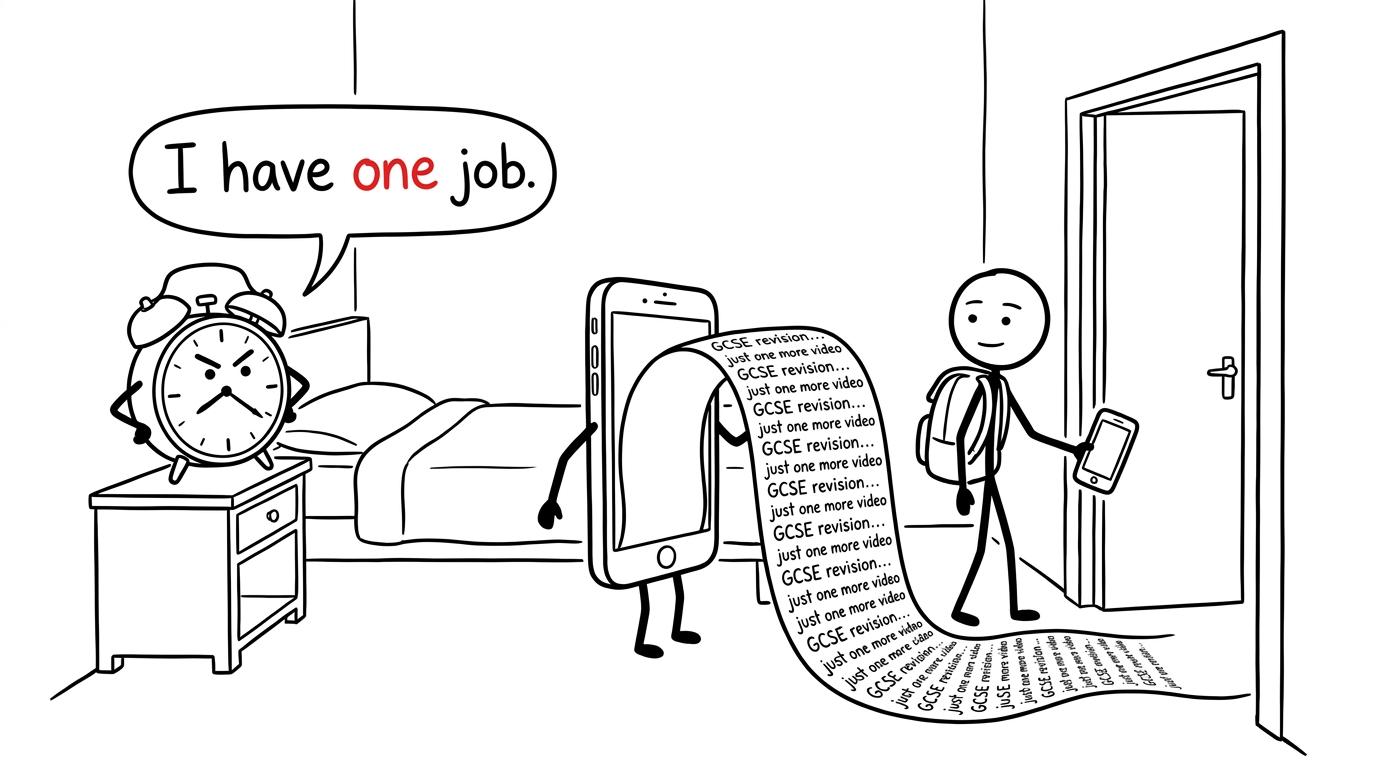 An alarm clock watches a student send the endless-scroll phone outside
If you cannot fall asleep
First, do not keep checking the clock. Clock-watching turns rest into a countdown.
If you remain awake and frustrated, get out of bed briefly if it is safe and practical. Sit somewhere dim and do something quiet, then return when you feel sleepier. Avoid restarting intensive revision or scrolling through social media.
One poor night does not erase months of learning. Follow your normal morning routine, eat if you usually do, arrive in good time and focus on the next manageable action. If sleep difficulties are frequent, severe or affecting daily life, speak to a parent, carer, school pastoral lead, GP or another appropriate health professional.
Common mistakes the night before the exam
Trading hours of sleep for low-quality cramming
The final hours of a long evening are often the least efficient. Attention drops, mistakes increase and familiar material begins to feel unfamiliar. Set a limit before tiredness makes the decision for you.
Trying to learn the entire vocabulary list
A huge list creates activity, not necessarily recall. Select a small number of weak but useful items, retrieve them without looking and correct them immediately.
Doing a full maths paper after Arabic revision
Students preparing for several GCSEs can accidentally create two night-before plans on one night. If maths also needs attention, choose targeted work from your board's resources. Edexcel students can use the Edexcel GCSE maths revision hub, while OCR students can use the OCR GCSE maths revision hub.
Full timed papers belong earlier in the schedule. For instance, the Edexcel GCSE maths past papers and AQA GCSE maths past papers are most valuable when you have enough time to mark them, diagnose errors and revisit weak topics.
Using predicted papers as predictions of certainty
Predicted papers are extra practice, not a promise about what will appear. Use them alongside official past papers, specification coverage and topic practice. They should reduce surprises, not encourage last-minute guessing.
Panicking after waking during the night
Waking briefly does not mean the whole night is lost. Avoid calculating every remaining minute. Return to a calm routine and remember that quiet rest is still preferable to reopening your notes in panic.
Protect tomorrow's attention
The night before a GCSE Arabic exam is not the moment to prove how long you can work. It is the moment to protect what you have already learned.
Aim for roughly 888 to 101010 hours of sleep, leave time to settle and keep the final revision session short and familiar. Sleep helps consolidate vocabulary and other learning, while supporting the attention and working memory needed for listening, reading, writing and speaking. The same rested brain will serve you in your next maths exam too.
Use MathsGenie to move the heavy work away from bedtime. Start with free revision lessons and practice questions, check your work using mark schemes and video solutions, then build exam confidence through mini tests, past papers and predicted papers. Plan earlier, practise deliberately and let the final night do its quieter job.