Should You Get a GCSE Arabic Tutor?
GCSE Arabic tutor guidance: decide if tuition would help, identify your weakest skill and choose safe, focused support that matches your exam board.
A disappointing mock result can make private tuition feel like the obvious next step. Yet a GCSE Arabic tutor is only worthwhile when you know what problem the tutor needs to solve. If you lack speaking feedback, struggle to write accurately or are preparing outside school, individual support may help considerably. If the real issue is irregular revision, however, another weekly lesson may simply add more work without changing the result.
The short answer is this: diagnose your weakest skill first, try targeted independent practice and then consider a tutor if you still need expert feedback, accountability or access to realistic conversation practice.
A quick decision checklist
A tutor may be useful if you:
- cannot get regular feedback from an Arabic teacher
- are learning independently or entering through a private examination centre
- speak Arabic confidently but struggle with formal written Arabic
- understand written Arabic but freeze during timed listening or speaking tasks
- repeatedly lose marks for grammar, spelling, register or incomplete answers
- need a structured plan because the specification feels difficult to navigate
- have practised consistently but cannot work out why your marks have stopped improving
You may not need one yet if you:
- have not checked your exact exam board and specification
- rarely complete independent practice between lessons
- have not attempted a timed paper or skill-based assessment
- mainly want reassurance rather than help with an identifiable weakness
- already receive useful, individual feedback from your school
The distinction matters. Tuition is most effective when it closes a visible gap, not when it becomes a substitute for revision.
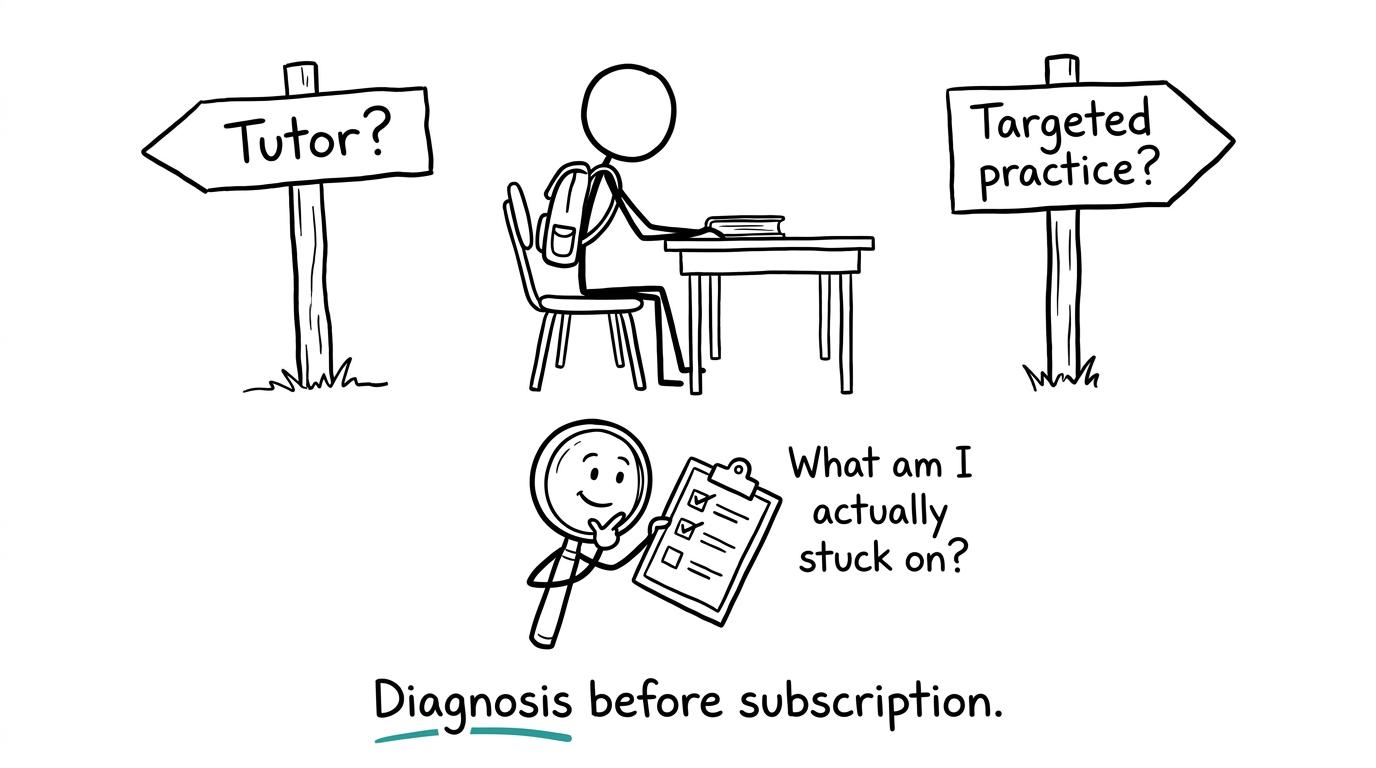 A student deciding between a tutor and targeted practice
Start by understanding your GCSE Arabic assessment
Before contacting tutors, confirm the qualification with your school or examination centre. Do not assume that every course called GCSE Arabic has the same papers. GCSE, International GCSE and first-language qualifications can have substantially different assessment arrangements.
For the current Pearson Edexcel GCSE Arabic specification, students are assessed in listening, speaking, reading and writing. Each skill contributes 25%25\%25% of the qualification. Foundation and Higher papers are available, but a student must enter the same tier across all four components. Dictionaries are not permitted in the assessments, including the preparation period for the speaking examination.
That structure changes the tutoring question. A fluent home speaker may still need help with formal writing, translation and examination rubrics. Another student may write accurately but lack the speed and spontaneity needed for speaking. Being comfortable in everyday conversation does not automatically mean being prepared for every assessment objective.
Ask your teacher or examination officer to confirm:
- the awarding body and specification code
- whether you are taking Foundation or Higher tier
- how and where the speaking assessment will be conducted
- the dates of internal mocks and formal assessments
- whether your school or centre provides past papers and mark schemes
A tutor should work from those details rather than teach a vague, general Arabic course.
How to tell whether tuition would actually help
Use evidence rather than anxiety
Complete one realistic assessment in each skill wherever suitable materials and supervision are available. Then classify what went wrong.
Was it a knowledge gap? Perhaps you did not know enough vocabulary or could not form a particular tense accurately. Was it an examination gap? You may have misunderstood the instruction, written too much for a short response or failed to answer every part of a prompt. Or was it a performance gap caused by timing, nerves or limited speaking practice?
This is the same principle used in effective maths revision. The MathsGenie guide to finding your weakest GCSE topics begins with evidence from questions, not a general feeling that everything is weak. The subject is different, but the decision-making habit transfers well.
Keep a short error log under four headings:
- Listening: missed vocabulary, speed, unfamiliar voices or misunderstood questions
- Speaking: hesitation, pronunciation, limited detail or inaccurate structures
- Reading: slow decoding, weak vocabulary, inference or translation
- Writing: spelling, grammar, organisation, register or failure to cover the prompt
After two or three pieces of assessed work, patterns should appear. Those patterns tell you whether a tutor has a useful job to do.
Ask whether the problem needs human feedback
Some gaps can be improved independently through vocabulary retrieval, repeated listening and timed reading. Others are harder to diagnose alone.
Human feedback is particularly valuable when you need someone to:
- conduct spontaneous speaking practice
- correct recurring grammatical or spelling errors
- explain why an answer did not meet a mark scheme
- distinguish everyday dialect from the formal language expected in assessment
- judge whether your writing has enough range, detail and accuracy
- adapt revision when progress stalls
If your main issue is simply not revising often enough, begin with a timetable. The principles in the GCSE maths revision timetable guide can be adapted across subjects: use short regular sessions, protect time for retrieval and make room for timed practice.
What to look for in a GCSE Arabic tutor
Knowledge of your exact specification
A strong Arabic speaker is not automatically an effective GCSE tutor. Look for somebody who understands your awarding body, tier, task types and mark schemes.
Ask direct questions before committing:
- Which GCSE Arabic specifications have you taught recently?
- Have you prepared students for my precise qualification and tier?
- How do you assess listening, speaking, reading and writing separately?
- How will you use mark schemes to identify lost marks?
- What will I need to complete between sessions?
- How will you report progress to me and my parent or carer?
A good answer should be specific. Be cautious if the tutor talks only about fluency, promises a particular grade or cannot explain how lessons connect to the assessment.
Ability to teach formal written Arabic
Some students looking for tuition already speak Arabic at home. Their challenge may be switching from a familiar spoken dialect to the formal written Arabic required by the examination.
The right tutor should respect the student’s existing language knowledge while identifying what must change for formal responses. They should be able to explain grammar clearly, correct writing precisely and help the student expand ideas without replacing the student’s own voice.
A diagnostic first lesson
A useful opening session should not be an hour of generic worksheets. The tutor should review existing work, ask about the specification, sample relevant skills and agree a small number of priorities.
A sensible early plan might focus on one major weakness and one supporting habit. Progress is easier to observe when the target is precise, such as reducing avoidable writing errors or sustaining unrehearsed conversation, rather than simply “improving Arabic”.
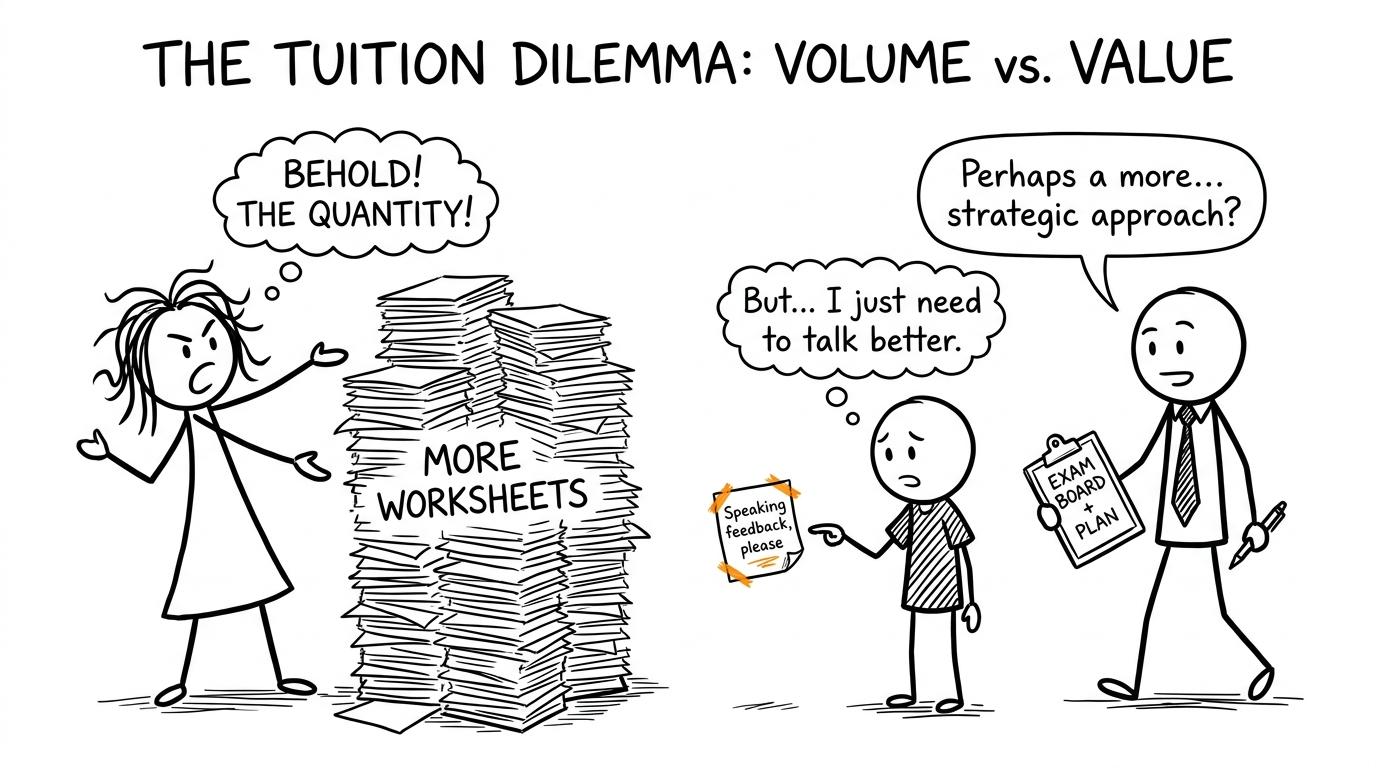 A generic worksheet pile meets a specific learning need
Clear safeguarding arrangements
A parent or carer should be involved in selecting and arranging tuition for a student under 181818. Check the tutor’s identity, relevant qualifications and recent references. Ask to see appropriate DBS evidence where available and understand what level and date of check it shows. A DBS certificate is useful evidence from a particular point in time, but it does not replace references, professional boundaries or parental oversight.
Lessons should take place in a suitable, observable environment. For online tuition, communication and bookings should remain visible to the parent or carer, with clear agreement about platforms, recordings, file storage and who may be present. If an agency is involved, ask about its safeguarding policy and how concerns are reported.
How to test whether the tutor is working
Do not judge tuition by how busy the lesson feels. Judge it by what you can do independently afterwards.
Agree a review point after several sessions and look for evidence:
- Is feedback specific rather than general?
- Are the same errors becoming less frequent?
- Can you complete previously difficult tasks with less prompting?
- Are timed responses becoming more accurate or fluent?
- Does the tutor set purposeful practice and revisit it?
- Can both student and tutor explain the current priority?
The cycle should be simple: diagnose, learn, practise, receive feedback and retest. MathsGenie uses the same logic in its guide to using GCSE past papers properly. A completed task is not the finish line. The review and correction are where much of the learning happens.
If no measurable change appears, discuss it. The tutor may need to alter the plan, or the match may not be right. Continuing indefinitely because lessons have become routine is an expensive form of optimism.
Balancing Arabic tuition with maths revision
GCSE students rarely have only one subject demanding attention. A tutor who creates several hours of extra work each week may unintentionally weaken preparation elsewhere.
Build a realistic schedule around school deadlines and examination dates. The MathsGenie one-month GCSE maths revision plan shows how focused practice, retrieval and timed papers can fit into manageable blocks. Use the same planning principle for Arabic: regular contact with the language is usually more sustainable than an occasional exhausting session.
Keep separate goals for each subject. For Arabic, that could mean vocabulary recall, one corrected writing task and a speaking session. For maths, use the GCSE maths revision hub to choose your exam board and tier, then move between revision lessons, practice questions and mini tests.
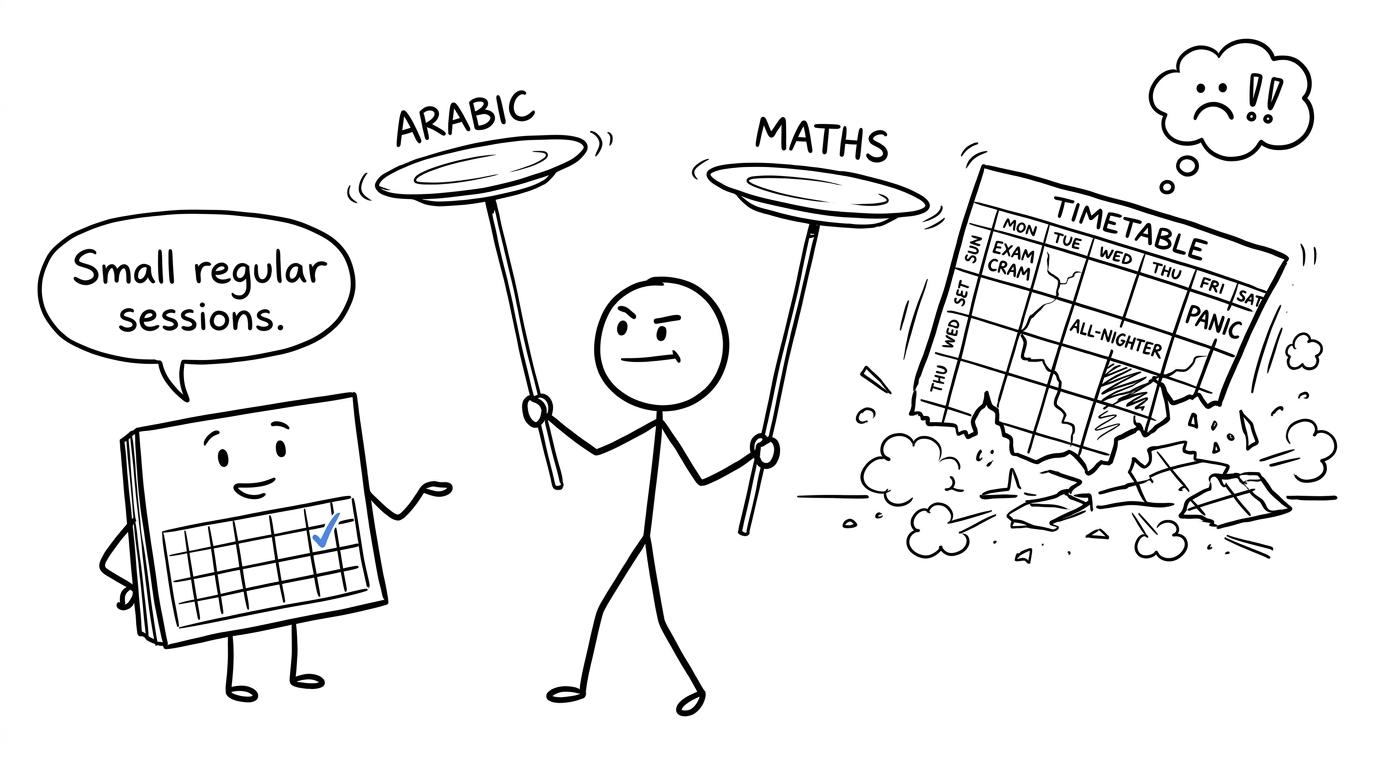 A student balancing Arabic and maths revision
Common mistakes when choosing Arabic tuition
Hiring before identifying the weakness
Without a diagnosis, lessons often become broad and repetitive. Bring marked work, mock results and your specification to the first meeting.
Choosing fluency over teaching ability
Fluent Arabic matters, but so do explanation, feedback and examination knowledge. Look for evidence that the tutor can teach your age group and course.
Ignoring the exact qualification
GCSE Arabic and International GCSE Arabic are not interchangeable labels. A tutor must know the papers you will actually sit.
Expecting the weekly lesson to do everything
One lesson cannot replace retrieval, reading, listening and independent writing. Tuition works best when it directs practice between sessions.
Measuring progress only through predicted grades
Grades can move slowly and depend on the assessment used. Track smaller indicators such as fewer repeated errors, stronger timing and more independent responses.
Neglecting maths and other subjects
Adding tuition without adjusting the wider timetable can create overload. Use MathsGenie’s GCSE topic and tier guide to keep maths priorities visible, and use the past-paper library when you are ready to test them under timed conditions.
Make the decision from evidence
A GCSE Arabic tutor can be a valuable investment when the student needs specialist feedback, structured speaking practice or guidance through a specific assessment. Tuition is less likely to help when the goal is unclear or independent practice never happens.
Start by confirming the qualification, testing all assessed skills and recording the exact reasons marks are lost. If a tutor is needed, choose somebody who understands the specification, teaches rather than merely speaks the language, sets measurable targets and works within clear safeguarding arrangements.
Then protect the rest of your revision. Use MathsGenie as your free maths base: learn through revision lessons, build confidence with practice questions and mini tests, and test yourself using past papers, predicted papers, mark schemes and video solutions. Good revision is not about collecting more help. It is about choosing the help that solves the right problem.