Should You Drop GCSE French Mid-Year?
Drop GCSE French or keep going? Learn how to judge your workload, what dropping affects, and what to ask your school before making a decision.

A bad French mock can make the whole subject feel impossible. Add unfinished maths revision, approaching exams and the suspicion that everyone else is coping better, and one thought becomes difficult to ignore: should you drop GCSE French?
The short answer is that you may be able to, but the decision belongs to your school and should be based on evidence rather than one disappointing result. Dropping French can create useful time and reduce pressure. It can also mean losing an assessed GCSE, the language element of the EBacc and, in many cases, the straightforward route into A Level French.
Before deciding, work out whether French is genuinely damaging your wider progress or simply exposing a problem that focused support could still solve.
The decision checklist
Before asking to leave the course, find clear answers to these questions:
- Is French compulsory under your school's curriculum or options policy?
- Are you struggling across listening, speaking, reading and writing, or mainly in one skill?
- What do your mocks, class assessments and completed homework actually show?
- Have you used the support already available from your teacher?
- Would changing tier make the course more manageable?
- What qualification, supervised revision or timetable arrangement would replace French?
- Could dropping it affect your sixth-form plans, total GCSE profile or EBacc entry?
- How would you use the released time to improve English, maths or science?
Do not assume that asking means the request will be approved. Mid-year changes are governed by individual school policies, timetable constraints, safeguarding considerations and exam-entry arrangements.
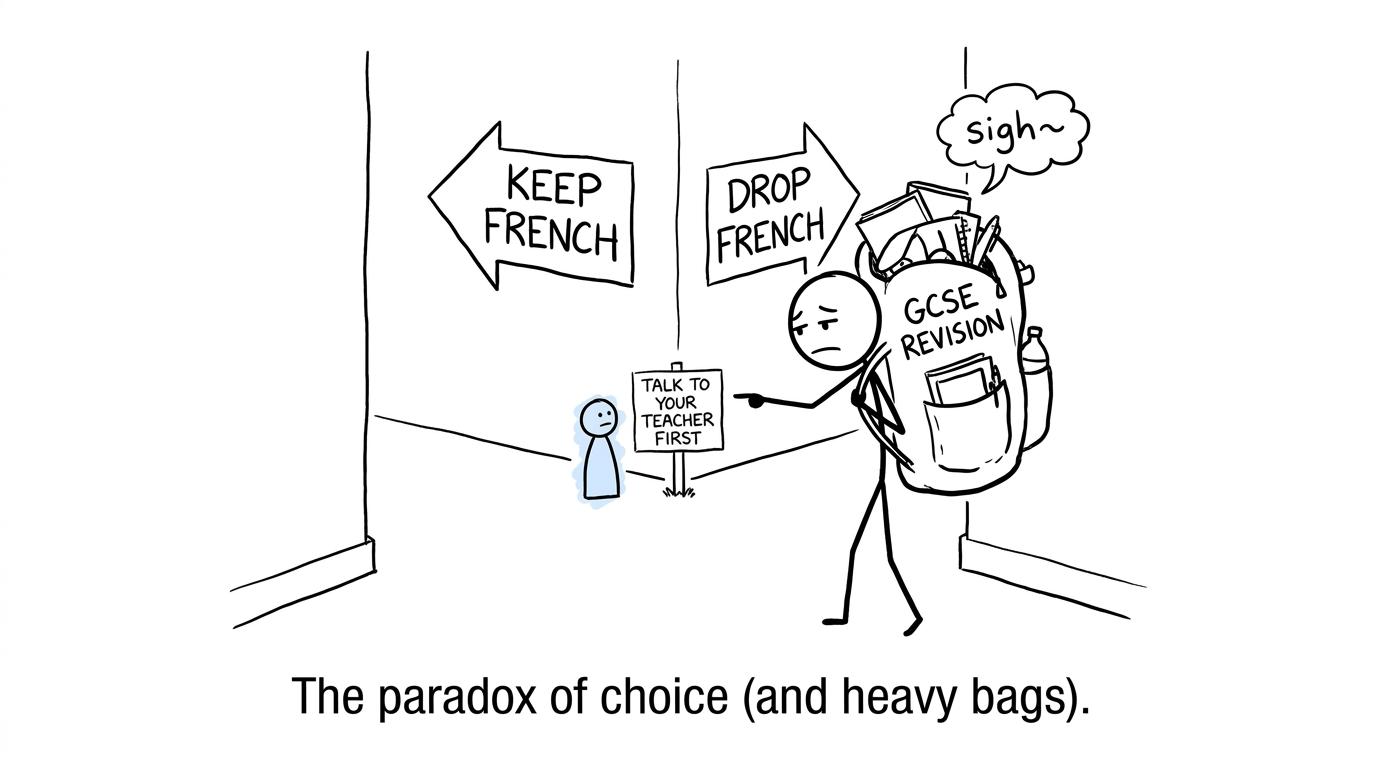 A student finds the sensible third path: talk to your teacher first
Can you drop GCSE French mid-year?
Possibly. There is no single national process through which a student independently cancels an option subject. Your school decides what curriculum you follow and whether discontinuing French is in your educational interests.
In England, schools must offer access to a modern foreign language at Key Stage 444, but this does not make GCSE French a universal statutory qualification for every pupil. Your own school may nevertheless require a language for some or all students, particularly where its curriculum is organised around the English Baccalaureate.
The EBacc is a school performance measure rather than a separate qualification. Its subject areas include English, maths, science, history or geography, and a modern or ancient language. If French is your only eligible language, dropping it normally means you will no longer complete the full EBacc combination. It does not remove the GCSEs you achieve in your other subjects.
Timing matters too. Leaving in Year 101010 may allow a school to reorganise your timetable, although joining another course late can involve too much missed content. In Year 111111, schools are often more cautious because much of the French course has already been taught and examination entries or speaking-assessment arrangements may be under way.
Start with your French teacher, form tutor or head of year. Involve a parent or carer, and ask for your school's written options or curriculum policy rather than relying on what happened to another student.
How to tell if you are actually in over your head
Feeling behind is not the same as being unable to recover. GCSE French deliberately tests several forms of communication. Current specifications assess listening, speaking, reading and writing, commonly at Foundation and Higher tier, although exact paper structures depend on the exam board and specification.
A student can therefore feel generally “bad at French” when the evidence shows something narrower: weak vocabulary recall, anxiety during speaking, difficulty recognising spoken words or inaccurate verb forms in writing. A specific weakness is usually more repairable than a broad label.
Look for a sustained pattern
One low mark is information, not a verdict. Look across several weeks of:
- class assessments and mocks;
- vocabulary tests;
- speaking tasks;
- homework completion;
- teacher feedback;
- attendance and missed lessons;
- time spent revising compared with progress made.
You may genuinely be overextended if you are working consistently, attending support and completing targeted practice but still cannot access substantial parts of the course. The case becomes stronger if French is also contributing to serious stress, persistent non-attendance or lost preparation for core subjects.
By contrast, the problem may still be recoverable if revision is irregular, homework is incomplete, feedback has not been acted upon or only one of the four skills is weak. In that situation, dropping the qualification could remove the symptom without addressing the revision habit behind it.
Ask whether tier is the real issue
French specifications from major boards such as AQA and Pearson Edexcel use Foundation and Higher tiers, with all assessed skills normally entered at the same tier. The available grade ranges and exact arrangements depend on the specification being taken.
If Higher-tier material is creating the sense that nothing makes sense, ask whether Foundation tier is appropriate. That is not a decision to make alone: your teacher must consider your current attainment, likely grade and the rules of your exam board.
Test a short rescue plan first
Unless wellbeing or another urgent concern makes delay unwise, agree a brief and measurable intervention with your teacher. It might include daily vocabulary retrieval, one supported speaking session each week and a timed reading or writing task followed by feedback.
Set a review date. Decide in advance what improvement would count as meaningful. A rescue plan turns “I hate this subject” into a question that evidence can answer.
What dropping French does affect
The most obvious consequence is that you may finish with one fewer GCSE than originally planned. Whether that matters depends on the entry criteria for the sixth forms, colleges, apprenticeships or courses you may consider. Institutions set their own requirements, so check the current published criteria directly and ask an admissions team if anything is unclear.
Dropping your only language also affects your EBacc combination. Remember, however, that the EBacc is not an extra certificate awarded to you. It is wrong to describe leaving French as “losing every part of the EBacc”; you still retain the individual qualifications you complete.
It is also likely to restrict progression into A Level French. Sixth forms commonly specify a minimum GCSE French grade for the course, though requirements vary. If languages might form part of your future plans, speak to the relevant sixth-form department before closing that route.
Finally, dropping can affect your timetable and school record. You might receive supervised revision, intervention lessons or another structured programme rather than unrestricted free periods. Ask exactly what will replace the lesson time.
What dropping French does not automatically affect
Leaving French does not change your maths tier, maths grade or the marks already earned in unrelated subjects. It does not automatically prevent you from applying to sixth form, college, university or an apprenticeship. What matters is whether you still meet the particular institution's overall and subject-specific requirements.
Nor does it guarantee better maths results. More available time only becomes valuable when it is deliberately reassigned.
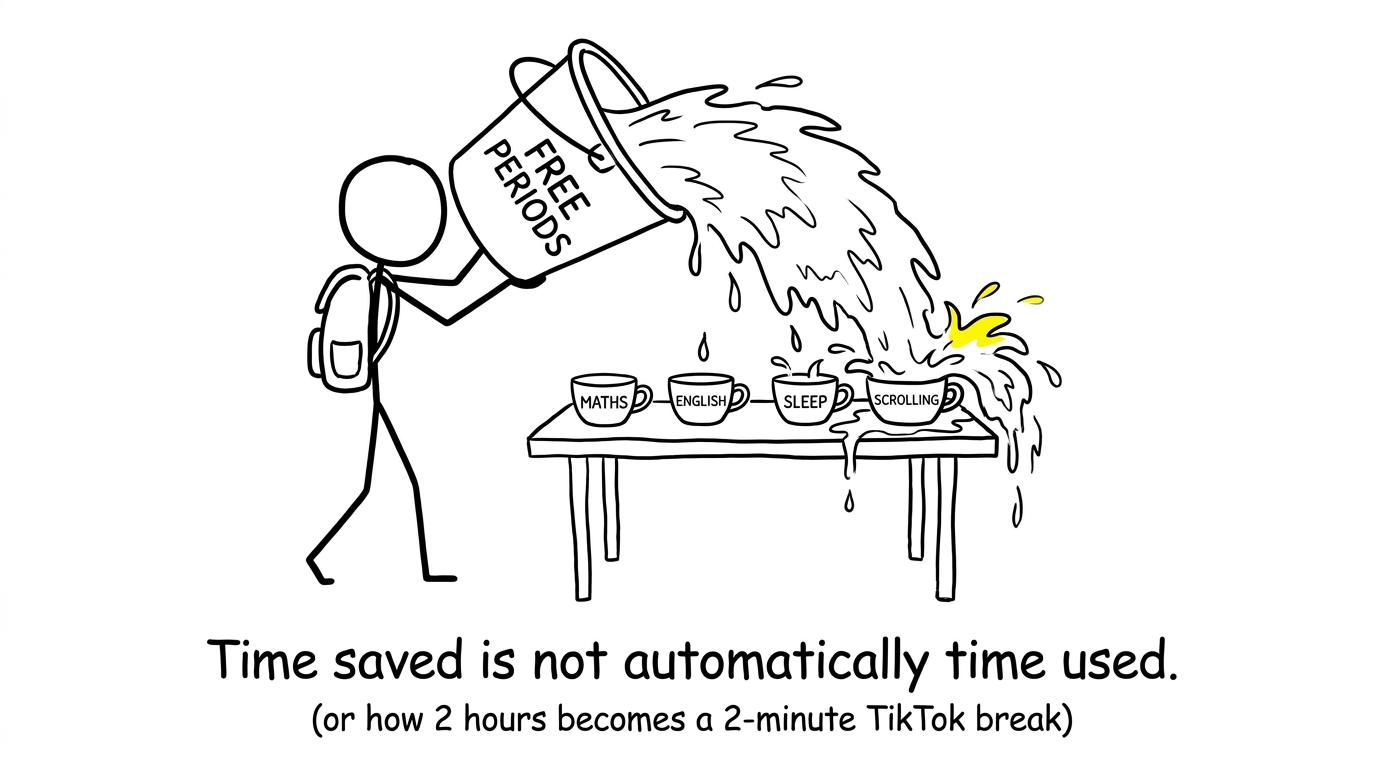 Revision time pours into several cups, with rather too much reaching scrolling
If French is removed so that you can strengthen maths, build a written plan. Start with the free GCSE Maths revision hub, select your exam board and confirm whether you are taking foundation or higher tier. Use the weak-topic diagnostic routine to identify where marks are actually disappearing.
Then divide the released sessions between revision lessons, practice questions and assessment. The one-month GCSE maths revision plan offers a useful structure, while the GCSE past-paper timing guide explains when shorter tests should become full timed papers.
Build an evidence-based case for your school
A calm meeting is more productive than an emotional ultimatum. Take a one-page summary covering:
- your recent French results and teacher feedback;
- the support you have tried;
- how the subject is affecting your wider workload or wellbeing;
- the options you have considered, including a tier change;
- your intended destination after GCSEs;
- a precise plan for any time released.
For maths, that plan could name the topics you will revisit, the days you will practise and the method used to check progress. MathsGenie's Edexcel GCSE Maths resources bring revision lessons, questions and papers together. Students on other boards can choose AQA, OCR or Eduqas from the main GCSE hub.
Use mini tests to diagnose gaps, mark them strictly, and follow difficult questions with video solutions where available. Later, use past papers for exam realism and predicted papers for additional practice near the examination. Predicted papers are practice tools, not promises about the questions that will appear.
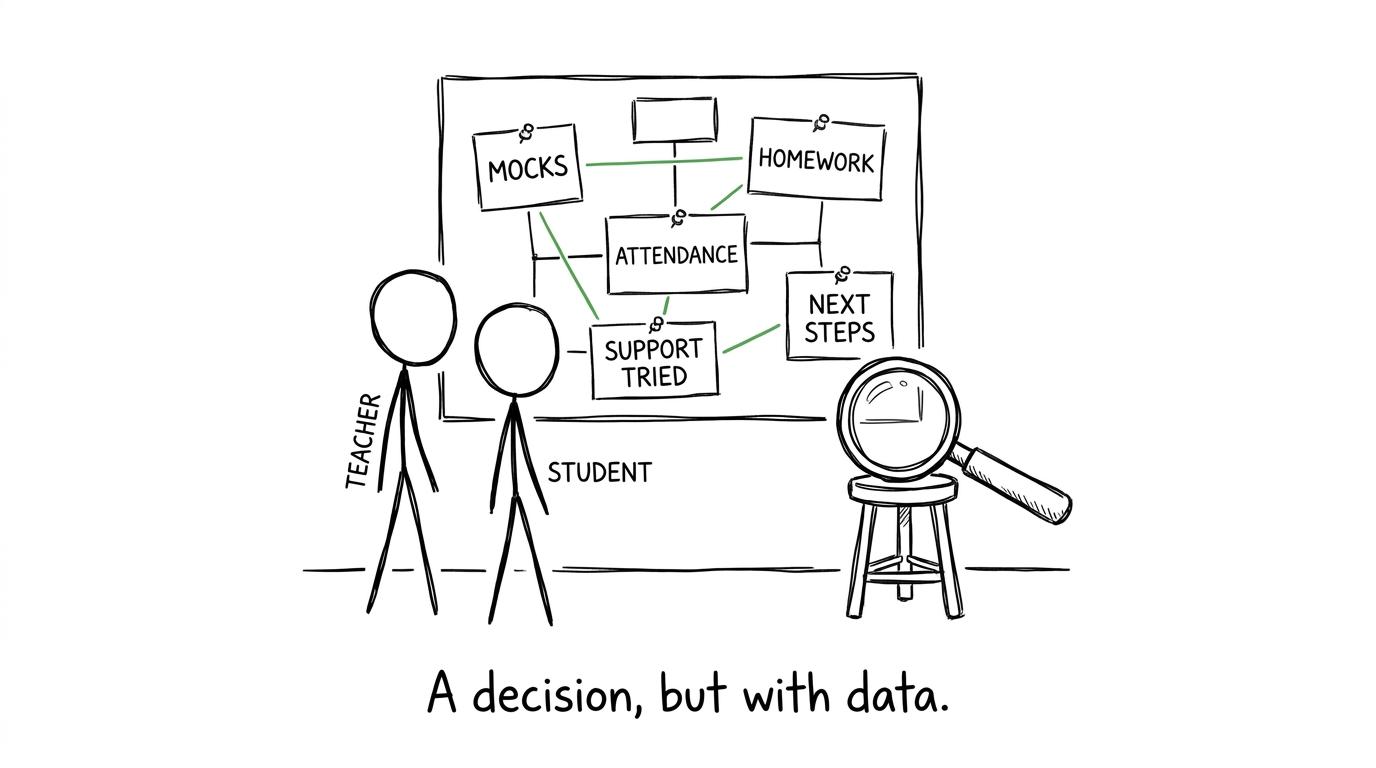 A student and teacher examine mocks, homework and support tried before deciding
Common mistakes when considering dropping French
Deciding after one bad mock
Mocks expose weaknesses under time pressure. They do not, by themselves, establish that improvement is impossible. Compare multiple assessments and ask your teacher what caused the lost marks.
Assuming the saved time will fix maths
Without a timetable, spare lessons can disappear. Use a revision planner and assign each session a purpose: learn, practise, mark or re-test. The guide to revising Edexcel maths efficiently shows how to turn errors into targeted practice.
Ignoring future entry requirements
Do not rely on a general claim that “universities want a language” or that “nobody cares about French”. Requirements vary by institution, course and year. Check the routes you might realistically take, especially if you are considering A Level French.
Treating Foundation tier as failure
A tier change may offer a better route to an attainable grade. Discuss the grade range, assessment evidence and specification rules with your teacher before assuming the only choices are Higher tier or withdrawal.
Thinking you can simply stop attending
Until the school formally changes your programme, continue attending lessons and completing required work. Unauthorised absence creates a new problem without resolving the original one.
Make the choice that improves the whole picture
The right decision is not always the one that keeps the largest number of subjects. Nor is it automatically the one that removes the hardest lesson. A sensible choice protects your wellbeing, preserves realistic future options and gives your remaining revision a clear structure.
Ask your school what is permitted. Review sustained evidence. Check sixth-form requirements. Try focused support where appropriate, then write down exactly how any released time would be used.
If improving maths is part of the reason, make that improvement visible. Begin at MathsGenie's free revision homepage, choose the correct exam board and tier, and move from revision lessons to practice questions, mini tests, mark schemes and video solutions. Finish with past papers and predicted papers, recording every lost mark in your revision planner.
Dropping French may create space. MathsGenie can help you make that space count.