Should I Take GCSE ICT? Honest Questions to Ask
Should I take GCSE ICT? Check the course, assessment, personal fit and workload before choosing, while protecting time for your GCSE maths revision.
Choosing GCSE options can feel oddly permanent. A subject occupies one small box on a form, yet it will appear on your timetable for the next two years. If you are wondering, should I take GCSE ICT?, the honest answer is: perhaps, but first confirm what your school actually means by “ICT”. In England, the old GCSE ICT has been discontinued, so the course may instead be GCSE Computer Science or a vocational digital qualification. Wales and Northern Ireland have different digital qualifications.
Once you know the qualification, ask whether you like its content, assessment style and workload. Do not choose it simply because you use computers, your friends are taking it or somebody has described it as easy.
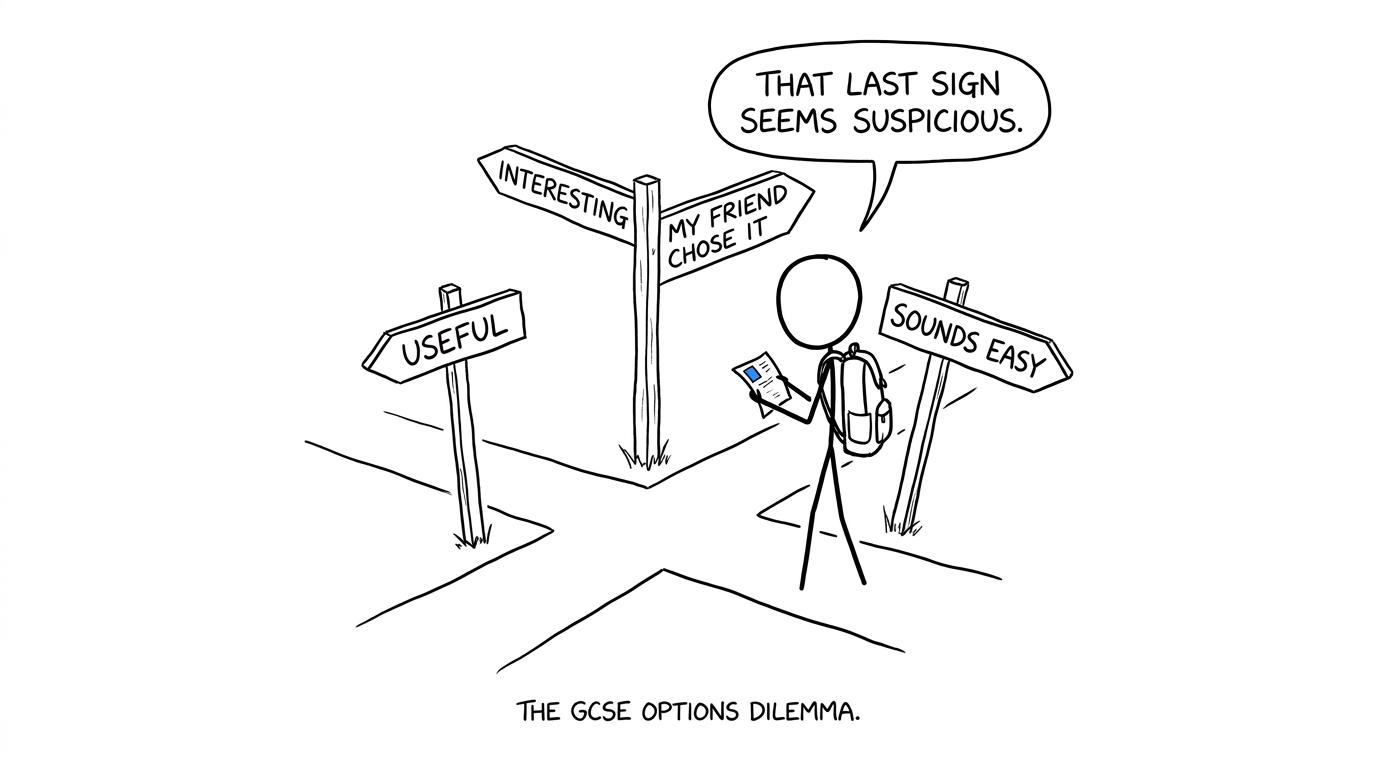 A student encounters some suspicious reasons for choosing a GCSE option
A quick GCSE ICT decision checklist
Before putting the subject on your form, find clear answers to these questions:
- What is the qualification's exact title and exam board?
- Is it ICT, Digital Technology, Computer Science or a vocational award?
- How much programming, written theory and practical work does it contain?
- Is it assessed through written exams, on-screen exams, non-exam assessment or a combination?
- Do you enjoy solving unfamiliar problems when the answer is not immediately obvious?
- Can you manage the workload alongside compulsory subjects and GCSE maths revision?
- Does it support an interest you genuinely want to explore?
- What do current pupils and the teacher say the lessons are actually like?
If you cannot answer the first three questions, you are not yet choosing a course. You are choosing a name.
What does your school mean by GCSE ICT?
This is the most important question because qualification names vary across the UK.
In England, GCSE ICT was discontinued and replaced in the qualification landscape by GCSE Computer Science. Current Computer Science specifications include areas such as algorithms, programming, data representation, computer systems, networks, cyber security and the consequences of digital technology. Schools may offer specifications from AQA, OCR, Pearson Edexcel or Eduqas, although availability is a school decision.
The Government has announced a future, broader GCSE in Computing for England, with the revised national curriculum intended for first teaching from September 2028. That does not automatically change the course being offered to you now. Your school should tell you the exact qualification and teaching year that apply.
The picture is different elsewhere:
| Location | Qualification you may encounter |
|---|---|
| England | GCSE Computer Science or a separate vocational digital qualification |
| Wales | GCSE Computer Science or GCSE Digital Technology, depending on the school's offer and teaching year |
| Northern Ireland | CCEA GCSE Digital Technology may be available |
Scotland has its own National qualifications rather than GCSEs. Wherever you live, read the current specification for your particular course instead of relying on a general description of “ICT”.
Are you expecting computer use or computer science?
Many students hear “ICT” and imagine creating presentations, editing documents and using spreadsheets. Those can be useful digital skills, but GCSE Computer Science is a different proposition.
Computer Science asks how digital systems work. You may need to follow and design algorithms, understand programming constructs, reason about data and explain technical ideas accurately. Knowing how to use a phone, gaming computer or office application does not automatically mean you will enjoy that work.
Digital Technology qualifications can be broader and may include creating digital products, understanding connected systems and communicating through digital media. Yet the balance depends on the specification. The title alone cannot tell you how practical or theoretical the course will feel.
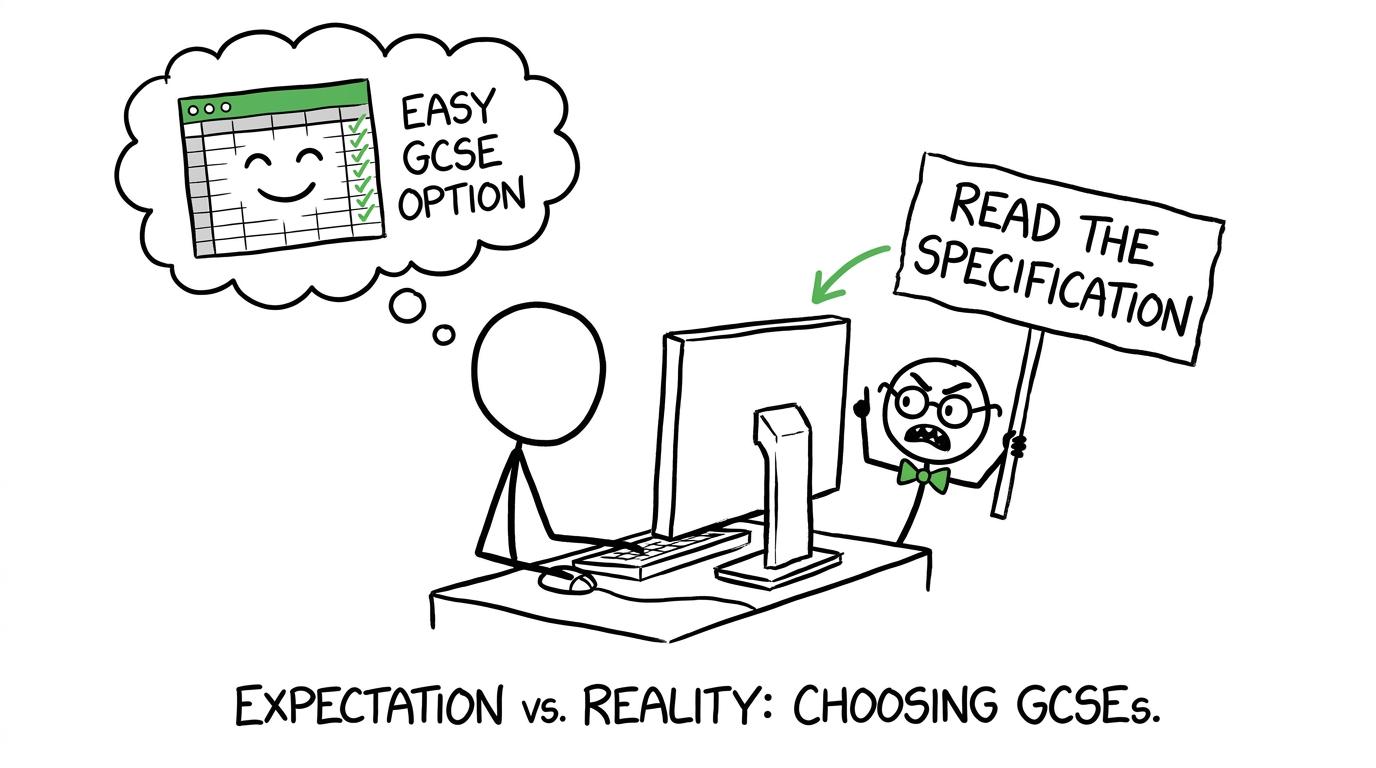 A supposedly friendly computer course reveals an algorithm hiding behind the screen
Ask to see:
- the official qualification title and code;
- a topic list from the specification;
- a recent assessment paper or sample assessment;
- an outline of any controlled or non-exam assessment;
- the programming language or software used;
- a typical piece of classwork.
A ten-minute look at real course materials is worth more than an hour of guessing from the option booklet.
Do you enjoy precise problem-solving?
The useful connection between computing and maths is not that every lesson is full of calculations. It is that both subjects reward precision.
An algorithm must follow a valid sequence. A program must handle the conditions it is given. A mathematical method must preserve logical steps. In both subjects, a tiny error can change the result, and improvement comes from locating the error rather than merely staring at the final answer.
You may be well suited to Computer Science if you like:
- breaking a large problem into smaller parts;
- finding patterns and applying rules;
- testing why something does not work;
- explaining a process in an exact order;
- improving an imperfect first attempt.
You do not need to find every programming task easy. In fact, being willing to remain patient when a solution fails is more useful than expecting immediate success.
If data interests you more than programming, explore MathsGenie's free GCSE Statistics revision resources and the Edexcel GCSE Statistics course hub. They provide a useful glimpse of the careful interpretation and structured thinking that digital subjects can also require.
Does the assessment style suit you?
Two subjects can sound equally interesting but feel completely different under assessment. This is where regret often begins.
Some computing courses rely heavily on written or on-screen examinations. Others include substantial non-exam assessment or practical tasks. Wales's new GCSE Digital Technology, for example, combines a digital examination with non-exam assessment, while GCSE Computer Science structures differ by exam board and country.
Ask yourself which types of work reveal your ability most fairly:
- Can you recall technical vocabulary accurately in an exam?
- Are you comfortable reading longer scenarios before answering?
- Do you prefer building a product over several lessons?
- Can you manage deadlines without leaving practical work until the end?
- Are you willing to practise programming away from the exact task shown in class?
Do not confuse your preferred assessment style with the easiest one. Coursework can reduce reliance on one final examination, but it can create steady deadline pressure. An exam can seem daunting, but its boundaries may be clearer. The better choice is the style in which you can work consistently.
Can your timetable carry the workload?
Every option has an opportunity cost. Time spent rescuing an unfinished digital project cannot also be spent revising algebra, English or science.
That does not mean you should avoid demanding subjects. It means your choice should fit the whole timetable rather than being judged alone. Consider your existing commitments, the number of examined subjects you will take and whether you already struggle to start independent work.
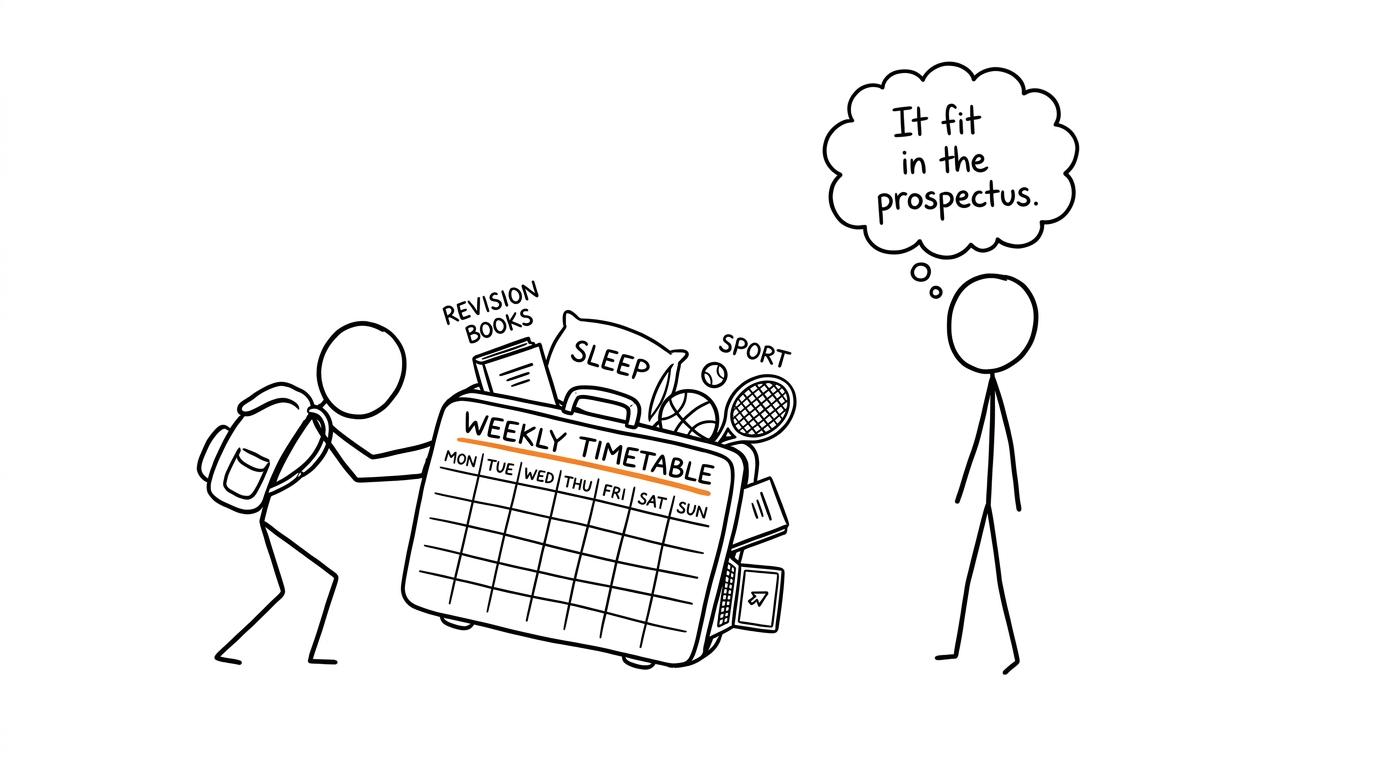 A student attempts to pack an entire GCSE workload into one small timetable
A realistic weekly plan is more useful than a promise to “work harder later”. MathsGenie's guide to building a GCSE maths revision timetable can help you see where topic practice, homework and rest will fit. If your current routine is already crowded, use the advice on revising GCSE maths efficiently before adding ambitious new commitments.
Are you choosing it for the right future?
A digital qualification can help you discover whether you enjoy computing, technology, data or digital production. It may provide useful preparation for related post-161616 courses, but one GCSE does not lock you into a career, and its absence does not automatically close every technology route.
Entry requirements vary between sixth forms, colleges, apprenticeships and later courses. Check the actual requirements of any route you are considering rather than trusting a rumour. Strong results in maths and other core subjects may also matter, particularly for more mathematical computing pathways.
The better question is not, “Will this GCSE guarantee a job?” No GCSE can sensibly carry that promise. Ask instead, “Will this course help me develop knowledge I value, and am I willing to do the assessed work?”
Common mistakes when choosing GCSE ICT
Assuming it is mostly everyday computer use
Computer Science is not a qualification in being generally good with technology. Read the specification and inspect an assessment paper before deciding.
Choosing it because friends are taking it
Friends can make a classroom more comfortable, but classes, teachers and option blocks can change. You will still sit your own assessments.
Believing it will be an easy grade
No GCSE is easy simply because its title sounds familiar. Technical vocabulary, programming, extended explanations and practical deadlines all require deliberate practice.
Ignoring the exact assessment balance
A course with substantial non-exam assessment creates a different workload from one dominated by final examinations. Find out when deadlines fall and how the qualification is marked.
Sacrificing core-subject revision without noticing
Options matter, but so do English, science and maths. Use a diagnostic approach to find your weakest GCSE topics, then protect regular time for them.
Make the decision with evidence
Create two columns: reasons to take the course and reasons not to. Only include reasons you can verify. “I enjoyed the sample programming task” is evidence. “People say it is useful” is not yet evidence.
Then speak to the subject teacher and ask what students usually underestimate. Look at authentic course material. Finally, imagine an ordinary Tuesday in Year 111111: lessons, homework, approaching deadlines and maths revision. Would you still choose the subject when the novelty has faded?
Whatever option you select, keep your core revision organised. Start with the free GCSE Maths revision hub, use the best order for learning GCSE maths topics, and turn mistakes into targeted practice. MathsGenie's revision lessons, practice questions, mini tests, past papers, predicted papers, mark schemes and video solutions give you a clear route from uncertainty to measurable progress.
Choose the digital course because you understand it and want its particular challenges, not because its name sounds safe. Then choose your next MathsGenie revision task with the same care.