Should I Take GCSE French? Honest Questions
Should I take GCSE French? Ask honest questions about interest, speaking, workload and revision before choosing a subject you can sustain for two years.

Choosing GCSE options can feel strangely permanent. A timetable box looks small, yet it represents lessons, homework, revision and exams spread across roughly two years. It is reasonable to wonder: should I take GCSE French, or will I regret seeing it on my timetable every week?
The short answer is that French may be a good choice if you enjoy making gradual progress, are prepared to practise speaking and can give vocabulary regular attention. It may be the wrong option if you are choosing it only because friends are, because it sounds impressive, or because you hope to avoid consistent work.
This is not about deciding whether French is universally easy or difficult. No useful subject-choice decision works like that. It is about whether the demands of the course match how you learn, what you value and the workload you can realistically sustain alongside GCSE maths and your other subjects.
A quick GCSE French decision checklist
Before choosing, ask yourself:
- Do I enjoy understanding and communicating ideas in another language?
- Am I willing to practise vocabulary in short, frequent sessions?
- Can I tolerate making mistakes while speaking?
- What does my school's exact French course and exam board involve?
- Am I choosing French for myself rather than following friends?
- Can I fit it around maths, English, science and my other options?
- Would dropping French close a route I may later want, such as the full English Baccalaureate combination?
You do not need an enthusiastic yes to every question. You do need enough honest answers to know what ordinary Tuesday-evening revision will feel like, not just what results day might look like.
 A student asks for the workload menu before choosing French
Do you like the process of learning French?
Enjoyment is often treated as a soft reason for choosing a subject. In reality, it has practical value. A subject you find interesting is usually easier to return to when revision becomes repetitive.
GCSE French is not simply a collection of travel phrases. Current qualifications in England develop listening, speaking, reading and writing. The revised French GCSE subject content was introduced for first teaching in September 2024, with first assessments in summer 2026. Courses include prescribed vocabulary and grammar, although the precise themes, tasks, timings and marks depend on your exam board.
Ask yourself what you enjoy now. Do you like spotting familiar words in a listening activity? Do you get some satisfaction from building a sentence accurately? Are you curious about how another language works?
You do not need to be the strongest person in your class. Current attainment matters, but willingness to improve matters too. A student who is reasonably interested and practises consistently may be better matched to the course than someone who finds it easy but dislikes every lesson.
Are you willing to speak before you feel ready?
For many students, the speaking assessment is the part that dominates the decision. That fear deserves an honest answer rather than a motivational slogan.
Speaking is assessed in GCSE French. Under the reformed qualifications, assessment continues to cover all four language skills, with tasks determined by the relevant specification. For example, current AQA and Pearson Edexcel specifications each allocate 25%25\%25% of the qualification to speaking, but you must check the specification used by your school rather than assuming every detail is identical.
The more important question is not, "Am I confident now?" It is, "Am I willing to practise while I am still uncomfortable?"
Language learning makes mistakes audible. A forgotten word in writing can be crossed out quietly; a hesitation in conversation feels more exposed. Yet speaking confidence normally grows through repeated low-stakes practice: saying answers aloud, rehearsing pronunciation, responding to unfamiliar prompts and accepting correction.
If you dislike speaking but are willing to practise, French may still suit you. If you strongly resent any situation in which you must speak another language, take that seriously and discuss the course with your teacher.
 A nervous microphone discovers that practice beats panic
Can you handle little-and-often revision?
Some subjects allow you to repair a forgotten topic in one concentrated session. Languages are less forgiving. Vocabulary, verb forms, pronunciation and listening recognition become more secure through repeated contact.
That does not mean French must consume your week. It means the pattern matters. Ten or fifteen focused minutes on several days will often be more useful than opening a vocabulary list once every fortnight and attempting to learn everything at once.
This is also where your maths revision matters. Your option choice should leave enough space for compulsory subjects. Use the free MathsGenie revision planner to sketch a realistic week before submitting your options. Include lessons, travel, clubs, rest and homework. Then add short French practice and regular maths sessions.
If the plan only works when every evening is perfect, it does not work. A sustainable timetable has room for tired days, forgotten homework and topics that take longer than expected.
What will your actual GCSE French course involve?
Never choose from the subject name alone. Ask your school for its current options booklet and specification details.
For French qualifications assessed from summer 2026 in England, students are assessed in listening, speaking, reading and writing. Foundation and higher tiers are used, and students take the assessments at one tier rather than mixing tiers. Foundation targets grades 1-5, while higher targets grades 4-9, with regulatory arrangements allowing a narrowly missed higher-tier grade boundary to produce a grade 3 in defined circumstances.
However, the experience can vary between exam boards such as AQA, Pearson Edexcel and Eduqas. Ask:
- Which exam board and specification does the school use?
- How is each language skill assessed?
- When does the school usually decide between foundation and higher tier?
- What speaking practice happens in lessons?
- What support is available if listening is your weakest skill?
- Can you see sample assessment materials before choosing?
A decision based on the real specification is more reliable than one based on stories from an older sibling who sat a previous version of the qualification.
Are you choosing French for a future reason?
French can support later language study and may complement interests in travel, international work, culture, history or communication. It also counts towards the language component of the English Baccalaureate, or EBacc, in England.
But the EBacc is a school performance measure built from English, maths, sciences, a language, and history or geography. It is not a separate qualification or certificate. Your school may encourage an EBacc pathway, so ask what its options policy means for you.
Future usefulness is a reasonable factor, but avoid pretending you can predict your entire career at thirteen or fourteen. A better question is whether French preserves opportunities you genuinely value. If a sixth form or future course interests you, check its published entry requirements directly rather than relying on rumours about what universities supposedly prefer.
What would you choose instead?
Every option has an opportunity cost. The real comparison is not French against an empty timetable; it is French against the subjects available in the same option block.
Compare ordinary course experiences rather than idealised versions. French may involve frequent vocabulary retrieval and speaking practice. Another subject may involve extended writing, performances, practical work, projects or a different style of examination.
Ask which type of effort you would rather repeat. "Which subject sounds easiest?" is rarely useful because difficulty depends on your strengths, teacher support and assessment style. "Which workload am I more willing to carry?" is a better question.
Friends should not decide this comparison. Timetables change, classes may be split and friendships survive different lessons. You will complete your own homework and sit your own assessments.
Can French and GCSE maths coexist in your timetable?
They can, but both reward consistency. The solution is not to make a grand revision timetable that collapses after three days. Protect small, repeatable blocks.
For maths, start with the GCSE maths revision hub, where you can select resources for Edexcel, AQA, OCR and Eduqas. Use revision lessons and practice questions to repair individual topics rather than repeatedly reading notes.
Short assessments can reduce the pressure on busy weeks. The Edexcel GCSE maths mini tests provide focused timed practice, while the guide to finding your weakest GCSE topics can help you decide where limited revision time should go.
Later in the course, use Edexcel GCSE maths past papers or the correct collection for your board. The principle is simple: attempt, mark, fix and retest. The guide to using GCSE past papers properly explains why completing papers without reviewing mistakes is not enough.
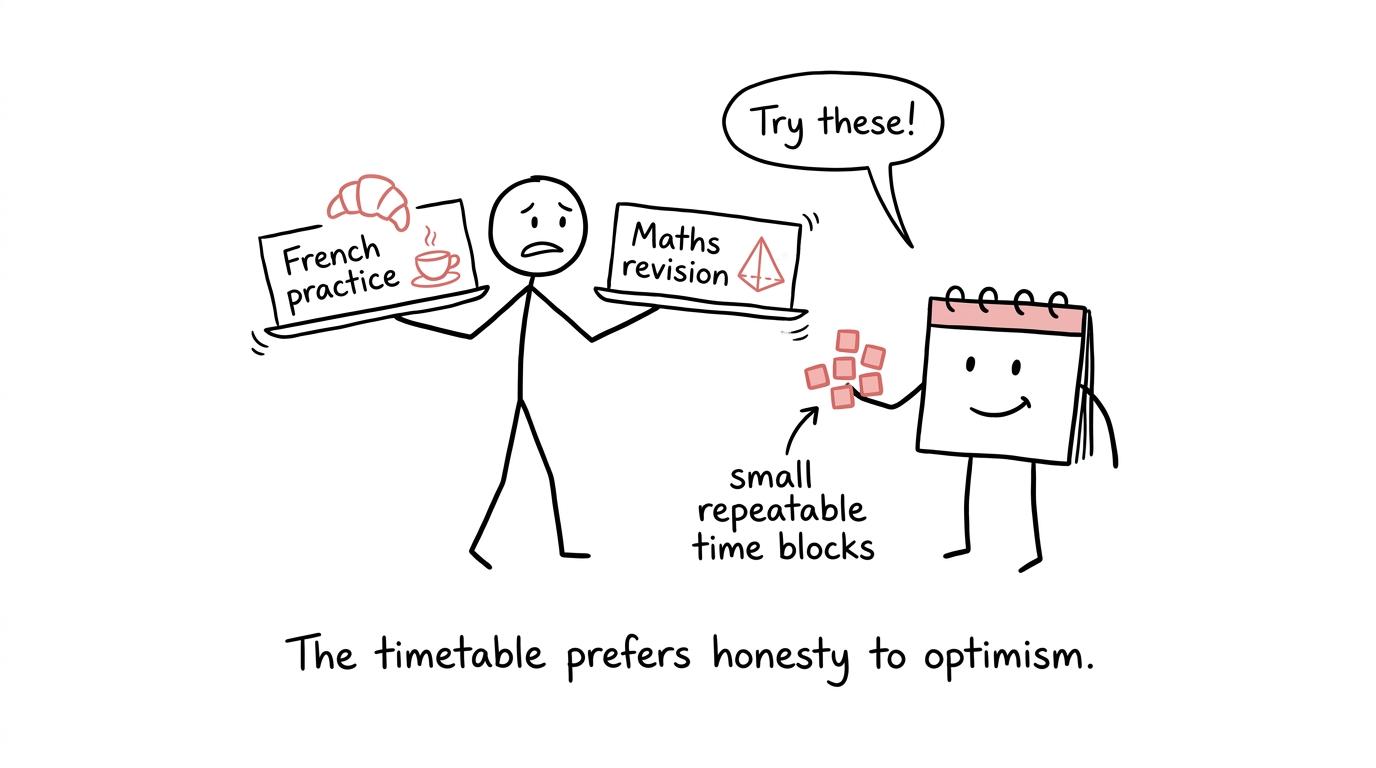 A calendar helps balance French practice and maths revision
Common mistakes when deciding whether to take French
Choosing because your friends chose it
Friends can make lessons enjoyable, but they cannot guarantee the same class or timetable. Choose the work you are willing to do independently.
Judging the GCSE by one difficult lesson
A poor listening task or awkward speaking activity is evidence, but it is not the whole course. Look at your experience across a term and ask your teacher for specific feedback.
Assuming languages are only for naturally confident speakers
Confidence is helpful, not compulsory. The more revealing question is whether you will rehearse, accept corrections and keep going after mistakes.
Ignoring the exact specification
The French GCSE changed for courses first taught from September 2024. Older advice may describe different vocabulary expectations or assessment tasks. Check your school's current board and materials.
Creating an impossible revision plan
Do not assume future you will suddenly have unlimited energy. Build a timetable from the time you actually have. MathsGenie's guide to creating a GCSE maths revision timetable can help you protect regular maths practice while accommodating French and other subjects.
Treating predicted papers as predictions of certainty
Near the maths exams, GCSE predicted papers can provide useful unseen practice. They should supplement full specification coverage and past papers, not replace them. The same principle applies to any subject: prepare for the course, not for a guessed list of questions.
Make the choice you can continue
So, should you take GCSE French? Choose it if you have enough interest to keep returning, enough willingness to speak imperfectly and enough space for frequent practice. Think carefully if your only reasons are friends, pressure or a vague belief that it will look impressive.
Before deciding, read your school's options booklet, inspect the current specification, speak to your French teacher and draft an honest weekly timetable. A good option is not merely attractive on options evening. It remains manageable when homework arrives beside maths revision, science tests and everything else in your life.
Whatever you choose, keep compulsory maths organised with MathsGenie. Begin with free revision lessons and practice questions, use mini tests to diagnose gaps, then progress to past papers, mark schemes, video solutions and predicted papers. Good revision rarely depends on one heroic weekend. It grows from small decisions you can repeat.