Revision Planning for Resit Students: A Clear Plan
Revision planning for resit students: build a realistic schedule, diagnose weak topics and use focused practice to prepare calmly for your next exam series.
Revision planning for resit students starts with your next exam date, evidence of lost marks and a realistic weekly schedule. Diagnose weaknesses, prioritise topics, practise actively and review mistakes. Repeating last year's revision with longer hours may leave the original problems untouched.
For a resit student, disappointment can make planning feel heavy. The useful question is what to do differently this time. A clear plan replaces regret with a manageable task and a way to check whether it helped.
Your resit revision checklist
Before building a timetable:
- Confirm your qualification, exam board, specification and tier where relevant.
- Check exam dates, eligibility and entry arrangements with your school, college or exam centre.
- Complete a diagnostic paper or review previous marked work.
- Identify gaps in knowledge, application, accuracy and exam technique.
- Set weekly sessions, including marking, corrections and later review.
- Gradually introduce timed sections and full papers.
GCSE maths has a November series for eligible candidates; many other GCSE and A Level resits take place in summer. Confirm arrangements and deadlines with your centre.
Diagnose where marks were lost
Begin with a paper under reasonably realistic conditions. Its purpose is to collect evidence, so do not treat the score as a prediction of your final result. Use the GCSE maths revision hub to find resources for your course.
Classify lost marks:
- Knowledge: you could not recall a fact, formula or method.
- Application: you knew the topic but could not adapt it.
- Accuracy: arithmetic, algebra or notation caused an error.
- Exam technique: you misread instructions, omitted working or managed time poorly.
Each problem needs a different response. A lesson can repair missing knowledge; rushed working needs deliberate checking practice. If one foundational topic repeatedly blocks progress, address it before attempting more papers.
Keep your error log brief enough to maintain. Record the topic, what went wrong and the action you will take next. A note such as “check negative signs when expanding brackets” gives your next practice session a purpose. Review these notes before a mixed test, then check whether the same errors return. This helps you distinguish a recurring weakness from an isolated slip without creating another lengthy revision task.
The guide to using GCSE past papers properly explains how marking and an error log turn results into revision priorities.
Build a weekly resit revision cycle
Writing “maths revision” in a timetable leaves the task undecided. Give each session a topic, an activity and a clear finishing point.
Learn or relearn
Choose a weakness from your diagnosis. Watch a focused revision lesson, then recall the method without looking. If you cannot explain the next step, revisit that part before answering questions independently.
Practise
Complete topic questions without copying solutions. Begin with accessible questions, then try unfamiliar or multi-step problems. For essay-based A Level subjects, use the same principle through retrieving evidence, planning arguments and writing timed paragraphs.
Mark and correct
Use the mark scheme to identify missing steps. Redo incorrect questions with the solution covered. Reading an answer is useful, but producing the method independently shows whether the correction has worked.
Revisit
Return several days later with a mini test or mixed questions. This checks what you can retrieve after the explanation is less familiar. If the weakness remains, schedule another focused session.
At the end of each week, compare your plan with what you actually completed. If marking repeatedly gets squeezed out, reduce the number of questions or give corrections their own session. If a topic now feels secure, test it again later and move your main attention elsewhere. Your timetable should respond to evidence. Keeping every original task unchanged can leave you spending time on material you already understand.
Use the GCSE revision timetable guide for structure or the GCSE maths revision timetable for subject-specific planning. Put these sessions into the Revision Planner, leaving space for corrections and unexpected commitments.
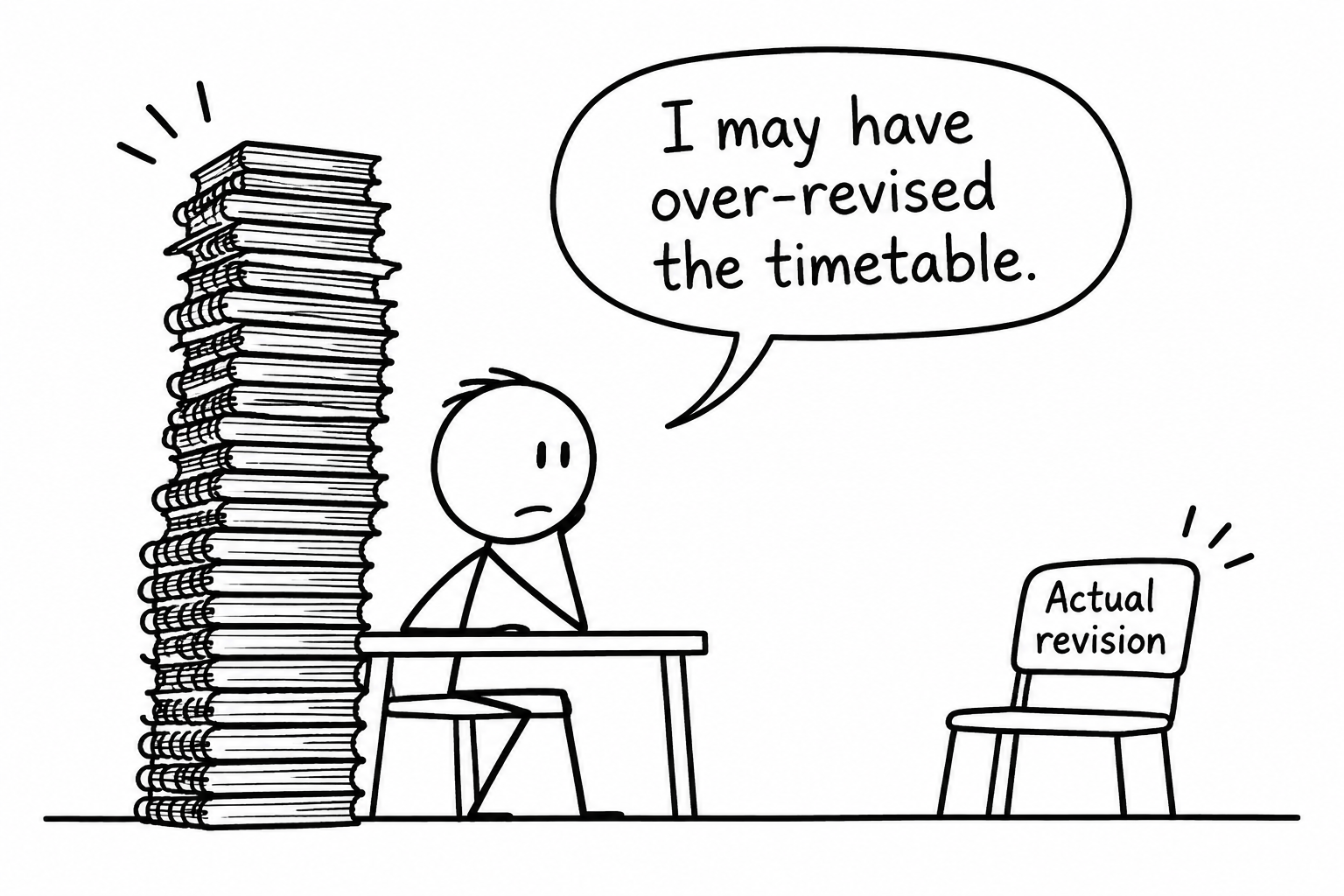 A resit student realises that planning revision is not the same as doing it
Choose a workload you can sustain
Resit students may balance lessons, employment, applications and other qualifications. Start with time you can reliably protect. Include a short retrieval task, focused practice and marking; allow breaks during longer sessions.
There is no universal daily total. Your workload depends on the time remaining, your starting point and other responsibilities. Measure progress through completed questions and corrected mistakes as well as time spent.
The guide to GCSE revision hours explores that balance. If time is short, adapt the one-month GCSE maths revision plan. Narrow your priorities while protecting sleep and review time.
Move towards exam performance
Topic practice develops methods. Mixed questions and full papers test whether you can select those methods independently under time pressure.
Start with diagnosed weaknesses, then introduce timed sections and complete papers. Leave enough time after each paper for marking and correction. Use recurring errors to choose the following week's priorities.
The guide to when to start past papers helps you judge that transition. Use MathsGenie's revision lessons, practice questions, mini tests, mark schemes and video solutions for specific needs. Predicted papers can provide additional practice, but cannot guarantee which topics will appear.
How parents can help
A short weekly check-in can make the plan easier to follow. Ask which task comes next, which mistake needs attention and whether practical help is needed with resources or entry details.
Keep ownership with the student. Recognise honest marking and completed corrections, rather than judging progress only by each paper's score. Adjust an overloaded timetable together.
Common resit planning mistakes
- Repeating passive revision: replace repeated rereading with recall, questions and corrections.
- Choosing favourite topics: use diagnostic evidence to allocate time while maintaining stronger areas.
- Overloading missed days: move the highest-priority task and remove something less urgent.
- Only completing papers: return to lessons and topic questions when missing methods recur.
- Using unsuitable resources: check the current specification, exam board and tier before practising.
Make the next session clear
Your plan becomes useful when it tells you what to do next and how to check your progress. Choose one weakness, complete focused practice, mark it carefully and schedule a return visit. Build those steps into MathsGenie's Revision Planner, then use its free revision resources to turn each session into evidence of improvement.