Edexcel GCSE Maths Grade 6 Boundary Explained
Edexcel GCSE maths grade 6 boundary examples, tier guidance and mark targets explained clearly for Year 11 students planning effective revision.
A Year 11 student opens a past paper, adds the marks and gets 118118118 out of 240240240. The first question is immediate: is that a grade 666?
The honest answer is that the Edexcel GCSE maths grade 6 boundary is not fixed before the exams. It changes between exam series, so no single mark can guarantee a grade 666 this year. Recent boundaries can still provide a sensible guide, however. On past Edexcel Higher tier papers, the grade 666 boundary has often been around half of the available marks, although students should build a safety margin rather than revise towards the minimum.
The grade 6 checklist
Here is what students and parents need to know:
- A grade 666 is available on Higher tier, not Foundation tier.
- Edexcel GCSE Maths has three papers worth 808080 marks each, giving 240240240 marks in total.
- Paper 111 is non-calculator; Papers 222 and 333 permit a calculator.
- The final grade is based on the combined total across all three papers.
- Grade boundaries are set after the papers have been marked.
- Past boundaries are useful reference points, not promises about a future series.
- A revision target should sit above the latest boundary to allow for variation and ordinary exam mistakes.
Students can compare their scores with the Edexcel GCSE Maths grade calculator, which brings previous boundaries together in one place.
Which tier includes grade 6 maths?
A grade 666 sits on Higher tier. Foundation tier awards grades 111 to 555, while Higher tier awards grades 444 to 999, with a restricted grade 333 available in certain circumstances.
That distinction matters. A Foundation student cannot receive a grade 666, even with full marks, because grade 555 is the highest available grade on that tier. A student aiming for grade 666 must therefore be entered for Higher tier.
Tier decisions should not be based on ambition alone. Higher papers contain more demanding content and award relatively few marks at the lower end of the grade range. Teachers consider classwork, assessments and mock papers when deciding which tier gives a student the best opportunity.
How the Edexcel grade 6 mark is calculated
Edexcel combines the raw marks from all three papers:
Total mark=Paper 1+Paper 2+Paper 3.\text{Total mark}=\text{Paper 1} + \text{Paper 2} + \text{Paper 3}.Total mark=Paper 1+Paper 2+Paper 3.Suppose our Year 11 student scores:
38+42+39=119.38+42+39=119.38+42+39=119.Their qualification mark is 119119119 out of 240240240. The papers are not graded separately, so a difficult Paper 111 can be recovered through stronger performances on Papers 222 and 333.
The percentage is:
119240×100≈49.6%.\frac{119}{240}\times 100\approx49.6\%.240119×100≈49.6%.This does not mean that 50%50\%50% always equals a grade 666. GCSE grades are determined from raw-mark boundaries for that particular exam series. Percentages are helpful for comparing performances, but the published boundary is what decides the grade.
Past Edexcel grade boundaries as dated examples
The safest way to answer “What mark do I need?” is to look at official boundaries for the exact qualification, tier and series. The table below gives clearly dated examples for Edexcel GCSE Mathematics A, specification code 1MA11\text{MA}11MA1, Higher tier.
| Exam series | Grade 6 boundary | Total available |
|---|---|---|
| June 2025 | 121121121 | 240240240 |
| November 2024 | 114114114 | 240240240 |
| June 2024 | 112112112 | 240240240 |
| June 2023 | 112112112 | 240240240 |
These figures show why there is no permanent Edexcel GCSE maths grade 6 boundary. Across these examples, the required total moved by several marks.
For the Year 11 student with 119119119, the interpretation depends on the series. That score was above some previous grade 666 boundaries but below the June 2025 example. The useful conclusion is not “I am definitely a grade 666”. It is “I am close, and a few more secure marks would make the outcome less dependent on the boundary.”
The GCSE Maths grade boundaries history provides wider context when comparing years. Always check that a table refers to Edexcel, Higher tier and the correct exam series before drawing conclusions.
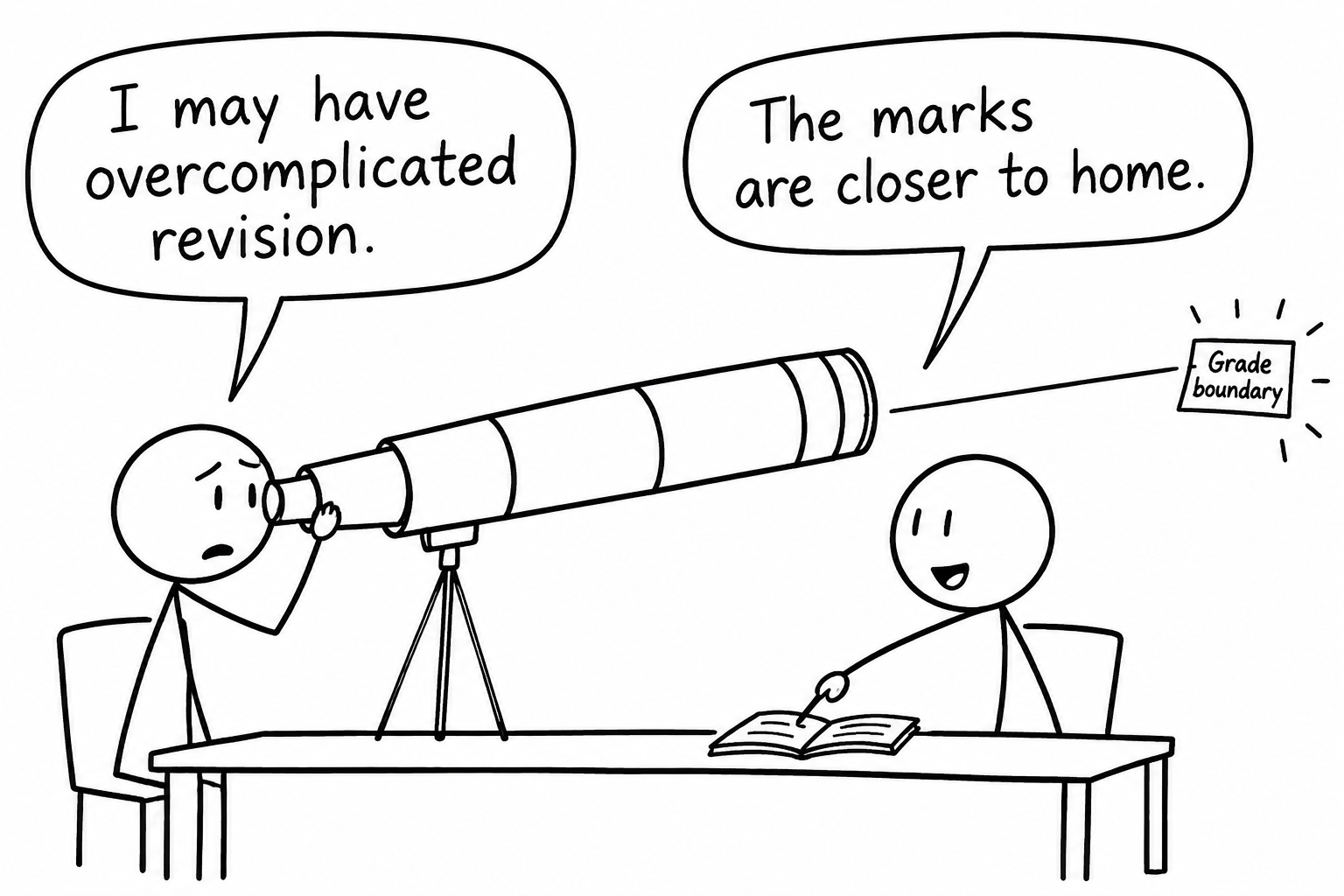 A student using a giant telescope to search for a grade boundary while the useful revision marks sit nearby
Why does the grade 6 boundary change?
Exam papers cannot be made identical in difficulty every year. One series may contain an unusually challenging geometry question; another may have more accessible algebra or statistics questions. Grade boundaries compensate for these differences.
After marking, the awarding process uses evidence about the paper and student performance to determine the raw marks required for each grade. If a paper proves more difficult, a boundary may be lower. If it proves more accessible, the boundary may be higher. The purpose is to keep the standard represented by a grade broadly comparable, not to award a predetermined percentage of students each grade.
Boundaries can also differ between June and November. A November boundary should therefore be treated as a dated example, not copied directly onto a June mock.
This is why predicted boundaries circulating before results day are only estimates. Nobody revising for an upcoming series knows its confirmed grade 666 mark in advance.
What should a grade 6 student aim for?
A student should not aim to land exactly on an old boundary. That approach leaves no room for a harder paper, a changed boundary or marks lost through misreading.
A practical personal target is around 130130130 marks or more across the three papers, while recognising that this is a revision target rather than an official prediction. That could be divided approximately as:
43+43+44=130.43+43+44=130.43+43+44=130.The marks do not need to be evenly distributed. More importantly, a student should track three figures after every paper:
- the raw mark;
- the marks lost through missing knowledge;
- the marks lost through method, notation or avoidable errors.
The last two numbers explain what to revise next. The first one merely describes what has already happened.
Lessons on the topics that move marks most
Grade 666 progress rarely comes from attempting only the hardest questions. It usually comes from making familiar Higher tier skills dependable.
Focus first on topics that appear in many contexts:
- fractions, percentages, ratio and proportion;
- rearranging formulae and solving equations;
- indices, standard form and surds;
- graphs and sequences;
- area, volume, Pythagoras and trigonometry;
- probability and statistical interpretation.
Use the Maths Genie GCSE revision hub to choose lessons by grade and topic. A productive cycle is simple: watch the lesson, attempt the questions without help, mark them carefully, then return to the exact step that failed.
Once topic skills are more secure, complete Edexcel GCSE Maths past papers under timed conditions. Mark schemes reveal where working earns credit, while video solutions help explain why an approach works. Predicted papers and mini tests can then add variety, rather than replacing official past-paper practice.
The important shift is from “I need another ten marks” to “Which ten marks can I make repeatable?” Maths Genie lessons make that question practical because each weak area can become a short, focused revision task.
Common mistakes when using grade boundaries
Treating an old boundary as a forecast
A June 2024 boundary describes June 2024. It does not announce the mark required in a later series.
Looking at the wrong tier
Foundation and Higher have different available grades and boundaries. Grade 666 belongs to Higher tier.
Averaging three paper grades
There is no separate final grade for each paper. Add the raw marks first, then compare the total with the qualification boundary.
Revising only grade 6-labelled questions
Exam marks are cumulative. Secure grade 444 and 555 skills remain essential, while selected grade 777 material can provide a useful buffer.
Ignoring method marks
Correct working can earn marks even when the final answer is wrong. Write substitutions, equations and intermediate steps clearly, and use the mark scheme to learn what examiners reward.
Turn the boundary into a plan
A boundary is a line drawn after the examination. Revision happens before it, one recoverable mark at a time.
Our Year 11 student does not need to predict the exact future boundary. They need to recognise that 119119119 is close to recent grade 666 territory, identify where the next 101010 to 151515 marks can come from, and practise until those marks stop feeling accidental.
Start with Maths Genie GCSE lessons, especially the topics that move marks most. Then use past papers, practice questions, mark schemes, video solutions, mini tests and the revision planner to turn a hoped-for grade 666 into a well-supported target.