GCSE Revision: How Many Hours Should You Revise?
GCSE revision hours explained: plan realistic daily study time, avoid burnout, and use Maths Genie past papers, predicted papers and mini tests to improve.
The honest answer: GCSE revision hours are not the point
If you have ever typed “how many hours should I revise?” at midnight, you are not asking about time. You are asking for certainty. The problem is that GCSE maths doesn’t reward the student who sits longest at a desk; it rewards the student who repeatedly does the right kind of practice, notices what went wrong, and fixes it.
So yes, we will talk about hours. But we’ll talk about them the way examiners do: as a tool, not a badge. A sensible number of hours only matters if it creates enough high-quality attempts at real GCSE-style questions, with mark schemes, methods, and mistakes you can learn from.
Maths Genie is built for exactly that loop: revision lessons, practice questions, mini tests, and past papers with mark schemes and video solutions.
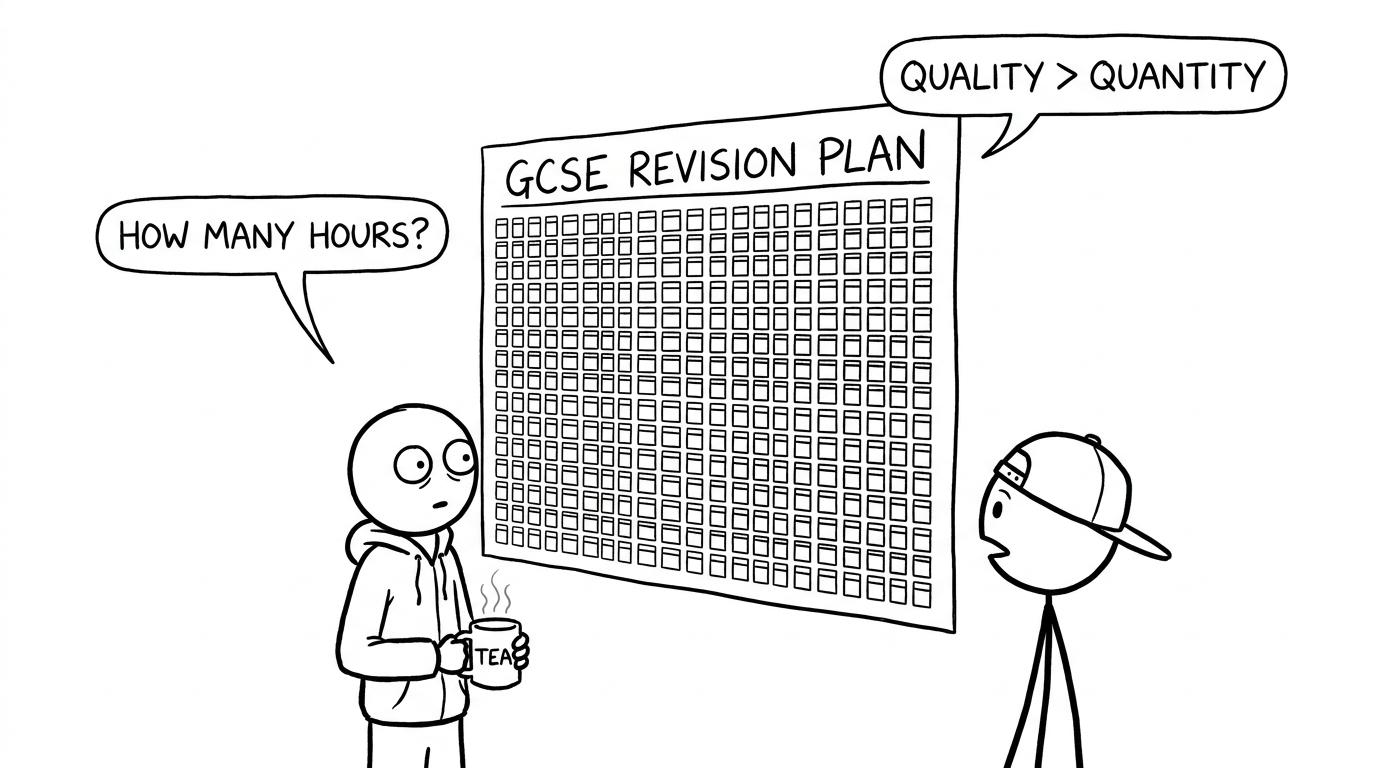 A student staring at a calendar asking how many hours to revise
A quick checklist for deciding your revision hours
Use this checklist to choose a number you can actually stick to. It works for GCSE and it scales up for A Level.
- How far are you from the exam? (months vs weeks vs days)
- What tier are you sitting? Foundation and higher have different “must-secure” topics.
- What’s your current accuracy? If you drop marks on method, you need slower, deliberate practice.
- Are you doing papers yet? Past papers change everything because they reveal timing and selection.
- Can you be consistent? 454545 minutes daily beats 666 hours once a week.
For structured coverage, the Edexcel GCSE learning journey is a calm way to organise your time: Edexcel GCSE Maths learning journey.
A realistic range of GCSE revision hours (and why it varies)
Most students want a single number. The truth is a range:
- Light but consistent: 333 to 555 hours per week (e.g. 303030 to 454545 minutes most days). Good if you’re on track and starting early.
- Solid and improving: 666 to 101010 hours per week. Good if you’re pushing up a grade, especially from grade 444 to grade 666.
- Intensive (short-term): 121212 to 181818 hours per week for a few weeks only. Useful close to exams, but only if sleep stays intact.
The mistake is thinking “more hours” automatically means “more marks”. In GCSE maths, two things create marks:
- Fluency (you can do the method without hesitation)
- Decision-making (you recognise which method to use under pressure)
Fluency comes from targeted topic practice. Decision-making comes from papers.
That’s why it helps to rotate three Maths Genie resources:
- Topic teaching and recall from GCSE revision resources (useful as a topic map even if you’re on the new spec).
- Exam practice via predicted and practice sets on GCSE resources.
- Full exam readiness using your board’s papers, like AQA GCSE papers or Edexcel predicted papers.
The “revision equation”: convert hours into attempts
Hours are vague. Attempts are real.
A strong GCSE revision session typically contains:
- 101010 to 151515 minutes: quick recall (formulae, rearranging, key facts)
- 252525 to 353535 minutes: exam questions under mild time pressure
- 101010 minutes: mark scheme review + mistake log
If you do that properly, you might only complete 666 to 121212 good questions. That sounds small until you realise what “good” means: each question is a method you can now reproduce.
Worked example: turning time into a plan
You have 444 weeks to go and can revise 666 days per week for 454545 minutes.
Total time:
4×6×45=1080 minutes 4 \times 6 \times 45 = 1080 \text{ minutes} 4×6×45=1080 minutesConvert to hours:
1080÷60=18 hours 1080 \div 60 = 18 \text{ hours} 1080÷60=18 hoursNow convert to quality attempts. Suppose you average 888 exam-standard questions per session.
Number of sessions:
4×6=24 4 \times 6 = 24 4×6=24Estimated total attempts:
24×8=192 questions 24 \times 8 = 192 \text{ questions} 24×8=192 questions192192192 well-marked attempts is a serious amount of learning. This is why “only” 454545 minutes can beat longer, messier revision.
GCSE vs A Level: the hours question changes slightly
For GCSE, progress is often “patch the gaps, then practise papers”. For A Level, progress is “build depth, then interleave topics”. You still benefit from consistency, but A Level questions tend to be longer and more connected.
If you’re revising for A Level alongside GCSE resits or tutoring siblings, use Maths Genie’s A Level bank of papers and topic support:
- A Level Maths revision
- Edexcel A Level past papers
- AQA A Level past papers
- OCR MEI A Level past papers
The hours are usually higher for A Level because one “attempt” simply takes longer. But the principle stays the same: time must translate into marked attempts and corrected methods.
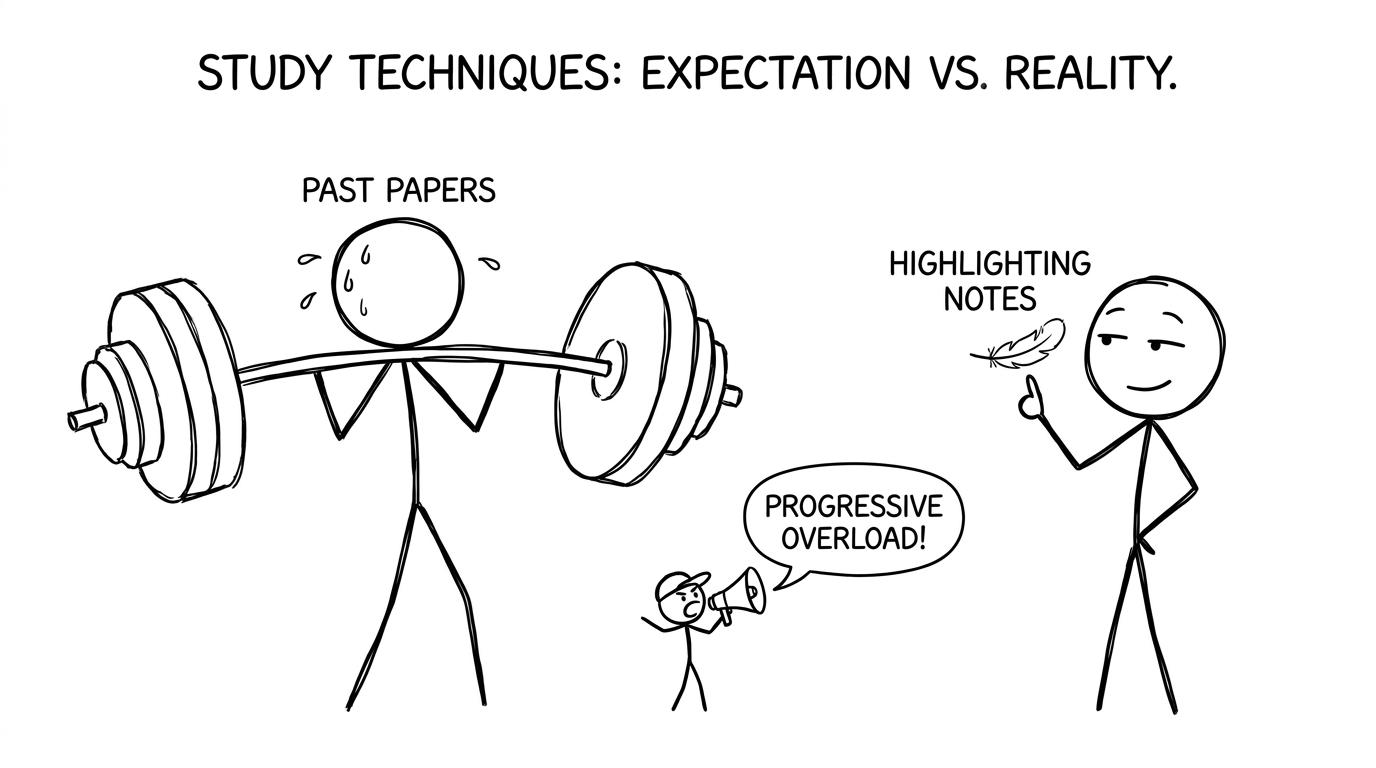 Stick figures lifting "Past Papers" vs "Highlighting notes"
The most efficient weekly structure (that doesn’t burn you out)
A good GCSE week has three flavours of work.
Skill sessions (two or three per week)
Pick one topic. Watch/skim the lesson. Do exam questions. Mark carefully.
If geometry is your weak spot, build a mini-cycle using: GCSE shape revision.
Mixed practice (one or two per week)
Do questions from different topics to force recognition: algebra, number, graphs, probability.
Paper practice (one per week at first, then more)
Use your exam board papers. For example:
When you mark, don’t just count marks. Categorise losses:
- Knowledge gap (didn’t know method)
- Accuracy (arithmetic/algebra slip)
- Exam technique (misread, didn’t show steps, ran out of time)
Worked example: planning revision by marks, not hours
Imagine your last GCSE maths paper was out of 808080 and you scored 464646.
Your percentage is:
4680×100=57.5% \frac{46}{80} \times 100 = 57.5\% 8046×100=57.5%Suppose your target is 70%70\%70%.
Marks needed for 70%70\%70%:
0.70×80=56 0.70 \times 80 = 56 0.70×80=56Extra marks required:
56−46=10 56 - 46 = 10 56−46=10Now translate “101010 marks” into behaviours. Typically, 101010 marks is not 101010 new topics. It might be:
- 444 marks from fixing repeated accuracy slips (fractions, negatives, rearranging)
- 333 marks from improving method setting-out (so you earn method marks even if the final answer is wrong)
- 333 marks from speed and question selection (not getting stuck early)
That kind of improvement often comes from doing fewer questions, but marking them more ruthlessly. Maths Genie’s mark schemes and video solutions make that process faster and clearer.
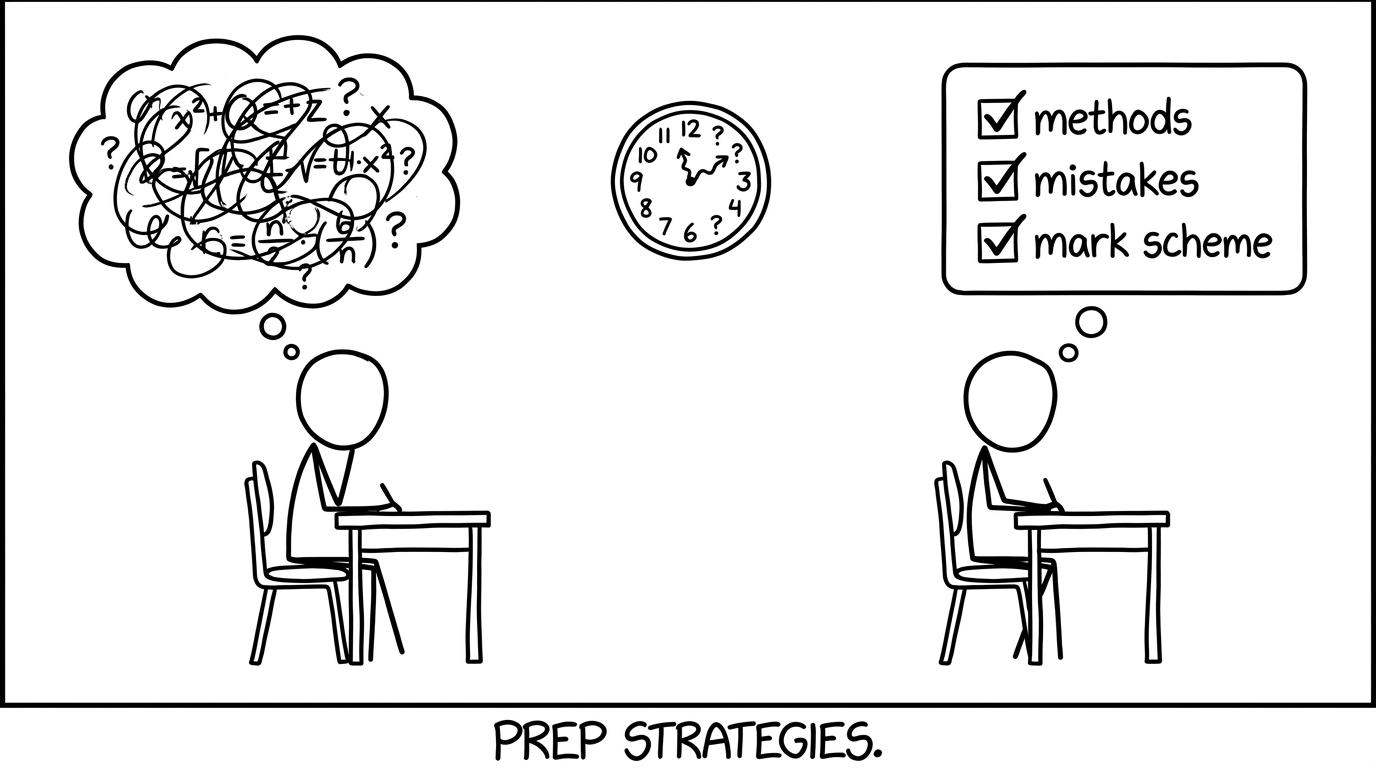 Exam hall thought bubbles: messy formulas vs neat checklist
Common mistakes when deciding how many hours to revise
Revising the timetable instead of the maths
Students build gorgeous plans, then avoid the difficult topics because the plan itself feels like progress. A GCSE plan is only useful if it forces you into honest practice.
Doing “easy hours”
Two hours of copying examples is comforting, but it doesn’t create exam decisions. If you want GCSE marks, you need exam questions and a mark scheme.
Skipping marking because it feels negative
Marking is where learning happens. If you avoid the mark scheme, you’re paying the time cost but refusing the reward.
Cramming in huge blocks
A 444-hour session can work occasionally, but it often becomes low-quality halfway through. For GCSE, consistent smaller blocks usually win.
Treating predicted papers like magic
Predicted papers are valuable because they focus revision, not because they “guarantee” questions. Use GCSE predicted papers and resources as a spotlight, then still practise broadly.
Bringing it together: choose hours that create GCSE marks
The best number of revision hours is the number you can repeat without breaking your sleep, your confidence, or your consistency. For GCSE maths, you are not paid in hours; you are paid in corrected attempts.
Here’s a simple way to start today:
- Pick one topic you keep dropping marks on.
- Use a Maths Genie revision lesson to refresh the method.
- Do exam questions and mark them carefully.
- Add one line to your mistake log: what went wrong and what to do next time.
Then, once per week, prove it on a paper. Use your board’s set, like AQA GCSE papers, or sharpen your focus with Edexcel GCSE predicted papers and the wider GCSE resources page.
If you do that, the hours take care of themselves. And your GCSE grade usually follows.