Edexcel GCSE Maths Grade 4 Boundary Explained
Edexcel GCSE maths grade 4 boundary explained with dated examples for both tiers, why boundaries change, and how to set a safer revision target for exam day.
A Year 11 student opens a marked mock paper and sees a total of 131131131 marks. The first question is not about algebra or geometry. It is simpler and more urgent: is that enough for a grade 4?
The short answer is that the Edexcel GCSE maths grade 4 boundary changes for every exam series. In June 2026, a grade 4 required 151151151 marks out of 240240240 on Foundation tier and 505050 marks out of 240240240 on Higher tier. Those figures are useful reference points, but they cannot tell you the boundary for a future paper.
That uncertainty can feel unhelpful. Used properly, however, past boundaries provide something valuable: a sensible range around which to build a safer revision target.
Grade 4 boundary at a glance
Here is the essential checklist:
- A grade 4 is available on both Foundation and Higher tier.
- Edexcel GCSE Maths consists of three papers worth 808080 marks each.
- Your marks are added to give a total out of 240240240.
- The official boundary applies to the combined total, not separately to each paper.
- Foundation tier awards grades 111, 222, 333, 444 and 555.
- Higher tier principally awards grades 444 to 999, with grade 333 available as an allowed grade below the normal range.
- Boundaries are confirmed after the papers have been sat and marked.
You can check your current total using the Edexcel GCSE Maths grade calculator, which compares marks with boundaries from previous series.
Recent Edexcel GCSE maths grade 4 boundaries
These are official overall boundaries from recent summer exam series. Each figure is the total required across all three papers.
| Exam series | Foundation grade 4 | Higher grade 4 | Maximum mark |
|---|---|---|---|
| June 2026 | 151151151 | 505050 | 240240240 |
| June 2025 | 144144144 | 535353 | 240240240 |
| June 2024 | 142142142 | 424242 | 240240240 |
| June 2023 | 147147147 | 474747 | 240240240 |
The June 2026 Foundation boundary was equivalent to:
151÷240=0.62916…151 \div 240 = 0.62916\ldots151÷240=0.62916…That is approximately 62.9%62.9\%62.9% of the available marks. On Higher tier, the calculation was:
50÷240=0.20833…50 \div 240 = 0.20833\ldots50÷240=0.20833…That is approximately 20.8%20.8\%20.8%.
This does not mean Higher tier is an easier route to grade 4. Its questions are more demanding, and students have fewer accessible marks near the beginning of each paper. A lower numerical boundary compensates for that increased difficulty.
For a wider view, the GCSE maths grade boundaries history shows how Edexcel boundaries have moved between exam series.
Following a Year 11 student through the calculation
Consider a hypothetical Year 11 student called Sam. Sam is entered for Foundation tier and receives these mock results:
- Paper 1: 434343 marks
- Paper 2: 464646 marks
- Paper 3: 424242 marks
The combined mark is:
43+46+42=13143 + 46 + 42 = 13143+46+42=131Sam compares 131131131 with recent Foundation boundaries. It is below the June 2024 boundary of 142142142, the June 2025 boundary of 144144144 and the June 2026 boundary of 151151151.
That does not predict Sam's final grade. A school mock may use a past paper, a custom paper or a paper with a different level of difficulty. It does reveal a useful revision gap. To reach 155155155 marks, Sam needs:
155−131=24155 - 131 = 24155−131=24Spread evenly across three papers, that is:
24÷3=824 \div 3 = 824÷3=8The practical goal becomes roughly 888 additional marks per paper. That feels different from the vague instruction to “get better at maths”. It points Sam towards missed methods, incomplete working and topics where a few focused lessons could recover dependable marks.
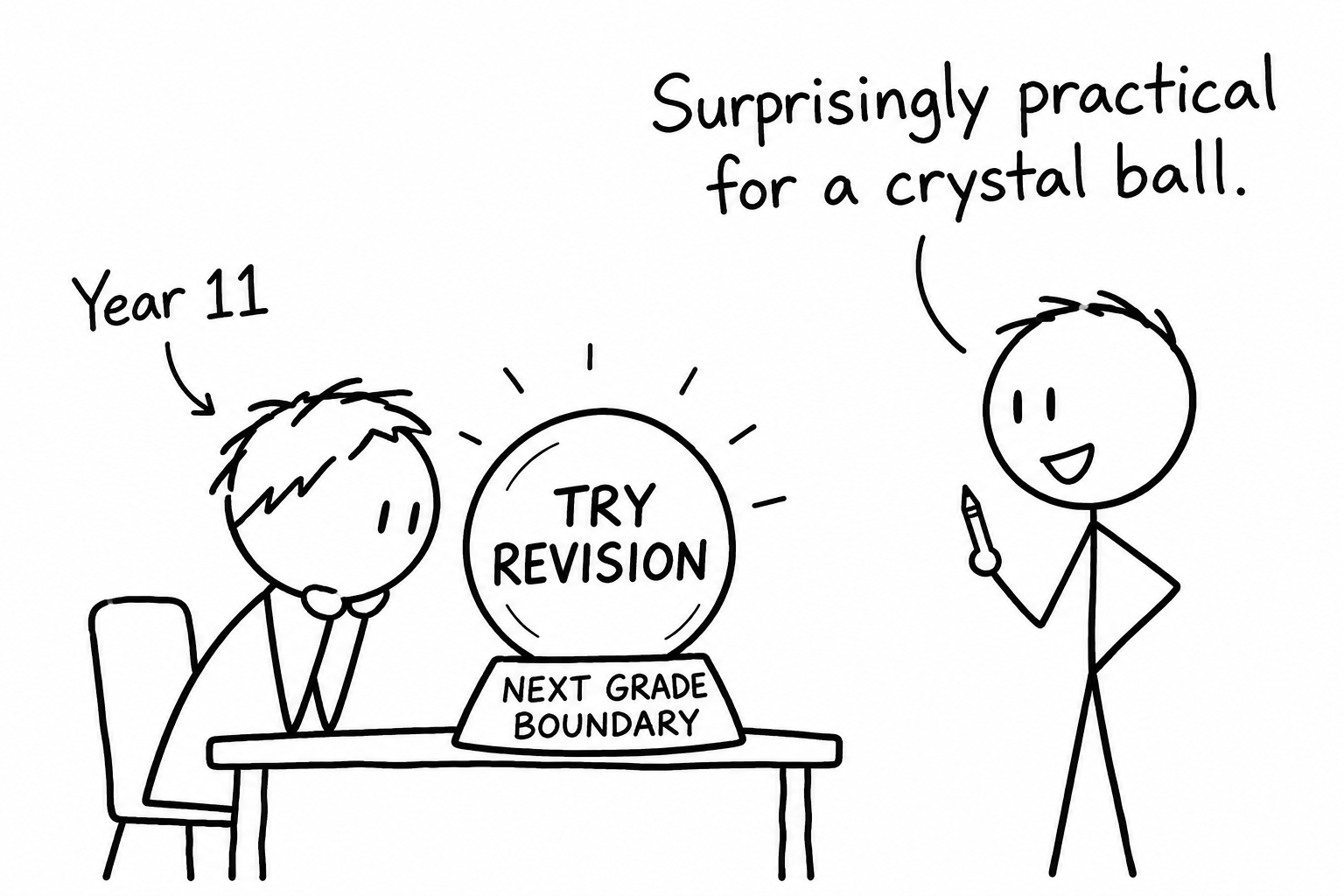 A Year 11 student asks a crystal ball about the next grade boundary and is told to try revision
Which tier should you take for grade 4 maths?
Grade 4 sits on both tiers, but the route is different.
Foundation papers contain more questions designed to assess the knowledge around grades 111 to 555. For a student whose main objective is a secure grade 4, Foundation can provide more opportunities to collect marks from familiar material.
Higher papers cover grades 444 to 999. The grade 4 boundary is much lower because the paper is harder, but accessible questions can be less plentiful. A student who struggles with Higher content should not assume that needing fewer marks automatically makes grade 4 easier.
Tier decisions should be discussed with the maths teacher. They can consider classwork, mock performance, consistency and whether grade 5 or above is a realistic objective. Past boundaries are evidence, not a complete tier-entry strategy.
Why Edexcel grade boundaries change
Exam boards aim to keep the standard of a grade consistent, but no two sets of questions are identical. One paper may contain an unfamiliar problem-solving question. Another may have more accessible early questions. Students cannot be expected to find every paper equally difficult.
After marking is nearly complete, awarding evidence is used to set boundaries that reflect the demand of that particular series. If students found the papers harder, a boundary may be lower. If the papers were more accessible, it may be higher.
This is why the Foundation grade 4 boundary moved from 142142142 in June 2024 to 144144144 in June 2025, then to 151151151 in June 2026. The change does not mean the meaning of grade 4 was casually rewritten. The boundary moved to preserve the intended standard across different papers.
Read how GCSE grade boundaries work for a fuller explanation of the awarding process.
Set a target above the boundary
A boundary is the minimum mark that earned the grade in one particular series. It is not an ideal target.
If Sam aims for exactly 144144144 because that was the June 2025 Foundation boundary, one difficult question or arithmetic error could remove the margin. A target such as 155155155 or 160160160 provides more protection, although it can never guarantee a grade before the official boundaries are announced.
Build the target from complete papers:
- Sit a paper under timed conditions.
- Mark it carefully using the official mark scheme.
- Record lost marks by topic and by type of mistake.
- Revisit the weakest topics using a lesson and practice questions.
- Attempt another paper and compare the three-paper total.
The Edexcel GCSE Maths revision page brings together free videos, worksheets, exam-style questions, past papers and mark schemes. A day-by-day revision planner can then turn the mark gap into manageable sessions.
Topics that can move a grade 4 mark total
Students often look for one difficult topic that will transform their result. Improvement is usually less dramatic and more dependable. It comes from collecting marks that were previously being left behind.
Start with recurring number, ratio, algebra and geometry skills. Then use marked papers to decide where your own gaps sit. Grade 4 topics such as expanding and factorising, Pythagoras and grade 4 probability are sensible places to practise when the mark scheme repeatedly identifies those weaknesses.
Revision lessons build the method. Practice questions test whether it can be used without support. Past papers, predicted papers, mini tests, mark schemes and video solutions then reveal whether the method survives under exam pressure.
Common mistakes when using grade boundaries
Treating an old boundary as a prediction
The next Edexcel GCSE maths grade 4 boundary is unknown until the awarding process is complete. Previous figures are guides, not promises.
Using a boundary from the wrong tier
Foundation and Higher have separate boundaries. Always check the tier printed on the paper before interpreting the total.
Applying the overall boundary to one paper
The published subject boundary is based on the combined mark out of 240240240. Dividing it by three may suggest an average, but you do not need the same mark on every paper.
Assuming a lower Higher boundary means an easier grade
Higher questions have greater overall demand. The lower boundary reflects the difficulty of the papers.
Aiming for the exact minimum
Boundaries move, and exam performance varies. A safer target sits above recent boundaries and is tested across several full papers.
Turn the number into a revision plan
Sam began with a question about one number. The useful answer was not simply 151151151, 144144144 or 142142142. It was the discovery that a grade is built from small, recoverable marks across three papers.
Calculate your current total, identify where marks are being lost and create a buffer above recent boundaries. Then start with Maths Genie Edexcel lessons on the topics that can move your marks most. The boundary will eventually be decided by Edexcel. The preparation before it is still yours.