

Revision Plan for a Grade 6 in GCSE Maths
Revision plan for a grade 6 in GCSE Maths: balance weak and secure topics, practise exam questions and follow a realistic weekly timetable with MathsGenie.
A grade 6 can feel like an awkward target. You are beyond the basics, but difficult higher-tier questions can still make the whole paper seem uncertain. A good revision plan for a grade 6 in GCSE Maths solves that problem by doing two things: protecting the marks you can already earn and steadily improving the topics where another few marks are realistic.
You do not need to master every grade 8 or 9 problem. You need secure foundations, reliable grade 5-6 skills and enough exam practice to use them in unfamiliar questions. This plan shows you which areas to prioritise, how to divide your time and what a useful week should look like.
Your grade 6 revision checklist
Before building your timetable, check that your plan includes:
- higher-tier revision, because foundation tier is limited to grades 1-5
- a short diagnostic paper to identify weak topics
- regular work on number, algebra, ratio, geometry and statistics
- more time for weak areas without abandoning secure ones
- exam questions marked with the official mark scheme
- a weekly mixed test or past-paper section
- time to correct mistakes and repeat questions
If you need a broader starting point, read the GCSE Maths revision timetable guide. It explains how to fit maths around your other subjects without producing a timetable that collapses after three days.
What does a GCSE Maths grade 6 require?
A grade 6 is available on higher tier, which covers grades 4-9. Grade boundaries change between exam series and exam boards, so there is no permanent number of marks that guarantees the grade. Use recent boundaries only as context, not as a target that lets you ignore parts of the course.
The safer goal is consistency. A student approaching grade 6 should usually be able to complete straightforward and moderately demanding questions accurately, show clear methods and make progress on multi-step problems. The meaning of a grade 6 in GCSE Maths guide provides more context about what the grade represents.
Your exact specification matters. Edexcel, AQA, OCR and Eduqas organise and assess content differently, even though they share a large core. Check the GCSE Maths topics by exam board and tier before deciding that a topic can be skipped.
Which topics carry the marks at grade 6 level?
No individual topic is guaranteed to appear in a particular position or carry a fixed number of marks. Papers also combine skills. A geometry question may require algebra, while a ratio problem may depend on confident fraction work.
For a grade 6 target, organise topics into three layers.
Secure foundations
These skills support questions across the paper:
- fractions, decimals and percentages
- negative numbers and order of operations
- ratio, proportion and unit conversions
- standard form, powers and roots
- rearranging and solving equations
- area, volume and basic angle facts
- averages, charts and elementary probability
They may look easier than grade 6 material, but losing several marks through fraction errors or inaccurate substitution can be the difference between grades. Keep these topics active with short mixed practice.
Grade 5-6 priorities
These are often valuable areas for a student trying to move securely into grade 6 territory:
- repeated percentage change and growth or decay
- bounds and error intervals
- direct and inverse proportion
- expanding and factorising quadratics
- quadratic equations and graphs
- simultaneous equations and inequalities
- sequences and algebraic proof
- trigonometry and Pythagoras in context
- similarity, congruence and transformations
- circle theorems and vectors
- probability trees and conditional probability
- cumulative frequency, histograms and interpreting data
The precise difficulty of a question depends on how the skill is presented. Knowing a rule is only the first stage. You must also recognise when to use it.
Stretch content
Harder questions still deserve some attention, but they should not consume most of your week. If a challenging vector proof takes an hour while your percentage methods remain unreliable, the allocation is working against your target.
Spend a smaller amount of time attempting demanding problems. Learn how to start them, write down relevant facts and collect method marks. The objective is useful progress, not perfection.
Students following Edexcel can use the Edexcel GCSE Maths revision hub to work through topics arranged by grade and difficulty.
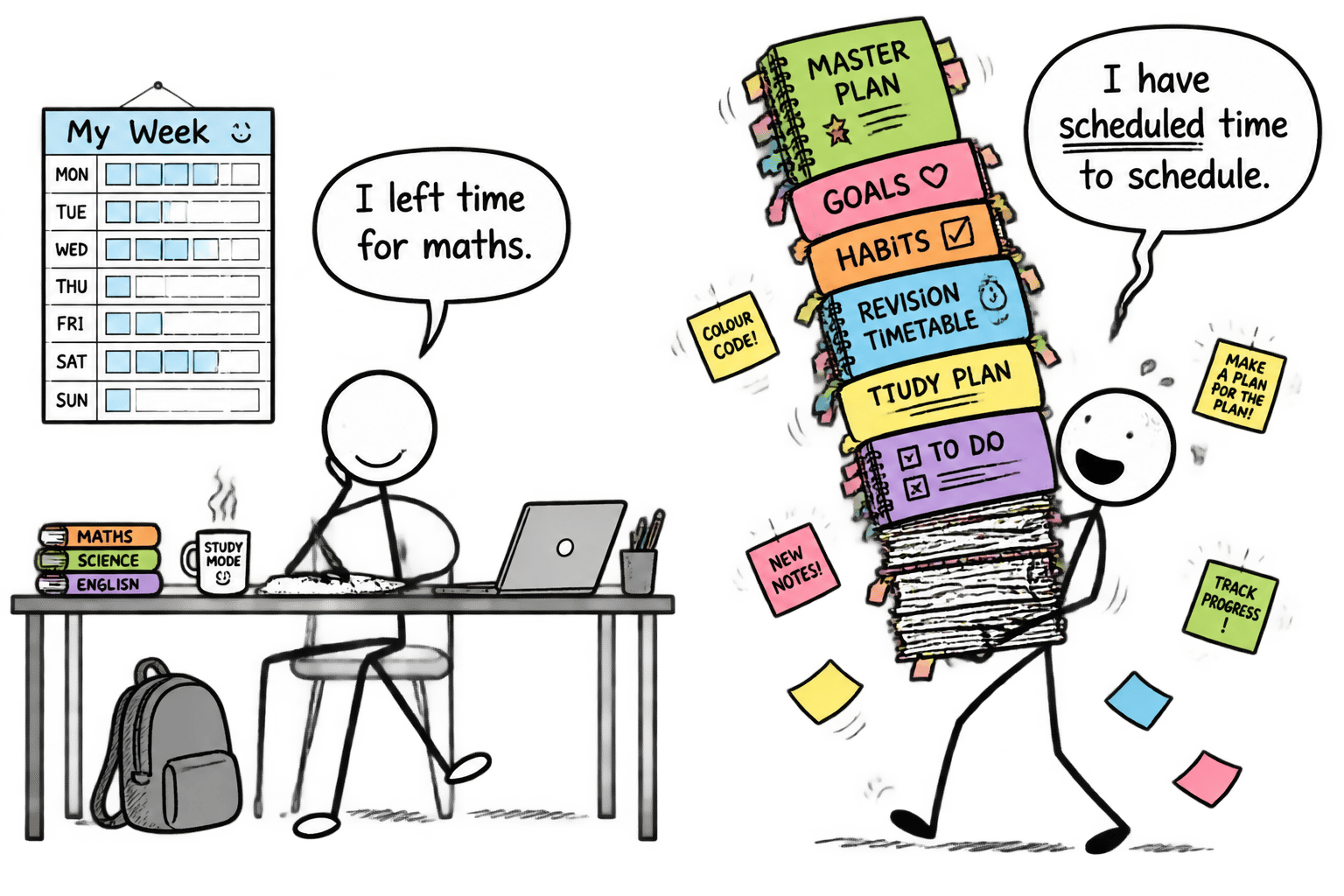 A student leaves time for maths while another schedules time to schedule
How to split revision between secure and weak areas
A sensible starting split is:
- 50%50\%50% on weak but achievable grade 5-6 topics
- 30%30\%30% on secure topics and mixed retrieval
- 20%20\%20% on timed exam questions and corrections
This is not a permanent formula. Review it each week. If algebra improves but probability remains weak, move the next block of time towards probability.
Label each topic red, amber or green after attempting questions without notes:
- Red: you cannot choose a method or complete the opening steps.
- Amber: you understand the method but make errors or need prompts.
- Green: you can answer several varied questions independently.
Most improvement comes from amber topics. They are close enough to secure that focused practice can convert uncertainty into marks. Give red topics enough lesson time to understand the method, but do not spend every session wrestling with one very difficult area.
A weekly revision plan for a grade 6 in GCSE Maths
Aim for five focused sessions rather than one exhausting weekend block. Sessions of about 404040-606060 minutes are long enough to learn and practise while remaining realistic alongside other GCSE subjects.
| Day | Focus | What to do |
|---|---|---|
| Monday | Weak topic | Watch a revision lesson, write a short method summary and complete practice questions. |
| Tuesday | Secure skills | Complete mixed questions on number, ratio and algebra without notes. |
| Wednesday | Second weak topic | Learn one grade 5-6 method, then move from routine to exam-style questions. |
| Thursday | Rest or catch-up | Leave space for homework, another subject or a missed session. |
| Friday | Exam technique | Complete a timed section from a higher-tier paper. |
| Saturday | Mark and repair | Use the mark scheme or video solutions, correct errors and retry unsuccessful questions. |
| Sunday | Mini test and planning | Take a short mixed test, update red, amber and green topics, then choose next week's priorities. |
You have now seen how the weekly structure works, so build your schedule in the Revision Planner instead of repeatedly drawing it out by hand.
Repeat this weekly template, but change the topics according to evidence from your questions. If you have only a month, adapt it using the one-month GCSE Maths revision plan. If the exam is much closer, the one-week GCSE Maths revision plan will help you make more selective decisions.
Make every revision session produce evidence
A session should end with something you can inspect: marked answers, a mini-test score, corrected questions or an updated topic list. Watching videos without attempting questions can create familiarity, but familiarity is not the same as being able to solve a problem independently.
Use this simple session structure:
- Spend the first 555 minutes recalling methods from memory.
- Use 101010-151515 minutes for a revision lesson or worked explanation.
- Spend 202020-303030 minutes answering questions without help.
- Use the final 101010 minutes to mark, correct and record mistakes.
Once a week, use GCSE Maths past papers and mark schemes for timed practice if you take Edexcel. Start with selected sections if a full paper feels unmanageable. Closer to the exams, complete whole papers under the correct conditions and use MathsGenie's worked or video solutions where available to understand errors.
Common mistakes in grade 6 revision
Revising only difficult topics
Higher-tier papers still reward accurate foundational work. Keep green topics alive through short mixed practice rather than abandoning them.
Spending equal time on everything
Equal time feels organised but ignores what your marked work is telling you. Give more time to amber and weaker grade 5-6 topics.
Copying solutions instead of retrying questions
A correction is useful only if you can later reproduce the method. Close the solution and attempt the question again, then repeat it several days later.
Treating every error as a knowledge gap
Some errors come from arithmetic, misreading, calculator use or missing units. Record the type of mistake so that your response is specific.
Avoiding timed work
Topic questions build methods, but timed papers build selection and pacing. You need both. MathsGenie brings revision lessons, practice questions, mini tests, past papers, mark schemes and video solutions into the same revision process.
Turn the plan into a schedule
Knowing what to revise is easier than returning to it consistently. Your grade 6 target becomes more manageable when weak topics, secure practice and timed questions each have a place before the fixed exam dates. Build your grade 6 schedule in the MathsGenie Revision Planner.















