Grade 6 GCSE Maths Meaning: What Comes Next?
Grade 6 GCSE maths meaning explained, including A Level entry, realistic next steps, result checks and free MathsGenie revision support.
Results Day has a strange habit of turning years of lessons, mocks and revision into one small number. If you received a grade 666, the grade 6 GCSE maths meaning is straightforward: you achieved a secure result above the government’s grade 444 standard pass and grade 555 strong pass benchmarks. You will not normally need to resit GCSE Maths, and the grade can support many sixth-form, college and apprenticeship routes.
The more important question is what the result means for your next step. That depends on the course you want, its entry requirements and whether you plan to continue with maths.
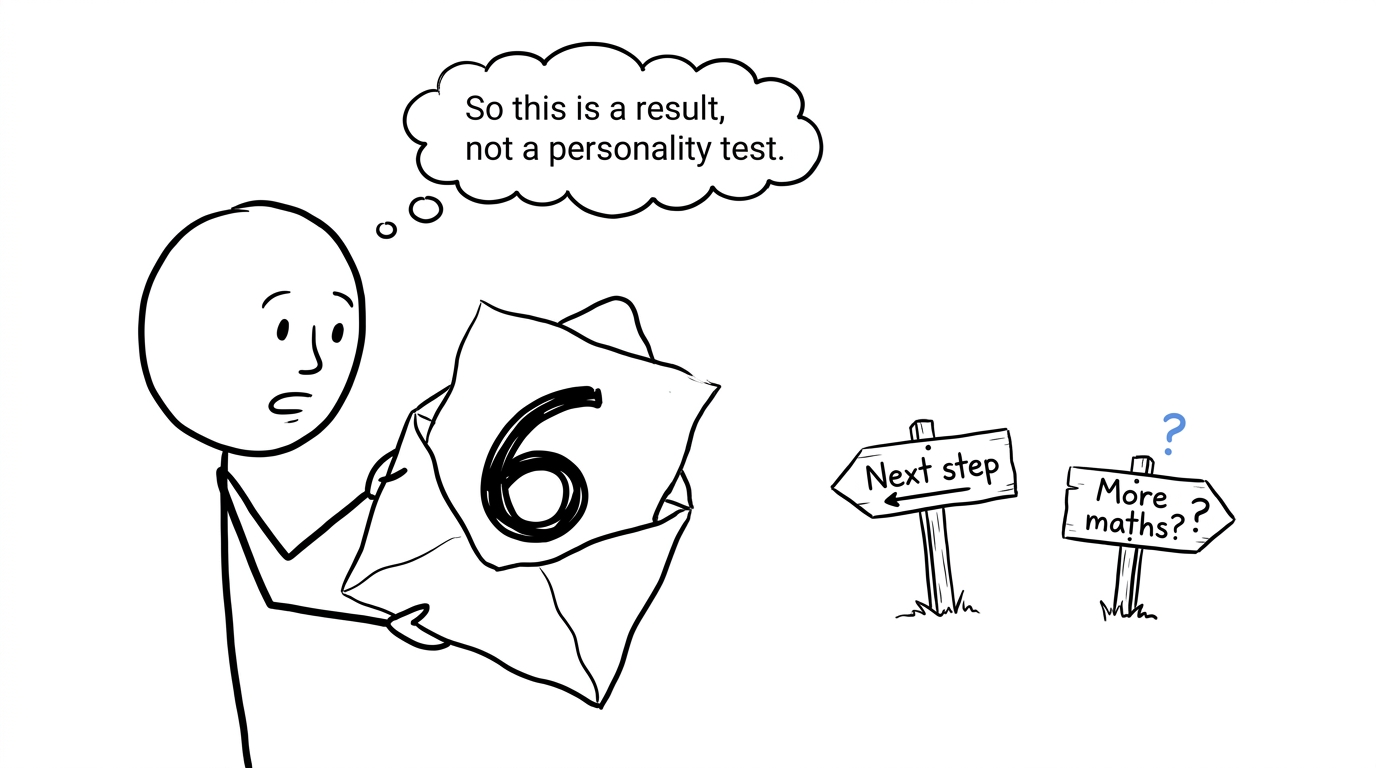 A student realises that a GCSE result is not a personality test
Your grade 666 checklist
Before making any decisions:
- Celebrate a strong GCSE Maths result.
- Confirm the entry requirements for your chosen sixth form or college.
- Check the specific requirement for each A Level, T Level or vocational course.
- Speak to your school if the result was unexpectedly below your mock performance.
- Strengthen higher-tier skills if your next course uses substantial mathematics.
- Use the free GCSE Maths revision hub if you need to maintain or improve your knowledge.
What does a GCSE Maths grade 666 mean?
GCSEs in England use grades from 999 to 111, with 999 being the highest. A grade 666 sits above both recognised pass benchmarks and indicates a sound understanding of much of the GCSE Maths specification.
It should not be described as an exact old-style letter grade. Ofqual explains that the numerical and former letter scales are comparable only at particular points: the bottom of grade 777 aligns with the bottom of the former grade A, while the bottom of grade 444 aligns with the bottom of the former grade C. Grades 444, 555 and 666 provide more differentiation across the former B and C range.
A GCSE Maths grade 666 also means you took higher tier, because foundation tier is capped at grade 555. Your exact percentage is not a permanent definition of the grade. Grade boundaries are set for each examination series and can differ between exam boards and years, reflecting the difficulty of the papers.
What next after grade 666 Maths?
A grade tells you where you finished one course. It does not make the next decision for you. These are the main options to consider.
Continue to A Level Maths
Many schools and colleges require grade 777 for A Level Maths, although some accept grade 666, occasionally with an additional assessment or support class. Entry rules are set by individual institutions, so check the current prospectus rather than assuming that one school’s policy applies everywhere.
If your preferred provider accepts grade 666, ask yourself a second question: are your algebra, graphs and trigonometry secure enough for a faster course? A Level Maths develops GCSE higher-tier ideas rapidly. Acceptance and readiness are related, but they are not identical.
Before the course begins, use the GCSE revision guides to revisit weak topics. Edexcel students can work through the Edexcel GCSE Maths revision hub, while AQA students can use the equivalent AQA GCSE Maths resources.
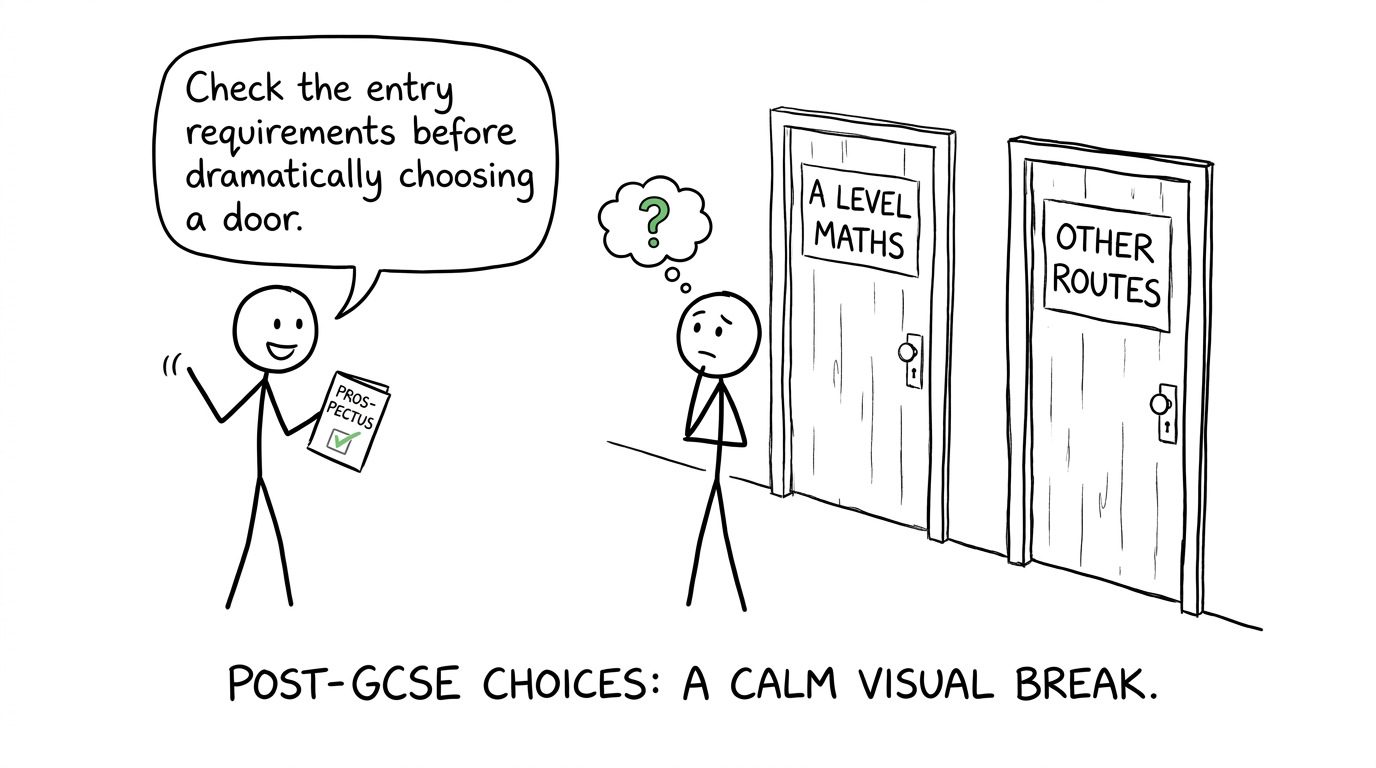 A student checks course requirements before choosing a door
Choose a course that uses some mathematics
A grade 666 can provide a useful foundation for subjects such as science, economics, psychology, geography, business or computing. However, subject requirements vary considerably. A course may ask for a particular grade in Maths even when GCSE Maths is not its main prerequisite.
Read the published requirements and contact the provider if anything is unclear. Core Maths may also be available for students who want to continue practical mathematics without taking the full A Level.
Move towards an apprenticeship or vocational route
A grade 666 demonstrates numeracy above the standard pass benchmark and can support applications for apprenticeships, T Levels and vocational courses. Employers and providers consider the complete application, though, including other grades, experience, interviews and any role-specific assessments.
Consider a result review only when there is evidence
You do not normally need to resit a grade 666. If you narrowly missed a grade 777 needed for a confirmed course, speak to your exams officer promptly. Your school can explain access to scripts and review-of-marking procedures, including deadlines, costs and the possibility that a mark can move down as well as up.
Do not request a review simply because the next grade feels close. Base the decision on the marked script, professional advice and a genuine entry requirement.
How to turn a grade 666 into stronger maths
If you are preparing for a future resit, an entrance assessment or A Level Maths, avoid restarting the entire specification. Diagnose the gaps first.
Complete a suitable paper or short assessment, mark it carefully, and classify each lost mark as a knowledge gap, execution error or exam-technique problem. The grades 444 to 666 target tests and Edexcel mini tests can make this manageable.
Then use a simple cycle:
- review one topic through a revision lesson;
- answer focused practice questions;
- check the mark scheme or video solution;
- record the precise mistake;
- test the same skill again later.
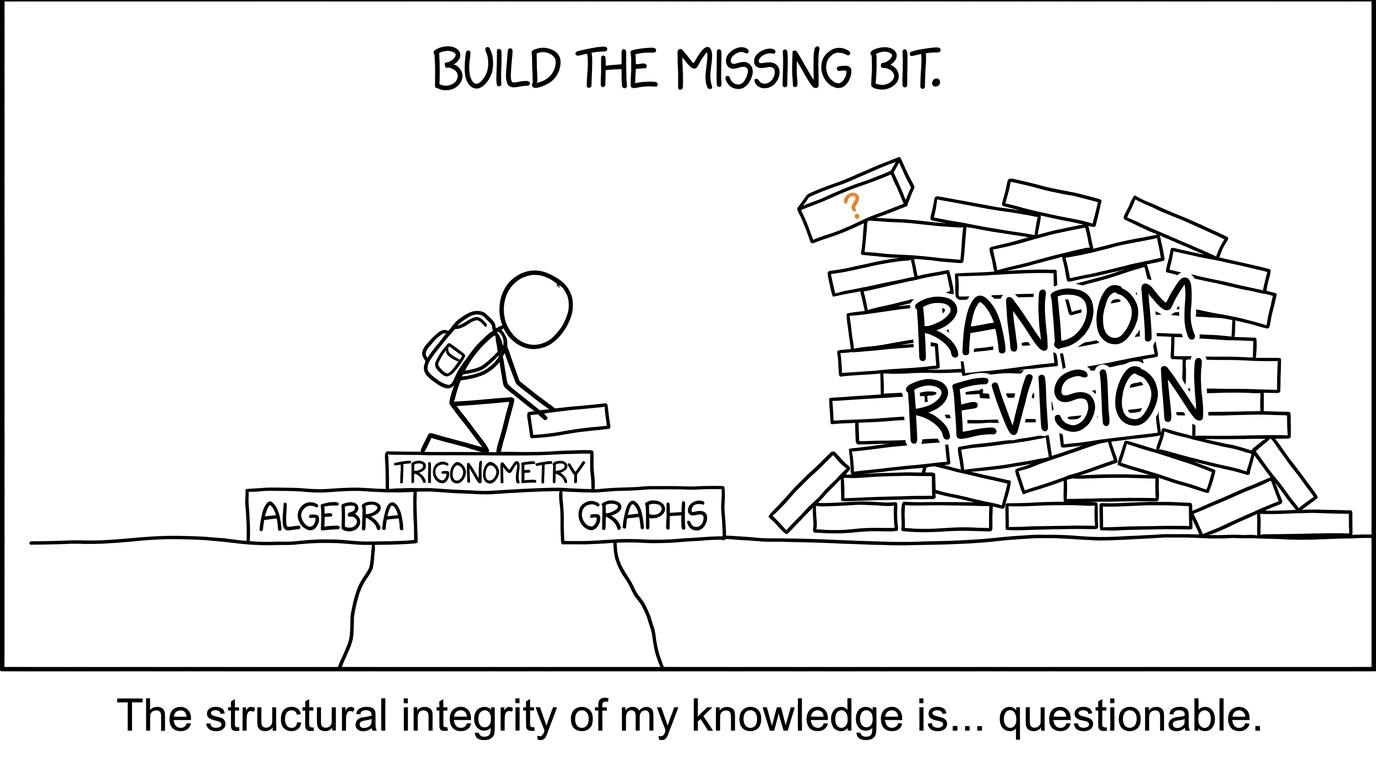 A student builds only the missing part of their maths bridge
Common mistakes after receiving a grade 666
Assuming every college has the same rules
A grade 666 may meet one provider’s A Level Maths requirement but not another’s. Always check the course page directly.
Treating the grade as a fixed percentage
Grade boundaries change between examination series. Use your marks and script to identify strengths rather than relying on a percentage found online.
Resitting without a clear purpose
A resit takes time that could be spent on your new course. Consider it only when a higher grade is genuinely required or supports a carefully discussed plan.
Forgetting GCSE skills over the summer
Students continuing with mathematical subjects benefit from light, targeted practice. A few focused sessions are more useful than random worksheets. MathsGenie’s predicted papers and exam resources are also available when preparing for a future examination series.
Your grade is a foundation, not a ceiling
A grade 666 in GCSE Maths is a strong pass that keeps many routes open. It may lead directly into your chosen course, or it may show you which foundations need strengthening before a more mathematical next step.
Begin with the requirement that matters, then make a specific plan. Use MathsGenie’s free revision lessons, practice questions, mark schemes, video solutions, mini tests, past papers and predicted papers to close genuine gaps rather than revising everything again. Start at the MathsGenie GCSE Maths revision hub and turn one result into a sensible next move.