The Quadratic Formula GCSE Maths Mock Guide
The quadratic formula GCSE maths guide for Year 11 mocks, with a clear method, two exam-style examples, common mistakes and focused practice.
A December mock can make revision feel larger than it really is. A Year 11 student opens a textbook intending to revise one topic, notices three others they have forgotten, and suddenly the evening becomes a judgement on everything they know.
The better approach is narrower. For the quadratic formula GCSE maths questions, learn what the formula does, practise substituting accurately, and check whether your answers are sensible. This guide takes you through that process, including two worked exam-style questions.
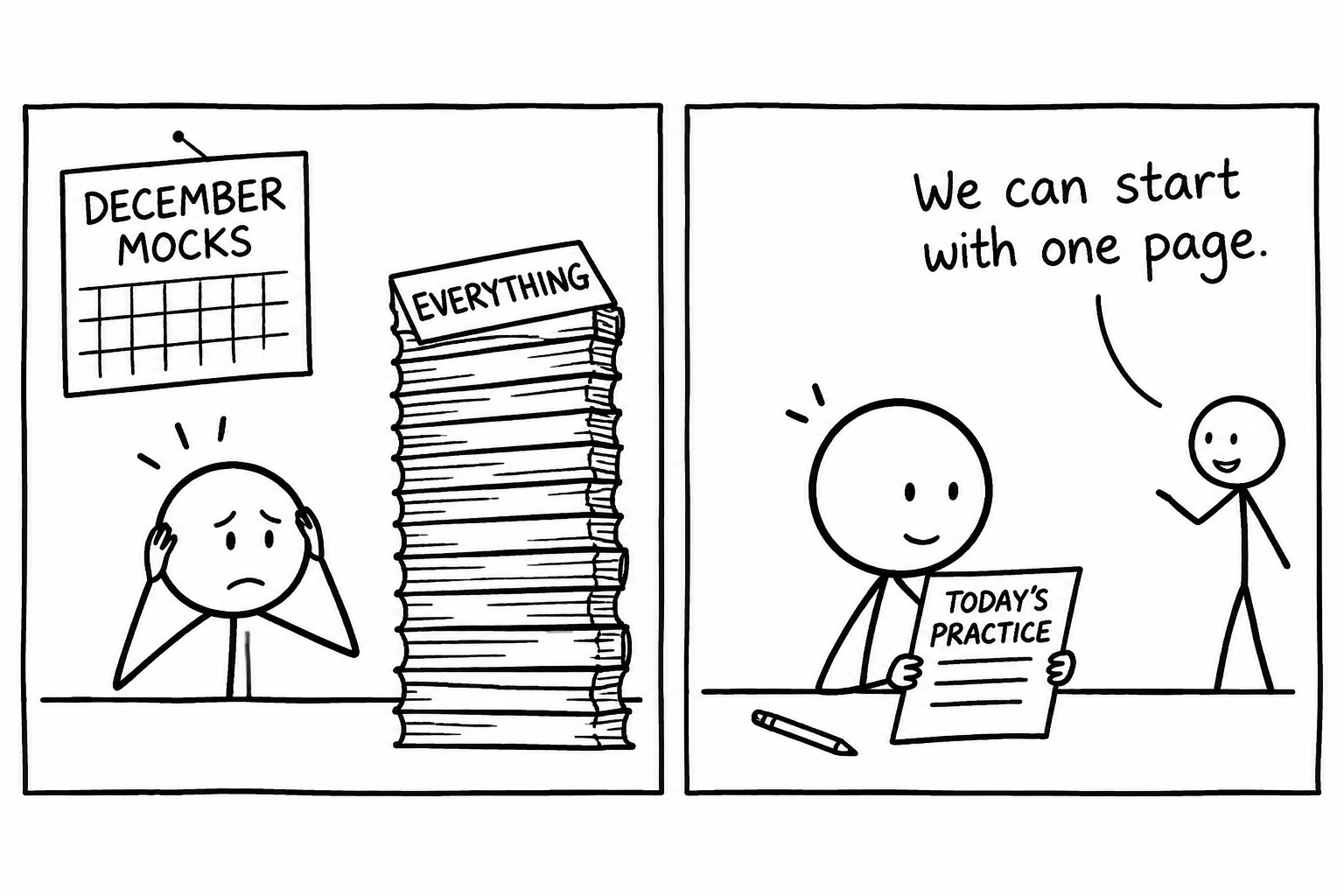 A Year 11 student replaces an overwhelming revision pile with one focused page
Your quadratic formula mock revision checklist
Before the mock, make sure you can:
- rearrange a quadratic equation into the form ax2+bx+c=0ax^2+bx+c=0ax2+bx+c=0;
- identify aaa, bbb and ccc, including negative values;
- substitute those values into the formula accurately;
- calculate both solutions using the ±\pm± sign;
- round answers to the accuracy requested;
- show enough working to make your method clear;
- check solutions by substituting them into the original equation.
The quadratic formula is used to solve equations of the form
ax2+bx+c=0,ax^2+bx+c=0,ax2+bx+c=0,where a≠0a\ne 0a=0. The formula is
x=−b±b2−4ac2a.x=\frac{-b\pm\sqrt{b^2-4ac}}{2a}.x=2a−b±b2−4ac.GCSE formula-sheet arrangements can change, so check the current information supplied by your school or exam board for your mock. Even when a formula is provided, you still need to recognise when to use it and substitute correctly.
How to use the quadratic formula
A reliable method is more useful than a clever shortcut. Use these steps every time.
Put the equation equal to zero
The formula applies when one side of the equation is 000. If necessary, rearrange first so that the equation reads
ax2+bx+c=0.ax^2+bx+c=0.ax2+bx+c=0.Keep the terms in descending powers of xxx. This makes the coefficients easier to identify.
Identify the coefficients with their signs
Read off aaa, bbb and ccc. The sign belongs to the coefficient. For example, in
3x2−7x−2=0,3x^2-7x-2=0,3x2−7x−2=0,we have a=3a=3a=3, b=−7b=-7b=−7 and c=−2c=-2c=−2.
Writing these values on a separate line is one of the simplest ways to prevent a substitution error.
Substitute using brackets
Replace every letter in the formula. Brackets are particularly important when bbb or ccc is negative:
x=−(−7)±(−7)2−4(3)(−2)2(3).x=\frac{-(-7)\pm\sqrt{(-7)^2-4(3)(-2)}}{2(3)}.x=2(3)−(−7)±(−7)2−4(3)(−2).Find both roots
The symbol ±\pm± creates two calculations: one using addition and one using subtraction. Unless the value under the square root is 000, a quadratic solved this way produces two distinct real solutions when the discriminant is positive.
Round only at the end
Keep the calculator value on screen and round the final answers to the requested accuracy. Early rounding can alter the last digit of an answer.
Worked question: solve a quadratic with two irrational roots
Question: Solve
2x2+3x−4=0.2x^2+3x-4=0.2x2+3x−4=0.Give your answers to 222 decimal places.
First identify the coefficients:
a=2,b=3,c=−4.a=2,\qquad b=3,\qquad c=-4.a=2,b=3,c=−4.Substitute them into the formula:
x=−3±32−4(2)(−4)2(2).x=\frac{-3\pm\sqrt{3^2-4(2)(-4)}}{2(2)}.x=2(2)−3±32−4(2)(−4).Simplify the expression under the square root:
x=−3±9+324=−3±414.x=\frac{-3\pm\sqrt{9+32}}{4} =\frac{-3\pm\sqrt{41}}{4}.x=4−3±9+32=4−3±41.Now calculate the two roots separately:
x=−3+414≈0.85,x=\frac{-3+\sqrt{41}}{4}\approx 0.85,x=4−3+41≈0.85,and
x=−3−414≈−2.35.x=\frac{-3-\sqrt{41}}{4}\approx -2.35.x=4−3−41≈−2.35.Therefore,
x≈0.85orx≈−2.35.x\approx 0.85\quad\text{or}\quad x\approx -2.35.x≈0.85orx≈−2.35.Notice where accuracy mattered. The value c=−4c=-4c=−4 was substituted with its sign, which changed −4ac-4ac−4ac into a positive contribution. The answers were also rounded only after both complete calculations had been entered.
Worked question: rearrange before using the formula
Question: Solve
5x2+2=7x.5x^2+2=7x.5x2+2=7x.Give your answers to 333 significant figures.
The equation is not yet equal to 000. Subtract 7x7x7x from both sides:
5x2−7x+2=0.5x^2-7x+2=0.5x2−7x+2=0.Now identify the coefficients:
a=5,b=−7,c=2.a=5,\qquad b=-7,\qquad c=2.a=5,b=−7,c=2.Substitute carefully:
x=−(−7)±(−7)2−4(5)(2)2(5).x=\frac{-(-7)\pm\sqrt{(-7)^2-4(5)(2)}}{2(5)}.x=2(5)−(−7)±(−7)2−4(5)(2).Simplify:
x=7±49−4010=7±310.x=\frac{7\pm\sqrt{49-40}}{10} =\frac{7\pm 3}{10}.x=107±49−40=107±3.The two solutions are
x=7+310=1,x=\frac{7+3}{10}=1,x=107+3=1,and
x=7−310=0.4.x=\frac{7-3}{10}=0.4.x=107−3=0.4.Therefore,
x=1orx=0.4.x=1\quad\text{or}\quad x=0.4.x=1orx=0.4.These answers are exact, so writing unnecessary trailing zeros is not required unless the question specifically asks for a particular form. You can check quickly:
5(1)2+2=7(1)5(1)^2+2=7(1)5(1)2+2=7(1)and
5(0.4)2+2=7(0.4).5(0.4)^2+2=7(0.4).5(0.4)2+2=7(0.4).Both statements are true.
What the discriminant tells you
The expression inside the square root,
b2−4ac,b^2-4ac,b2−4ac,is called the discriminant. It gives useful information before you finish the calculation:
- if b2−4ac>0b^2-4ac>0b2−4ac>0, there are two distinct real roots;
- if b2−4ac=0b^2-4ac=0b2−4ac=0, there is one repeated real root;
- if b2−4ac<0b^2-4ac<0b2−4ac<0, there are no real roots.
At GCSE, this can help you spot calculator or substitution mistakes. If your graph clearly crosses the xxx-axis twice but your calculation gives a negative discriminant, return to the coefficients and signs.
Common slips in quadratic formula exam questions
The most damaging mistakes are often small enough to feel harmless.
Losing the sign of a coefficient
In 4x2−5x−3=04x^2-5x-3=04x2−5x−3=0, the correct values are a=4a=4a=4, b=−5b=-5b=−5 and c=−3c=-3c=−3. Writing b=5b=5b=5 changes several parts of the calculation.
Squaring a negative value incorrectly
If b=−5b=-5b=−5, then
b2=(−5)2=25,b^2=(-5)^2=25,b2=(−5)2=25,not −25-25−25. Put negative coefficients in brackets before squaring.
Dividing only the square-root term by 2a2a2a
The entire numerator is divided by 2a2a2a:
x=−b±b2−4ac2a.x=\frac{-b\pm\sqrt{b^2-4ac}}{2a}.x=2a−b±b2−4ac.Entering the numerator in calculator brackets helps preserve the fraction structure.
Giving only one answer
The ±\pm± sign usually produces two roots. Write both calculations explicitly until the habit is secure.
Using the formula before rearranging
An equation such as 3x2+4=8x3x^2+4=8x3x2+4=8x must first become
3x2−8x+4=0.3x^2-8x+4=0.3x2−8x+4=0.Only then can you identify aaa, bbb and ccc correctly.
Rounding too early or ignoring the instruction
A question may request decimal places or significant figures. Keep full calculator accuracy until the final line, then state both rounded solutions clearly.
A focused plan before December mocks
The quadratic formula mock revision does not need to consume every revision session. Begin with a short lesson review, then complete a small set of questions without notes. Mark them immediately and classify each error: rearranging, signs, calculator entry, missing root or rounding.
That classification matters. Doing ten more random questions is less useful than correcting the exact stage that failed. If signs are the problem, practise questions with negative bbb and ccc. If rearranging is the problem, choose equations not initially equal to 000. If calculator entry is unreliable, write the substituted formula before touching the calculator.
Use MathsGenie's free revision lessons, practice questions, mini tests, past papers, predicted papers, mark schemes and video solutions to move from learning the method to applying it under exam conditions. The revision planner can help you return to the topic after a few days rather than treating one successful session as the finish line.
Turn one weak topic into a useful mock plan
The calmest revision is specific. You do not need to feel confident about every quadratic question before you begin. You need one dependable process: rearrange, identify, substitute, calculate twice, round and check.
Start now by using MathsGenie's Mock Exam Builder to build a targeted practice paper containing quadratic formula exam questions. Complete it under timed conditions, mark it carefully, and use every lost mark to choose what you practise next. That is how a difficult-looking formula becomes a routine source of marks.