GCSE Maths Resit Myths: What Is Actually True?
GCSE maths resit myths can make your next step confusing. Learn the truth about November resits, grade boundaries, tiers and targeted revision.

A GCSE maths resit can feel different from the first attempt. You may be balancing college, work or an apprenticeship while returning to a qualification you hoped was finished. Meanwhile, everyone seems to have advice.
Most GCSE maths resit myths stretch a small truth too far. You cannot assume November is easier, that everyone must enter that series, or that preparation means restarting the course. The useful approach is to check your circumstances, identify lost marks and practise deliberately.
The resit facts to check first
Before planning revision, confirm these details with your college or exam centre:
- your exam board, such as Edexcel, AQA, OCR or Eduqas
- your foundation or higher tier entry
- your intended exam series
- calculator requirements for each paper
- entry arrangements and internal deadlines
- the grade your next destination requires
Choose resources from the GCSE Maths revision hub that match your board and tier.
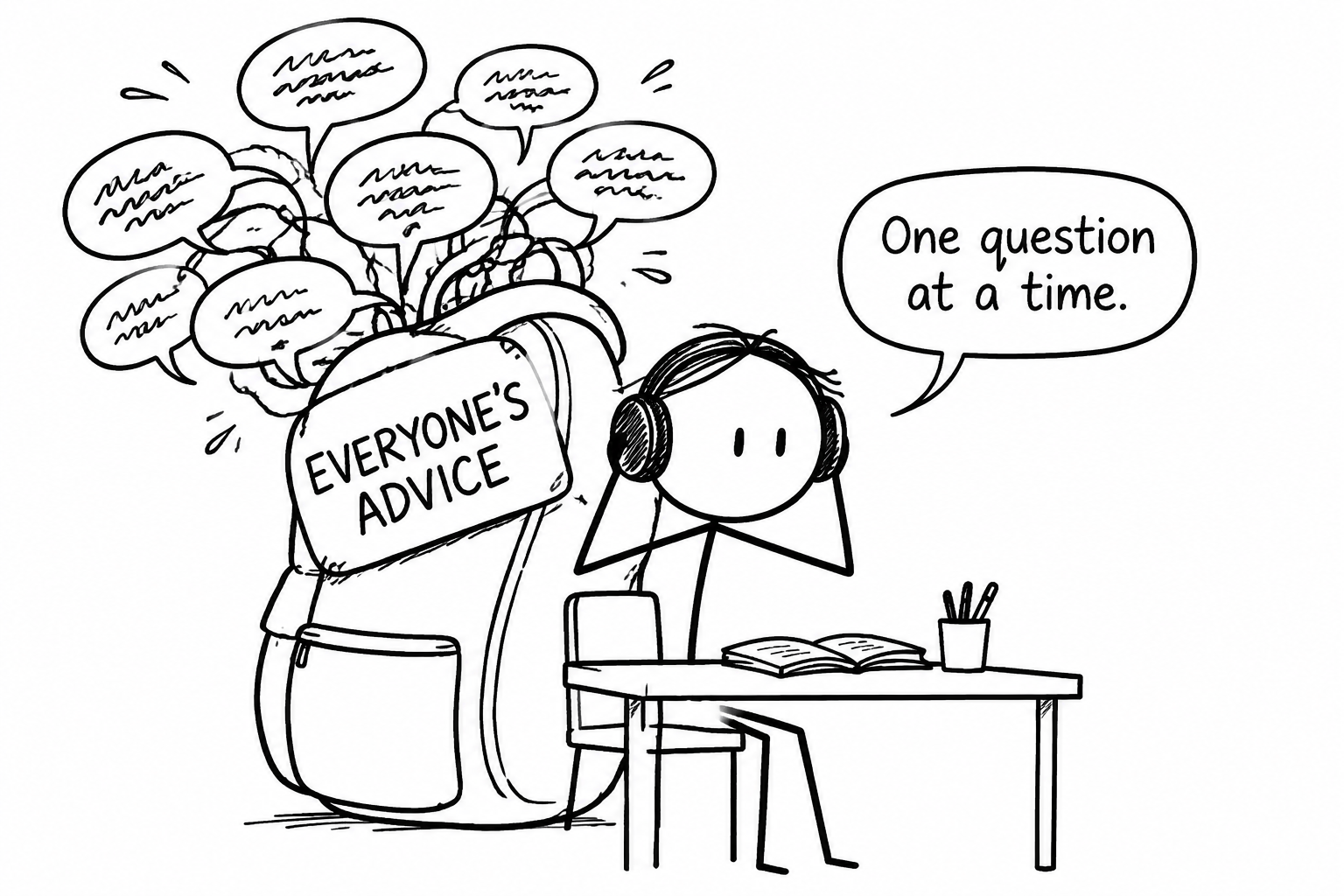 A post-16 student calmly ignores a rucksack overflowing with conflicting resit advice
Myth: everyone without a grade 444 must sit in November
This confuses continuing maths learning with entering a particular exam series.
In England, Department for Education funding rules require relevant students on funded 16-19 programmes without a grade 444 or an accepted equivalent to continue approved maths learning. That is a study requirement, not an automatic November entry requirement. Institutions decide when students are ready.
Full-time students entering with a grade 333 normally continue towards GCSE maths. Arrangements differ for lower prior grades, part-time programmes, exemptions and provision outside England. Ask your college which rules apply.
November may suit someone with limited gaps. Summer may provide more time for substantial rebuilding. Readiness matters more than rushing.
Myth: the November resit is easier
November may feel more manageable because the material remains familiar. That does not guarantee an easier paper or a lower pass mark.
Papers assess the exam board's specification, and grade boundaries are set for each series. There is no permanent percentage that always produces a grade 444. Boundaries can change as paper difficulty varies.
Use previous November papers to understand question style and timing. The Edexcel GCSE Maths past papers include November and summer series. Complete a suitable paper under timed conditions, then investigate the topics behind each lost mark.
Myth: resitting means learning everything again
A previous grade does not reveal which skills are secure. You might handle ratio confidently but repeatedly lose marks on algebra. Giving both equal revision time would ignore useful evidence.
Use a cycle:
- Diagnose: complete a mixed assessment without notes, following its timing and calculator rules.
- Classify: identify whether marks were lost through missing knowledge, misreading, incomplete working, calculator errors or time pressure.
- Repair: revisit a focused lesson and practise the method independently.
- Retest: attempt fresh questions without looking at the solution.
The Edexcel GCSE Maths mini tests can help concentrate practice. Understanding a video explanation is encouraging, but independent success is the stronger check.
Myth: foundation tier is not a proper achievement
Foundation and higher are routes through the same GCSE qualification. Foundation offers grades 111-555; higher targets grades 444-999, with grade 333 available within the permitted safety range.
If your goal is a secure grade 444, foundation may be appropriate. Higher includes more demanding content, so the tier should reflect assessment evidence and progression requirements.
Ask your teacher what recent papers suggest and what improvement would justify changing tier. Comparison with someone else's entry is less useful than understanding your own performance.
Myth: doing lots of papers is enough
Completed papers make effort visible. Improvement depends on what happens after marking.
For every paper, use the mark scheme, review unfamiliar methods through video solutions and record weak topics. Practise those separately before returning to mixed questions. Otherwise, another paper may simply repeat the same mistakes.
MathsGenie's free GCSE Mock Exam Builder offers subject and board selection. The Maths Exam Builder supports targeted practice using exam-style questions. Select suitable topics, length and difficulty, checking the available paper and mark scheme options.
For a resit student, this makes practice more specific: percentages, equations or compound measures can receive attention when they are the actual gaps.
Myth: missing November means the opportunity is over
GCSE maths is also examined in the summer series. If November is unsuitable, discuss later entry and any consequences for your course or progression plans with your centre.
Check dates for the relevant series. Your centre's internal deadline may be earlier than the exam board's entry deadline.
The practical question is which available series gives you sufficient preparation time while meeting your next destination's requirements.
Common mistakes in GCSE maths resit preparation
Revising from feelings rather than evidence. An uncomfortable topic is not necessarily the one costing most marks. Let marked work guide priorities.
Reading solutions without attempting questions. Recognition feels reassuring, but the exam requires you to choose and carry out methods independently.
Leaving out working. A valid method may earn marks even when the final answer is wrong. Clear stages also help you locate errors.
Planning an unrealistic routine. Revision must fit post-16 commitments. The 20-minute maths revision routine provides a starting structure, while the GCSE maths revision timetable guide can help organise longer preparation.
Make the next attempt more targeted
Your previous result provides information, alongside experience of exam conditions and question styles. Use it to make preparation more precise.
Start with one timed assessment. Mark it honestly and choose three topics costing accessible marks. Use MathsGenie's free revision lessons, practice questions, mini tests, mark schemes and video solutions to work through those gaps.
Then open the Mock Exam Builder and test your progress with a targeted paper. A resit becomes more manageable when you know what needs attention and how you will check improvement.