Functions GCSE Maths: Revise for Your Mock
Functions GCSE maths revision made clear: learn notation, composite and inverse functions, avoid common slips, and prepare confidently for your mock exam.
A functions question can look harder than it is. The notation is compact, several operations may be hidden inside one line, and a small mistake near the beginning can follow you through the whole answer. For a Year 11 student approaching December mocks, that combination can feel unsettling.
The useful truth is that functions GCSE maths questions are built from a short set of repeatable methods. You substitute an input, follow operations in the correct order, reverse a function or combine two functions. Once you can identify which of those jobs the question requires, the notation becomes much less mysterious.
This guide explains the methods, works through two exam-style questions and gives you a focused revision plan. You can also use the free GCSE Maths revision hub to choose resources for your exam board and tier.
Your functions mock revision checklist
Before your mock, aim to be able to:
- understand function notation such as f(x)f(x)f(x) and f(4)f(4)f(4);
- substitute positive numbers, negative numbers and algebraic expressions;
- evaluate a composite function such as f(g(x))f(g(x))f(g(x));
- understand why the inside function is completed first;
- find an inverse function using inverse operations;
- distinguish f−1(x)f^{-1}(x)f−1(x) from 1f(x)\frac{1}{f(x)}f(x)1;
- solve equations involving functions;
- show enough working for the mark scheme;
- check an inverse by composing it with the original function.
Simple functions can appear through input-output rules in GCSE Maths. More advanced inverse and composite functions are Higher tier material on specifications such as AQA. Check the requirements for your board rather than assuming every functions question is relevant to your paper. MathsGenie’s GCSE topics by exam board and tier can help you focus your revision.
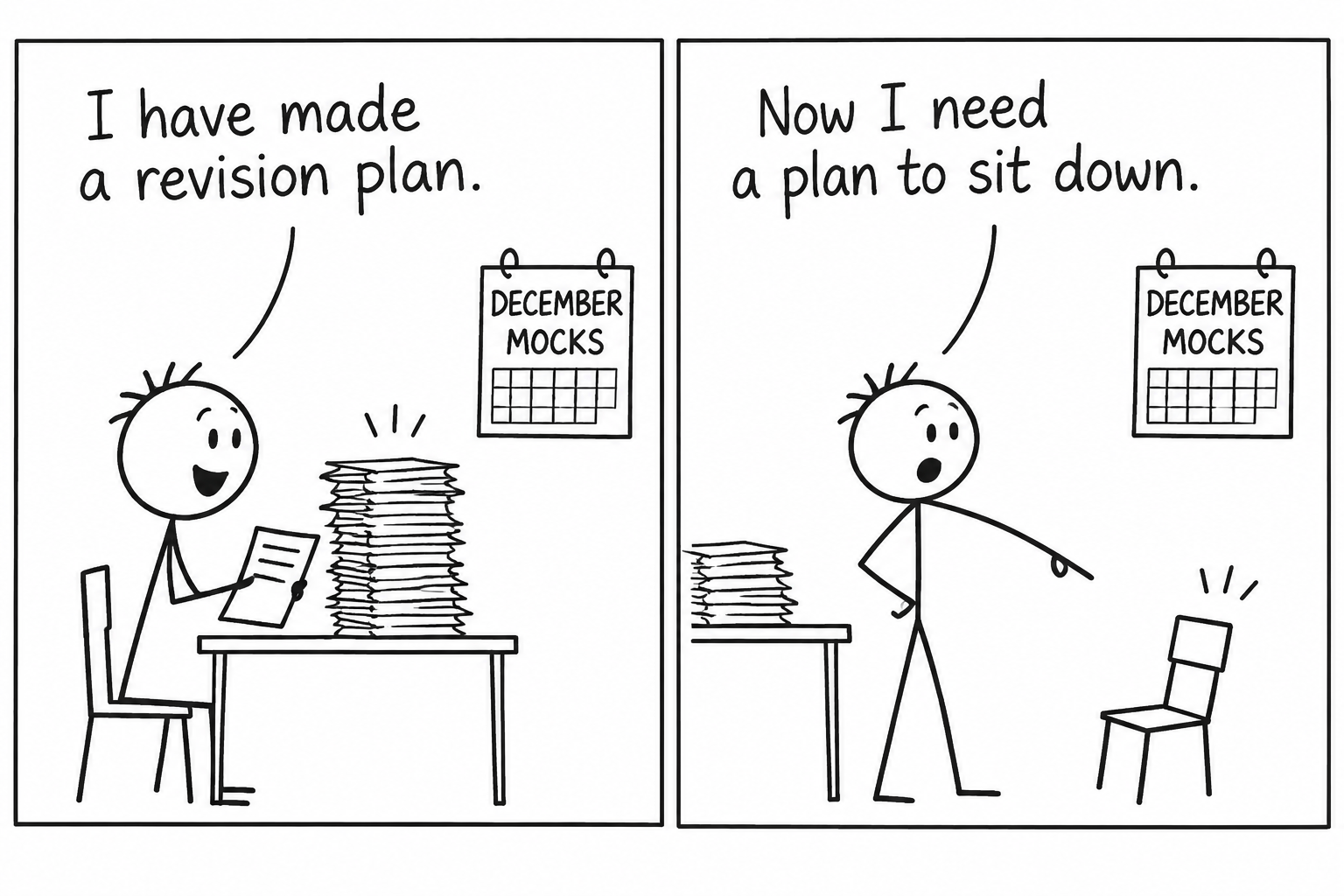 A Year 11 pupil discovers that making a revision plan and beginning it are two different functions
Begin by treating a function as a machine
A function takes an input and produces an output according to a fixed rule. If
f(x)=3x−4,f(x)=3x-4,f(x)=3x−4,then the function multiplies the input by 333 and subtracts 444.
The letter xxx is a placeholder. It does not mean that you must always substitute a number. You might be asked for f(5)f(5)f(5), f(−2)f(-2)f(−2) or even f(a+1)f(a+1)f(a+1). In each case, replace every xxx in the rule with the entire new input.
For example, finding f(a+1)f(a+1)f(a+1) requires brackets:
f(a+1)=3(a+1)−4.f(a+1)=3(a+1)-4.f(a+1)=3(a+1)−4.The brackets preserve the input as one complete object. This habit matters even more when the function contains squares. If g(x)=x2+1g(x)=x^2+1g(x)=x2+1, then
g(−3)=(−3)2+1,g(-3)=(-3)^2+1,g(−3)=(−3)2+1,not −32+1-3^2+1−32+1. Brackets make the intended substitution unambiguous.
Use the Inverse and Composite Functions revision lesson to review the notation alongside exam-style practice and worked solutions. If you follow a different exam board, select the corresponding course from the GCSE revision hub.
Composite functions: work from the inside out
A composite function applies one function and then another. The notation
f(g(x))f(g(x))f(g(x))means that ggg acts first. Its output becomes the input of fff.
It helps to read the expression from the inside out:
- calculate g(x)g(x)g(x);
- put that result into fff;
- simplify carefully.
The order matters. In general,
f(g(x))≠g(f(x)).f(g(x)) \ne g(f(x)).f(g(x))=g(f(x)).Functions behave rather like instructions in a recipe. Changing the order can change the result, even when the same two instructions are used.
Exam-style question: evaluating a composite function
Let
f(x)=3x−4f(x)=3x-4f(x)=3x−4and
g(x)=x2+1.g(x)=x^2+1.g(x)=x2+1.Find f(g(2))f(g(2))f(g(2)). Then solve f(x)=17f(x)=17f(x)=17.
Start with the function inside the brackets:
g(2)=22+1=5.g(2)=2^2+1=5.g(2)=22+1=5.Now use this output as the input of fff:
f(g(2))=f(5)=3(5)−4=11.f(g(2))=f(5)=3(5)-4=11.f(g(2))=f(5)=3(5)−4=11.Therefore,
f(g(2))=11.f(g(2))=11.f(g(2))=11.For the second part, substitute the function rule into the equation:
3x−4=17.3x-4=17.3x−4=17.Add 444 to both sides:
3x=21.3x=21.3x=21.Then divide by 333:
x=7.x=7.x=7.The important decision came before any arithmetic: ggg had to be completed first. Writing the intermediate value g(2)=5g(2)=5g(2)=5 also makes the method visible to an examiner and reduces the chance of combining both functions incorrectly.
Inverse functions: undo the original rule
An inverse function reverses what the original function does. If a function multiplies by 333 and then adds 555, its inverse subtracts 555 and then divides by 333.
The order reverses as well as the operations. That is the detail students often miss.
A reliable algebraic method is to:
- write y=f(x)y=f(x)y=f(x);
- rearrange the equation to make xxx the subject;
- replace yyy with xxx;
- write the result as f−1(x)f^{-1}(x)f−1(x).
Exam-style question: finding and using an inverse
The function fff is defined by
f(x)=x+53.f(x)=\frac{x+5}{3}.f(x)=3x+5.Find f−1(x)f^{-1}(x)f−1(x) and then work out f−1(9)f^{-1}(9)f−1(9).
Begin with
y=x+53.y=\frac{x+5}{3}.y=3x+5.Multiply both sides by 333:
3y=x+5.3y=x+5.3y=x+5.Subtract 555:
x=3y−5.x=3y-5.x=3y−5.Replace yyy with xxx to write the inverse function:
f−1(x)=3x−5.f^{-1}(x)=3x-5.f−1(x)=3x−5.Now substitute 999:
f−1(9)=3(9)−5=22.f^{-1}(9)=3(9)-5=22.f−1(9)=3(9)−5=22.A quick check is to put 222222 into the original function:
f(22)=22+53=273=9.f(22)=\frac{22+5}{3}=\frac{27}{3}=9.f(22)=322+5=327=9.The inverse has returned the original input, so the result is consistent. For additional questions with answers, use the Inverse and Composite Functions exam booklet or inspect an individual functions question with its mark scheme.
Common slips that cost marks
Functions exam questions are often lost through notation and order rather than difficult arithmetic. Watch for these recurring errors:
- Doing the outside function first. In f(g(3))f(g(3))f(g(3)), calculate g(3)g(3)g(3) before applying fff.
- Treating the inverse as a reciprocal. The notation f−1(x)f^{-1}(x)f−1(x) means the inverse function. It does not mean 1f(x)\frac{1}{f(x)}f(x)1.
- Reversing operations without reversing their order. Undo the final operation first.
- Forgetting brackets around negative inputs. Write (−4)2(-4)^2(−4)2, not −42-4^2−42, when the complete input is squared.
- Substituting into only one occurrence of xxx. Every xxx in the function rule must be replaced.
- Stopping after finding an intermediate output. If the question asks for f(g(2))f(g(2))f(g(2)), finding g(2)g(2)g(2) is only the first stage.
- Giving an inverse rule without showing rearrangement. Clear algebra can earn method marks even if a later arithmetic slip occurs.
- Ignoring the command word. “Find f(3)f(3)f(3)”, “find f−1(x)f^{-1}(x)f−1(x)” and “solve f(x)=10f(x)=10f(x)=10” are three different tasks.
When marking your practice, do more than count the marks. Label each error as notation, substitution, order, algebra or arithmetic. That diagnosis tells you what to practise next.
A focused plan before your December mock
Functions mock revision works best when it moves from method to mixed practice.
First, spend one session reviewing function notation and straightforward substitution. Next, practise composite functions, writing the inside result on a separate line every time. Then revise inverse functions and check each answer using the original rule.
Finish with a short set of mixed functions exam questions under timed conditions. Mark them immediately using the solutions and mark schemes, then redo each incorrect question without looking at the answer. A one-week GCSE Maths revision plan can help you fit this work around your other mock subjects.
Past papers are valuable, but a full paper may contain only a small amount of the topic you need. For targeted practice, use MathsGenie’s GCSE Mock Exam Builder to build a paper around functions and the connected algebra skills that caused difficulty. Sit it without notes, mark it carefully, and use the results to choose your next revision lesson.
Functions become manageable when you stop seeing the notation as a puzzle and start seeing it as a sequence of instructions. Review the method, practise the sequence and learn from the exact step where an answer went wrong. Build your targeted paper in the Mock Exam Builder today, then let your mistakes decide what you revise tomorrow.