Revision Order GCSE Art and Design: Does It Matter?
Revision order GCSE Art and Design matters less than deadlines, energy and spacing. Build a balanced timetable that protects art and maths revision time.
The difficult thing about revising GCSE Art and Design alongside maths is that the two subjects ask for different kinds of effort. Maths has questions you can answer, mark and revisit. Art may involve developing an idea, experimenting with materials, refining a composition or recording decisions in a portfolio.
So, does revision order GCSE Art and Design actually matter? Yes, but not because Art must always come before maths, or vice versa. Order matters when it reflects deadlines, weaknesses, available materials and your concentration. There is no universally correct sequence. A sensible timetable gives urgent practical work enough space while protecting regular, focused maths practice.
The goal is not to discover a perfect order. It is to stop either subject quietly consuming all the available time.
The short answer: use priorities, not a fixed subject order
A strong revision order follows this checklist:
- Put work with a genuine teacher or submission deadline first.
- Schedule demanding maths questions during a high-concentration period.
- Give Art a defined task and stopping point rather than an open-ended session.
- Revisit both subjects across the week instead of completing one enormous block.
- Match each Art task to your specification and your teacher's guidance.
- Use marked maths work to decide what comes next.
- Leave room for breaks, drying time, equipment changes and unexpected delays.
If nothing is immediately due, a useful default is to begin with the subject requiring the most precise concentration. For many students, that will be maths. Art can come first when materials are already prepared, a practical process is time-sensitive or a portfolio deadline is approaching.
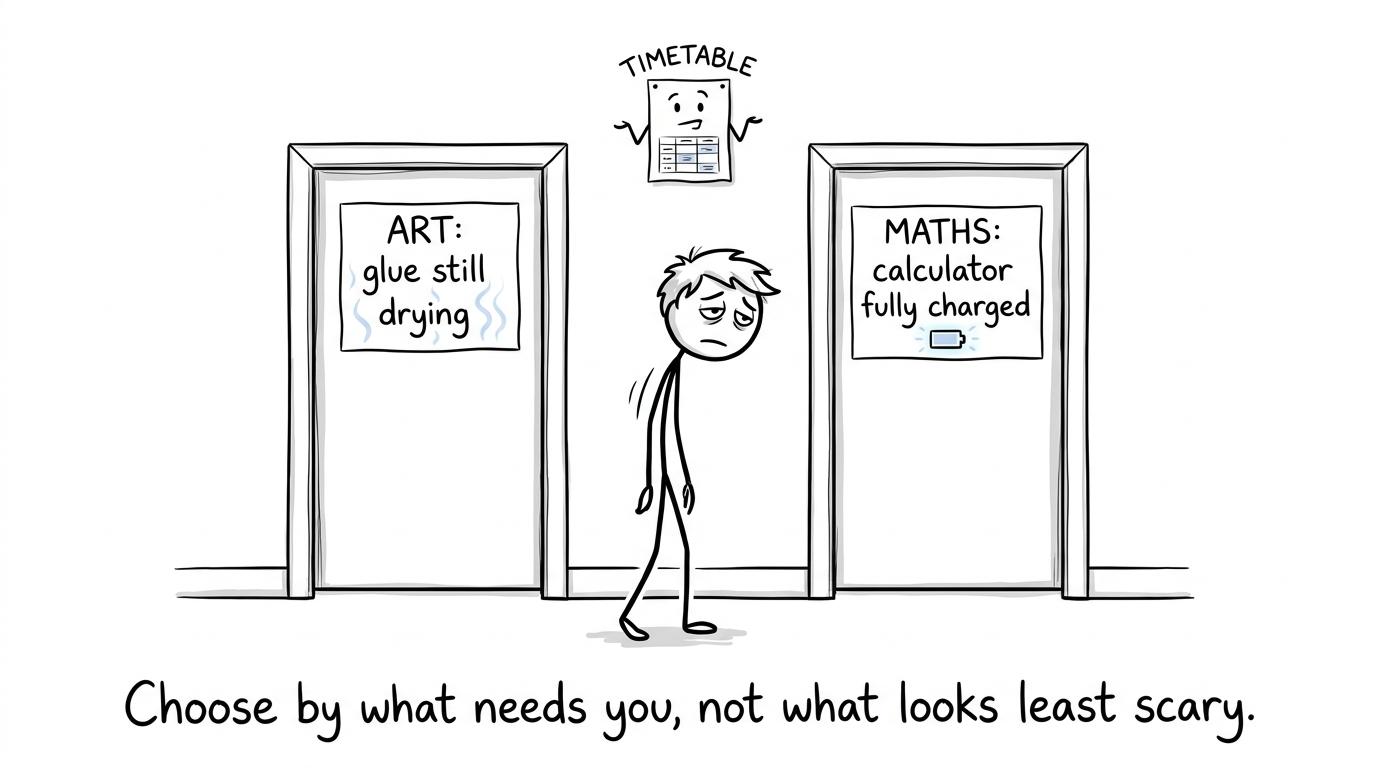 A student choosing between Art and maths revision doors
Why Art and maths need different kinds of planning
GCSE Art and Design is not revised in quite the same way as a written subject. Depending on your exam board and course, assessed work generally includes a portfolio or non-exam assessment component and an externally set assignment. The precise terminology, requirements and school deadlines vary, so check the specification used by your centre and follow your teacher's instructions.
Art preparation may include:
- investigating artists, designers or relevant sources;
- recording observations and ideas;
- experimenting with media and techniques;
- explaining how ideas have developed;
- refining work after reflection;
- producing a meaningful personal response.
Maths revision is more cyclical. You attempt questions, check them with a mark scheme, identify an error and practise the underlying topic again. MathsGenie's guide to finding your weakest GCSE topics helps turn vague worry into a specific repair list.
This difference matters. An Art session may need physical preparation and uninterrupted creative time. A maths session can often fit into a shorter, tightly defined block. Treating both subjects as identical entries on a timetable usually produces frustration.
What should determine your revision order?
Start with real deadlines
A deadline changes the value of time. If your Art teacher needs a portfolio section tomorrow, that task has a stronger claim than an unfocused hour of general maths revision. But an approaching maths paper also deserves protected practice before the final evening.
Write down:
- internal Art deadlines set by your school;
- dates for supervised or externally set work;
- maths mock and examination dates;
- the exam board and tier for each maths paper;
- materials or school facilities needed for practical work.
Do not rely on generic online dates for internal Art deadlines. Schools organise preparation and authentication carefully, and your teacher is the correct source for centre-specific arrangements.
Consider your energy, not just the clock
Revision time is not equally valuable throughout the day. If algebraic reasoning is hardest for you, placing it at the end of an exhausting evening is a poor bargain. Use your more alert period for unfamiliar higher-tier problems, multi-step foundation questions or timed paper sections.
Lower-energy periods can still be useful. You might organise Art references, label developmental work, review teacher feedback or mark maths questions already attempted. The key is to avoid confusing low-effort activity with high-value progress.
Put weaknesses before comfortable tasks
Students naturally begin with work that feels familiar. It offers a quick sense of progress, but comfort is not the same as readiness.
For maths, use a mini test, practice set or past paper to find where marks are being lost. The GCSE past-paper timing guide explains how topic practice and timed papers can play different roles as exams approach.
For Art, use teacher feedback and the assessment objectives in your own specification. Ask what is genuinely underdeveloped: research, recording, experimentation, refinement, annotation or the connection between investigation and final response. Do not simply add decorative pages because they are easier to complete.
Account for practical constraints
Some Art tasks depend on drying time, specialist equipment, natural light or access to a school studio. That can make order genuinely important. Starting a practical process first may allow you to complete maths while materials dry.
This is not procrastination if both tasks are planned. It is sequencing work around a real constraint.
 A relay race between a paintbrush and calculator
A better weekly pattern than “Art first” or “maths first”
Research on spacing generally supports revisiting learning across separate sessions rather than relying on one last-minute block. Evidence for interleaving also suggests that mixing related material can improve discrimination and later recall, although findings vary by task and much of the research does not recreate every condition of a GCSE timetable.
The practical lesson is modest: do not disappear into Art for a week and then expect one enormous maths session to repair everything.
A balanced weekly pattern might contain:
- short maths topic sessions on several days;
- one or two longer Art development sessions;
- a timed maths section or mini test;
- a separate marking and correction period;
- an Art review against teacher feedback;
- an unscheduled buffer for unfinished practical work.
MathsGenie's one-week GCSE maths revision plan offers a useful structure when time is tight. Adapt the available blocks rather than copying any timetable blindly.
Use a two-stage session when both subjects are urgent
When Art and maths both need attention, divide the evening deliberately:
- Focused stage: complete the task requiring the greatest concentration.
- Practical stage: switch subjects after a proper break and complete one clearly defined outcome.
Define the outcome before starting. “Revise maths” is too broad. “Complete and mark one mini test” is actionable. “Do Art” is equally vague. “Test two compositions and annotate the stronger choice” gives the session an endpoint.
This prevents Art from expanding indefinitely and prevents maths from becoming a ritual of watching videos without answering questions.
How to protect maths revision during an Art-heavy period
Art deadlines can become intense because practical work is difficult to compress. The answer is not to abandon Art. It is to preserve a minimum maths rhythm.
Start from the Edexcel GCSE maths revision approach, or apply the same diagnose-practise-check cycle to AQA, OCR or Eduqas:
- select one weak topic;
- review the relevant method;
- answer practice questions without copying;
- mark the work carefully;
- record the reason for each lost mark;
- return to the skill in a later session.
Near the examination, move gradually towards timed papers. Edexcel GCSE Maths predicted papers can provide unfamiliar practice, but they should complement the specification and past papers rather than become a guessing strategy. The guide to GCSE predicted topics explains why selective predictions should not replace broad preparation.
If a full paper is unrealistic during a busy Art week, use a mini test or a short collection of topic questions. Consistency matters more than making every session impressive.
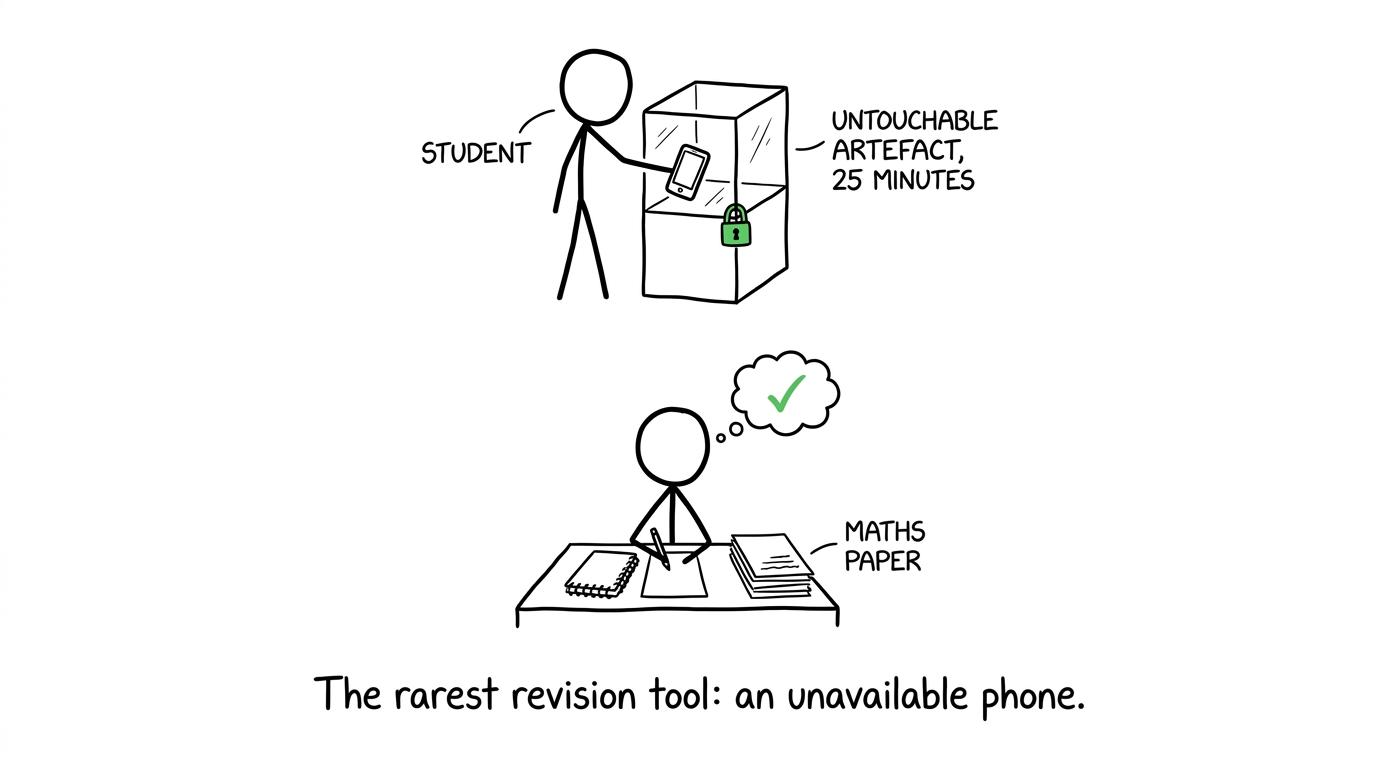 A phone displayed as an untouchable revision artefact
How to make Art sessions easier to stop
Creative work often has no obvious finish line. There is always another detail to adjust. Give each session a boundary based on evidence rather than perfection.
Before beginning, write down:
- the precise piece or page being developed;
- the assessment objective or teacher feedback it addresses;
- the material needed;
- what “finished for today” will look like;
- the next action for the following session.
Take care with annotation. It should communicate decisions, connections, experiments and evaluation where relevant. More writing is not automatically better, and presentation should not replace meaningful development.
A stopping rule protects tomorrow's maths session. It also helps you return to Art without wasting time trying to remember your intention.
Common revision-order mistakes
Always beginning with your favourite subject
Enjoyment can help you start, but repeating the comfortable choice may leave important weaknesses untouched. Alternate the opening subject or let deadlines and evidence decide.
Giving Art unlimited time
“Until it looks right” is not a measurable plan. Link each session to a specific decision, experiment or development goal.
Leaving maths until the night before
Last-minute revision may refresh familiar facts, but it leaves little time to diagnose and repair weak methods. If an exam is very close, use the GCSE maths night-before plan to prioritise short practice, corrections, equipment and sleep.
Counting passive activity as practice
Watching a solution is useful only if it leads to independent work. In Art, collecting images is not the same as investigating and developing from them. In maths, reading a method is not the same as retrieving and applying it.
Redoing work without fixing the cause
A second attempt is valuable after reflection and targeted practice. The guide to redoing GCSE past papers shows how marking, diagnosis and repair should come before repetition.
Ignoring recovery time
A timetable that assumes perfect concentration every evening will fail. Include breaks and one weekly buffer. Revision order only helps when the plan remains physically and mentally sustainable.
Build an order you can repeat
The best revision order for GCSE Art and Design is conditional, not fixed. Begin with urgent deadlines, protect your strongest concentration for demanding work, and keep both subjects returning across the week. Art may need longer practical blocks. Maths benefits from frequent questions, honest marking and targeted correction.
Use the MathsGenie revision planner to organise those decisions, then make each maths block count with free revision lessons, practice questions, mini tests and video solutions. As the exam approaches, add past papers, mark schemes and predicted papers in the correct tier and board format.
Do not ask which subject deserves all your time. Ask what the next focused block must achieve, then begin.