

Revising GCSE French With Music: Does It Help?
Revising GCSE French with music can lift your mood, but lyrics may harm memory and reading. Learn when to choose silence, instrumentals or French songs.
There is a familiar moment at the start of revision: the book is open, the flashcards are ready, but the room feels too quiet. Reaching for a playlist seems harmless. It might even make the session feel easier.
But is revising GCSE French with music actually a good idea? The short answer is that silence is usually safest for demanding language tasks. If silence feels uncomfortable, quiet instrumental music is a better choice than songs with lyrics. French songs can still be useful, but mainly when the song itself becomes an active listening exercise rather than background noise.
That distinction matters. Music can make revision feel better without necessarily making learning better. The goal is not to create the nicest hour at your desk. It is to remember vocabulary, understand French accurately and perform when the music stops.
The quick checklist
Use this decision guide before pressing play:
- Choose silence for learning vocabulary, reading, translation, dictation and timed practice.
- Try quiet instrumental music for routine organisation or simple review if it helps you settle.
- Avoid familiar songs with lyrics while completing language-heavy tasks.
- Use French songs actively for a defined listening or pronunciation exercise, not as unrelated background sound.
- Complete some revision in realistic exam conditions: silent, timed and without your phone.
- Test your own results rather than judging music by how productive it makes you feel.
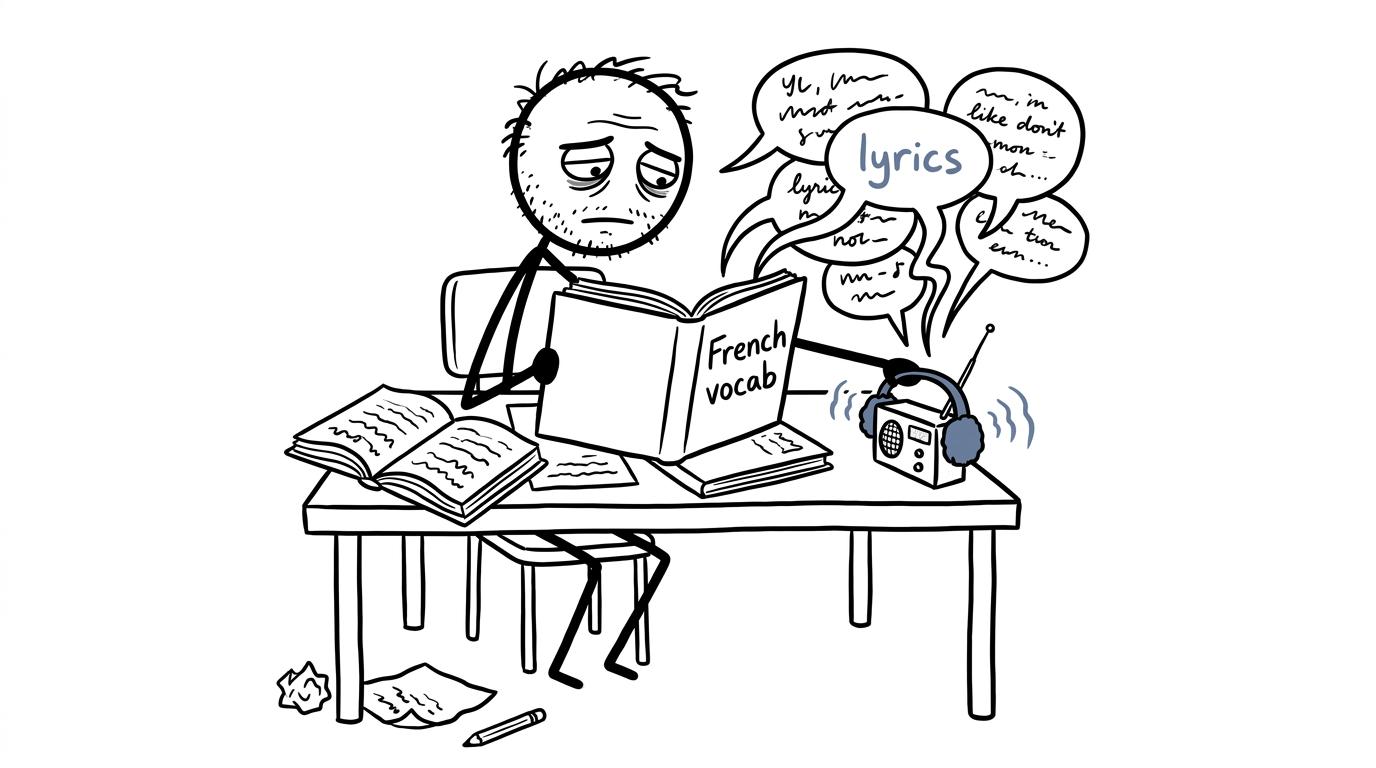 A student protecting French vocabulary revision from a singing radio
What research says about background music and focus
Research does not support the simple claim that music always improves concentration. Its effect depends on the task, the listener and the type of sound.
A systematic review of background music and cognitive performance found that effects were often absent or negative, particularly for memory and language-related work. Music containing lyrics tended to be more disruptive than instrumental music. Difficult tasks also appeared more vulnerable to distraction than easy ones.
A controlled study published in 2023 compared silence, instrumental lo-fi music and music with lyrics across verbal memory, visual memory, reading comprehension and arithmetic tasks. Performance was generally strongest in silence, between the two extremes with instrumental music, and weakest with lyrical music. Instrumental lo-fi did not reliably improve or harm performance.
More recent research into first-language and second-language reading also found poorer comprehension with lyrical pop music than in silence. Songs using the same language as the text could be especially distracting because the lyrics and the reading task competed for language processing.
There is an important limit to these findings: much of the experimental research involves adults or university students, not pupils preparing specifically for GCSE French. It therefore cannot tell every GCSE student exactly what will happen. It does, however, give a sensible default rule: for verbal memory and reading, lyrics introduce a risk without offering a dependable benefit.
Why lyrics can interfere with GCSE French revision
GCSE French places several demands on attention at once. You may need to recognise vocabulary, hold a sentence in memory, notice a verb ending and decide what the speaker or writer means.
Background lyrics create another stream of language. Even if you believe you are ignoring it, familiar words, changes in melody and a favourite chorus can pull attention away from the task. This is especially relevant when your revision already involves words.
Vocabulary and grammar
Learning vocabulary requires accurate links between a French word and its meaning. Grammar practice may require you to hold a sentence structure in mind while changing tense, person or agreement. Music with lyrics can compete with that short-term verbal processing.
Silence is therefore the strongest default for flashcards, spelling tests, verb recall and translation. Instrumental music may be acceptable if it is quiet and predictable, but it should not replace active recall. Looking through a vocabulary list while enjoying a playlist can feel fluent because everything looks familiar. Closing the book and retrieving the words reveals what you actually know.
Reading and translation
Reading comprehension is particularly sensitive to competing language. When translating, you must preserve meaning rather than replace each word mechanically. That requires careful attention to context, negatives, time phrases and unfamiliar vocabulary.
English lyrics may draw your attention because you understand them automatically. French lyrics may be even more complicated: your brain can begin processing the song while you are trying to process a different French text. Two French sentences are not necessarily twice the learning. They may simply compete.
For reading and translation, silence is the sensible first choice.
Listening and dictation
Listening practice needs clean audio. Background music makes it harder to distinguish pronunciation, word boundaries and small grammatical details. This matters because current GCSE French specifications include listening alongside reading, writing and speaking, with dictation featuring in the reformed qualifications first assessed from 2026.
During a listening task, the recording should be the only important sound. Use headphones if your surroundings are noisy, but do not layer a playlist underneath the exam audio.
Writing and speaking preparation
Writing and speaking both require retrieval. You need to produce language rather than merely recognise it. Silence helps you notice whether a phrase comes to mind independently or only feels familiar when you see it.
Music may be less disruptive while organising notes or preparing a revision folder. Once you begin planning an answer, recalling structures or practising aloud, turn it off. Speaking over music can also hide hesitation and pronunciation problems that become obvious in a quiet room.
When instrumental music may be reasonable
Instrumental music is not a proven concentration upgrade. Research often finds that it has little reliable effect either way. Still, that can make it a practical compromise for students who find silence unsettling or who need help beginning a session.
If you use it, choose music that is:
- quiet enough to forget;
- free from vocals and spoken samples;
- familiar but not emotionally absorbing;
- steady rather than full of sudden changes;
- controlled by a fixed playlist, so you do not keep choosing tracks.
The task matters too. Instrumental music is more suitable for low-demand activities such as arranging notes, updating a timetable or checking which topics need attention. It is less suitable for first-time learning, difficult reading or timed papers.
This principle applies across subjects. A student balancing French with GCSE maths might use gentle instrumental sound while organising the week, then switch to silence for French vocabulary retrieval and exam-style maths questions. The free MathsGenie revision planner can help separate those tasks before the session begins.
French songs are different when you use them actively
A French song playing behind a grammar worksheet is background music. A French song paused, replayed and examined for meaning is a learning resource. Those are different activities.
Research into music as a language-teaching method is mixed, but it suggests songs may be useful when learners actively engage with vocabulary, pronunciation, rhythm or repeated phrases. Passive exposure alone should not be mistaken for complete revision.
You could use one short extract to:
- identify words you genuinely hear;
- compare your transcription with accurate lyrics;
- notice pronunciation and connected speech;
- find a small number of useful phrases;
- repeat a line and then say it without the recording.
Choose suitable, clearly pronounced material and remember that song lyrics may contain slang, unusual word order or stretched pronunciation. Your exam board's prescribed vocabulary and grammar remain the better guide to what you must know.
Run a simple revision test on yourself
Preferences are real, but they are not the same as performance. The best way to judge your playlist is to compare results.
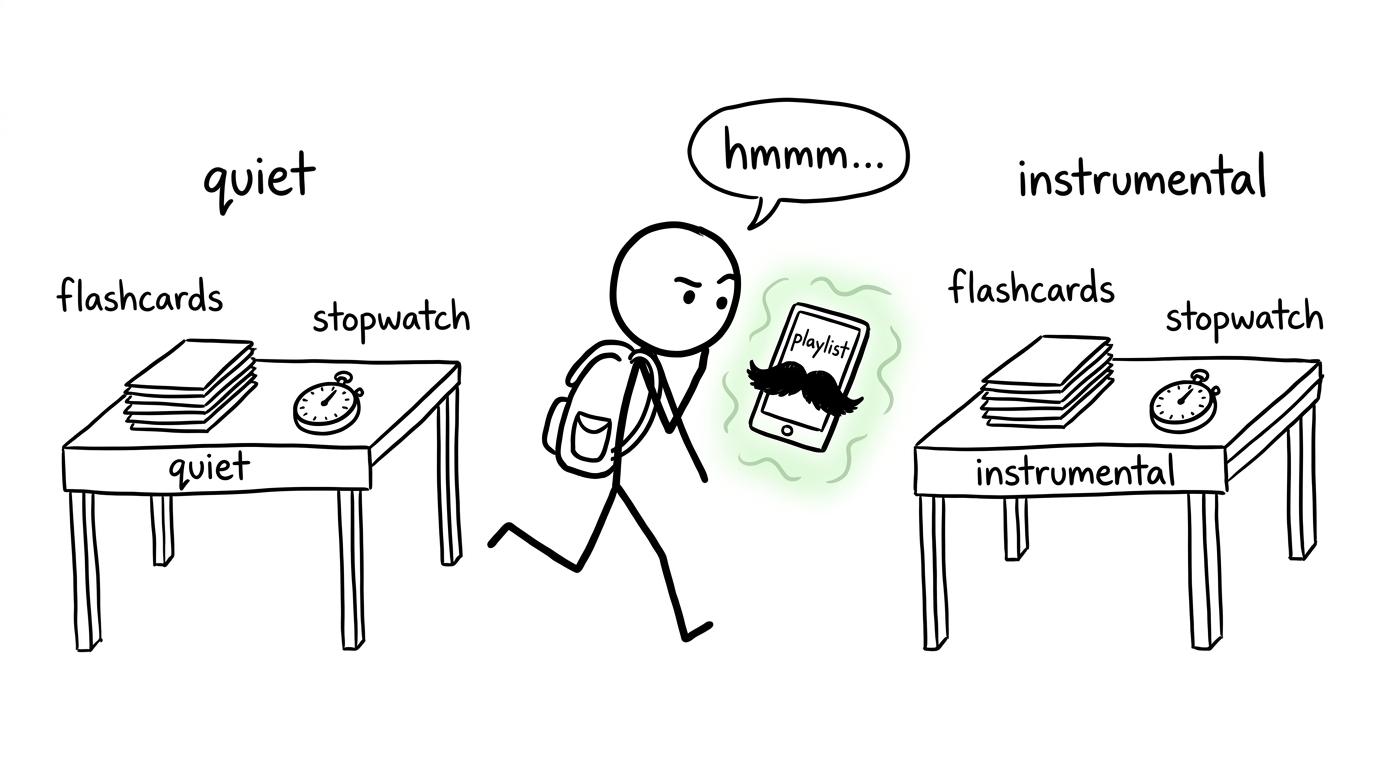 A student testing quiet and instrumental revision while a playlist wears a disguise
Use two similar revision sessions on different days. Keep the task, length and difficulty as consistent as possible:
- Complete one session in silence.
- Complete another with quiet instrumental music.
- Test yourself immediately without notes.
- Test the same material again after a delay.
- Record accuracy, time taken and how often your attention wandered.
Do not compare a difficult translation in silence with easy flashcards during music. That would test the tasks rather than the sound. Also avoid testing a favourite lyrical playlist first: familiarity and enjoyment can influence your judgement even if recall is weaker.
The result may show that instrumental music makes little difference. That is useful information. It may also show that silence produces better recall despite feeling less pleasant. Revision often works like that: what feels smooth is not always what leaves the strongest memory.
Match the environment to the exam
AQA and Pearson Edexcel's current GCSE French qualifications assess listening, speaking, reading and writing, while Eduqas candidates should follow their own current specification and teacher guidance. Whatever your board, the assessment will not give you a personal background playlist.
Some silent practice is therefore essential. It builds familiarity with the conditions in which you must retrieve knowledge.
The same rule is valuable in maths. Topic learning can happen in different surroundings, but a full paper should eventually be attempted under realistic conditions. MathsGenie's guide to using GCSE past papers properly explains the cycle of completing, marking, repairing and retesting. You can then choose the correct board and tier through the GCSE maths revision hub.
Edexcel students can use GCSE maths past papers with mark schemes, followed nearer the exams by Edexcel predicted papers. In both French and maths, silence is not a punishment. It is part of making practice resemble performance.
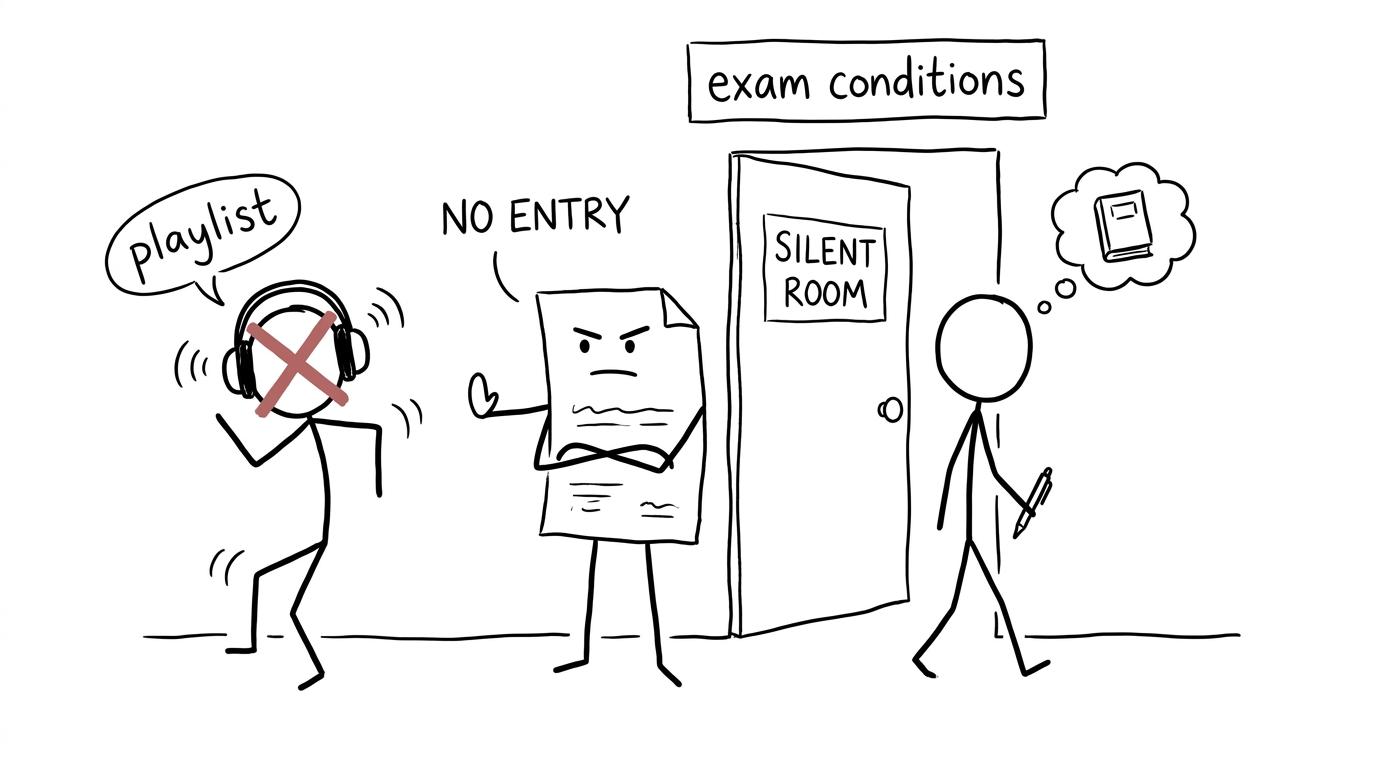 An exam paper refusing entry to a noisy playlist
Common mistakes when revising with music
Choosing songs because they are motivational
A song can improve mood while reducing attention. Enjoyment is valuable if it gets you to the desk, but use the track before revision or during a break rather than assuming motivation proves better learning.
Using French lyrics behind French work
It sounds educational, but unrelated French lyrics can compete directly with vocabulary, reading and translation. Make the song the task or turn it off.
Constantly editing the playlist
Skipping songs, checking notifications and searching for the perfect soundtrack fragment attention. If you use instrumental music, prepare a fixed playlist and keep the phone out of reach.
Never practising in silence
The examination room will be quiet. Complete regular timed work without music so that silence itself does not feel unfamiliar.
Measuring time rather than recall
A two-hour playlist proves that two hours passed. It does not prove that learning happened. Finish with a closed-book test and revisit mistakes later.
Letting one subject consume the timetable
French, maths and other GCSE subjects compete for limited revision time. Build a plan before motivation makes the decision for you. MathsGenie's one-month GCSE maths revision plan offers a repeatable structure, while the 20-minute maths revision routine helps keep maths moving during language-heavy weeks.
The best practical answer
For most demanding GCSE French work, begin with silence. If silence prevents you from settling, test quiet instrumental music and keep it only if your recall and accuracy remain strong. Avoid lyrical background music for vocabulary, reading, translation, dictation and writing. Use French songs deliberately as short listening resources rather than as a soundtrack.
Then train for the room in which the result will be decided. Work quietly. Use a timer. Retrieve without prompts. Mark honestly.
For the maths part of your GCSE timetable, MathsGenie gives you a clear next step: begin with free GCSE revision lessons and practice resources, diagnose gaps with mini tests, and build towards past papers, predicted papers, mark schemes and video solutions. Choose one focused task, put the playlist aside when the thinking becomes difficult, and let the evidence from your answers guide what happens next.











