Revising GCSE English Literature With Music
Revising GCSE English Literature with music? Learn when lyrics harm focus, when instrumentals may be acceptable, and how to test what works for you.
There is a familiar moment at the start of revision: the book is open, the highlighters are ready, and then comes the decision that somehow takes longer than expected: which playlist should you put on?
The short answer is that revising GCSE English Literature with music is usually less effective when the music contains lyrics. Literature revision depends heavily on reading, verbal memory and careful language analysis. Songs with words compete for some of the same attention. Quiet instrumental music may be less disruptive, but research does not show that it reliably improves learning compared with silence.
That does not mean every revision session must feel like a silent library. It means the music should fit the task, rather than becoming the task.
The quick music and revision checklist
Before pressing play, ask:
- Am I reading, memorising quotations or writing an essay? Choose silence first.
- Does the music contain lyrics I can understand? Turn it off for language-heavy work.
- Am I doing routine organisation or reviewing familiar material? Quiet instrumental music may be acceptable.
- Am I preparing under timed conditions? Recreate the quiet exam environment.
- Do I genuinely work better with music, or does it simply make revision feel easier?
- Have I compared my recall and accuracy in silence and with music?
The distinction between feeling focused and performing well matters. Music can make a session more pleasant without improving what you remember afterwards.
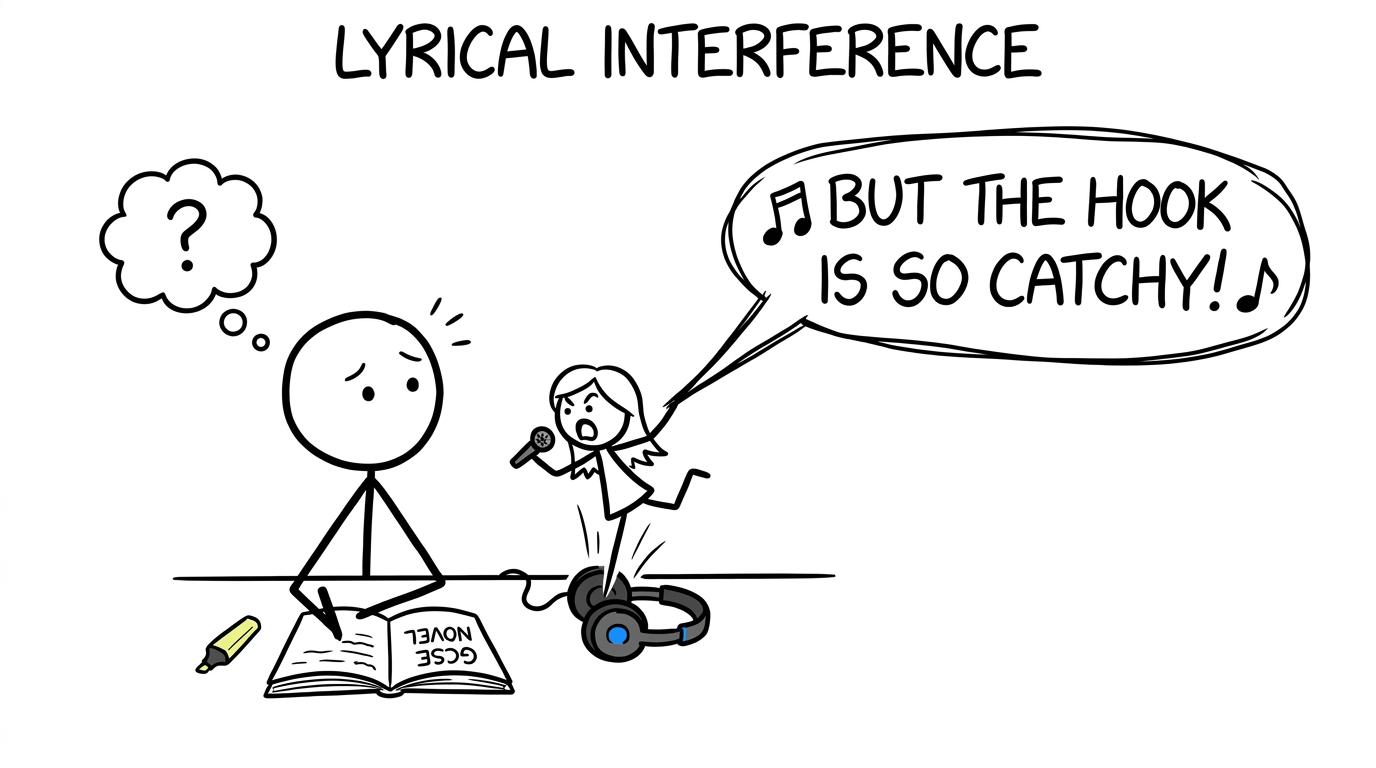 A student discovers that the singer in their headphones also wants to analyse the novel
Does background music help GCSE revision?
The research gives a more cautious answer than many playlists promise.
A systematic review of background music and cognitive performance found no general learning advantage. Effects varied according to the task and the type of music, but songs with lyrics were more likely to harm memory and language-related performance. Instrumental music was often no better or worse than silence.
A controlled study comparing silence, instrumental lo-fi and lyrical music reached a similar conclusion. Music with lyrics reduced performance in verbal and visual memory tasks. For reading comprehension, students performed better with instrumental music than with lyrical music, while the instrumental condition did not provide a reliable improvement over silence.
Another recent reading study found that pop music with lyrics reduced comprehension compared with no music. Lyrics in the same language as the text could be particularly distracting because both streams of information require linguistic processing.
These studies largely involved older students rather than GCSE candidates, so they cannot predict precisely how every teenager will respond. However, their findings are directly relevant to the mental activities involved in English Literature: reading closely, holding words in memory and developing written interpretations.
Why lyrics interfere with English Literature revision
GCSE English Literature is not passive reading. Across AQA, Edexcel, OCR and Eduqas, students are expected to understand texts, support interpretations with textual references, analyse language, form and structure, and consider context where relevant. The precise papers and weightings vary, but those core assessment objectives are shared.
Each task places demands on verbal attention.
When you read a speech from Macbeth while listening to a song, your brain receives two streams of language: Shakespeare's words and the singer's words. You may believe you are ignoring the song, yet familiar phrases can still capture attention. The result might be a missed image, a weaker inference or a quotation that never settles properly into memory.
This is especially important when you are:
- learning quotations;
- annotating an unfamiliar extract;
- analysing individual words;
- comparing poems;
- planning an argument;
- writing complete essay paragraphs;
- checking spelling, punctuation and sentence clarity.
Silence does not automatically create concentration, of course. A silent desk beside a constantly buzzing phone is hardly distraction-free. But removing lyrical music eliminates one avoidable source of competing language.
When instrumental music may be acceptable
Instrumental music is usually a safer choice than lyrical music because it removes the competing words. Even so, safer does not mean beneficial.
Quiet, predictable instrumental music may be reasonable when you are completing a relatively routine task, such as organising quotation cards, tidying notes or reviewing material you already understand. It may also mask irregular background noise in a busy household. In that situation, the music is not teaching you; it is helping to make the environment more consistent.
Keep it:
- quiet enough to forget about;
- free from lyrics and spoken samples;
- familiar rather than surprising;
- steady rather than dramatically changing;
- controlled by a prepared playlist, not constant song selection.
If you notice yourself anticipating a chorus, changing tracks or thinking about the music, it is no longer background sound.
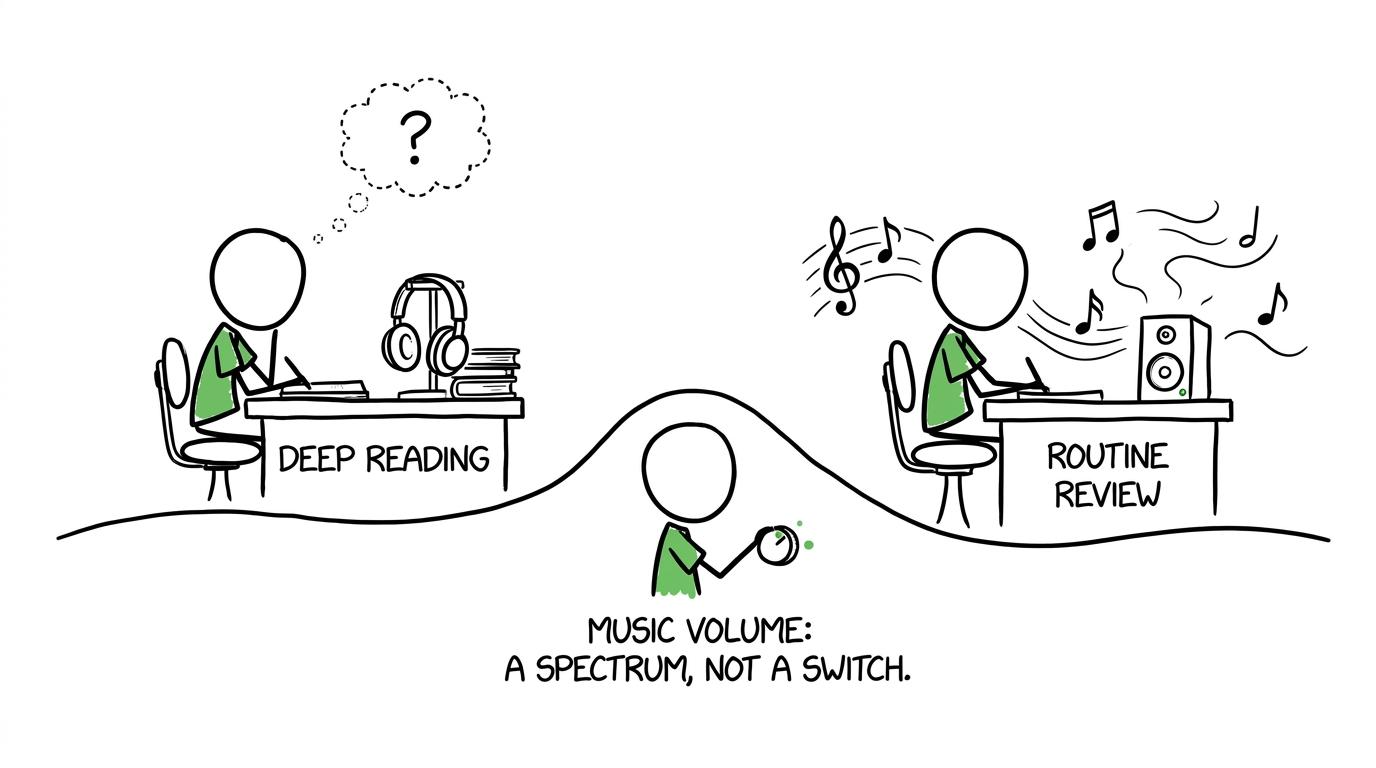 A student adjusts the music according to the revision task rather than using one rule for everything
Match the sound to the revision task
The most useful rule is not music or no music. It is match the environment to the cognitive demand.
Use silence for deep language work
Choose silence when learning quotations, reading a new chapter, analysing poetry or writing an essay from memory. These activities depend on precise verbal processing. Silence also makes it easier to notice when your understanding is weak rather than allowing the rhythm of a playlist to carry you through the session.
Consider instrumental music for low-demand tasks
Quiet instrumental audio may be tolerable while sorting notes, creating a revision timetable or copying teacher feedback into an action list. If the task becomes more demanding, pause the music.
Practise exam tasks in exam conditions
Music will not accompany you into the examination. Complete timed essays and recall tests in silence so you know that your concentration can survive without headphones.
The same principle applies when you switch to maths. A controlled study found no credible effect of background music on its arithmetic task, but GCSE maths papers involve more than routine calculation. They require interpretation, multi-step reasoning and sustained attention. Use silence when completing GCSE maths past papers, particularly when timing yourself.
Test whether music is helping rather than guessing
Personal preference matters, but preference is not proof. Run a simple comparison across several similar revision sessions.
Choose two comparable English Literature tasks. For example, use two sets of quotations from the same text or two similar poetry-analysis activities. Complete one in silence and the other with your normal music. Alternate which condition comes first on another day so tiredness does not always affect the same option.
After each session, record:
- how many quotations you can recall later without looking;
- how accurately you explain their effects;
- how long the task takes;
- how often you change tracks or lose your place;
- how mentally tired you feel.
Do not judge only by enjoyment. If music feels pleasant but recall becomes weaker, it is not serving the goal of the session.
You can use the same evidence-led approach for maths revision. Start with the GCSE maths revision hub, complete a short set in silence, mark it, and compare your accuracy with a similar session using instrumental music. The Edexcel GCSE maths mini tests are useful for short, controlled practice if Edexcel is your board.
Build a revision routine that does not depend on a playlist
The deeper risk is not one distracting song. It is teaching yourself that revision cannot begin until the sound, desk and mood are perfect.
A repeatable routine removes that negotiation. Decide the task before opening a music app. You might use a focused block of around 252525 minutes, followed by a short break. During the block, complete one defined activity: recall quotations, plan one essay or analyse one extract. At the end, test what you remember.
For a balanced GCSE timetable, use the free MathsGenie revision planner to organise your maths sessions around your other subjects. If exams are approaching, the one-month GCSE maths revision plan provides a structured route from topic practice to timed papers. A shorter one-week GCSE maths plan can help when time is limited.
The principle is the same in English and maths: learn actively, retrieve without looking, check your work and return to weak areas. Music cannot replace that loop.
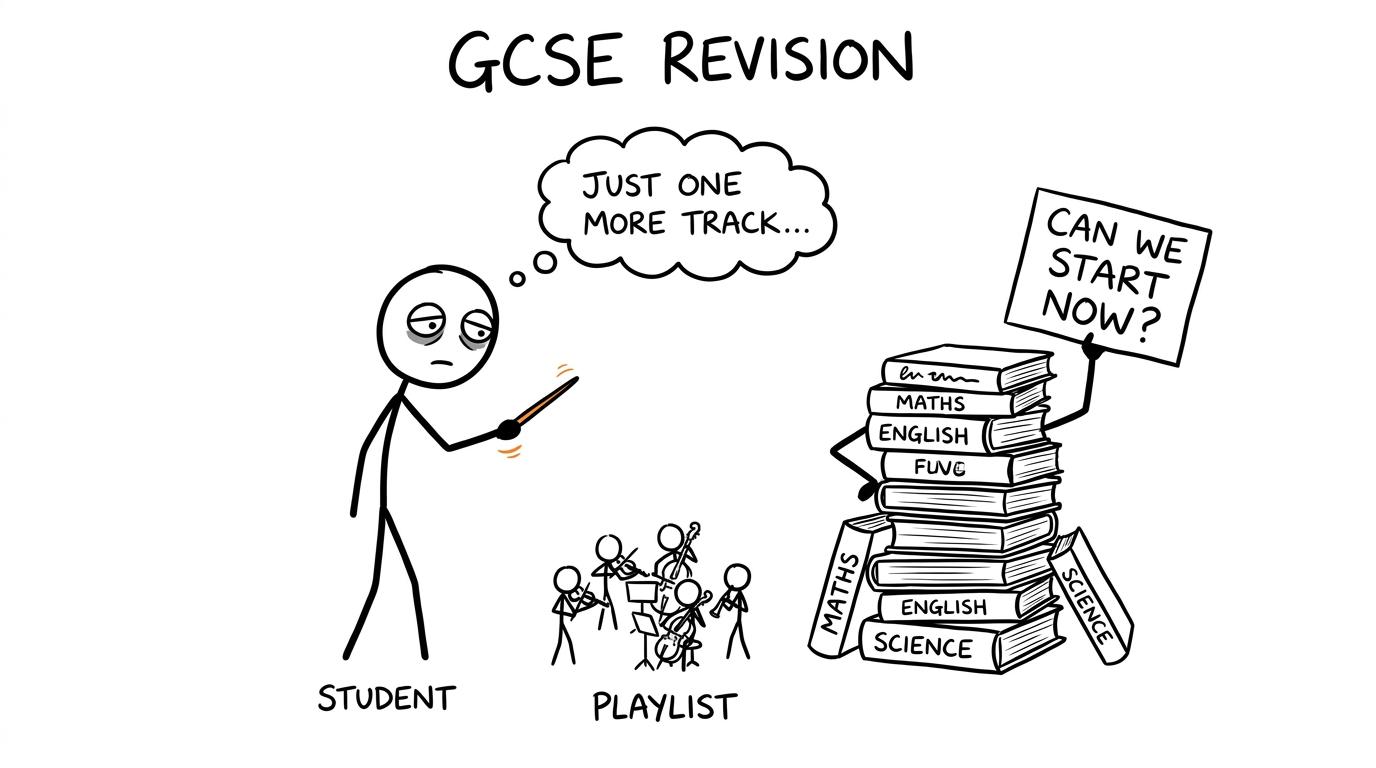 A revision playlist demands more preparation time than the books
Common mistakes when revising with music
Choosing favourite songs for difficult reading
Favourite songs are often the easiest to sing along with mentally. That makes them a poor companion for close reading, quotation learning and essay writing.
Assuming instrumental music improves memory
Instrumental music is generally less disruptive than lyrical music, but there is no consistent evidence that it makes learning stronger than silence. Treat it as an environmental preference, not a revision technique.
Spending too long building playlists
A playlist can become productive procrastination. Prepare one simple instrumental list in advance or begin in silence. The revision task should start within minutes, not after a long search for the ideal atmosphere.
Testing music on tasks that are too different
Comparing silent quotation learning with music-assisted note tidying tells you little. Compare similar tasks, then judge delayed recall, accuracy and time.
Never practising without headphones
If every session includes music, quiet exam conditions may feel unfamiliar. Complete regular timed work in silence, including essays, past-paper practice and mixed maths questions.
Mistaking time spent for learning achieved
A long session can feel successful because an album played from beginning to end. The better question is what you can now recall or do independently. For maths, the guidance on stopping forgotten GCSE content explains how retrieval, spaced practice and exam questions make revision stick.
The best decision for your next session
For demanding English Literature work, begin with silence. If your environment is noisy or silence feels genuinely uncomfortable, try quiet instrumental music and measure the result. Avoid lyrical songs while reading, memorising quotations or writing analytical responses, and always complete some timed work under realistic exam conditions.
Then carry the same disciplined approach into maths. Open the MathsGenie GCSE revision hub, choose one weakness, use a free revision lesson, complete the practice questions and check the mark scheme or video solution. Build towards mini tests, past papers and predicted papers.
The best revision soundtrack is not necessarily the one you enjoy most. It is the one quiet enough to let the learning remain centre stage.