

Revising GCSE Computer Science With Music: Does It Help?
Revising GCSE computer science with music? Learn when lyrics distract, when instrumentals may be harmless, and how to test what truly helps you focus.
The playlist is ready. Your headphones are on. Then, twenty minutes later, you know every lyric but cannot explain the algorithm you just read.
So, is revising GCSE computer science with music a good idea? Sometimes, but it depends on the music and the task. Songs with lyrics are more likely to interfere with reading, memorising and understanding technical explanations. Quiet instrumental music may be harmless for some students, particularly during routine practice, but research does not show that it reliably improves learning. For difficult work and realistic exam practice, silence is the safer default.
That answer may feel less satisfying than a simple yes or no. It is also more useful. Computer science revision involves several different kinds of thinking, and the background that feels comfortable is not always the one that produces the best recall.
The quick music and revision checklist
Use this as your starting rule:
- Choose silence for learning unfamiliar content, tracing complicated code and completing timed papers.
- If silence makes it difficult to begin, try quiet instrumental music during easier practice.
- Avoid songs with lyrics, especially while reading, writing explanations or memorising terminology.
- Keep the volume low and use a familiar playlist without adverts or frequent track changes.
- Put your phone out of reach once the music starts.
- Test your performance rather than trusting how productive the session feels.
- Complete some revision in silence because your GCSE examination will not come with a soundtrack.
The important distinction is between music helping you settle down to work and music helping you learn. Those are not necessarily the same thing.
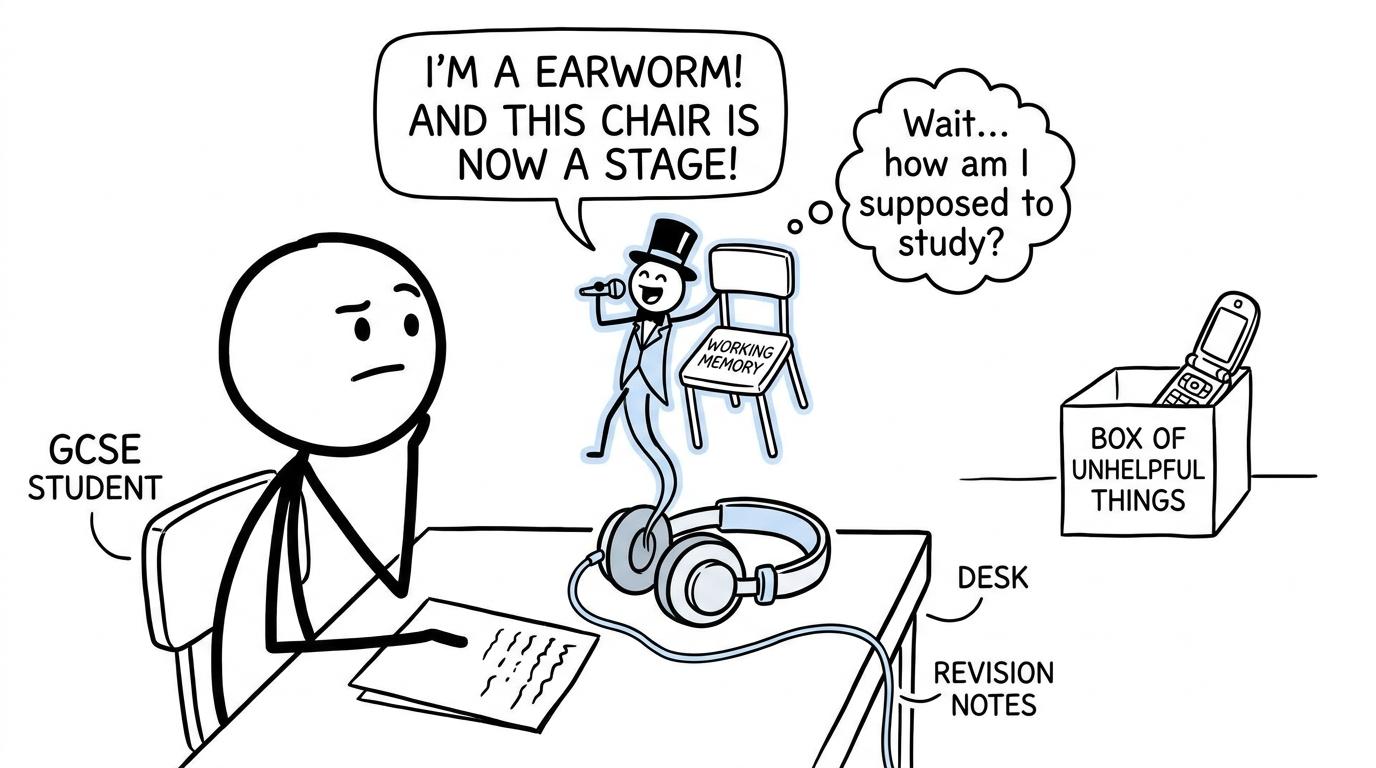 A cartoon singer escaping from headphones and stealing the student's working-memory chair
What research says about background music and focus
Research into background music and cognitive performance is mixed. The outcome can depend on the task, the listener, the volume and the kind of music being played. That makes sweeping claims such as “classical music makes you cleverer” or “music always ruins concentration” difficult to defend.
One peer-reviewed study published in 2023 compared silence, instrumental lo-fi music and music with lyrics while university students completed verbal memory, visual memory, reading comprehension and arithmetic tasks. Music with lyrics hindered memory and reading performance. The instrumental condition did not provide a credible improvement or impairment overall.
Earlier controlled research has also found that lyrics can reduce attention. Other studies have reported benefits under particular conditions, while more recent work on sustained attention continues to produce results that vary with task demands and individual differences.
The balanced conclusion is straightforward: music is not a dependable learning aid, and lyrics present the clearest risk. Instrumental music may make revision more pleasant without noticeably changing performance, but pleasant and effective are different measurements.
There is another limitation worth remembering. Much of this research uses adults or university students rather than GCSE pupils. It can guide your decisions, but it cannot prove exactly what will happen in your bedroom during computer science revision. A short personal test is therefore more valuable than copying somebody else’s playlist rule.
Why GCSE Computer Science makes lyrics risky
GCSE Computer Science is not one mental activity. Across specifications from exam boards such as AQA, OCR, Edexcel and Eduqas, students may need to recall technical knowledge, interpret algorithms, reason through programming problems and construct precise written answers. Always check your current specification and follow your teacher’s guidance because content and assessment arrangements vary by board and examination series.
Reading and learning technical vocabulary
Topics such as computer systems, networks, cyber security, data representation and ethical issues require careful reading. Your brain must hold the sentence you have just read while connecting it to the next one.
Lyrics introduce another stream of language. Even when you believe you are ignoring the song, familiar words can compete with the words in your notes. This is why lyrical music is particularly unhelpful when you are:
- reading a revision guide;
- learning definitions;
- creating flashcards;
- planning an extended response;
- checking the wording of a mark scheme.
Silence will not automatically make the revision active, of course. You still need to close the notes and retrieve the information. But it removes one avoidable source of verbal distraction.
Tracing algorithms and debugging code
Code tracing requires you to keep track of variables, conditions and iteration. Debugging requires a similar kind of disciplined attention: noticing what the program does rather than what you expected it to do.
Music with sudden changes, strong vocals or an irresistible chorus can break that chain of thought. After the interruption, you may need to reconstruct the state of the algorithm from the beginning. Instrumental music is less linguistically competitive, but silence remains sensible when the code is unfamiliar or the logic is demanding.
Repeating routine questions
Music has a better case during familiar, lower-demand work. If you are repeating definitions you already know, organising revision cards or completing straightforward practice, quiet instrumental music might help you stay at the desk.
The key phrase is might help. If the playlist causes track skipping, singing, daydreaming or phone checking, it is no longer background music. It has become the main task.
When revising GCSE Computer Science with music may work
Music is most defensible when it reduces the friction of starting without competing with the work itself. A familiar instrumental playlist can create a simple cue: headphones on, resources open, begin.
It is more likely to work when:
- the task is familiar rather than conceptually new;
- the music has no lyrics;
- the volume is low;
- tracks are predictable and do not demand attention;
- the playlist is prepared before the session;
- notifications and adverts cannot interrupt you.
This does not mean instrumental music is a revision technique. Retrieval practice, answering questions and reviewing mistakes are revision techniques. Music is part of the environment in which those techniques happen.
The same principle applies to maths. Watching a revision video with a song playing over it creates competing audio, while solving a demanding higher-tier problem may require uninterrupted working memory. If maths is also part of your revision week, start with the free GCSE Maths revision hub, where resources are organised by exam board and topic.
When silence is the better choice
Choose silence whenever accuracy and deep understanding matter more than comfort. That includes:
- learning a topic for the first time;
- reading dense explanations;
- writing longer answers;
- tracing unfamiliar algorithms;
- finding subtle errors in code;
- memorising precise terminology;
- completing timed examination questions.
Silent practice also tells you whether you can sustain attention without external stimulation. That matters because GCSE examinations take place under controlled conditions. You do not need every revision session to imitate the exam, but some should.
For maths, full papers should also be completed without music, hints or pauses. MathsGenie explains how to turn a paper into useful feedback in its guide to using Edexcel GCSE Maths past papers properly. Students taking another board can use the same sit, mark, repair and retest principle.
Test whether music actually helps you
A playlist can make a session feel smoother while quietly reducing what you remember. The simplest solution is to measure the result.
Choose two revision sessions containing tasks of similar difficulty. Complete one in silence and one with your usual music. Keep the duration, time of day and revision method as similar as reasonably possible.
After each session, record:
- how many questions you completed;
- how many answers were correct;
- how often you changed tracks or checked your phone;
- whether you could recall the material later;
- how mentally tiring the session felt.
Do not judge music after one unusually good or bad day. Repeat the comparison and look for a pattern. If the results are similar but instrumental music makes it easier to begin, keeping it for routine sessions may be reasonable. If silence produces better recall or fewer careless errors, the evidence is telling you something useful.
This approach is stronger than asking whether you “like” revising with music. Preference matters because a routine must be sustainable, but examination performance depends on what you can retrieve and apply.
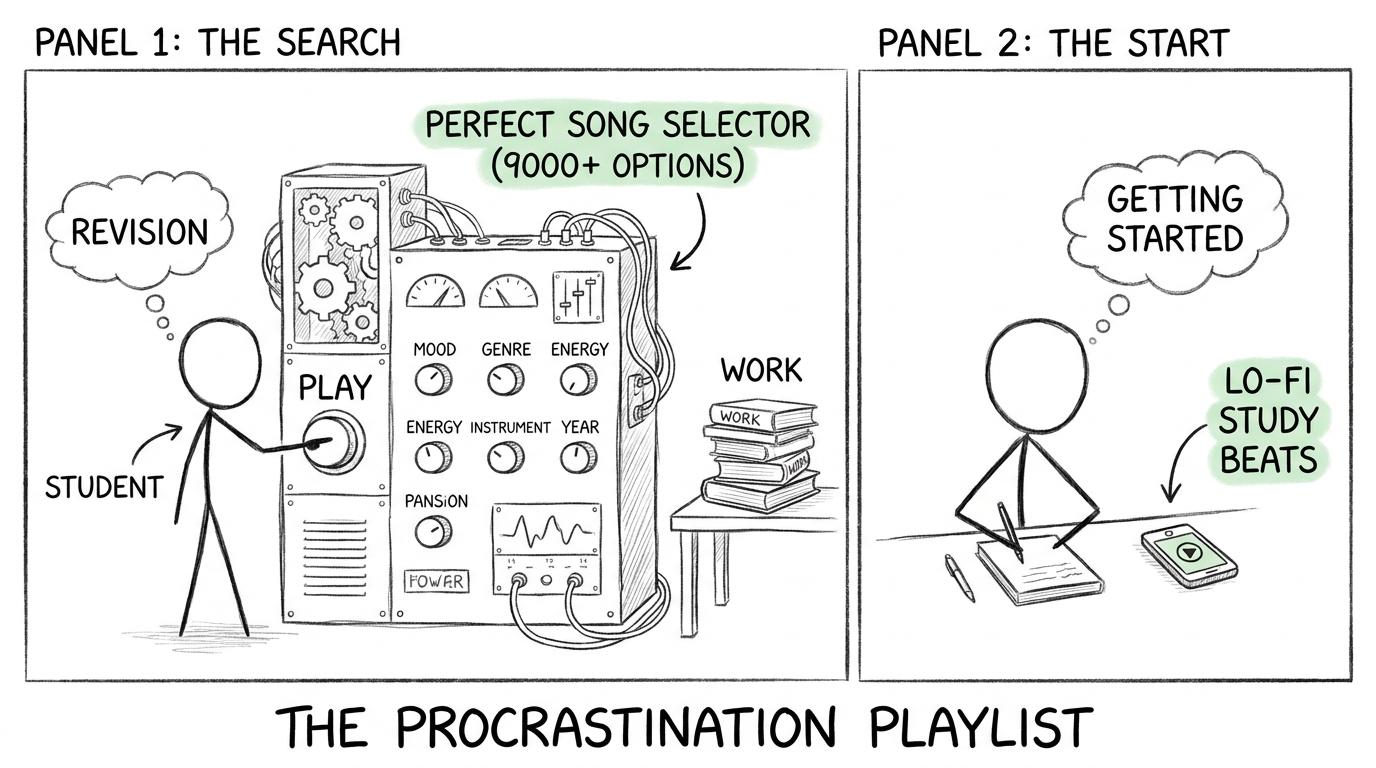 A student stops adjusting an enormous perfect-playlist machine and begins revising with one simple playlist
Build a revision session that works with or without music
A productive session needs a clear job. “Revise computer science” is too vague. “Recall network protocols, answer questions and correct mistakes” gives your attention somewhere to go.
A reliable structure is:
- Recall: write down what you know without opening your notes.
- Repair: use your specification, lesson materials or revision guide to fill gaps.
- Practise: answer questions or trace and write code.
- Mark: compare your response with the mark scheme or model answer.
- Retest: return to the weak material later without help.
Decide the music rule before starting. For example, you might use quiet instrumental music during the recall warm-up, then switch it off for difficult questions. That is better than negotiating with yourself every few minutes.
MathsGenie uses the same movement from explanation to independent practice. The free GCSE maths resources include self-assessment materials that can help identify weaknesses. If you need a broader routine, the one-month GCSE maths revision plan shows how retrieval, focused topic work and paper practice can fit together.
Common mistakes when using music for revision
Choosing favourite songs with lyrics
Familiar songs can be especially difficult to ignore because your brain anticipates the next line. Save them for breaks, travel or low-attention organisational jobs.
Spending longer on the playlist than the revision
Searching for the perfect concentration soundtrack is sophisticated procrastination. Prepare one simple instrumental playlist and stop adjusting it.
Mistaking time at the desk for learning
A long session can produce little learning if you only reread notes. Check progress with closed-book recall, marked questions and later retesting.
Using music during every practice paper
This creates a comfortable routine that does not resemble the examination. Complete timed papers in silence. Maths students can read when to start GCSE past papers before planning this stage of revision.
Ignoring the phone attached to the music
The playlist may be harmless while messages, recommendations and track changes are not. Start the audio, activate a focus setting and place the phone beyond easy reach.
Copying somebody else’s rule
One student may tolerate instrumental music during routine practice while another loses the thread immediately. Use comparable tasks and marked outcomes to decide what works for you.
Make the environment serve the task
Good revision is often less about discovering a perfect trick and more about removing small obstacles. Music can sometimes remove the discomfort of beginning. It can also add noise to a task that already asks a great deal from your attention.
For revising GCSE Computer Science with music, use silence as the default for new, verbal or demanding material. If music helps you start routine work, choose a quiet, familiar instrumental playlist and test whether your accuracy and later recall remain strong. Avoid lyrics when language, memory or careful reasoning is central.
Then apply the same honest test to maths revision. Open the MathsGenie GCSE Maths hub, choose a focused revision lesson and complete the practice questions without distractions. As examinations approach, add Edexcel predicted papers, mini tests, past papers, mark schemes and video solutions. The soundtrack is optional. Active practice and useful feedback are not.











