Revising Before Bed GCSE ICT: Help or Harm?
Revising before bed GCSE ICT can support memory, but not if it cuts sleep. Learn what to review, when to stop and how to protect your next-day exam focus.
A familiar revision trap begins with a reasonable promise: one final topic before sleep. Then one video becomes three, a quick check of your notes becomes an hour of rereading, and tomorrow's energy is quietly exchanged for tonight's sense of effort.
So, does revising before bed GCSE ICT content help? A short, calm review followed by enough sleep may support memory consolidation. Staying awake later to cram usually works against you because it reduces the sleep that helps preserve learning and supports attention the next day.
The useful distinction is not simply revision or sleep. It is whether revision fits before sleep without stealing from it.
The short answer
Bedtime revision is most likely to help when you:
- review material you have already learnt;
- retrieve answers rather than passively reread them;
- keep the session short and tightly focused;
- avoid stressful, unfamiliar tasks;
- stop at a planned time; and
- still leave enough opportunity for sleep.
It is more likely to hurt when you:
- begin a large new topic late at night;
- continue because you feel guilty rather than alert;
- use bright, distracting devices without limits;
- sacrifice sleep for another hour of low-quality work; or
- arrive at school tired and unable to concentrate.
For teenagers, health guidance commonly recommends around 888 to 101010 hours of sleep in each 242424-hour period, although individual needs vary. A bedtime routine should be designed backwards from the time you must wake up, not extended until your notes finally feel complete.
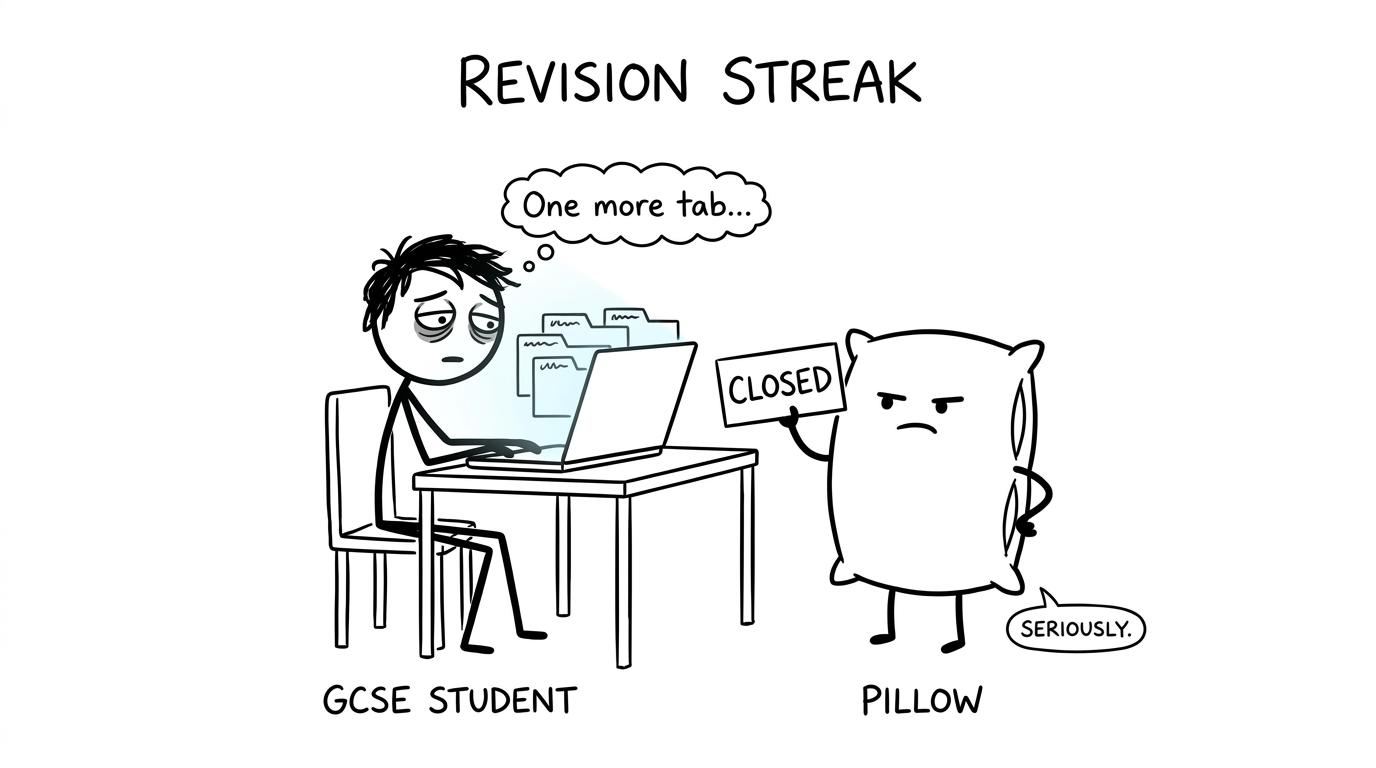 A tired GCSE student negotiates with an impatient pillow after opening one more revision tab
How sleep helps memory consolidation
Learning does not end when you close a textbook. New information initially leaves a memory trace that can still be fragile. During subsequent rest and sleep, the brain continues processes associated with stabilising and reorganising what has been learnt. This is known as memory consolidation.
Research comparing sleep with an equivalent period awake generally finds that sleep can reduce forgetting. Studies involving educational facts and adolescent vocabulary have also found overnight benefits, although results differ according to the material, timing and study design. Sleep is helpful, but it is not a magical recording function.
If you merely look at a page without understanding it, sleep cannot turn that page into secure knowledge. If you misunderstand the difference between validation and verification, for example, sleeping afterwards will not automatically correct the confusion. The learning still needs to be accurate and effortful.
This is why a short retrieval session can be useful. Trying to recall a definition, process or advantage before checking the answer gives your brain a clearer learning event than repeatedly scanning highlighted notes.
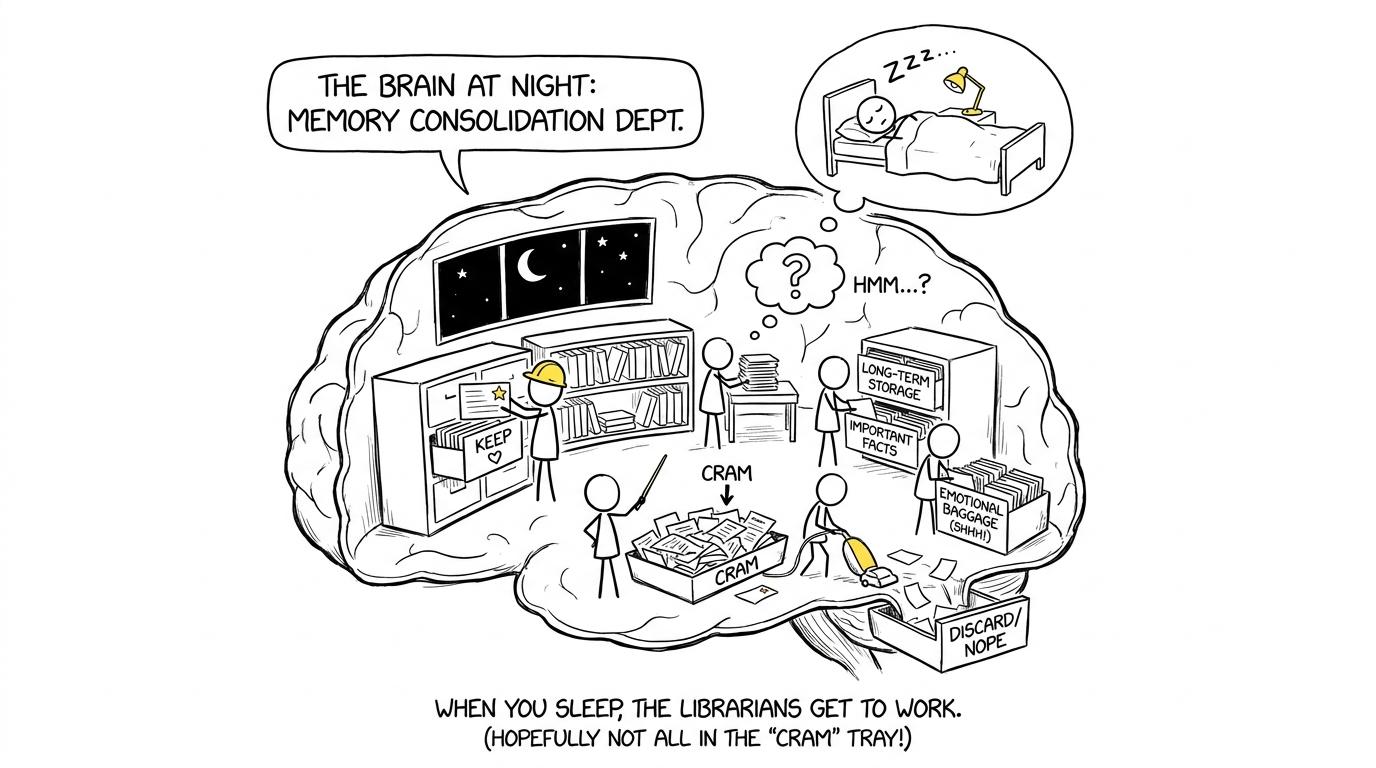 Tiny librarians inside a sleeping brain sort useful revision cards away from an overflowing cram tray
Why cutting sleep can cancel the benefit
There is an important catch. Revision before sleep may help consolidation, but late-night revision that reduces sleep can damage the conditions needed for that consolidation.
Sleep restriction is also associated with weaker attention, learning, mood regulation and decision-making. Those abilities matter in every GCSE exam. You need attention to notice command words, working memory to hold several details in mind, and judgement to decide which knowledge fits the question.
The same principle applies directly to maths. A tired student may know how to rearrange a formula but copy a value incorrectly or miss a negative sign. Knowledge is only part of exam performance; alert execution matters too.
If bedtime revision moves your sleep from approximately 888 hours to 666 hours, the extra revision has not been free. You have paid for it with part of the night. The relevant question is whether that tired final hour gives more value than the sleep it replaces. In most cases, a planned review followed by sleep is a better bargain than an unplanned cram.
What should you revise before bed?
The best bedtime material is familiar, small and easy to stop.
For a subject described by students as GCSE ICT, that might include definitions, hardware and software concepts, database terminology, cyber security principles, legal or ethical issues, and the advantages and disadvantages of different technologies. However, check your own specification. Depending on your nation, school and awarding organisation, the qualification may be called ICT, Digital Technology, Computer Science or another related title.
For maths, suitable material might be formula recall, short flashcards or a few previously corrected questions. The free GCSE maths revision hub lets you choose resources by exam board rather than revising material that may not match your course.
Good bedtime tasks
Choose one of these:
- recall five key terms without notes;
- explain one process aloud in your own words;
- answer a small set of flashcards;
- write a brief list of facts you keep forgetting;
- review errors from work completed earlier that day; or
- plan the first task for tomorrow's revision.
Retrieval should come before checking. Close the notes, attempt the answer, then compare it with the source. If the answer is incomplete, correct it once and add it to tomorrow's list.
Tasks better saved for earlier
Avoid starting a full past paper, a substantial coursework-style task or a difficult new unit immediately before bed. These activities require time, feedback and sustained concentration. They are also harder to stop when something goes wrong.
Maths students can use MathsGenie's guide to finding weak topics earlier in the day, then reserve bedtime for a calm review of the errors identified. Full papers belong in a wider plan; the guide to when to start GCSE past papers explains how to build towards timed practice.
A sensible pre-sleep revision routine
A useful routine does not need to be elaborate. It needs an ending.
Decide your stopping time first
Work backwards from your wake-up time and sleep needs. Include time to get ready for bed and settle down. Treat the stopping time as part of the revision plan, not as an optional reward for finishing everything.
Choose one narrow target
Do not write “revise ICT” or “revise maths”. Choose something you can complete, such as recalling network types or checking one set of formula flashcards. A narrow target reduces the temptation to keep going.
If you need a repeatable structure for maths, adapt the GCSE 202020-minute revision routine. Near bedtime, you may shorten it further and focus on recall rather than difficult exam questions.
Retrieve, check and record
Try to remember the material before opening the answer. Check it accurately, then record no more than three items that need attention tomorrow. This prevents unfinished work from becoming a vague source of worry.
Close the session properly
Shut the book, close the revision tabs and put materials away. Pack anything needed for the morning. The GCSE maths night-before plan follows the same principle: focused preparation should create calm, not consume the whole night.
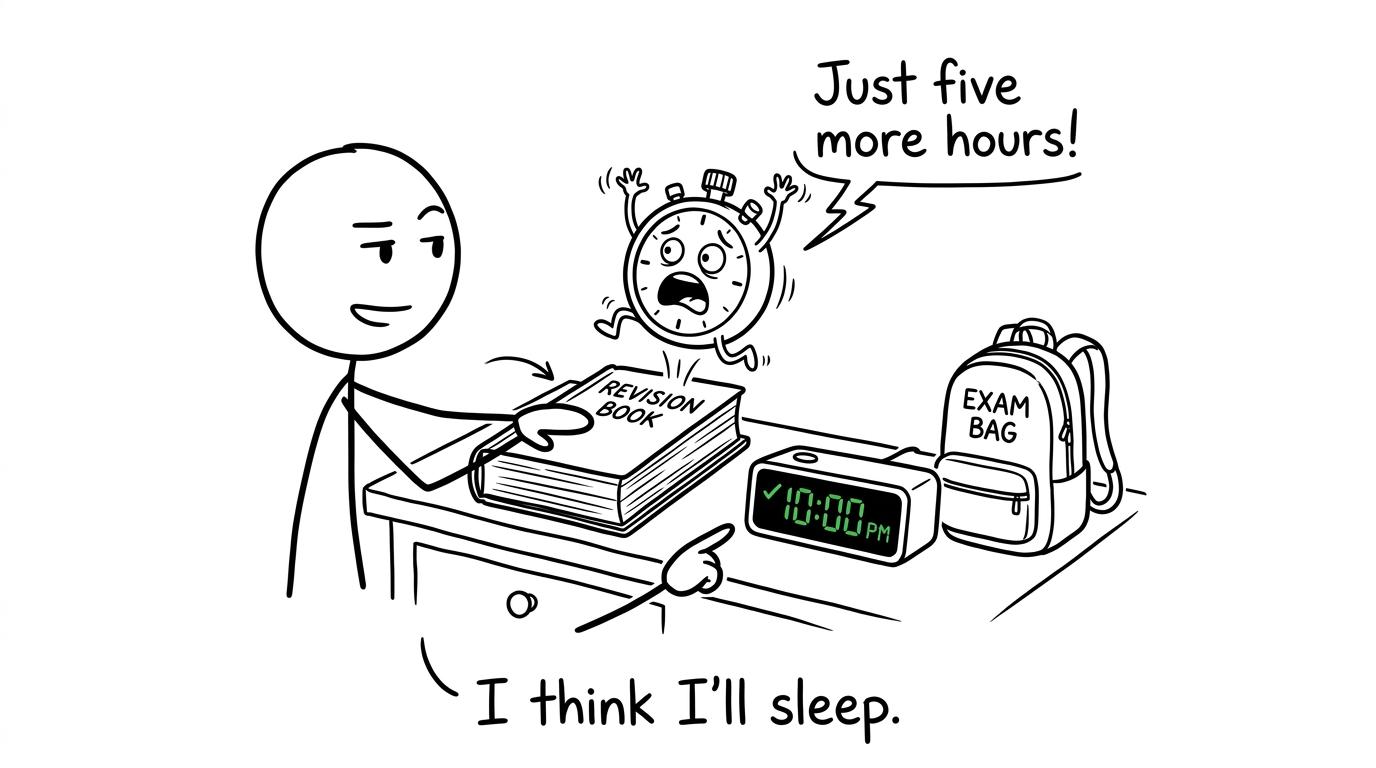 A student calmly ends revision while a dramatic stopwatch begs for five more hours
Screens, revision and bedtime
It is tempting to reduce the issue to a simple rule that every screen is bad. The evidence is more nuanced. A small experimental study of adolescents did not find that a controlled 454545-minute period of pre-sleep social media use significantly changed sleep quality or memory consolidation compared with reading conditions. That does not prove unlimited late-night scrolling is harmless.
The practical problem is often behavioural. Devices make stopping difficult. Notifications interrupt retrieval, videos continue automatically, and a planned ten-minute quiz can expand without a clear endpoint. Content that is stressful or exciting may also leave you less ready to settle.
If you revise digitally, use full-screen mode, disable notifications and set an external stopping alarm. When possible, finish with a paper checklist or a few handwritten prompts rather than opening another app.
Revising ICT and maths in the same exam season
GCSE revision rarely involves one subject. The risk is not that a brief ICT review will somehow damage maths knowledge. The risk is allowing every subject to claim the final hour of the day.
Use a revision planner to decide which subject receives focused practice earlier and which, if any, receives a short bedtime review. MathsGenie's one-week GCSE revision plan shows how diagnostic work, topic practice and papers can be spread across several days instead of compressed into one evening.
For independent revision, the principle is consistent: learn, practise, mark and return to weaknesses. The guide to self-studying GCSE maths explains how revision lessons, practice questions, mini tests, mark schemes and video solutions can support that cycle.
Common mistakes with late-night revision
Mistaking time spent for learning achieved
An hour of rereading can feel productive because it is tiring. Test what you can recall without looking. Evidence of learning matters more than the length of the session.
Using bedtime to rescue an unrealistic plan
If the day's list could never be completed, extending revision into the night does not repair the plan. Reduce tomorrow's list and prioritise the topics most likely to recover marks.
Learning unfamiliar content when exhausted
New ideas need attention and opportunities to practise. Move difficult learning earlier, then use the evening only to revisit it.
Completing questions without checking them
Practice without feedback can reinforce errors. Use mark schemes and video solutions, and keep a short error log. The efficient Edexcel GCSE maths revision guide demonstrates this learn-practise-mark-retest cycle.
Treating sleep as wasted revision time
Sleep is not a rival to learning. It supports memory while also protecting the attention needed to use that memory. A sensible stopping time is part of exam preparation.
The best decision tonight
Revising immediately before bed can help when it is a brief session of accurate retrieval followed by sufficient sleep. It hurts when “one last topic” becomes a habit of sacrificing rest.
Keep demanding work earlier. At night, recall a small amount, check it, write down tomorrow's priority and stop. That approach will not feel as dramatic as cramming. It is simply more sustainable.
For maths preparation, begin with the free MathsGenie GCSE revision resources. Use revision lessons to understand a topic, practice questions and mini tests to retrieve it, mark schemes and video solutions to correct it, and past papers or predicted papers to test it under exam conditions. Then close the page at the time you planned. Good revision includes knowing when the work is finished.