

Revise Weakest Topic First GCSE Arabic: A Guide
Revise weakest topic first GCSE Arabic? Usually, yes. Learn how to order weak skills, use active recall and create a balanced, effective revision session.
There is a familiar moment at the start of revision: you know exactly which topic needs attention, so you suddenly become interested in reorganising your notes. The difficult topic remains untouched while easier work creates the feeling of progress.
If you are wondering whether to revise weakest topic first GCSE Arabic, the short answer is usually yes, but not necessarily in the first minute of the session. Begin with a brief warm-up, tackle the weakness while your concentration is still strong, and finish by retrieving it again without notes. Leaving it until the very end often means giving it the part of the session with the least energy and the greatest chance of being skipped.
The important distinction is that “first” should mean early and deliberately, not cold, anxious and unprepared.
The quick decision checklist
Use this before deciding where your weakest Arabic area belongs:
- Start it early if you regularly avoid it, cannot begin exam questions on it or need careful concentration.
- Use a short warm-up first if jumping straight into difficult material makes you freeze.
- Move it later temporarily if another assessment is more urgent, such as an approaching speaking assessment.
- Split it across the session if the weakness is broad, such as vocabulary across several themes.
- Revisit it on another day rather than assuming one long session has repaired it.
- Finish with a quick success check, not another passive read-through.
This is the same principle used when building an effective GCSE maths revision timetable: priorities should come from evidence, while the timetable must remain realistic enough to follow.
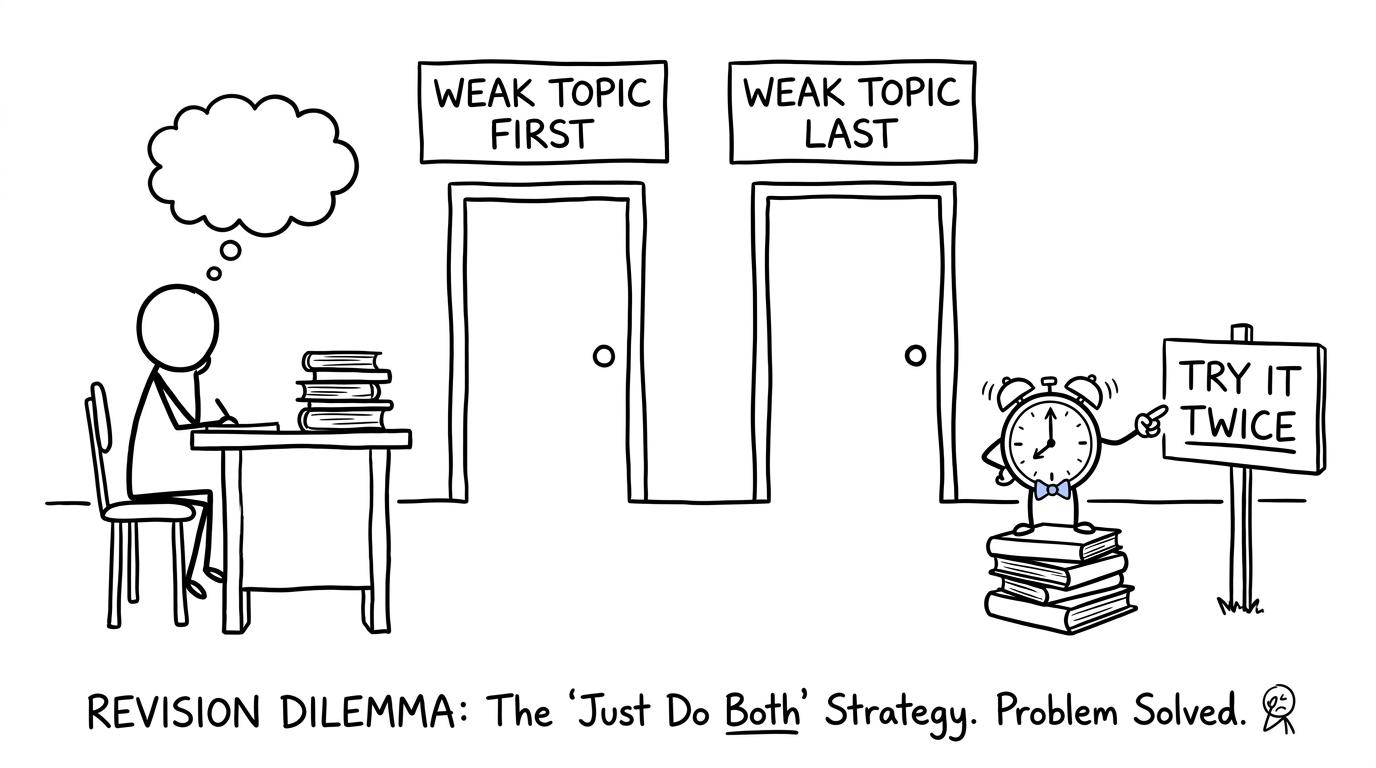 A student choosing when to face a weak revision topic
Why revising your weakest topic early usually works
The beginning of a revision session is normally when your attention is least depleted. Difficult grammar, unfamiliar vocabulary or demanding listening work requires more concentration than reviewing material you already recognise. Giving the weakness an early position protects time for it.
There is also a behavioural reason. Work expands to fill the space we give it, but avoidance does too. If “weak Arabic topic” appears as the final item on a long list, every earlier task becomes a respectable-looking excuse not to reach it.
Starting early changes the purpose of the session. You are no longer asking, “What can I complete?” You are asking, “What can I improve?”
Research on retrieval practice supports active attempts to recall knowledge rather than repeated rereading. However, retrieval must be accessible, appropriately challenging and followed by feedback. That means beginning with your weakest area does not mean staring at an impossible question for half an hour. It means trying, identifying the precise gap, checking the correct language and trying again.
Maths students can see the same process in the guide to finding your weakest GCSE topics: diagnose, practise the smallest repairable skill and retest it later.
Why the very first minute may be too soon
A weak topic can carry emotional weight. Perhaps you have repeatedly confused verb forms, struggled to understand a listening extract or found it difficult to develop answers in the speaking assessment. Beginning with the hardest possible task, without any preparation, can turn productive difficulty into discouragement.
A short warm-up solves this. Spend a few minutes retrieving familiar vocabulary, reading a manageable passage aloud or answering several straightforward prompts. The warm-up should activate Arabic, not become a hiding place.
Then move to the weakness while the session is still young.
A useful sequence is:
- retrieve something familiar without notes;
- attempt the weak skill independently;
- check your answer against reliable feedback;
- record one precise correction;
- attempt a similar task;
- return to the skill briefly at the end.
This structure combines confidence with challenge. MathsGenie follows a comparable learn-practise-check rhythm through its free GCSE revision guides, practice questions and solutions.
Decide what “weakest Arabic topic” really means
“Arabic” is too broad to revise, and even labels such as “writing” are often too broad to be useful. Your weakness needs to describe something you can actually practise.
For the current Pearson Edexcel GCSE Arabic qualification, listening, speaking, reading and writing each account for a quarter of the qualification. The papers draw on vocabulary and structures across the prescribed themes. This makes it unwise to ignore an entire skill simply because another feels more comfortable. Always confirm the specification and assessment arrangements used by your school.
A precise weakness might be:
- recognising key details in a listening extract;
- responding quickly during a role play;
- extending spoken answers with reasons and opinions;
- understanding unfamiliar vocabulary through context;
- translating accurately from Arabic into English;
- translating sentences from English into Arabic;
- controlling tense and agreement in writing;
- writing accurately in Modern Standard Arabic;
- answering questions whose instructions are in Arabic.
Do not rely only on how a topic feels. Use marked classwork, teacher feedback and exam-style tasks. A topic that feels uncomfortable may simply be demanding. A genuinely weak topic repeatedly costs marks or prevents you from starting.
This evidence-led approach is also central to using GCSE past papers properly. A paper is not merely a score. It is a map of what should happen next.
A better structure than simply first or last
The strongest approach is often a sandwich session: easy activation, difficult focus, mixed application and a final retrieval check.
Begin with activation
Use a short closed-book recall task. Retrieve useful connectives, common opinion phrases, tense markers or vocabulary connected to the planned topic. Keep it brief and relevant.
Tackle the specific weakness
Work on one narrow area while your attention is strong. If listening is weak, practise extracting targeted details rather than vaguely “doing listening”. If writing accuracy is weak, focus on one recurring grammatical problem rather than rewriting pages of notes.
Apply it in exam conditions
Move from isolated knowledge to the way it appears in an assessment. Vocabulary must eventually be recognised in speech and text; grammar must survive inside spontaneous speaking, translation and extended writing.
Finish with retrieval
Close the notes and reproduce the corrected language. Say the response aloud, rewrite the sentence from memory or list the cues you should notice in a listening task. Feedback matters because repeatedly retrieving an incorrect answer can strengthen the mistake.
This final check is the language equivalent of a short test. For maths revision, GCSE mini tests serve the same purpose: they reveal whether a topic is genuinely becoming secure.
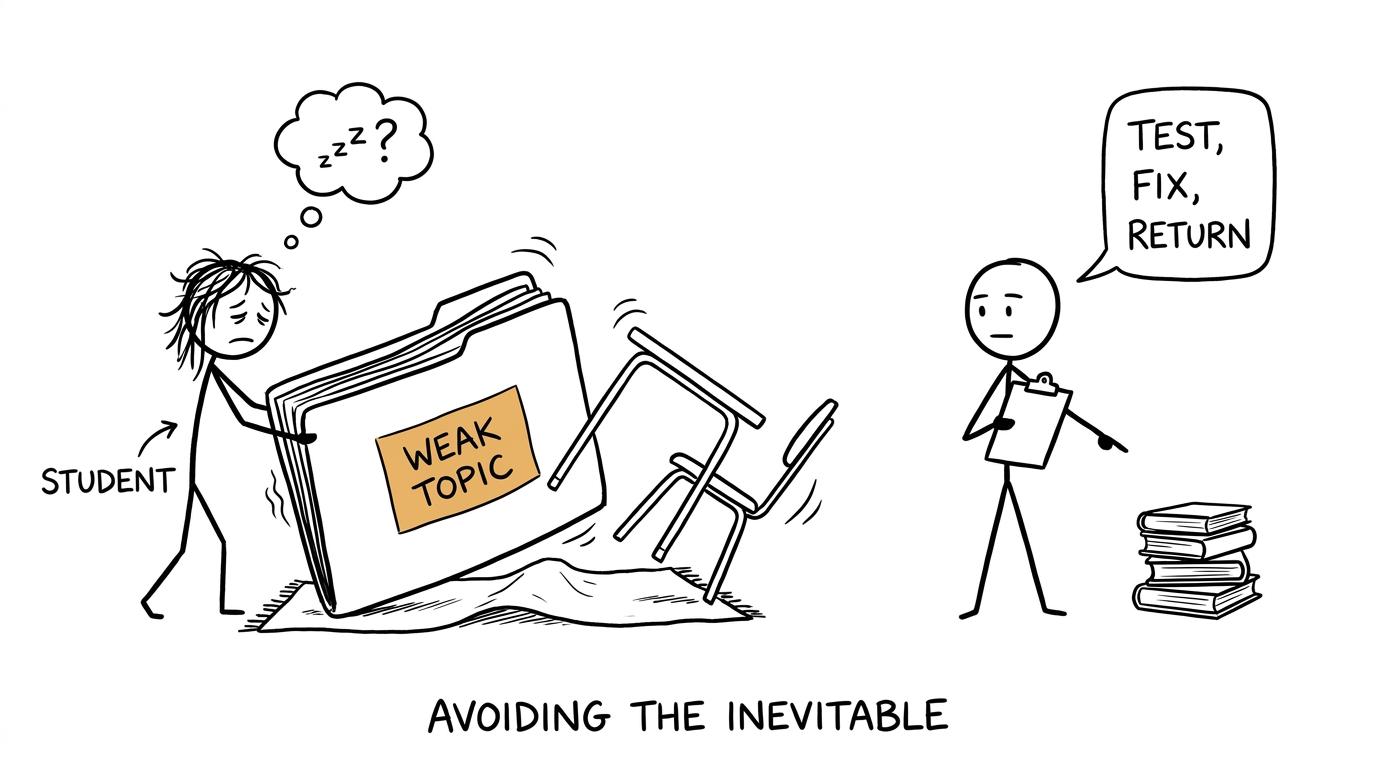 A weak topic becoming harder to ignore
When revising the weakest topic last can make sense
“Usually first” is not the same as “always first”. There are several reasonable exceptions.
You need a diagnostic first
You may believe that translation is your weakest area when the real problem is limited vocabulary or insecure grammar. A short mixed assessment can reveal the underlying gap before you spend a full session treating the wrong problem.
Another assessment is closer
GCSE Arabic speaking is assessed separately from the written papers, and your school will confirm its examination window and individual arrangements. If speaking is imminent, urgency may temporarily outweigh overall weakness. Prioritising it is planning, not avoidance.
Your weakness depends on another skill
If extended writing is weak because you cannot recall core verbs, a vocabulary and grammar foundation may need to come first. Revision order should follow dependency as well as difficulty.
The session is for consolidation
Not every session needs to begin with repair. Before an assessment, you may use a short session to secure familiar material and protect confidence. The mistake would be turning every session into consolidation while the underlying weakness remains untouched.
You genuinely work better later
Some students need time to settle. Test this rather than assuming it. Try the same type of weak-topic task early in one session and later in another, using similar conditions. Compare focus, accuracy and whether the work was actually completed. Your timetable should respond to evidence.
Space the weakness across several sessions
A weak topic is rarely fixed by one heroic evening. Spacing learning across days generally supports retention better than concentrating every encounter into one block, although the effect depends on the material and how the strategy is implemented.
Plan several contacts with the same skill:
- diagnose the problem;
- learn or correct the relevant language;
- retrieve it after a delay;
- use it in a different context;
- test it under timed conditions;
- return to errors highlighted by feedback.
The later sessions matter because successful performance immediately after looking at notes can create false confidence. What counts is whether you can retrieve and apply the language after some time has passed.
Avoid allowing Arabic to consume every revision session, especially if mathematics is also a priority. Keep a small, protected maths block using the GCSE maths revision hub. Revision is a portfolio: improving one subject should not quietly create a new weakness elsewhere.
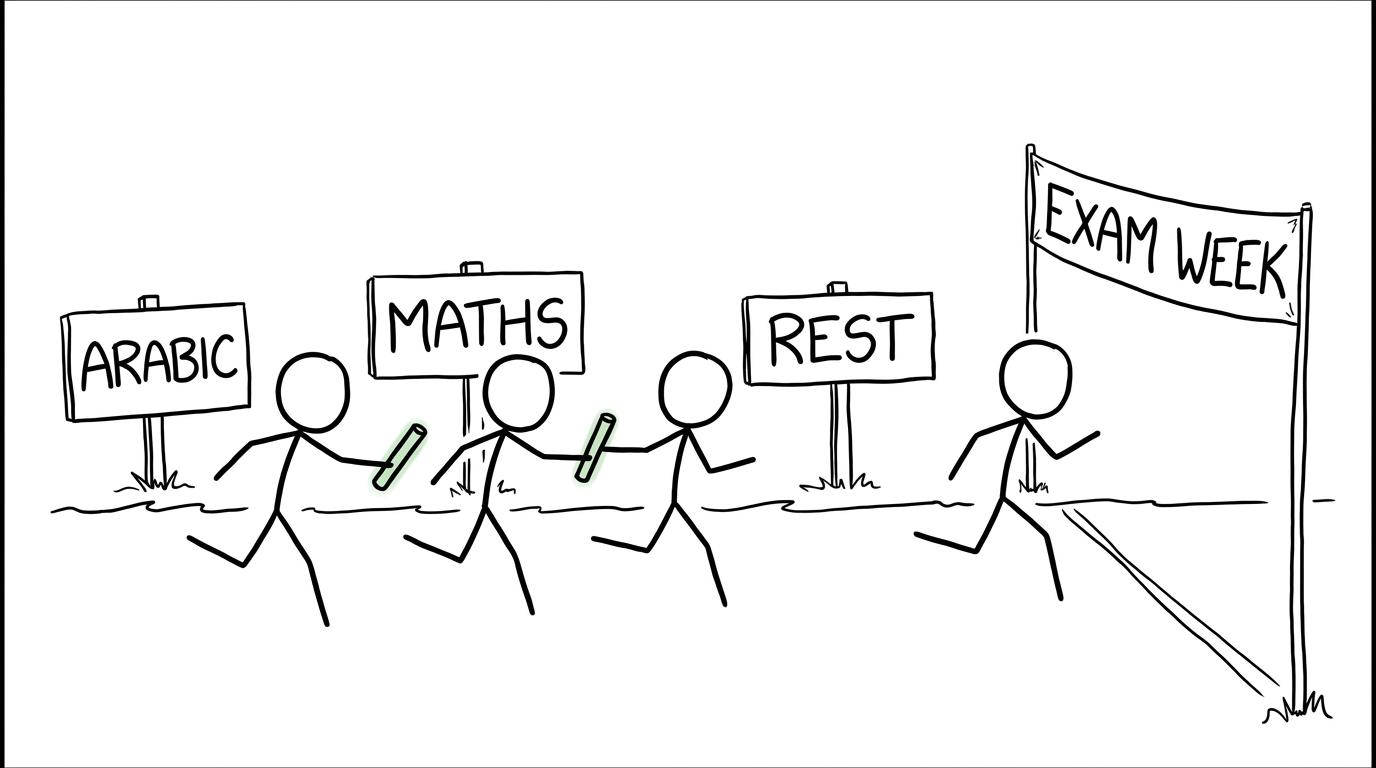 A revision relay between Arabic, maths and rest
Common mistakes when prioritising weak topics
Choosing by anxiety rather than evidence
The topic you fear most is not automatically the one losing the most marks. Use marked work, teacher comments and assessment performance.
Calling an entire skill weak
“Speaking” gives you no clear next action. “Giving an extended answer using more than one time frame” is specific enough to practise.
Spending the whole session relearning
Explanations and notes can rebuild understanding, but they do not prove recall. Include an independent attempt and feedback.
Starting so hard that you stop
Productive challenge is not the same as being completely stuck. Reduce the task, review one prerequisite and build back towards exam-level work.
Leaving the weakness until last every time
If the topic is repeatedly postponed, “last” really means “never”. Place it earlier or make it the only major target of a short session.
Never returning to the topic
One accurate answer immediately after correction is not secure learning. Revisit the skill after a delay and in a mixed task.
Neglecting other GCSE subjects
A sensible Arabic plan should coexist with maths and your other qualifications. Use Edexcel GCSE maths past papers or the appropriate board resources to keep exam technique active, then use targeted topic work to address any marks lost.
The best answer is early, specific and repeated
So, should you revise your weakest GCSE Arabic topic first or last? Put it early in the session after a brief warm-up, unless assessment urgency or a missing prerequisite gives you a clear reason not to. Then revisit it at the end and on a later day.
The placement makes a difference because early work receives more protected attention, while final retrieval checks whether learning has survived beyond the explanation. But order alone cannot repair a weakness. The task must be precise, active, checked and repeated.
Use the same discipline across your GCSE revision. Keep Arabic focused on the exact language skill that needs repair, then make MathsGenie your free home for maths revision lessons, practice questions, mark schemes, video solutions and GCSE predicted papers. Diagnose honestly, practise deliberately and return to the things that once felt difficult. That is how a weakness gradually stops being one.











