Revise GCSE Media Studies With No Quiet Space
Revise GCSE Media Studies with no quiet space using short sessions, portable resources, school study time and realistic routines that protect focus.
A quiet desk, an empty room and an uninterrupted evening make a lovely revision plan. They are not available to everyone.
If you need to revise GCSE Media Studies with no quiet space at home, the answer is not to wait for perfect conditions. Build a portable system, match each task to the noise around you and protect short periods of genuine concentration. Use quieter places such as school or a public library for demanding exam practice, then complete flashcards, recall and organisation during noisier periods.
This matters when Media Studies is only one subject competing for your attention. You may also be preparing for English, science and maths exams. Your revision system must work across a real week rather than an imaginary one.
Your no-quiet-space revision checklist
Start with this practical plan:
- Check your exam board, current specification and set products.
- Divide revision into small, specific tasks.
- Identify the quietest times and accessible places in your week.
- Reserve those periods for analysis and extended responses.
- Use noisy periods for flashcards, recall grids and sorting notes.
- Keep a portable revision kit ready.
- Ask your school whether a classroom or library is available.
- Test yourself with exam questions and mark schemes.
- Include breaks and protect your sleep.
The aim is not silence all day. It is giving the right task the best available conditions.
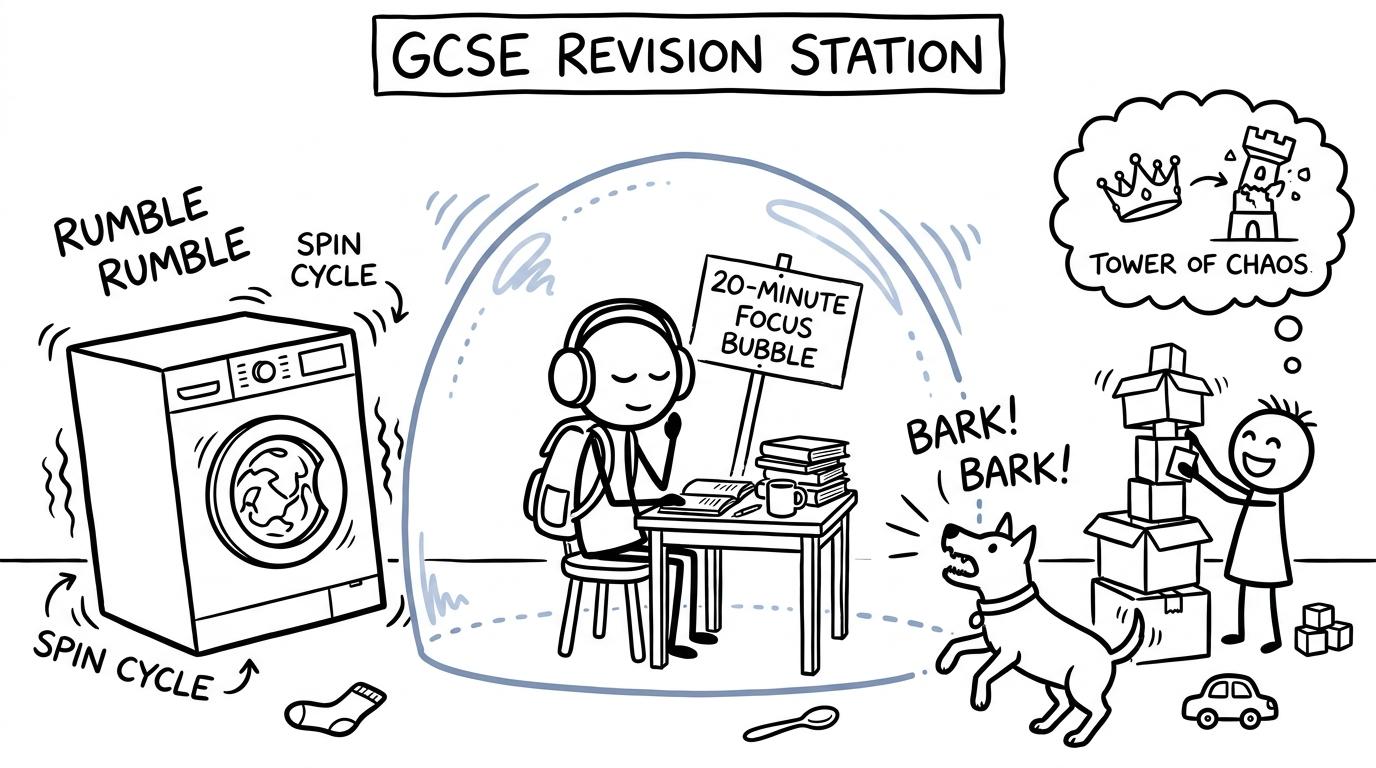 A student creating a small focus bubble in a busy home
Know exactly what you are revising
Noise becomes more frustrating when the task itself is vague. “Revise Media Studies” gives you no obvious starting point. “Recall five facts about the audience for one set product” does.
GCSE Media Studies commonly develops knowledge and analysis across four parts of the media framework:
- media language
- media representations
- media industries
- media audiences
You also need detailed knowledge of the products prescribed by your exam board. These products and assessment arrangements are not interchangeable. AQA, OCR, Eduqas and other boards can specify different products, paper structures and non-exam assessment requirements. Set products may also change between teaching or examination years.
Before making resources, check the current specification and information supplied by your teacher. Create a one-page course map containing:
- every set product you must know
- the relevant media form
- key contexts
- useful theories or concepts
- likely comparison pairings
- question types and mark totals
- topics you can recall confidently
- topics requiring further work
This turns an intimidating subject into a collection of visible jobs.
Match the Media Studies task to the noise level
Not all revision requires the same concentration. Trying to write an extended analytical response beside a loud television is difficult. Reviewing ten flashcards in the same room may be entirely realistic.
Tasks for the quietest available periods
Protect your best conditions for work involving sustained reading, judgement or writing:
- planning extended responses
- answering timed exam questions
- analysing an unseen media product
- comparing two set products
- studying a complicated theory
- reviewing an answer against a mark scheme
Your quietest period might be before other people wake up, during a school lunch break or immediately after lessons. It does not need to be at home.
Tasks for moderate background noise
When conversation or household movement is present but manageable, try:
- creating a mind map for one set product
- adding examples to existing notes
- turning class notes into questions
- completing a comparison grid
- annotating a print product
- watching a teacher-approved explanation with headphones
Pause video resources when needed and write a brief summary from memory. Watching without recalling can feel productive while leaving little behind.
Tasks for the noisiest periods
Save low-friction tasks for the most difficult conditions:
- sorting flashcards into secure and insecure piles
- recalling terminology aloud or on paper
- organising folders and naming digital files
- selecting evidence for a later essay plan
- checking which topics have been covered
- packing materials for tomorrow’s school study session
This approach removes an unhelpful judgement. A noisy half-hour is not automatically wasted; it simply calls for a different task.
Build a portable Media Studies revision kit
When you cannot control one room, make your revision easy to move. Keep a small folder or bag containing:
- your specification checklist
- concise set-product summaries
- flashcards secured with a band
- a notebook for recall and essay plans
- pens, highlighters and headphones or earplugs
- downloaded resources that work without reliable internet
- a short list of tasks requiring ten, twenty or forty minutes
Digital notes are convenient, but paper is often useful when your phone also carries messages, videos and notifications. If you use a device, activate its focus or do-not-disturb setting and close unrelated tabs.
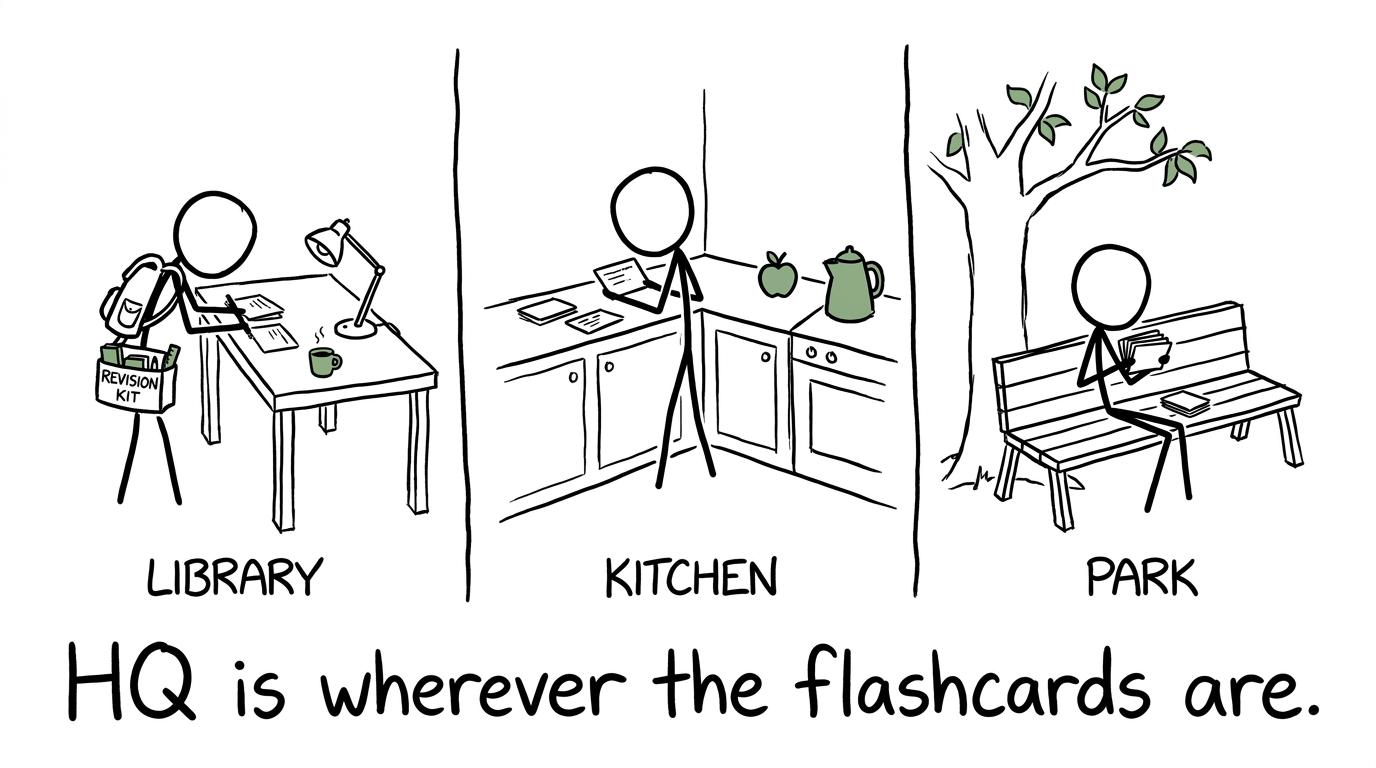 A student carrying a portable revision kit between study spaces
A portable system also helps with maths. The free GCSE Maths revision hub brings together lessons, exam questions and papers, so you can choose a focused activity instead of spending your available time searching.
Find quiet space beyond your home
Asking for somewhere to work is not making an excuse. It is solving a practical problem.
Speak to your form tutor, Media Studies teacher, head of year or school librarian. Ask whether you can use:
- the school library before lessons, at lunch or after school
- an empty supervised classroom
- a homework or revision club
- a local public library
- a trusted relative’s home
Check opening times, age requirements, travel arrangements and whether booking is necessary. If travelling would be unsafe, expensive or unrealistic, explain that to a trusted adult at school. They may know about supervised spaces or support that has not been widely advertised.
Use outside study time deliberately. Arrive knowing that you will complete one essay plan, one timed response or one difficult comparison. Do not spend the quietest hour of your week decorating headings.
Create focus without demanding complete silence
Some noise is outside your control. Other distractions can be reduced.
If possible, face a wall rather than a television or busy room. Keep only the current materials in front of you. Ask the people at home for one clearly defined period rather than requesting silence for an entire evening: “Could I have twenty minutes without being interrupted?” is specific and easier to understand.
Headphones, ear defenders or inexpensive earplugs may reduce disruption. If you play audio, keep it at a safe volume. Instrumental sound may be less intrusive than lyrics during reading and writing, but test this honestly. The question is not whether the playlist feels calm; it is whether you can remember and apply more afterwards.
Short sessions can also lower household friction. Set one precise goal, work until the timer ends, take a proper break and then decide whether another session is useful. Official UK guidance on exam pressure recommends manageable targets, time limits, testing and reviewing progress rather than trying to tackle everything at once.
Revise actively, not just quietly
Silence cannot rescue a passive technique. Reading the same page repeatedly is usually less revealing than trying to retrieve the material without looking.
For each Media Studies product, close your notes and answer prompts such as:
- What meanings are created through media language?
- Which groups or ideas are represented, and how?
- Who produced or distributed the product?
- Who is the intended audience?
- How might different audiences respond?
- Which social, cultural, political or historical contexts matter?
- What precise evidence supports each claim?
Then check your answers and fill the gaps in another colour. The change of colour is not the learning; noticing and correcting the gap is.
Past questions are especially valuable because GCSE Media Studies assesses more than factual recall. You may need to apply knowledge, analyse products, compare examples, reach judgements and use subject terminology accurately. Review the command word, available marks and mark scheme before deciding what a strong response requires.
The same active cycle applies when you return to maths revision: learn, attempt, mark and correct. MathsGenie provides AQA GCSE Maths past papers and Edexcel GCSE Maths past papers, with mark schemes and worked solutions where available. Its guide to when to start GCSE past papers can help you balance paper practice across subjects.
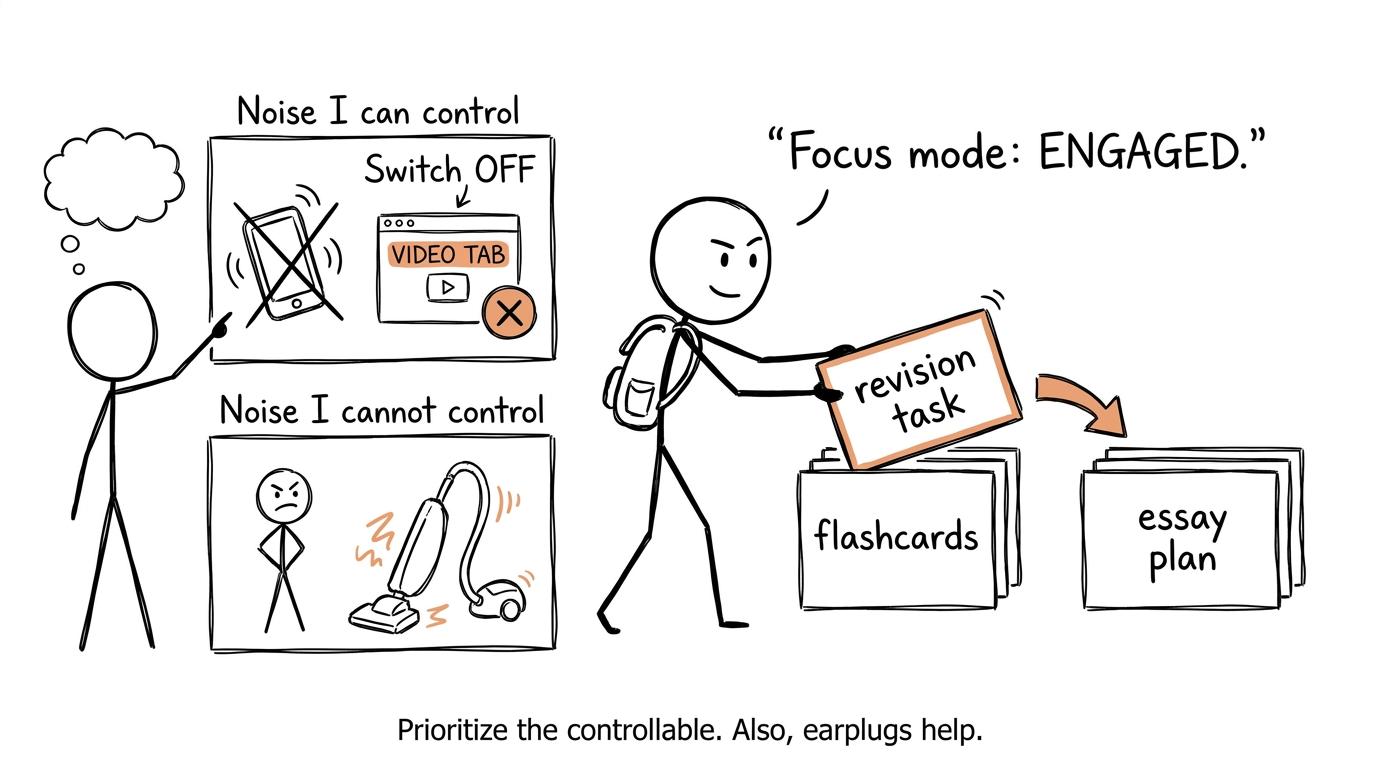 A student separating controllable distractions from unavoidable noise
Plan around energy as well as noise
The quietest time is not always your best time. Waking extremely early may create silence but leave you exhausted in lessons. Revising late into the night can produce a similar trade-off.
Look across the whole week. Mark school study opportunities, library sessions, travel, caring responsibilities, meals and rest. Then allocate demanding tasks to periods when you have both workable conditions and enough energy.
A realistic week might contain several short recall sessions at home and one longer session elsewhere for timed writing. Regular, repeatable revision is more useful than a heroic plan that collapses after two days.
When maths is the next exam, use a smaller, clearly defined resource rather than opening an entire paper automatically. The GCSE maths night-before plan explains how targeted practice can reduce last-minute overload. For deeper paper review, follow the method in how to use Edexcel GCSE Maths past papers properly.
Common mistakes when revising without quiet space
Waiting for perfect conditions
A completely silent evening may never arrive. Identify the smallest useful task you can complete now, while protecting better conditions for deeper work.
Doing only easy revision
Flashcards suit noisy rooms, but they cannot replace analytical writing. Schedule difficult tasks at school, in a library or during your quietest home period.
Revising the wrong set products
Do not rely on an old online list. Confirm your exam board, examination year and current products with your teacher and specification.
Wearing headphones without removing digital distractions
Headphones can reduce household noise while your phone continues to interrupt you. Silence notifications and keep unrelated apps closed.
Measuring progress by time alone
An hour at a desk says little about what you learned. Record outputs: questions answered, products recalled, plans completed and mistakes corrected.
Hiding the problem from school
If your home environment is seriously affecting revision, tell a trusted member of staff. Schools cannot consider practical support if they do not know what is happening.
Make the next session small enough to begin
You do not need a perfect room to make meaningful progress. You need a clear task, an honest view of the conditions around you and somewhere to place the work that requires deeper concentration.
Choose one Media Studies product. Write five recall questions. Decide where and when you will answer them. Then reserve your next quiet school or library session for an exam response.
When you switch back to maths, use MathsGenie as your free revision base. Start with a revision lesson, practise exam questions, check the mark scheme or video solution, and use past papers, predicted papers and mini tests when you are ready to test your progress. A calm system will not remove every interruption. It will stop those interruptions from deciding what you can achieve.