Revise GCSE History: Can't Sit Still? Try This
Revise GCSE History, can't sit still? Use active recall, walking timelines, voice notes and exam questions to learn without relying on long desk sessions.
There is a particular kind of revision frustration that has little to do with motivation. You open the textbook, sit down and genuinely intend to work. Within minutes, you are tapping a pen, checking the clock or finding reasons to leave the chair.
If you searched revise GCSE History can't sit still, the practical answer is simple: stop making sitting still the entry price for learning. Use short retrieval tasks while standing, walking or changing location. Then gradually add brief seated exam practice, because the final assessment is written even if your revision does not have to be.
Movement is not a failure of discipline. NHS guidance encourages young people to break up long periods without movement. The important question is whether your movement supports retrieval or quietly replaces it.
Your active GCSE History revision checklist
A useful movement-friendly routine contains five things:
- One precise target: a person, event, development or exam skill.
- Active recall: retrieve information before opening your notes.
- Purposeful movement: walk, stand or change stations while answering.
- Immediate checking: correct omissions and inaccurate details.
- Exam application: finish with a question, plan or paragraph.
This creates a repeatable cycle:
Recall, check, correct, apply, revisit.
The same principle works across GCSE subjects. If you are balancing History with maths, the GCSE Maths revision hub provides free lessons, practice questions and papers that fit naturally into short, focused sessions.
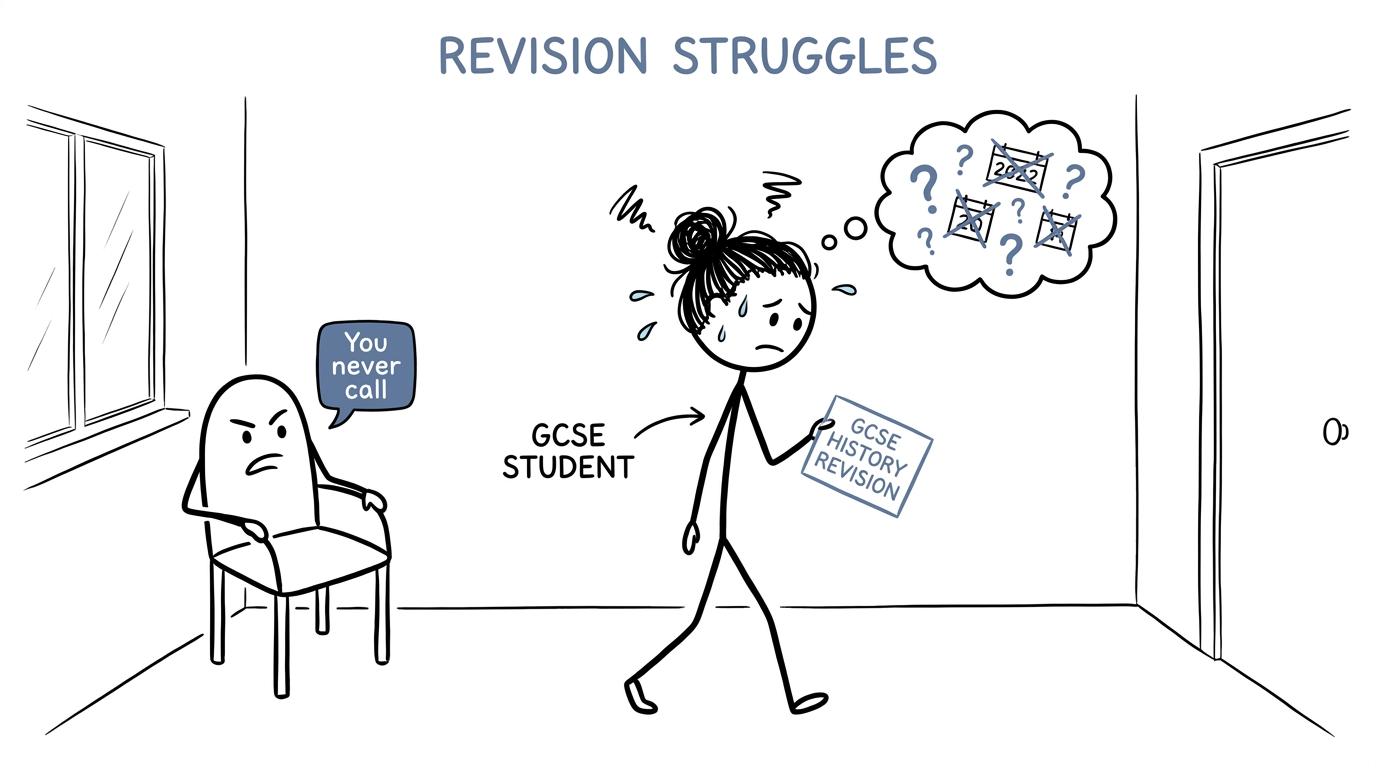 A pacing student revises while an abandoned chair complains
Why short, active revision can work
Long revision sessions often create the appearance of effort. Pages are highlighted. Notes are copied. Time passes. Yet recognising a sentence in a textbook is different from producing that knowledge in an examination.
Retrieval practice means trying to bring information back from memory. Educational research consistently supports repeated retrieval, particularly when attempts are spaced across different days and followed by feedback. That makes short sessions potentially valuable, provided each session requires you to remember something without looking.
For GCSE History, retrieval should cover more than dates. Across AQA, Edexcel, OCR and Eduqas, the precise papers and question formats vary, so always follow your own specification. However, GCSE History assessment broadly requires:
- accurate knowledge and understanding;
- explanation using concepts such as cause, consequence, change, continuity and significance;
- analysis and evaluation of contemporary sources;
- analysis and evaluation of historical interpretations.
A student who can recite dates but cannot explain why an event mattered has only completed part of the job. Your moving revision therefore needs to combine factual recall with historical thinking.
Build revision around movement, not against it
Movement should be designed into the task. Wandering around while occasionally glancing at a textbook is still passive reading. Walking while answering a carefully chosen question is active revision.
Try walking flashcards
Put a question on the front of each card and a concise answer on the back. Walk slowly around a safe, familiar space while answering aloud. Commit to an answer before turning the card over.
Use prompts that demand different kinds of knowledge:
- What happened?
- Why did it happen?
- What changed afterwards?
- What stayed the same?
- Why was this development significant?
- Which evidence would support this judgement?
Sort the cards into secure, uncertain and incorrect piles. Revisit the uncertain and incorrect cards later rather than immediately repeating them until they merely feel familiar.
Create a human timeline
Place event cards in different positions around a room. Walk between them in chronological order, explaining the connection from one event to the next.
The value is not simply remembering sequence. At each stop, ask what caused the event, what consequence followed and whether it represented change or continuity. When the order feels secure, remove some cards and reconstruct the missing stages from memory.
For a thematic study, you can arrange stations by period and compare the same issue across time. For a depth study, a tighter chain of cause and consequence may be more useful.
Use revision stations
Give different locations distinct jobs:
- Station A: retrieve key facts;
- Station B: organise causes or consequences;
- Station C: analyse a source or interpretation;
- Station D: plan an examination response;
- Station E: check against notes or a mark scheme.
Changing position gives your movement a purpose. It also prevents one vague task called “revise History” from consuming the entire evening.
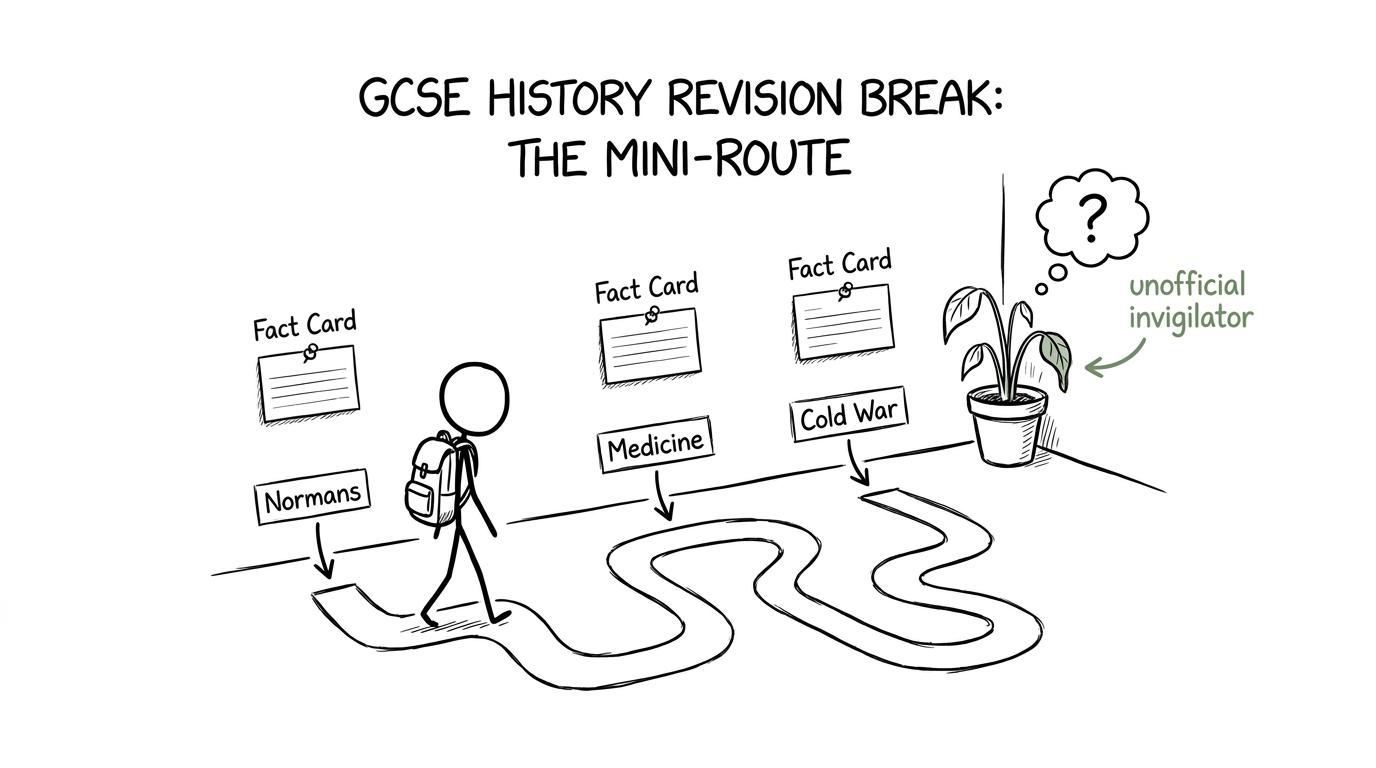 A student walks between History revision stations while a houseplant supervises
Use voice without turning revision into background noise
Speaking can make recall more active, especially if writing for a long period feels difficult. Explain a topic aloud as though you are teaching someone who knows nothing about it. Then check your explanation against your specification or class materials.
Voice notes can also be useful, but record questions as well as summaries. Pause after each question and answer before hearing the recorded response. Simply playing an audio summary while scrolling or travelling may feel productive without testing what you can retrieve.
Keep outdoor listening safe. Use familiar routes, remain aware of traffic and avoid reading cards while walking near roads.
Match each activity to the examination skill
The command word tells you what kind of response is required. “Describe” asks for characteristics, while “explain” requires reasons or relationships. “Evaluate” or “assess” requires an informed judgement supported by evidence. Exact wording and mark requirements differ between exam boards and papers, so use your board's current materials.
Make separate movement activities for separate skills:
Knowledge and explanation
Walk through a chain of events and explain each link aloud. If your explanation becomes a list, stop and add the connection: why one development led to another, or why one factor was more important.
Sources
Place three prompt cards around the room: content, provenance and context. Move between them while considering what the source says, who produced it and what your own knowledge adds. Do not assume provenance automatically makes a source reliable or unreliable. Its usefulness depends on the question and the claim you are investigating.
Interpretations
Assign one side of the room to each interpretation. Stand in each position and explain its argument and supporting evidence. Finish in the centre and make a justified comparison. An interpretation is not wrong merely because another historian disagrees with it.
Extended responses
Put possible arguments on separate cards. Physically arrange them into a logical order, then choose the strongest line of reasoning. After planning on your feet, sit down and write one paragraph or conclusion.
Keep seated practice small but unavoidable
You may revise successfully while moving, but GCSE History examinations still require sustained reading and writing. Avoiding all seated work creates a gap between revision and performance.
Begin with a manageable written task: a plan, one paragraph or one source question. Build towards longer timed sections over several weeks. The aim is not to force yourself through an exhausting silent session immediately. It is to increase exam stamina gradually while preserving the active methods that help you learn.
A simple session might look like this:
- retrieve facts aloud while standing;
- walk through causes and consequences;
- check your missing knowledge;
- sit down for one focused exam response;
- mark it and record one improvement.
This resembles the approach used in MathsGenie's short GCSE revision routine: make the task small, complete real questions and use feedback before deciding what comes next.
Plan by outcomes rather than hours
“Revise for two hours” tells you how long to remain near your work. It does not tell you what learning should happen.
Use outcome-based targets instead:
- retrieve the main causes of one event;
- rebuild one timeline without notes;
- compare two interpretations;
- complete and check one examination question;
- revisit yesterday's weakest recall cards.
Put these tasks into the free MathsGenie revision planner, including History alongside your maths commitments. Leave short gaps between blocks so movement happens deliberately rather than as an escape from an undefined task.
Spacing matters too. Revisit material on later days instead of exhausting one topic in a single evening. The effort involved in retrieving partly forgotten knowledge is useful because it reveals what is genuinely available from memory.
Transfer the method to GCSE Maths
Students preparing for several GCSE examinations do not need a completely different revision system for every subject. The content changes, but the productive loop remains familiar: attempt, check, correct and return later.
For maths, movement might mean saying a method aloud while standing before sitting down to complete questions. Use the GCSE Maths topic and tier guide to select an appropriate skill, then test it through written practice.
MathsGenie's GCSE 45-minute tests offer a bridge towards longer concentration. When you are ready for full-paper practice, use resources matching your board and tier, such as AQA GCSE Maths past papers or OCR GCSE Maths past papers.
The paper itself is only the diagnosis. Improvement comes from marking, correcting and practising the weak skill again. The guide to using GCSE past papers properly explains this feedback loop in more detail.
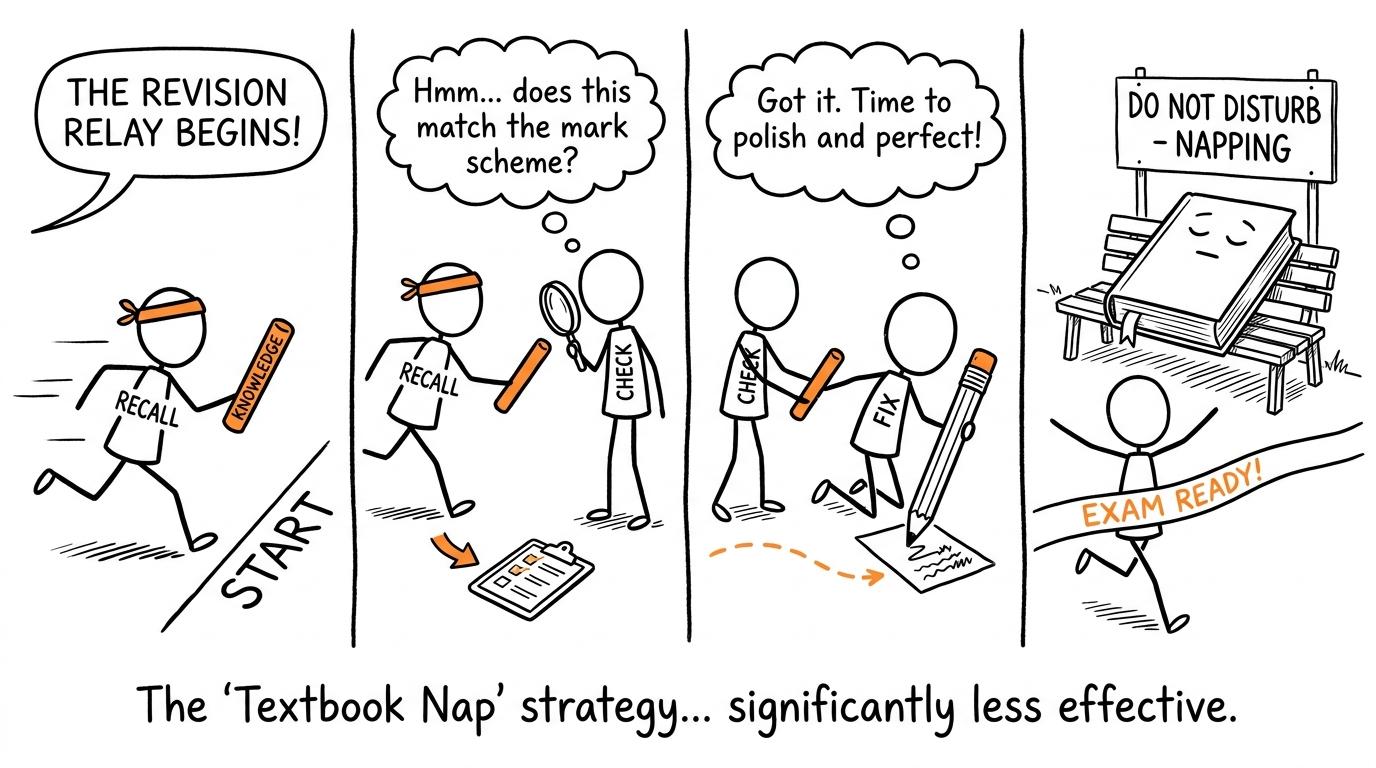 Recall passes the revision baton to checking and correction
Common mistakes when you cannot sit still
Treating movement as the whole method
Movement can support attention, but it does not create learning by itself. Every active task needs a retrieval prompt and a way to check the answer.
Rereading while pacing
Walking with a revision guide may feel different from sitting with it, but the learning demand is largely unchanged. Close the book first. Retrieve, then check.
Revising facts without examination skills
Names, dates and events matter, but History also rewards explanation, analysis and judgement. Combine knowledge cards with source questions, interpretation tasks and essay plans.
Ignoring your exact specification
AQA, Edexcel, OCR and Eduqas organise content and assessment differently. Revise the options your school teaches and use the correct paper structure, mark scheme and command words.
Never practising under examination conditions
Movement-friendly revision helps you build knowledge. It does not remove the need to practise handwriting, timing and sustained responses. Increase seated practice gradually rather than postponing it until the final week.
Measuring time instead of evidence
A long session can produce little learning. Judge a session by what you retrieved, corrected and applied. If you are unsure where to begin in maths, MathsGenie's guide to finding your weakest GCSE topics uses mistakes to choose the next task.
Revision should fit the learner and prepare the candidate
You do not have to become someone who loves silent, uninterrupted desk sessions. You need a system that helps you remember accurate knowledge, explain historical relationships and produce answers under examination conditions.
Start on your feet. Walk through a timeline, answer flashcards aloud or move between source-analysis stations. Then sit down briefly and turn that knowledge into an exam response. Check it. Correct it. Revisit it on another day.
If difficulty sitting still affects lessons, examinations or daily life, speak to a parent or carer, your teacher, form tutor or school SENCO. They can help you explore practical support without assuming a diagnosis.
For the maths part of your GCSE revision, make MathsGenie your next stop. Use free revision lessons and practice questions to repair individual topics, mini tests to build pace, and past papers or predicted papers to develop exam readiness. Mark with the available mark schemes and video solutions, then return to the exact skill that cost you marks.
You do not need a heroic evening. You need one active cycle that you can repeat tomorrow.