

Revise GCSE Combined Science Alone or With Others?
Revise GCSE Combined Science alone or with others? Compare both approaches, match methods to topics and build a focused revision routine that works.

The difficult part of Combined Science revision is not always understanding the content. Sometimes it is deciding how to revise it. Alone, you can concentrate properly but may not notice gaps in your explanations. With friends, difficult ideas can become clearer, but an hour can disappear into conversation.
So, is it better to revise GCSE Combined Science alone or with others? For most students, the best answer is both. Revise alone when you need focused recall, calculations and exam practice. Work with others when explaining concepts, comparing methods or checking practical reasoning. The important decision is not which approach wins. It is which approach suits the task in front of you.
The quick revision checklist
Use solo revision for:
- learning equations and scientific vocabulary
- practising calculations without help
- completing timed exam questions
- identifying your genuine knowledge gaps
- reviewing mistakes at your own pace
Use group revision for:
- explaining processes aloud
- testing each other with retrieval questions
- discussing required practicals
- comparing interpretations of graphs and data
- checking answers against a mark scheme
A productive routine normally moves between the two. Learn and practise independently, discuss what remains unclear, then return to independent questions to see whether the discussion actually helped.
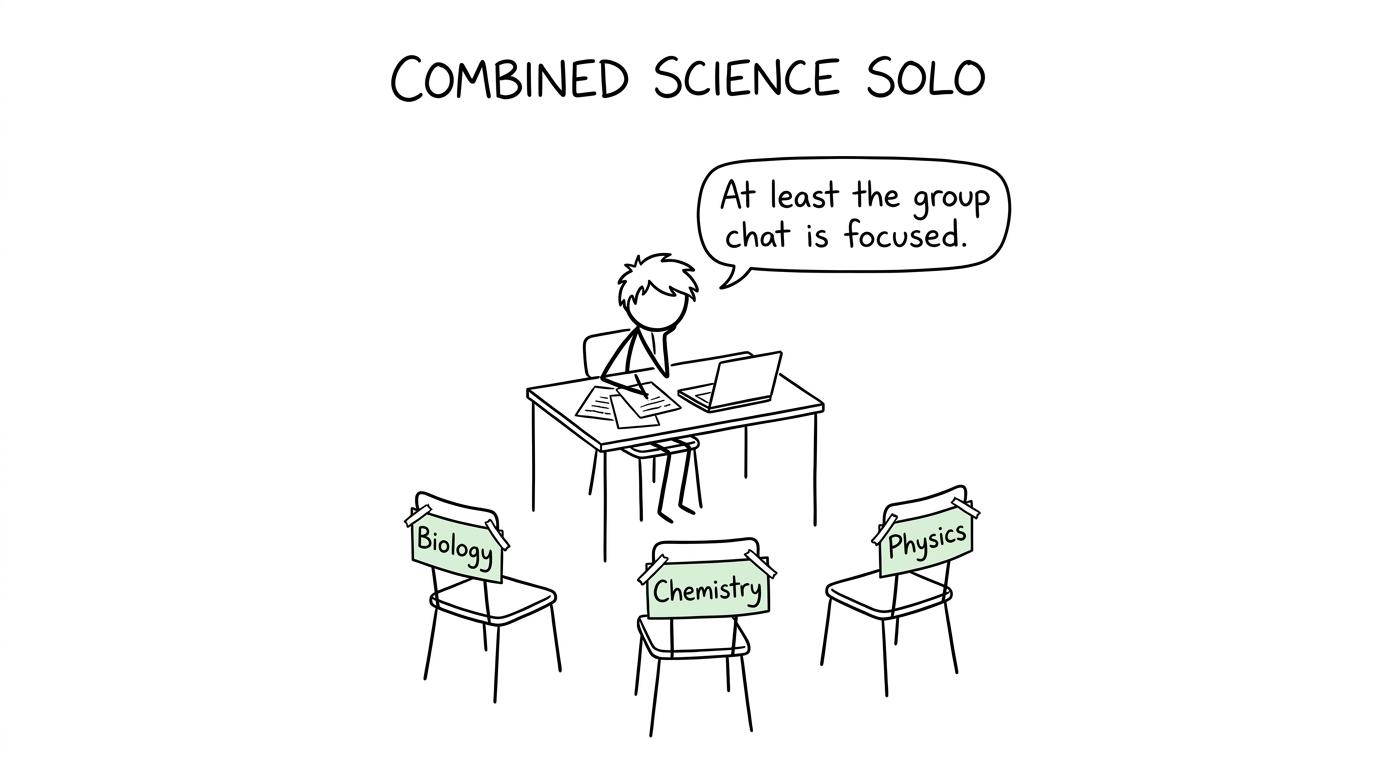 A student conducting a very focused solo Combined Science group session
When revising GCSE Combined Science alone works best
Solo revision gives you control. You choose the topic, pace and level of difficulty, and you cannot hide behind a friend who answers first. That last advantage matters. Recognition can feel like knowledge when somebody else is speaking, but the examination asks you to produce an answer independently.
Calculations and equation practice
Combined Science includes mathematical skills across biology, chemistry and physics. Depending on your specification, you may need to rearrange equations, convert units, use ratios, interpret graphs, calculate percentages and express quantities in standard form.
These skills need quiet, independent practice. If you are working with density, for example, recognising
density=massvolume\text{density} = \frac{\text{mass}}{\text{volume}}density=volumemassis not enough. You need to select the correct relationship, substitute values with suitable units and judge whether the result is sensible without somebody prompting the next step.
MathsGenie's free GCSE Maths revision hub is useful when the science feels manageable but the calculation does not. You can target the underlying maths rather than repeatedly attempting a science question with the same unresolved weakness.
Relevant areas often include standard form revision, ratio, proportion, percentages and rearranging formulae. Although the exact organisation varies between Edexcel, AQA, OCR and Eduqas, these mathematical foundations recur across GCSE specifications.
Timed questions and honest diagnosis
Independent exam practice reveals what you can retrieve under pressure. Complete a short set without notes, videos or messages, then mark it carefully. Separate your errors into categories:
- missing scientific knowledge
- weak mathematical method
- incorrect unit or conversion
- imprecise exam language
- misreading the command word
That diagnosis tells you what to do next. A weak definition needs retrieval practice; a calculation error may require a maths lesson; an incomplete explanation needs closer attention to the mark scheme.
The same principle is explained in MathsGenie's guide to using past papers properly: the paper identifies the weakness, while the revision happens when you repair and retest it. The approach transfers naturally to science papers.
Topics that suit solo revision
Independent sessions are particularly useful for:
- equation recall and rearrangement
- unit conversions
- balancing symbol equations
- recalling definitions and key facts
- drawing and interpreting graphs
- calculation-heavy physics questions
- timed extended responses
- correcting personal mistakes
Solo revision also suits students who need a quiet environment to process information. That is not a sign that group revision is unsuitable forever. It simply means group work should have a precise purpose rather than becoming the default.
When revising with others works best
A revision group becomes valuable when everyone has to think. Its purpose is not to divide the work so that each person learns less. It is to make understanding visible.
Structured collaborative learning can support progress, but structure is the crucial word. Students need a shared task, individual responsibility and a way to check whether the discussion produced accurate knowledge. A group that merely rereads notes together offers little protection against distraction or shared misconceptions.
Explaining scientific processes
Processes such as photosynthesis, electrolysis, natural selection and homeostasis can feel familiar until you try to explain them precisely. Teaching the idea to another student forces you to organise the stages and connect cause to effect.
Use a simple rule: the listener may ask questions but should not rescue the speaker immediately. When the explanation ends, compare it with your specification, class materials or mark scheme. A confident explanation can still be wrong.
This approach works especially well for questions containing command words such as explain, compare, evaluate and suggest. A partner can notice when your answer states a fact but does not explain why it matters.
Required practicals and experimental reasoning
Discussion is useful for practical work because experiments contain connected decisions: variables, equipment, measurements, hazards, repeat readings and conclusions. One student can describe a method while another looks for missing controls or vague instructions.
Good group prompts include:
- Which variable is changed?
- Which variable is measured?
- What must be controlled?
- How could reliability be improved?
- What pattern would the results support?
- Is the conclusion justified by the data?
These questions are more productive than asking someone to recite a memorised method. They test whether the method makes scientific sense.
Graphs, tables and unfamiliar data
Data questions benefit from brief comparison because two students may notice different features. You can independently interpret the graph first, then compare conclusions and justify them using evidence.
The independent-first rule matters. If the group discusses the graph before everyone has committed to an interpretation, quieter students may simply adopt the first confident answer.
If axes, scales or correlation cause difficulty, use MathsGenie's scatter graphs revision resources to strengthen the mathematical skill. Remember that correlation describes an association; it does not, by itself, prove that one variable caused the other.
 A revision group discovers an unexpected off-topic variable
Which approach suits which Combined Science topics?
Different topics create different revision problems. Use the method that addresses the problem rather than following one fixed preference.
Biology
Group revision works well for explaining cycles, feedback systems, inheritance and ecological relationships. Ask each person to explain a process without notes, then let the group identify missing links.
Solo work is better for precise vocabulary, genetic diagrams, magnification calculations, percentages and interpreting biological data. If ratio or proportional reasoning is the barrier, check the relevant areas in the GCSE Maths topic list.
Chemistry
Revise particle models, bonding and chemical changes with others when discussion helps you connect observations to explanations. Required practicals also suit a small, focused group.
Work alone when practising formulae, balancing equations, relative formula mass, concentration calculations and quantitative chemistry. You need to discover whether you can choose and complete a method independently.
Physics
Group explanation can clarify energy transfers, forces, waves and electromagnetism. Sketching a simple diagram and asking another student to challenge your reasoning can expose hidden assumptions.
Solo practice is essential for equation selection, rearrangement, unit conversion and graph interpretation. MathsGenie's guide to the best order for learning GCSE Maths topics can help if several prerequisite skills need rebuilding rather than one isolated fix.
How to run a useful group revision session
Keep the group small enough for everybody to participate. Agree on one topic and one outcome before starting. “Revise chemistry” is too broad; “retrieve the electrolysis rules and answer six exam questions” is specific.
A focused session might follow this pattern:
- Begin with silent retrieval so everyone answers independently.
- Compare responses and identify disagreements.
- Let one person explain each disputed idea.
- Check the explanation against trusted course material or a mark scheme.
- Complete fresh questions independently.
- Finish by recording individual topics to revisit alone.
Assigning roles can help: one person keeps time, one asks questions and one checks the mark scheme. Rotate the roles so nobody becomes the permanent teacher or spectator.
Phones should be used only when needed for resources or timing. A group chat may help organise the session, but it is rarely the best place to conduct it.
Build a hybrid Combined Science revision routine
The most reliable plan treats solo and shared revision as parts of one cycle:
Prepare alone
Choose a narrow topic and attempt retrieval questions without notes. Use your exam board's specification as a checklist and flag uncertain areas.
Discuss selectively
Bring genuine questions to a partner or group. Explain difficult concepts, compare practical methods and resolve disagreements using authoritative materials.
Test alone again
Complete fresh questions without help. If you still cannot answer independently, the topic is not secure. Return to the lesson, practise again and retest after a gap.
Review the maths underneath the science
Science calculations often expose a more general mathematical weakness. You may understand the scientific relationship but lose marks through fractions, percentages, graphs or standard form. MathsGenie's guide to GCSE Maths topics that frequently recur helps you identify these high-value foundations.
Nearer the examination, add timed practice. MathsGenie's GCSE revision resources include revision lessons, practice questions, mini tests, past papers, predicted papers, mark schemes and video solutions for developing the mathematical fluency that science calculations demand.
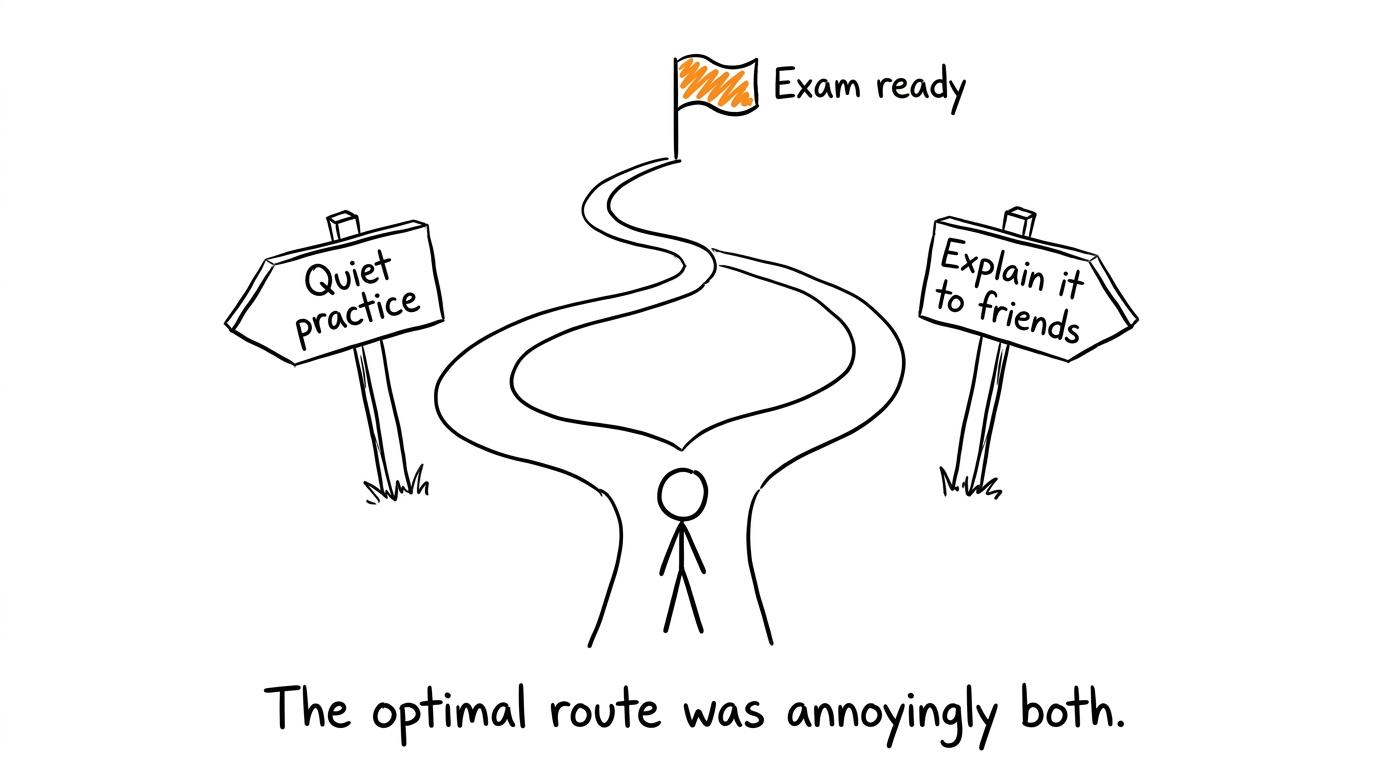 Two different revision paths meet at the same exam-ready destination
Common mistakes when revising alone or with others
Choosing company instead of a method
Friends can make revision feel easier without making it more effective. Decide what each person must produce by the end, such as answers, explanations or corrected questions.
Revising only in your preferred way
Quiet revision may feel comfortable, but never explaining a concept can conceal weak understanding. Group discussion may feel productive, but never sitting a paper alone conceals weak recall. Use both forms deliberately.
Letting the strongest student answer everything
If one person supplies every answer, the others are observing rather than retrieving. Give everyone thinking time and ask each student to commit to an answer first.
Accepting confident explanations without checking
Confidence is not evidence. Verify disputed points against your current exam-board specification, teacher materials and official mark schemes.
Ignoring the calculation skills
Reading scientific notes does not build mathematical fluency. Practise calculations independently and show each stage clearly, including substitutions and units.
Completing papers without repairing errors
A score measures performance at one moment. Improvement comes from analysing lost marks, revising the underlying topic and attempting a fresh question later.
Choose the method that makes you think
There is no permanent answer to whether you should revise GCSE Combined Science alone or with others. The better method changes with the topic. Calculations, recall and timed questions usually belong in solo sessions. Explanations, practical reasoning and careful comparison can improve through structured work with other students.
The useful question is: What must I be able to do alone in the examination, and what kind of support will help me learn it now?
Build your week around that distinction. Use discussion to uncover ideas, then use independent practice to prove that they have become yours. When scientific calculations expose gaps in graphs, ratio, standard form or algebra, visit MathsGenie for free revision lessons, practice questions, mini tests, past papers, predicted papers, mark schemes and video solutions. Start with one weakness, repair it carefully and test it again.











