Revise GCSE Arabic When You Can't Sit Still
Revise GCSE Arabic but can't sit still? Use short, active sessions for vocabulary, listening, speaking and writing while keeping GCSE maths on track.
Revision advice often starts with a desk, a silent room and an hour-long timer. That picture works for some students. For others, it makes concentration disappear before the book is even open.
If your search was “revise gcse arabic cant sit still”, the practical answer is this: stop treating stillness as a requirement for learning. Use short, active sessions involving walking, speaking, listening and retrieval. Then build sitting stamina separately for the parts of the examination that demand it.
The aim is not to force yourself through somebody else's ideal routine. It is to create a system that covers GCSE Arabic properly while leaving enough attention for your other subjects, particularly GCSE maths.
Your movement-friendly revision checklist
Start with these principles:
- Work on one small outcome at a time.
- Rotate between listening, speaking, reading and writing.
- Retrieve information before checking your notes.
- Use movement during learning, but practise sitting for exam-style tasks.
- Revisit material across several days rather than cramming it once.
- Record mistakes and turn them into the next session's target.
- Keep Arabic and maths revision in separate, clearly defined blocks.
Pearson Edexcel GCSE Arabic assesses listening, speaking, reading and writing. Each skill contributes 25%25\%25% of the qualification, and students enter either foundation or higher tier across all four papers. A successful plan therefore cannot consist only of memorising vocabulary, even if vocabulary feels like the easiest place to begin.
Stop measuring revision by time in a chair
There is a quiet trap in revision: confusing visible effort with useful learning. Sitting at a desk for ninety minutes looks serious, but it does not guarantee that anything can be recalled the following day.
A better measure is output. At the end of a short Arabic session, ask:
- Which words could I recall without looking?
- What did I understand from an audio clip?
- Which answer did I say aloud?
- What did I write accurately?
- Which error should I revisit tomorrow?
This approach reflects a broader lesson from evidence about revision. Retrieval practice, trying to bring knowledge back from memory, is generally more useful than repeatedly rereading familiar notes. Spacing that retrieval across different days also helps to avoid the false confidence created by one long cramming session.
Maths revision works on the same principle. MathsGenie's twenty-minute GCSE maths revision routine shows how a small, specific session can include recall, practice and checking rather than passive reading.
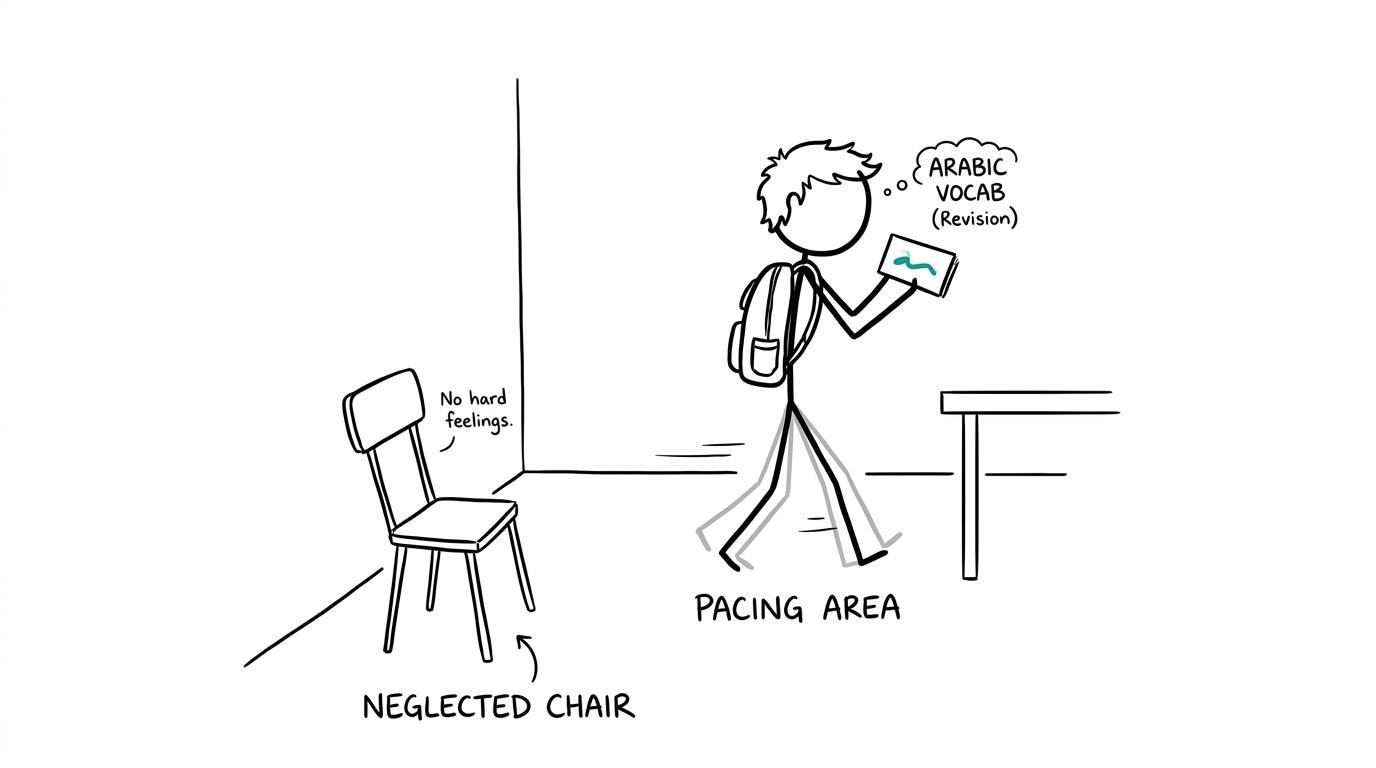 A student walking with an Arabic flashcard while a chair accepts its redundancy
Build short GCSE Arabic revision loops
When sitting still feels difficult, make the session short enough to start and active enough to continue. A useful loop might contain four stages.
Choose one precise target
Avoid targets such as “revise Arabic”. They are too broad to direct your attention. Choose something observable instead:
- recall vocabulary about school;
- recognise five opinions in a listening extract;
- rehearse answers for one speaking theme;
- read a short passage and identify its tense;
- write one accurate paragraph using more than one time frame.
A precise target removes the exhausting decision about what to do next. This is also why the best order for learning GCSE maths topics begins with manageable stages rather than asking students to tackle the whole specification at once.
Retrieve before you review
Close the vocabulary list. Say or write everything you remember about the chosen theme. Only then check what was missing.
You could place vocabulary cards at opposite ends of the room, pace while recalling English meanings, or ask somebody to test you while you stand. The movement is not the learning mechanism by itself. The important part is attempting to recall the Arabic before seeing the answer.
Keep a small “not secure yet” pile. Correct answers should reappear later, but uncertain words need to return sooner.
Produce something
Recognition is not the same as production. A word can look familiar on a page and still disappear when you need it in a speaking or writing assessment.
End each loop by producing Arabic. That could mean recording a voice note, answering an unseen question aloud, writing several connected sentences or giving a brief description of an image. Check accuracy afterwards using class materials, teacher feedback and the correct exam-board resources.
Leave a next action
Do not finish with “continue tomorrow”. Write a concrete instruction such as “retest travel vocabulary” or “rewrite the paragraph with corrected verb endings”. Starting becomes easier when tomorrow's first decision has already been made.
MathsGenie's guide to finding your weakest GCSE topics applies the same idea: use evidence, identify the narrow gap and retest it after a delay.
Match movement to each Arabic skill
Movement-friendly revision should still reflect the four assessed skills. Each one needs a different kind of practice.
Listening while walking
Use an appropriate GCSE Arabic audio recording and listen while walking somewhere safe or moving around at home. Give each listen a purpose.
On the first listen, identify the topic and overall attitude. On a later listen, focus on details such as reasons, time references, negatives and changes of opinion. Pause afterwards and say what you understood without replaying immediately.
Walking is suitable for initial listening and recall. When answering an examination-style question, however, sit down and follow the paper so that you also practise coordinating the recording, question wording and written response.
Speaking on your feet
Speaking is naturally compatible with movement. Put possible questions around the room and move to a new position for each answer. Practise responding without reading a complete script.
For Pearson Edexcel GCSE Arabic, speaking includes a role play, a picture-based task and a conversation. Your preparation should therefore include short, direct responses as well as developed answers containing opinions, reasons and different time frames.
Record yourself occasionally. Listen for hesitation, missing details and repeated vocabulary. Fluency matters, but accuracy and communication must not be sacrificed simply to speak faster.
Reading in short searches
Turn a reading passage into a search mission. Stand at a counter or use separate stations for different tasks: find a negative, locate an opinion, identify a past reference and summarise the main message.
Do not translate every word automatically. GCSE reading rewards understanding the required information. Unknown vocabulary can often be interpreted from context, but check carefully when a single word changes the meaning.
Writing with planned movement breaks
Writing needs sustained accuracy, so it cannot be replaced entirely by oral practice. Make the process active around the writing itself.
Plan ideas while walking. Say each sentence aloud. Then sit or stand at a stable surface and write the paragraph without constantly consulting notes. Move away for a short break before returning to check verbs, agreement, spelling, time frames and whether every bullet point has been addressed.
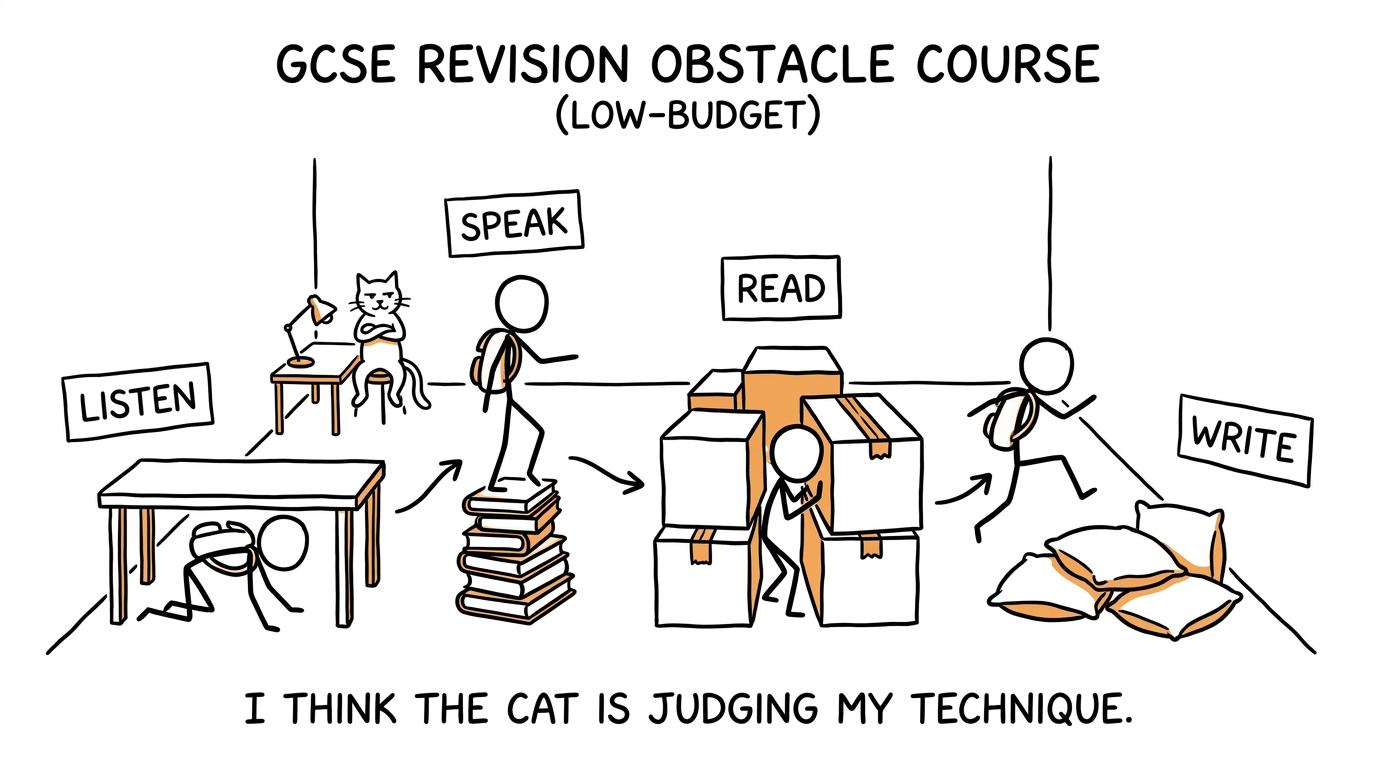 Four tiny revision stations and a cat occupying the only desk
Use a station system instead of one long session
Set up four simple revision stations:
- Listen: one short recording and two questions.
- Speak: one prompt answered without a script.
- Read: one paragraph with a specific search task.
- Write: one short response checked for accuracy.
Move after completing the task, not merely when you become bored. This distinction matters. Movement should support a finished piece of learning rather than become a route away from anything difficult.
You do not need to complete every station daily. Across the week, keep a simple record so that one comfortable skill does not crowd out the others.
The same structure can protect your maths revision. Open the GCSE maths revision hub, choose one lesson or set of practice questions, complete it and mark it before changing activity. If independent planning is difficult, the realistic GCSE maths self-study plan provides a clear route through topics, mini tests and papers.
Build exam sitting stamina separately
Active revision helps you learn, but the real listening, reading and writing papers still require you to remain in an examination setting. Do not leave that experience until the final mock.
Begin with a short seated, timed task. Put your phone away, use only permitted materials and finish without wandering between resources. Gradually extend the task as it becomes manageable. Treat sitting stamina like any other exam skill: specific, practised and developed over time.
Past papers are valuable here because they reveal both knowledge gaps and concentration patterns. You might notice that accuracy falls after a particular length of time or that you rush when a passage looks unfamiliar. MathsGenie's guide to when you should start GCSE past papers explains why shorter sections can come before complete timed papers.
If restlessness regularly affects lessons, sleep or everyday life, speak to a parent, carer, teacher, SENCO or healthcare professional. Revision advice cannot diagnose the reason, and you do not need to solve it alone.
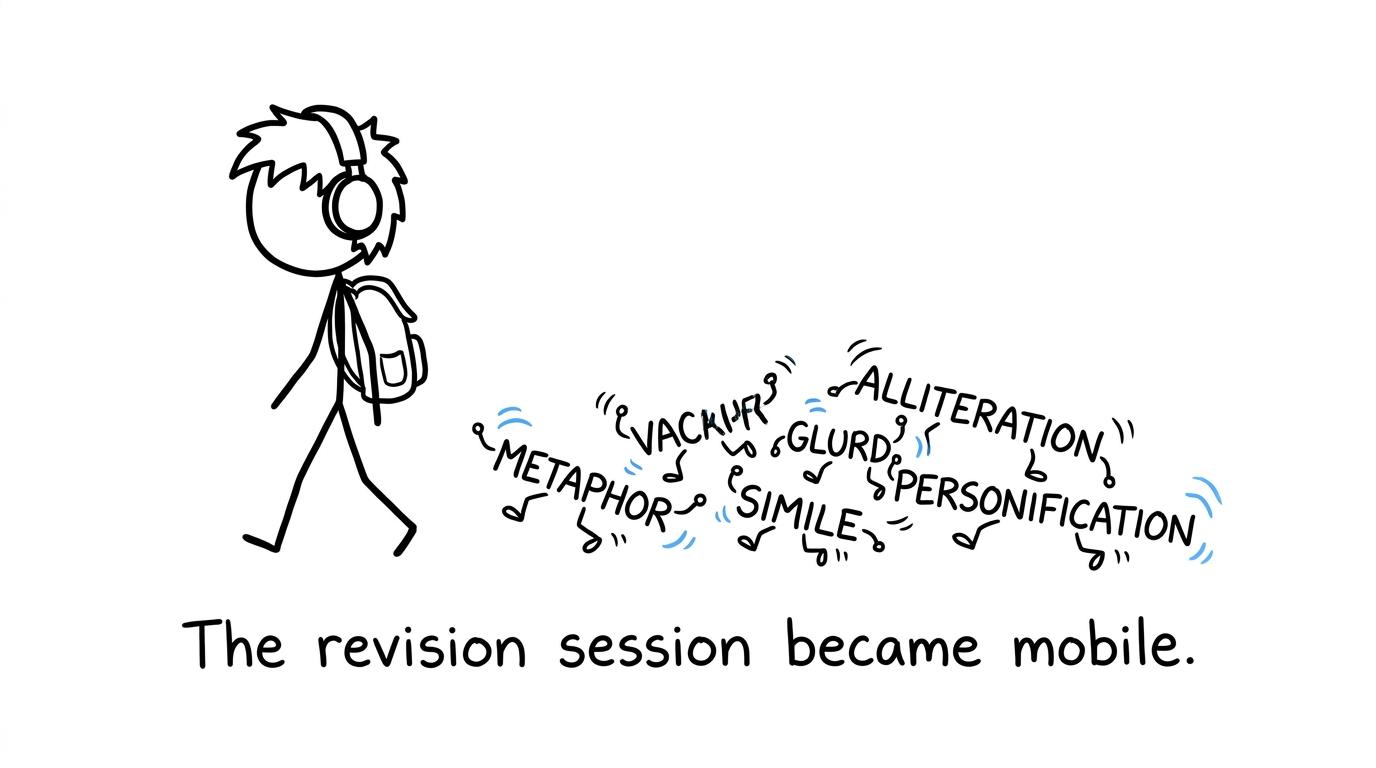 A walking student whose mobile revision session is being chased by vocabulary
Keep GCSE Arabic and maths revision balanced
Arabic vocabulary can expand endlessly, while maths can produce an equally endless list of topics. Without boundaries, whichever subject feels more urgent can consume the evening.
Use alternating micro-sessions. Complete one defined Arabic task, take a movement break, then complete one defined maths task. Keep the resources ready before starting so that the break does not become a search through messages and websites.
For maths, identify your exam board and tier first. MathsGenie supports Edexcel, AQA, OCR, Eduqas and other boards through free revision lessons, exam questions, worksheets and past papers. The GCSE maths topics by exam board and tier guide can help you select an appropriate next task rather than revising randomly.
Common mistakes when revising without sitting still
Moving without retrieving
Listening to vocabulary while pacing can feel productive, but familiarity is not enough. Stop the audio and recall the words independently.
Avoiding writing because speaking feels easier
Movement suits speaking, but written accuracy needs physical practice. Include short, regular writing tasks and check them carefully.
Changing tasks before anything is finished
Frequent switching can create activity without progress. Define the finish line before starting: one paragraph, one recording or one vocabulary test.
Revising only favourite themes
Comfortable topics create reassuring sessions. Use mistakes from class assessments and practice papers to decide what returns next.
Expecting movement to replace exam practice
Learn actively, but rehearse the conditions you will face. Reading and writing papers still require sustained seated attention.
Using past papers without reviewing errors
A paper is useful only when its mistakes influence future practice. This is true in Arabic and maths. The MathsGenie guide to using Edexcel GCSE maths past papers properly demonstrates the cycle: attempt, mark, diagnose, repair and reattempt.
Make revision fit the learner and the examination
You do not earn extra marks for having revised in the most traditional-looking way. You earn them by understanding the language, communicating accurately and responding effectively under examination conditions.
So walk while learning vocabulary. Speak while standing. Turn reading into a short search and divide writing into plan, produce and check stages. Then practise sitting in gradually longer exam-style blocks. Movement and discipline are not opposites; movement can be part of the structure.
When it is time to protect your GCSE maths grade as well, make MathsGenie your free revision base. Use the revision lessons to rebuild a method, complete practice questions, check mark schemes and video solutions, then measure progress with mini tests, past papers and predicted papers. Choose one small task now, finish it properly and leave the next action ready.