Review Mock Mistakes GCSE Spanish: Now or Later?
Review mock mistakes GCSE Spanish effectively: record errors straight away, correct them within a day, then re-test later to improve recall and exam technique.
A mock paper can feel unusually heavy once it has been marked. The score seems final, the red pen feels personal, and putting the paper away for a few days is tempting. Yet if you are wondering when to review mock mistakes GCSE Spanish, the best answer is not simply “now” or “later”.
Record and understand mistakes as soon as useful feedback is available, ideally that day or within about 242424 hours. Then return to the same skills several days later and attempt them again without notes. Immediate correction stops confusion from settling in; delayed re-testing checks whether anything has actually been learned.
This principle applies especially well to vocabulary, grammar, translation and listening errors in Spanish. It also transfers directly to GCSE maths, where a forgotten method, an exam-technique problem and a careless slip require different repairs.
The short answer: correct now, re-test later
Use this simple sequence after a mock:
- Take a short emotional break if the result has unsettled you.
- Record every lost mark while you still remember your reasoning.
- Classify the cause rather than merely copying the correct answer.
- Make the smallest useful correction that day or within 242424 hours.
- Practise the weak skill with fresh questions.
- Re-test it after roughly 222 a few 333 days.
- Check it again about a week later if it remains insecure.
The key distinction is between waiting to review and deliberately spacing a re-test. Waiting passively risks forgetting why you made the error. Spacing an active second attempt can strengthen recall.
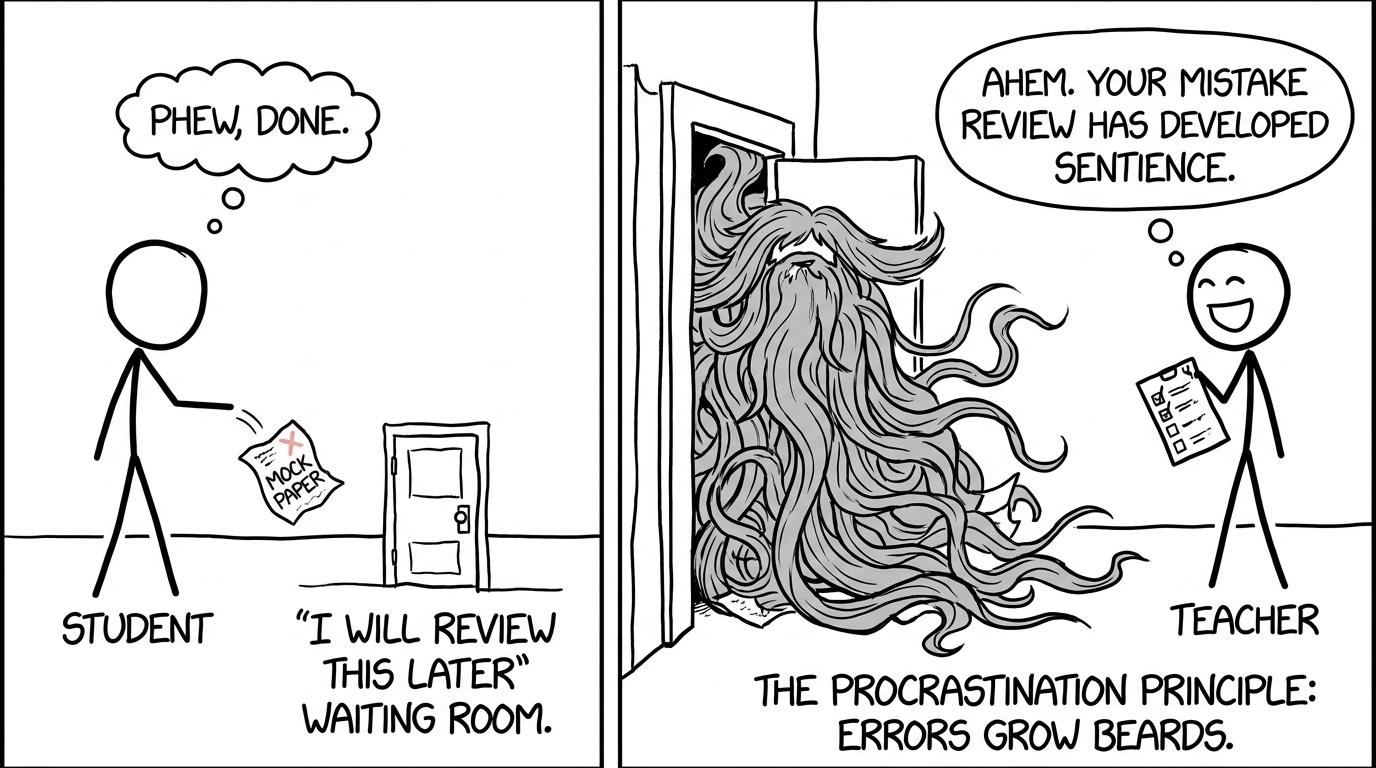 A mock paper growing a beard while waiting to be reviewed
Why immediate review usually matters
Research on feedback does not produce one universal rule for every learner and task. Both immediate and delayed feedback can support learning, and some studies find benefits from delay because it creates another spaced encounter. However, feedback must be processed and acted upon. If delaying means that the paper remains unopened, immediate review is the safer choice.
The Education Endowment Foundation describes useful feedback as information that helps a pupil improve the task, the underlying subject knowledge or their self-regulation. That is different from simply seeing a mark. A score tells you where you finished; effective review changes what you do next.
Your original thinking is still visible
Soon after a mock, you may remember why you chose a particular Spanish word, misread an instruction or abandoned a maths method. Several days later, the wrong answer remains on the page but the thinking behind it may have disappeared.
That memory matters. Consider the difference between:
- not knowing the relevant vocabulary;
- knowing it but failing to recognise it in speech;
- misunderstanding the question;
- recalling the right idea too slowly;
- making a transcription, spelling or calculation slip;
- running out of time.
Those errors can produce the same lost mark, but they should not produce the same revision task.
Incorrect ideas can otherwise remain unchallenged
Retrieval practice is powerful because attempting to remember strengthens later access to knowledge. But an incorrect response needs corrective feedback. In Spanish, that could be a mistaken verb form or an unreliable word meaning. In maths, it might be a false rule that appears to work on an easy question.
Reviewing promptly lets you compare your answer with the mark scheme, model response or teacher feedback before repeating the same faulty approach. For maths students, the GCSE Maths revision hub brings together free lessons, exam questions, papers and solutions for this repair work.
Why you should still return a few days later
An immediate correction can create a dangerous feeling: “I understand it now, so it is fixed.” Recognition is not the same as independent recall.
When the correct answer is directly in front of you, it will often look obvious. A delayed re-test removes that support. You must retrieve the vocabulary, grammar rule, interpretation strategy or mathematical method from memory.
This is why the most useful routine contains two separate events:
prompt correction+delayed retrieval=stronger evidence of learning\text{prompt correction} + \text{delayed retrieval} = \text{stronger evidence of learning}prompt correction+delayed retrieval=stronger evidence of learningThe delayed attempt should use a fresh question testing the same skill. Do not merely reread the original correction. If you can answer independently after a gap, the repair is becoming durable. If you cannot, you have discovered that the topic needs another revision cycle.
Maths students can use GCSE mini tests and revision resources to turn this principle into short, measurable re-tests rather than repeatedly completing full papers.
What waiting actually costs you
A delay of a few days does not automatically destroy learning. The cost depends on what happens during that delay. Four risks matter most.
You forget the cause of the mistake
The answer remains, but the decision that produced it fades. Your review becomes less diagnostic because you can no longer tell whether the problem was knowledge, interpretation, timing or confidence.
Avoidance becomes easier
A scheduled pause can be sensible. An indefinite pause is different. Mock results often carry emotion, and “I will do it later” can quietly become “I no longer want to look at it”. The longer the paper stays closed, the more effort it takes to reopen.
You lose a revision cycle
Correction is only the start. You still need targeted practice and a later check. Waiting several days before beginning compresses the time available for those stages, particularly near the real exams.
You may practise the same misconception elsewhere
If an incorrect rule remains uncorrected, you can repeat it in homework, revision or another paper. Prompt feedback limits that risk.
For a broader system, MathsGenie’s guide to finding weak GCSE topics explains how to turn lost marks into focused revision priorities.
A practical mock-review routine
Cool down without disappearing
You do not have to analyse the paper while feeling angry or embarrassed. Take a genuine break, eat, walk or move to another task. Then set a specific return time. “At 666 pm tonight” is a plan; “later” is not.
If teacher marking or an official mark scheme is not yet available, capture what you can immediately: questions that felt uncertain, sections where time ran out and answers you guessed. Complete the detailed correction when reliable feedback arrives.
Build a mistake log
For every lost mark, record:
- the paper and question;
- the skill being assessed;
- the marks lost;
- the cause of the error;
- the action needed;
- the date of the re-test.
For Spanish, useful categories include vocabulary, grammar, listening discrimination, pronunciation, reading inference, translation, task completion and timing. Check your own exam board and specification because the precise tasks can differ, particularly around specification changes.
For maths, categories might include missing knowledge, incorrect method, weak algebra, calculator use, units, rounding, interpretation or insufficient working. The GCSE maths topics guide can help you connect an isolated error to the wider topic that needs attention.
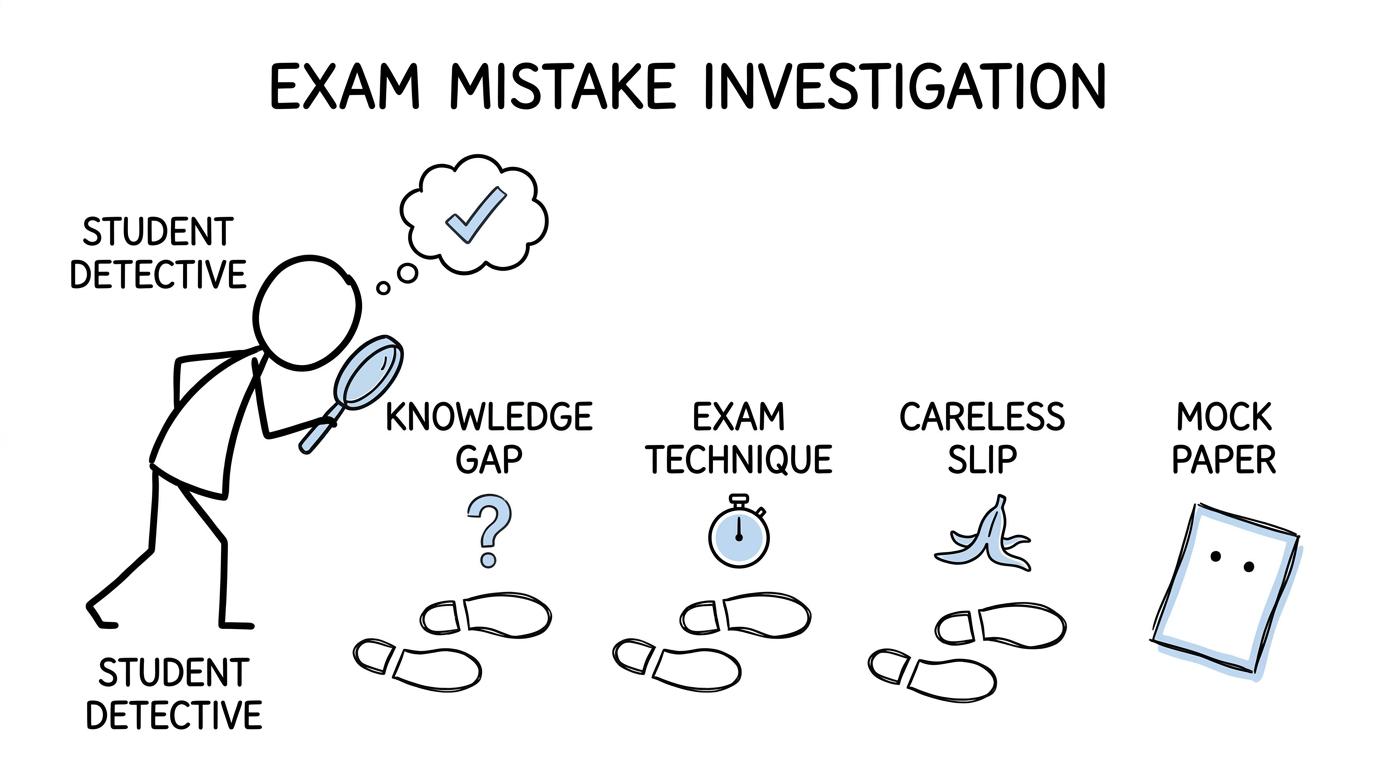 A student detective classifying mock-paper mistakes
Choose a repair that matches the cause
A knowledge gap needs relearning. A retrieval problem needs repeated recall. An exam-technique error needs a similar timed task. A careless slip needs a checking routine.
This is where many reviews become inefficient. Students rewrite whole answers because rewriting feels thorough, even when the actual problem was one missing instruction word or an omitted unit. Repair the smallest underlying weakness that explains the lost mark.
MathsGenie’s one-month GCSE maths revision plan shows how short retrieval, focused topic work and exam-style questions can fit into a realistic week.
Re-test without support
Close the notes and correction. Use a fresh task under modest time pressure. For Spanish, this could mean recalling vocabulary, completing a new translation, responding to a fresh prompt or listening again without a transcript. For maths, choose an unseen question testing the same method.
Mark the new attempt strictly. A correct answer with uncertain reasoning may need one further check. An incorrect answer should return to the revision list.
How this applies to GCSE maths preparation
Although the search phrase concerns GCSE Spanish, the decision rule is valuable for students preparing for maths exams too. Maths errors are often cumulative: a weak manipulation, misunderstood graph or omitted unit can affect several later topics.
After a maths mock, avoid doing another full paper immediately just to escape the uncomfortable topics. First diagnose the mistakes. Use a revision lesson to rebuild the method, practise a small set of questions, and then use a mini test or paper section to check it later.
The guide to starting GCSE past papers explains how targeted topic work and timed papers can support each other. If forgetting is the main problem, use the spacing ideas in MathsGenie’s guide to remembering GCSE maths content.
Full papers are valuable, but only when their evidence changes your next action. Otherwise, they become repeated measurements without treatment.
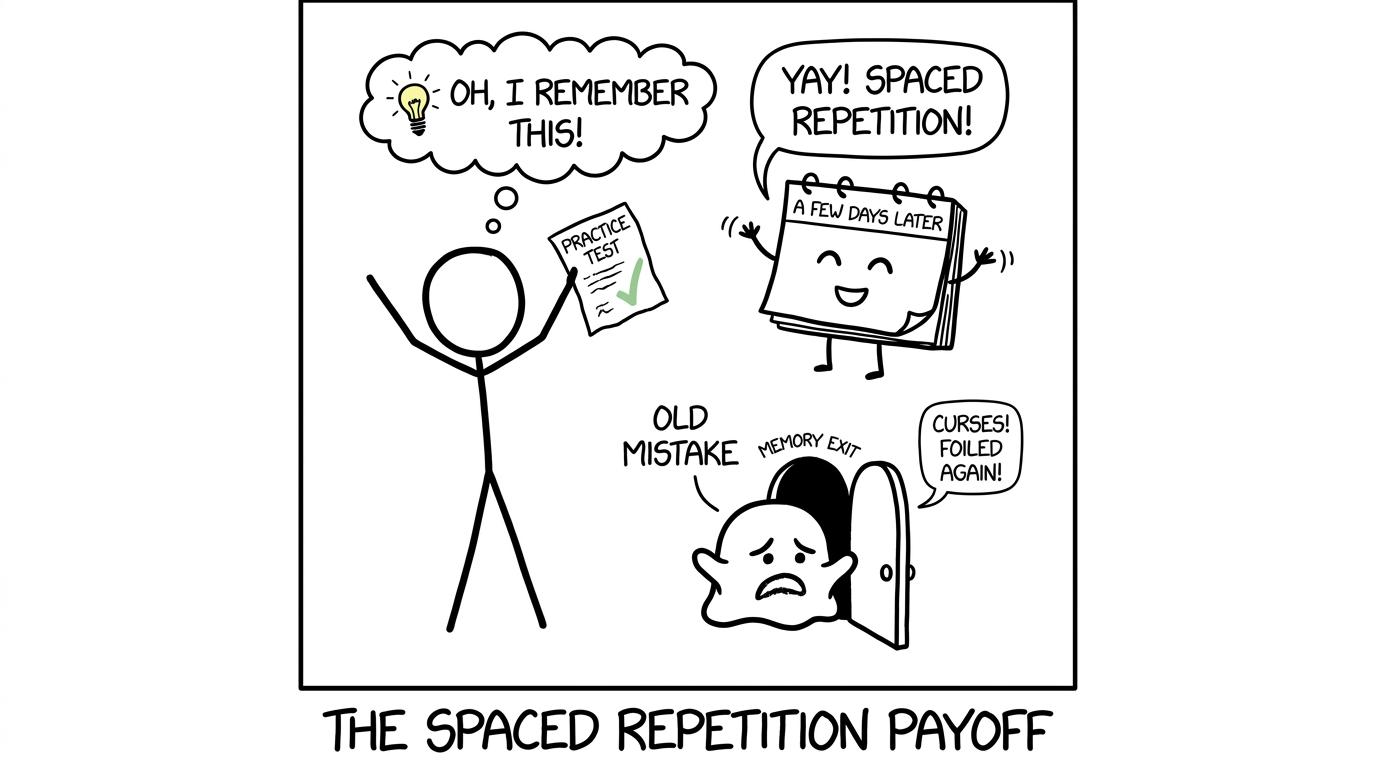 A calendar cheering as a student returns for a delayed re-test
Common mistakes when reviewing mocks
Looking only at the total mark
The total tells you how the paper went, not why. Two students with the same score may need completely different revision plans.
Copying corrections without retrieving them
A neat corrected answer can disguise weak memory. Always follow correction with an unsupported attempt later.
Treating every error as carelessness
“Careless” is often too vague to guide improvement. Name the precise behaviour: missed command word, copied value incorrectly, failed to check units or rushed the final line.
Waiting for motivation
Review does not need to feel appealing. Give it a small starting point: classify the first three errors or work for 151515 minutes. Momentum usually arrives after beginning.
Repeating the whole paper too soon
Immediate repetition can test memory of the answers rather than command of the skills. Use new questions first, then return to the paper after a meaningful gap.
Ignoring correct answers
A correct response may have involved guessing or insecure reasoning. Effective feedback also confirms what worked. Mark confident correct answers differently from lucky ones so that fragile knowledge is not overlooked.
Turn a mock result into better revision
The best time to review is soon enough to preserve your thinking, but calmly enough to learn from it. Record and correct errors once useful feedback is available. Then create distance and prove the correction with a fresh attempt.
A mock is not valuable because it predicts a grade perfectly. It is valuable because it reveals the next useful action.
For GCSE maths, start with the free MathsGenie GCSE revision resources. Use revision lessons to rebuild weak methods, practice questions and mark schemes to correct them, video solutions when the reasoning is unclear, and mini tests to re-test after a gap. When your foundations are stronger, move to past papers and predicted papers under timed conditions.
Do not leave the marked paper to gather dust. Open it, find one marks leak, repair it and schedule the re-test. That small loop is how a disappointing mock becomes useful evidence, and useful evidence becomes progress.