Review Mock Mistakes GCSE Further Maths: When?
Review mock mistakes GCSE Further Maths students make with a two-stage method: diagnose promptly, correct carefully, then retest after a short delay.
A mock paper can feel unusually vivid when you first put down your pen. You remember the question that consumed ten minutes, the sign you changed at the last second and the calculus problem you never managed to start. A few days later, the paper looks familiar but the decisions behind it are harder to reconstruct.
The best way to review mock mistakes GCSE Further Maths students make is not to choose between reviewing now and reviewing later. Do both, for different reasons. Capture and diagnose mistakes promptly, ideally the same day or within about 242424 hours. Correct the underlying skills carefully. Then retest them after a gap of roughly two or three days, followed by another check about a week later.
Immediate review preserves context. Delayed retesting reveals whether the correction has lasted.
The short answer: review now, retest later
Use this simple sequence after a GCSE Further Maths mock:
- Decompress first: take a short break if the paper has left you frustrated or tired.
- Capture the evidence promptly: record difficult questions, unfinished sections and moments of uncertainty before they fade.
- Mark accurately: use the mark scheme and any teacher feedback rather than relying on the final answer alone.
- Classify each lost mark: distinguish a knowledge gap from an execution error, a misread question or poor time management.
- Repair the method: use a focused revision lesson and closely matched practice questions.
- Retest after a delay: attempt new questions without notes two or three days later.
- Check again: return to the skill approximately one week later or include it in your next mixed paper.
This approach combines prompt feedback with spaced practice. Research supports feedback, retrieval and spacing as useful learning principles, although it does not establish one perfect review interval for every student or every mathematical skill.
The practical lesson is simpler: do not postpone the first diagnosis for several days, but do not mistake an immediate correction for secure learning either.
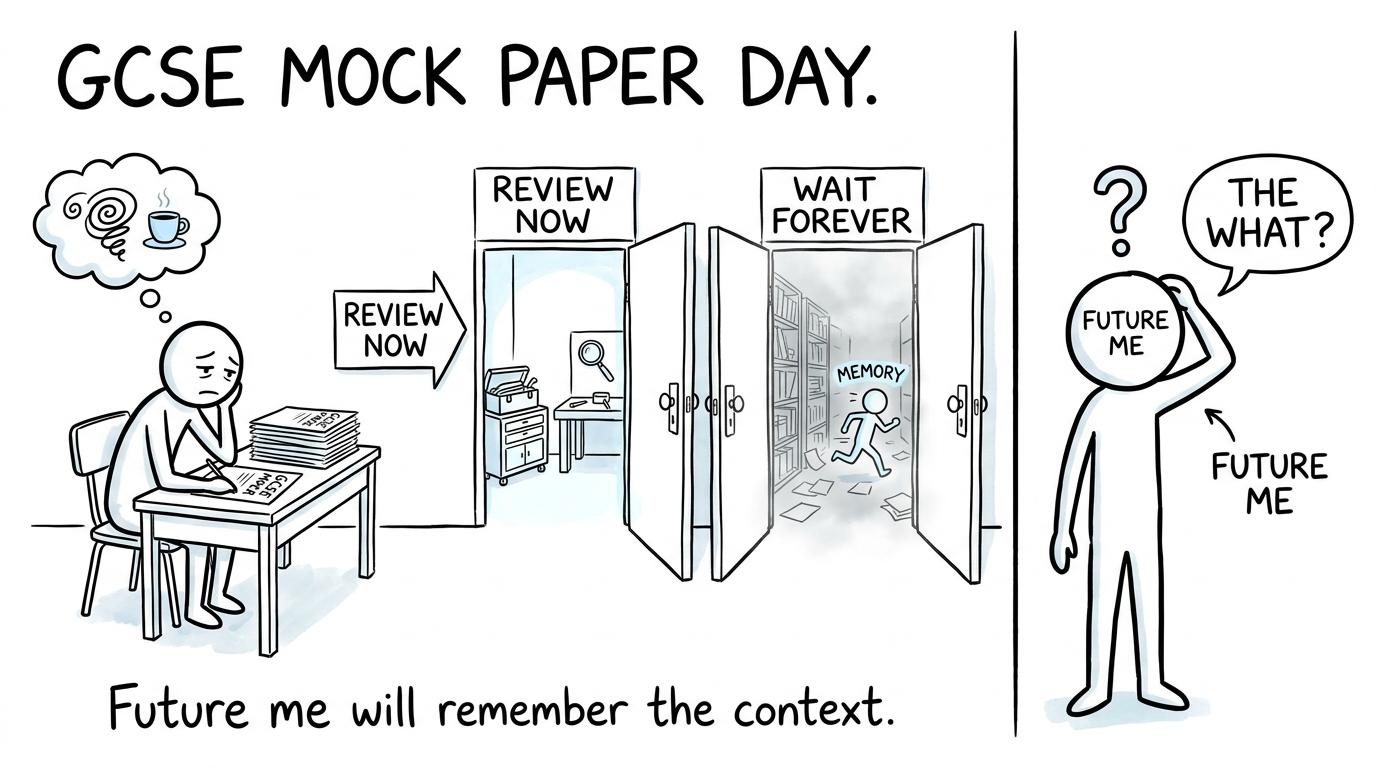 A student choosing between reviewing now and waiting forever
Why immediate mock review matters
A mark tells you that something went wrong. It does not tell you why.
Soon after the paper, you may still remember that you knew the algebraic method but rushed the final simplification. You may remember misreading a transformation, forgetting that the question was non-calculator or spending too long trying to force an unproductive approach.
That information matters because identical scores can hide different problems. A student who does not understand matrix transformations needs teaching and guided practice. A student who understands them but copies one entry incorrectly needs a checking routine. Giving both students another complete paper would be inefficient.
Prompt review lets you preserve details such as:
- where you became stuck;
- which formula or fact you could not recall;
- whether your working became disorganised;
- where you guessed rather than reasoned;
- which questions consumed disproportionate time;
- whether you recognised the topic correctly.
Start with the AQA GCSE Further Maths revision hub when matching a mistake to a lesson, question set or paper. The qualification commonly called GCSE Further Maths is formally the AQA Level 2 Certificate in Further Mathematics. It is an additional, untiered qualification rather than a replacement for GCSE Mathematics, and it extends algebra, geometry and problem solving while introducing areas such as calculus and matrices.
That breadth makes accurate diagnosis particularly valuable. Writing “bad at algebra” is almost useless. Writing “could not rearrange before differentiating” gives your next revision session a clear purpose.
Why waiting a few days can still help
Waiting is useful for retesting, not for forgetting that the review exists.
When you correct a question while looking at the mark scheme, the method can feel obvious. Yet recognition is not the same as recall. The page is supplying cues: the question, your previous working and the correct line in the mark scheme are all in front of you.
A delayed attempt removes some of those supports. If you can select and apply the method to a fresh question several days later, you have stronger evidence that the learning is becoming durable.
Spacing also prevents all your practice from being concentrated into one comfortable session. Evidence from mathematics education generally favours spaced over massed practice for longer-term retention, though the size of the benefit varies by context. Retrieval followed by feedback is also preferable to simply rereading a completed solution.
This is why a productive review has two clocks:
- the diagnosis clock, which should start promptly;
- the retention clock, which needs a deliberate gap before retesting.
The MathsGenie guide to finding weak GCSE topics can help turn paper evidence into a focused revision list. If your ordinary GCSE Maths foundations also need attention, use the GCSE Maths revision hub to select your exam board and rebuild the prerequisite skill.
What delaying the first review actually costs
The cost of delay is not that every memory disappears after a fixed number of hours. Learning is not governed by such a precise deadline. The real cost is a gradual loss of useful context and repair time.
You lose diagnostic detail
After several days, “I was confused by the notation” can become “I got the question wrong”. The second statement is true but less useful. It cannot tell you what to practise.
Misconceptions remain unchallenged
If you used an invalid algebraic step and do not check it, that method may still feel reasonable. Feedback matters because practice without correction can repeat the same error rather than repair it.
Your revision plan remains inaccurate
A mock should change what you do next. If the review sits untouched for a week, you may spend that week revising comfortable topics while the skills costing marks remain untreated. The GCSE one-month maths revision plan offers a useful structure for placing diagnosis, topic repair and paper practice into the same schedule.
You reduce the number of possible retests
Suppose there are two weeks before another assessment. Reviewing promptly leaves room for an initial repair, a delayed topic test and a later mixed-paper check. Waiting most of a week compresses that cycle. The cost is therefore not merely memory. It is lost opportunity to practise, receive feedback and try again.
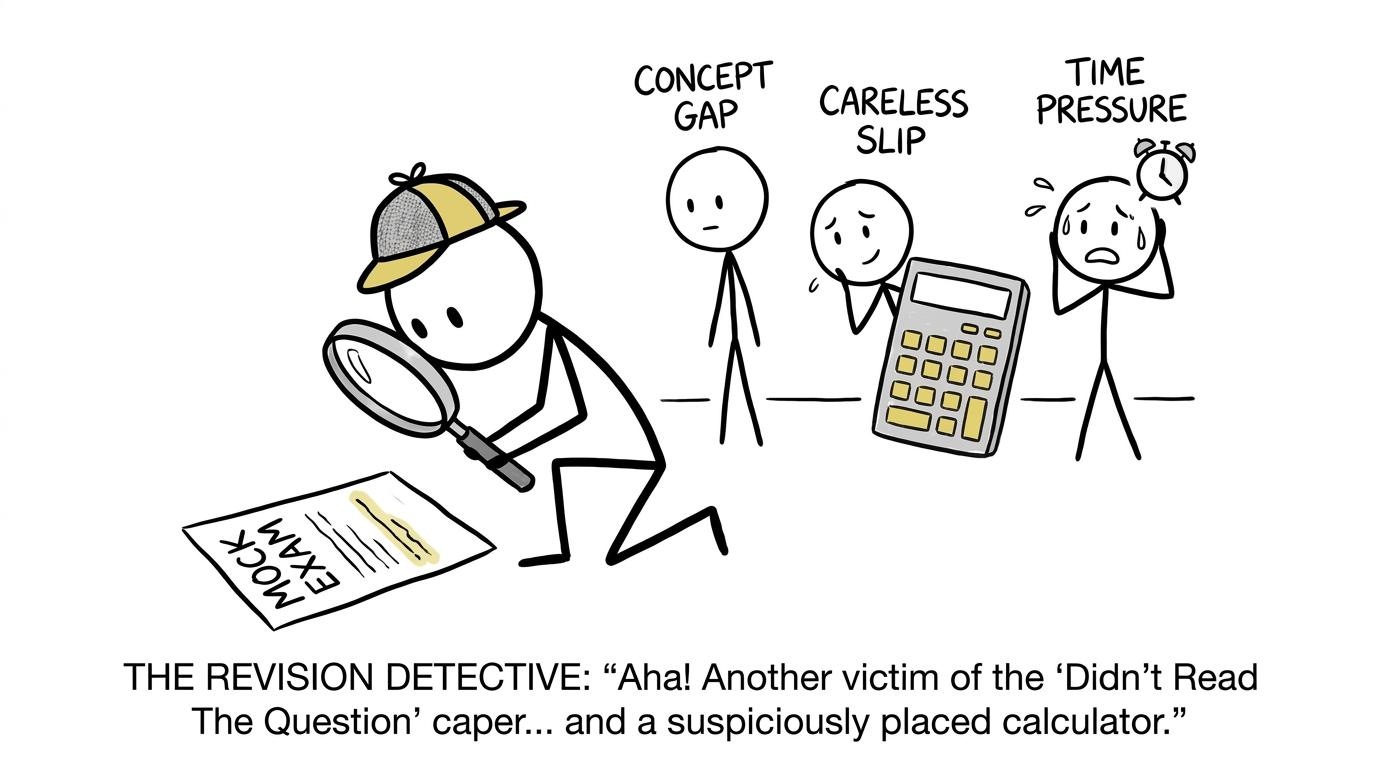 A student detective identifying different causes of mock mistakes
A practical mock-review system
A useful mistake log should be small enough to maintain and specific enough to guide action.
| Record | What to write |
|---|---|
| Question | Paper and question reference |
| Topic | A precise label such as matrix transformation or differentiation |
| Marks lost | The marks available but not earned |
| Cause | Knowledge, method, accuracy, interpretation or timing |
| Immediate fix | The lesson or practice set you will use |
| Retest date | A date two or three days later |
| Result | Secure, improving or needs more support |
Separate the error from the topic
Use four broad categories:
- Knowledge gap: you did not know the required fact, definition or method.
- Selection gap: you knew several methods but chose the wrong one.
- Execution error: the plan was sound, but algebra, arithmetic or notation failed.
- Exam-management error: you misread the instruction, omitted working or ran out of time.
One question may involve more than one category. Record the main cause that should shape your next action.
Repair the smallest useful skill
Do not respond to one mistake by vaguely revising all of Further Maths. Find the smallest skill that would have changed the outcome. Watch the relevant video solution or revision lesson, write a short statement of the correct method, and complete a focused set of practice questions.
If the mock exposes several ordinary higher-tier GCSE gaps, alternate Further Maths work with targeted GCSE practice. Further Maths assumes secure Key Stage 4 knowledge, so repairing the foundation is not a diversion. It is often the shortest route forward.
Retest without copying the correction
A retest should use a fresh question. Close your notes, remove the mark scheme and decide independently what the problem requires. Mark the result immediately afterwards.
For mixed practice, GCSE predicted papers can provide fresh exam-style material, while official past papers remain essential for understanding the genuine style and demand of your qualification. Predicted papers should supplement past papers, not replace them.
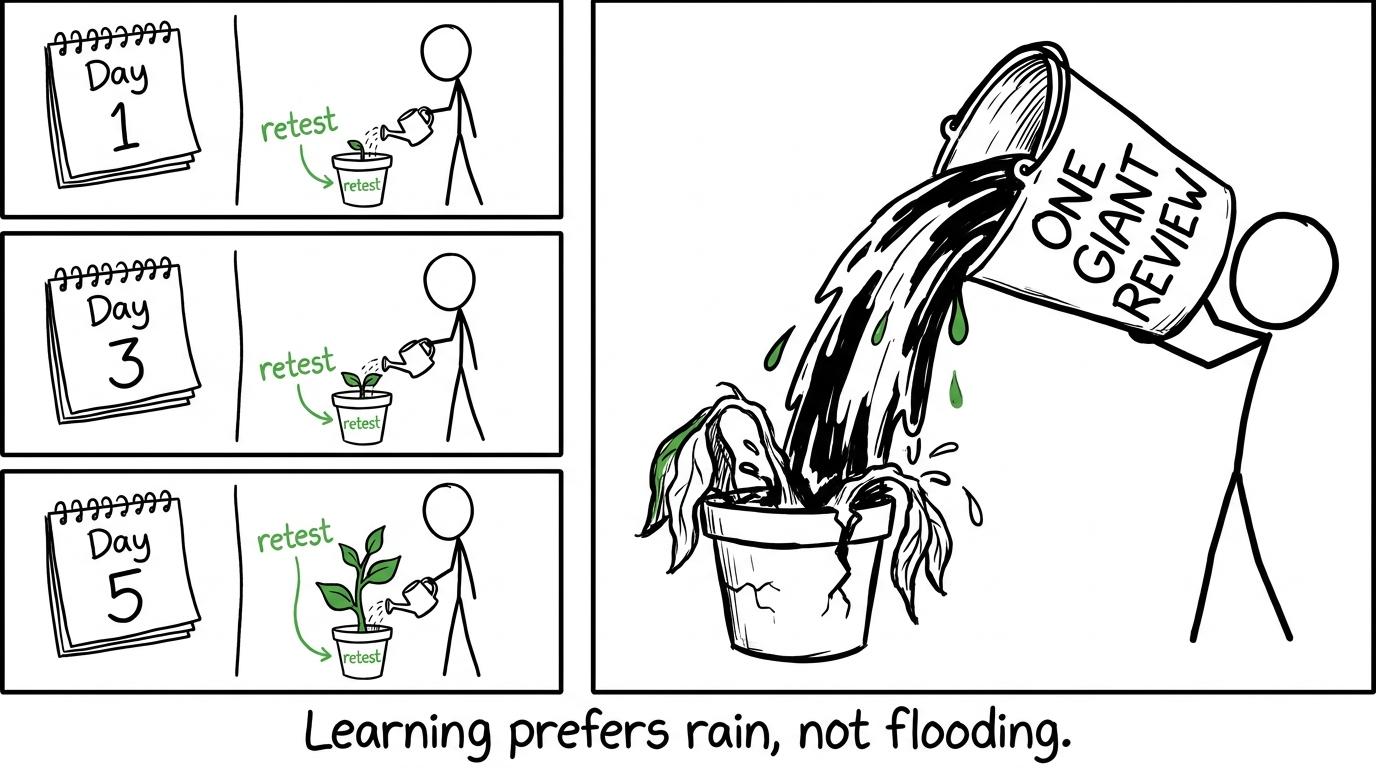 Two students discover that learning prefers spaced rain to one revision flood
When not to review immediately
“Promptly” does not mean forcing yourself through a mark scheme while exhausted or upset.
If you have just completed a demanding mock, take a proper break. Eat, move around and let the emotional intensity settle. A calm review later that day may be more accurate than an angry review five minutes after the paper.
You may also need to wait because your teacher has not returned the script or because the mark scheme is unavailable. In that case, make a quick memory note immediately: list questions that felt uncertain, methods you guessed and sections where time disappeared. Complete the detailed diagnosis once reliable feedback arrives.
For students sitting several mocks close together, sleep and preparation for the next paper may be more valuable than a late-night forensic review. Capture the evidence, schedule the full review and stop. The mistake is not waiting until tomorrow. It is waiting without a plan.
Common mistakes when reviewing Further Maths mocks
Copying the mark scheme
A copied solution can look perfect while teaching very little. Read the scheme, close it and explain the method in your own words. Then test that understanding on a new question.
Treating every lost mark equally
A one-off arithmetic slip and a repeated inability to start calculus questions should not receive equal revision time. Prioritise recurring mistakes, high-mark topics and gaps that block several other skills.
Looking only at incorrect answers
Review correct answers that involved guessing, excessive time or unclear working. A lucky mark is not yet a secure mark.
Redoing the same question too soon
Immediate redrafting checks whether you understood the feedback. It does not prove long-term recall. Keep the immediate correction, but schedule a fresh delayed question as well.
Completing another paper before repairing anything
More papers create more evidence, but evidence alone does not improve performance. Paper practice becomes valuable when it leads to focused teaching, practice and retesting. The guide on when to start GCSE past papers explains how to move from short diagnostics to full timed papers without wasting them.
Turn every mock into a revision decision
A mock is not merely a forecast of your final grade. It is a map of decisions made under pressure. Review it promptly and you preserve the reasons behind those decisions. Retest later and you discover whether your corrections survive without the mark scheme beside you.
Use MathsGenie to run the complete cycle: begin with free revision lessons, repair weak skills through practice questions, check methods with mark schemes and video solutions, and test progress using mini tests, past papers and predicted papers. If Further Maths is preparing you for Level 3 study, you can also explore the A Level Maths revision hub when the time is right.
Open your latest mock today. Record the three mistakes that cost the most marks, choose one precise skill to repair and schedule a fresh retest. The paper has already taken your time. Make sure it now gives something back.