

Review Mock Mistakes GCSE French: Now or Later?
Review mock mistakes GCSE French with a smart timing plan: correct errors promptly, revisit them after a gap, and build stronger recall for exams.
A mock paper can feel strangely heavier after it has been marked. Beforehand, it was only a test. Afterwards, every lost mark seems to say something about you.
It does not. It says something about what to do next.
If you want to review mock mistakes GCSE French effectively, the best answer is not simply “immediately” or “wait”. Use both timings for different purposes: inspect and correct important mistakes promptly, ideally on the same day or within the next day, then retest yourself after a short gap. This hybrid approach stops errors settling in while using spacing to check whether the correction has actually lasted.
The same principle is especially useful for GCSE maths. A mock identifies where marks escaped; the review turns that information into revision.
The short answer: correct now, retrieve later
Use this checklist after a French or maths mock:
- Take a short break before reviewing if you feel tired or upset.
- Record the total mark, but do not make it the centre of the review.
- Inspect every lost mark while you can still remember your reasoning.
- Classify the cause rather than merely copying the correct answer.
- Correct serious misconceptions promptly.
- Choose a small number of priorities for targeted practice.
- Retest those areas without notes after a gap of roughly two or three days.
- Return to them later using unfamiliar questions or prompts.
This distinction matters: feedback and retesting are not the same activity. Feedback tells you what needs changing. Retesting shows whether it changed.
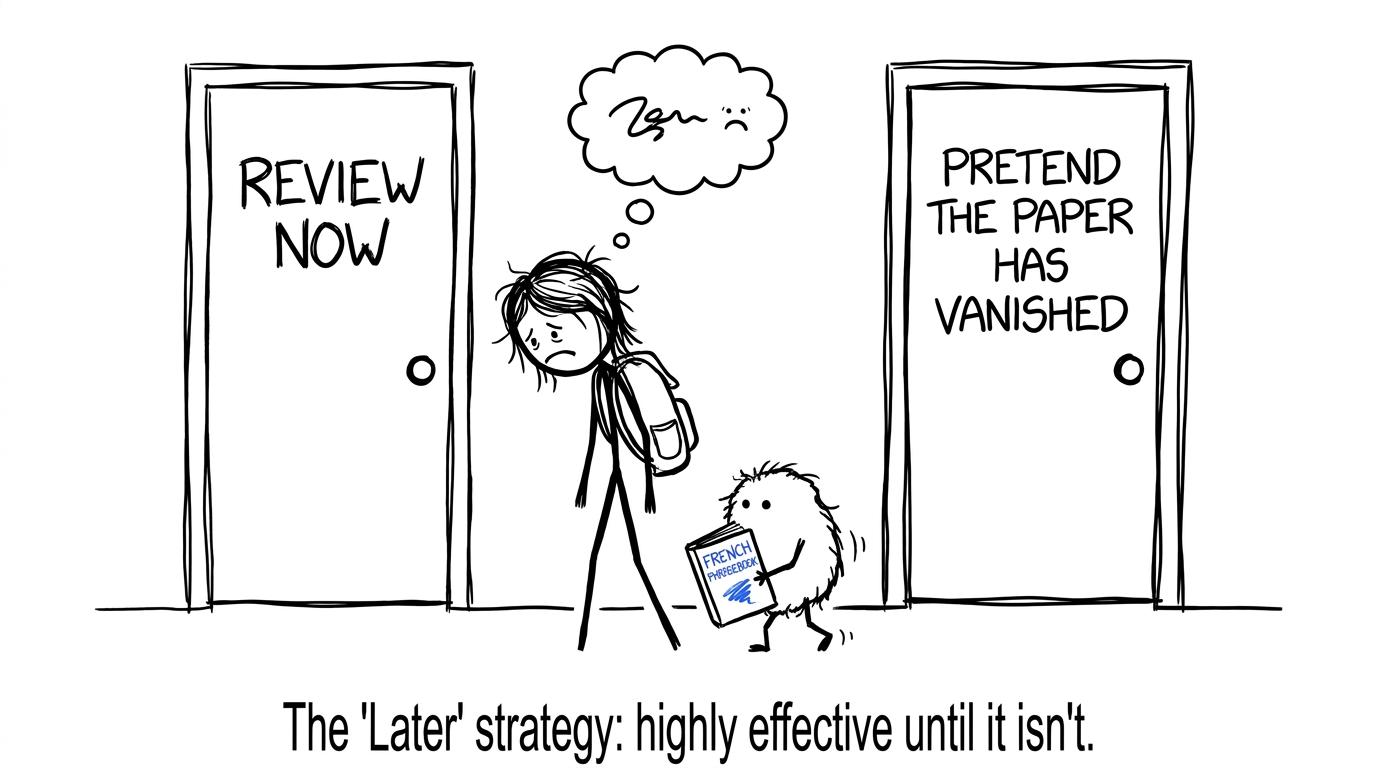 A GCSE student choosing between reviewing now and pretending the mock vanished
Why an immediate mock review helps
A prompt review preserves information that will soon become difficult to recover. You may still remember why you chose a particular French phrase, where you lost the thread in a listening task, or which part of a maths question made you hesitate.
Several days later, you might see only a cross on the page. You know the answer was wrong, but not what produced it.
That difference is valuable. Consider two broad types of error:
- A knowledge error: you did not know the vocabulary, grammar, formula or method.
- A performance error: you knew enough, but misread the question, rushed, omitted working or managed your time poorly.
Both lose marks, but they need different repairs. Knowledge errors require relearning and practice. Performance errors may require a checking routine, better annotation or timed work.
Research on educational feedback does not provide one universal best moment for every task. Guidance reviewed by the Education Endowment Foundation notes that feedback can be useful during learning, immediately afterwards or following a delay. Timing should depend on the task and learner, while the feedback itself must move learning forward.
That supports a practical rule: if the mistake involves a misconception, a missing fact or a method you cannot explain, deal with it promptly.
Why waiting can sometimes help
Delay is not automatically wasted time. A short, deliberate gap can create another retrieval opportunity.
If you correct an answer and immediately reproduce it, success may come from short-term familiarity. The mark scheme is still in view. The wording is still echoing in your head. It feels fluent, but that feeling may not survive until the exam.
When you close the notes and return later, the task becomes harder. That is useful. You must retrieve the correction rather than recognise it.
For GCSE French, this might mean recalling vocabulary, selecting the right tense or rebuilding an improved speaking response without looking. For GCSE maths, it means recognising the topic and reconstructing the method on a fresh question.
Evidence from retrieval-practice research generally supports giving corrective feedback after an attempt. Studies disagree about whether immediate or delayed feedback is always superior, partly because the result depends on the material, the length of the delay and what happens during it. The sensible conclusion is not to worship one timing. It is to ensure that correction is followed by another genuine attempt.
What delaying the whole review costs you
Waiting before a retest can be productive. Waiting before doing anything with the paper is different.
You forget your original reasoning
The paper records what you wrote, not everything you thought. As time passes, it becomes harder to tell whether you guessed, misunderstood a command word, ran out of time or applied the wrong rule.
Incorrect ideas remain unchallenged
An unchecked error may be repeated in homework or another revision session. Prompt feedback is particularly useful when a misconception could spread into connected topics.
You lose revision-planning time
A mock is diagnostic evidence. If it reveals weak listening vocabulary or unreliable algebra, those findings should influence your next sessions. Leaving the paper untouched means continuing with a revision plan that may no longer match your needs.
For maths, the GCSE maths revision hub makes that adjustment straightforward: identify the weak topic, use the relevant revision lesson and questions, then check it again with a mini test or paper.
Avoidance becomes easier
A delay chosen for learning has a return date. Avoidance says “later” without deciding when later is. The difference is a calendar entry.
If you need recovery time after the mock, take it. Then set a specific review session rather than relying on motivation to reappear.
A better two-stage review method
The most dependable approach combines a prompt diagnosis with delayed retrieval.
Stage one: diagnose and repair
Review the marked paper once you are calm enough to think clearly. That may be later the same day or the following day.
For each lost mark, choose a label:
- missing knowledge;
- misunderstood question;
- incorrect method;
- accuracy or transcription error;
- incomplete answer;
- poor time management;
- uncertain guess that happened to be correct.
Include lucky correct answers. Feedback should confirm what worked as well as expose what failed, and a guess is not secure knowledge merely because it earned a mark.
Write one concise correction for each important pattern. Avoid copying entire model answers. Your note should explain the decision you need to make next time.
Then select the two or three errors most likely to recur. Maths students can use the process in Find Your Weakest GCSE Topics to turn lost marks into a manageable priority list.
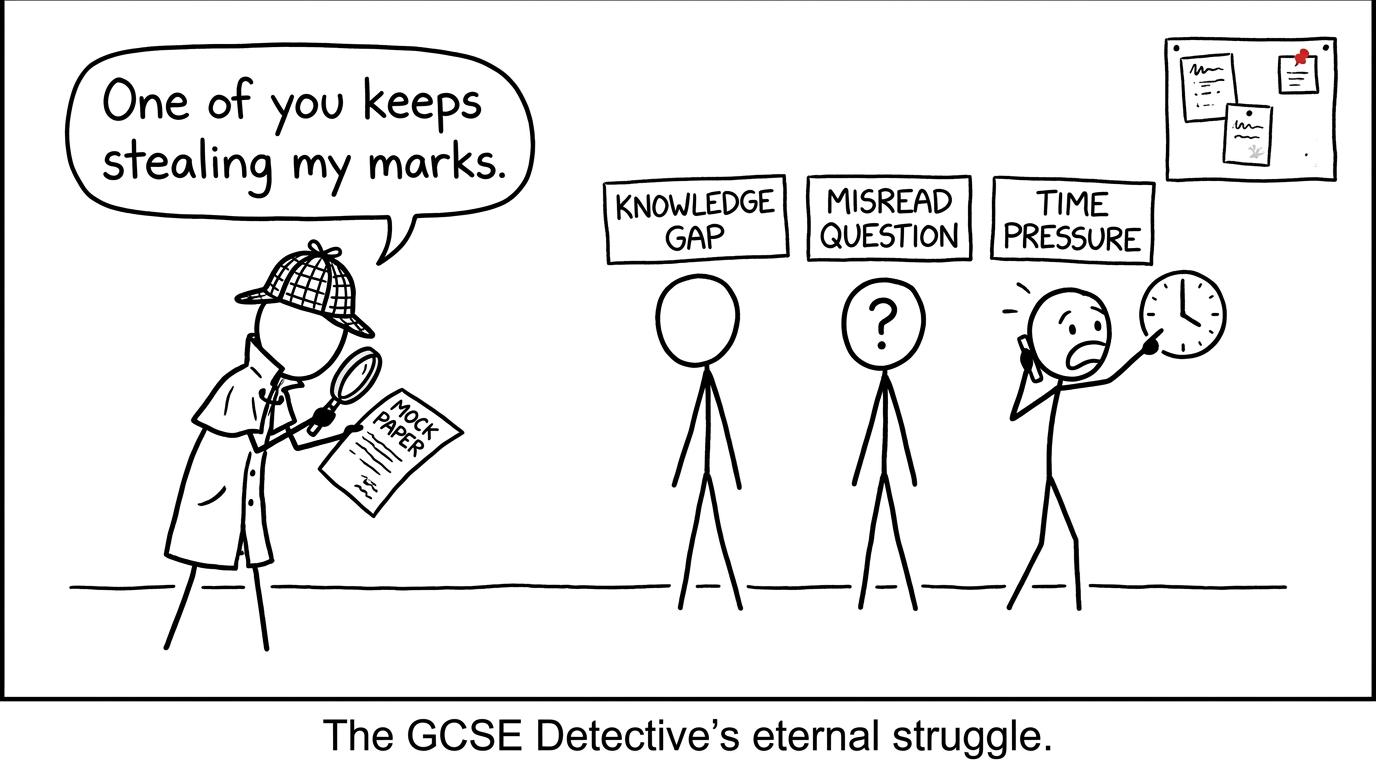 A student detective interviewing the suspects who stole their mock marks
Stage two: retest without support
After a short gap, return without the mark scheme open.
For French, test the corrected vocabulary, grammar or response structure from memory. For maths, attempt related questions before returning to the exact mock item. A fresh question checks whether you understand the method rather than remember the layout of one answer.
Finish by revisiting the original question. If you can now explain why the first attempt failed and complete the task independently, the review has done useful work.
MathsGenie’s twenty-minute GCSE maths revision routine is well suited to this cycle. A short session can include retrieval, focused practice, marking and one clear error note without turning the review into another exhausting mock.
How to review a maths mock using the same principle
Although the search question is about GCSE French, the timing lesson transfers directly to maths. The key difference is that maths marks often depend on both the answer and the method shown.
Start with a paper that matches your board and tier. The Edexcel GCSE maths past papers include mark schemes and worked support where available, while students taking OCR can begin from the OCR GCSE maths revision hub.
When marking, identify the precise line where the method stopped being valid. Do not reduce the diagnosis to “careless mistake”. That phrase hides the action you need to change.
A useful correction is specific: check signs after expanding brackets, retain full calculator values until the final answer, label units, or write the formula before substituting. The correction should be brief enough to remember and concrete enough to follow.
Next, practise the underlying topic. Once it is more secure, use an unseen set such as the Edexcel GCSE maths predicted papers to check whether the improvement transfers. Predicted papers should complement past-paper practice, not replace it.
For a fuller paper-review system, follow How to Use Edexcel GCSE Maths Past Papers Properly. The useful rhythm is attempt, mark, diagnose, repair and retest.
Common mistakes when reviewing mocks
Looking only at the total mark
A score measures one performance. It does not tell you what to revise next. Two students with the same mark may have completely different gaps.
Copying the mark scheme without thinking
Transcription can look like correction. If you cannot reproduce or explain the answer later, the gap remains.
Reviewing while emotions are still too strong
Immediate does not have to mean the second the mock ends. A short break can improve the quality of your attention. The aim is prompt, thoughtful review rather than punishment.
Correcting everything in one sitting
A long mistake list creates activity but not necessarily improvement. Prioritise recurring errors and topics that account for several lost marks.
Waiting several days with no planned return
A purposeful delay ends with retrieval. An unplanned delay often ends with the paper disappearing beneath other work.
Retaking the whole mock too soon
You may remember specific answers and mistake that familiarity for mastery. Repair topics first, then use fresh practice before returning to selected mock questions.
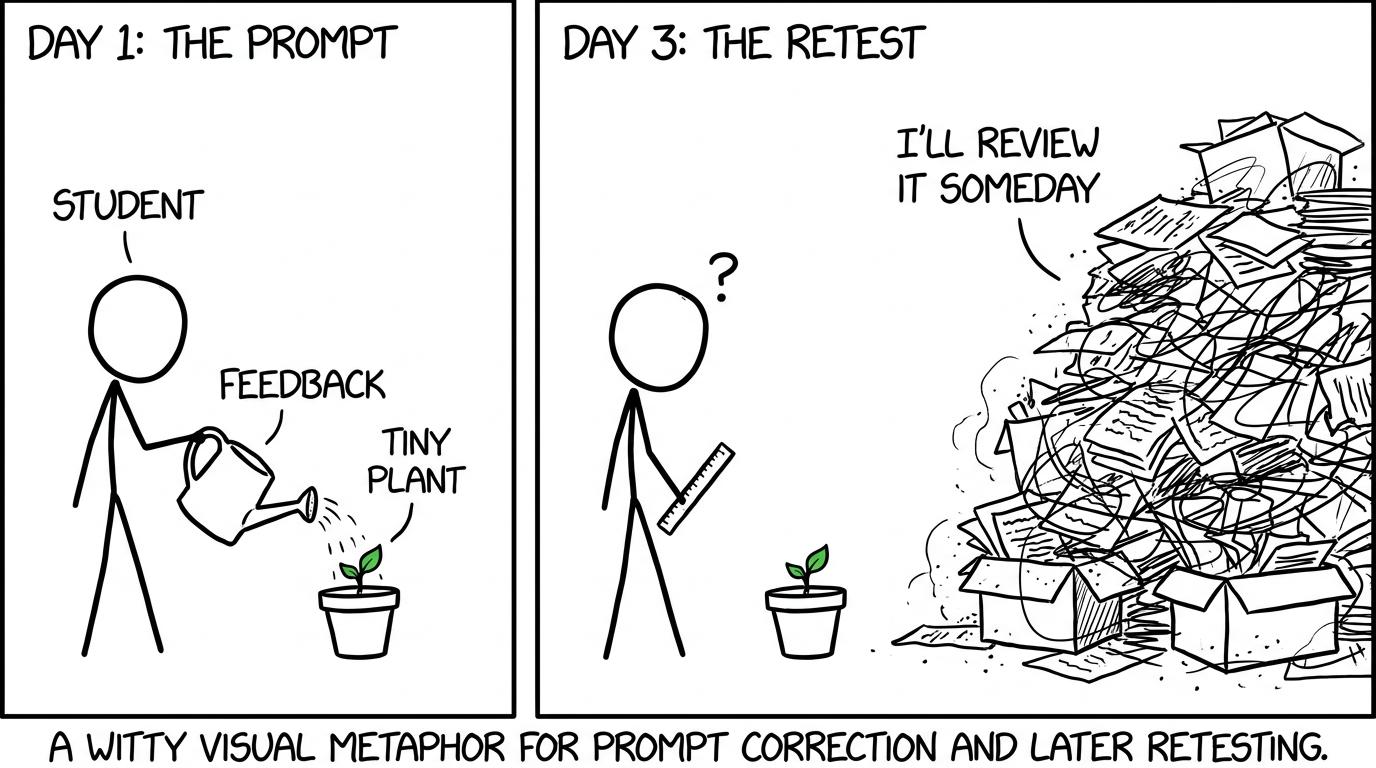 A small feedback plant beside an enormous dusty pile of postponed revision
Make the mock earn its place in your revision
A mock is not valuable because it predicts your future perfectly. It is valuable because it makes your current weaknesses visible while there is still time to change them.
So do not choose between immediate review and delayed review as if only one can be right. Correct significant mistakes promptly. Then create a gap and test yourself again. The first stage protects you from forgetting what happened; the second reveals whether the repair survived.
For GCSE maths, build that cycle around MathsGenie. Use the free revision lessons and practice questions to repair individual topics, mini tests to check progress, GCSE past-paper guidance to improve exam technique, and predicted papers, mark schemes and video solutions to test your next step. A Level students can use the same review habit with more advanced material.
Open your mock. Choose the first recurring mistake. Give it a name, give it a repair, and give yourself a date to prove that it is fixed.











