Review Mock Mistakes: GCSE Food and Nutrition
Review mock mistakes GCSE Food and Nutrition papers effectively: check errors promptly, repair weak knowledge, then retest after a short delay.
A marked mock can feel heavier than the paper it is printed on. Every cross seems permanent. It is not. If you want to review mock mistakes GCSE Food and Nutrition papers reveal, the best approach is neither to analyse everything while exhausted nor to leave the paper untouched for a week.
Do a short review as soon as possible, ideally on the same day or the next day. Identify what went wrong and correct dangerous misconceptions. Then return after a short gap for deeper repair and a closed-book retest. Immediate feedback stops errors settling in; delayed retrieval checks whether the correction has genuinely lasted.
This principle matters in Food Preparation and Nutrition, but it is equally valuable for GCSE maths. A mock is not merely a score. It is a map of the marks still available to you.
The short answer: review now, retest later
Use this simple sequence:
- Soon after the mock: mark accurately and classify each lost mark.
- Within 242424 hours: correct factual errors and misunderstood questions.
- Over the next few revision sessions: practise the weakest topics.
- After roughly 222 to 333 days: answer the missed questions again without notes.
- About a week later: use new questions to test whether the learning transfers.
The key distinction is between feedback and retesting. Feedback should usually arrive promptly. Retesting benefits from a gap because you must retrieve the knowledge rather than recognise an answer you have just seen.
Research on feedback timing does not support one universal delay for every learner and task. Some studies favour immediate feedback, while others find little difference or benefits from delayed feedback in particular settings. The more dependable conclusion is that feedback must be clear, acted upon and followed by spaced retrieval. Simply reading corrections, whether immediately or later, is not enough.
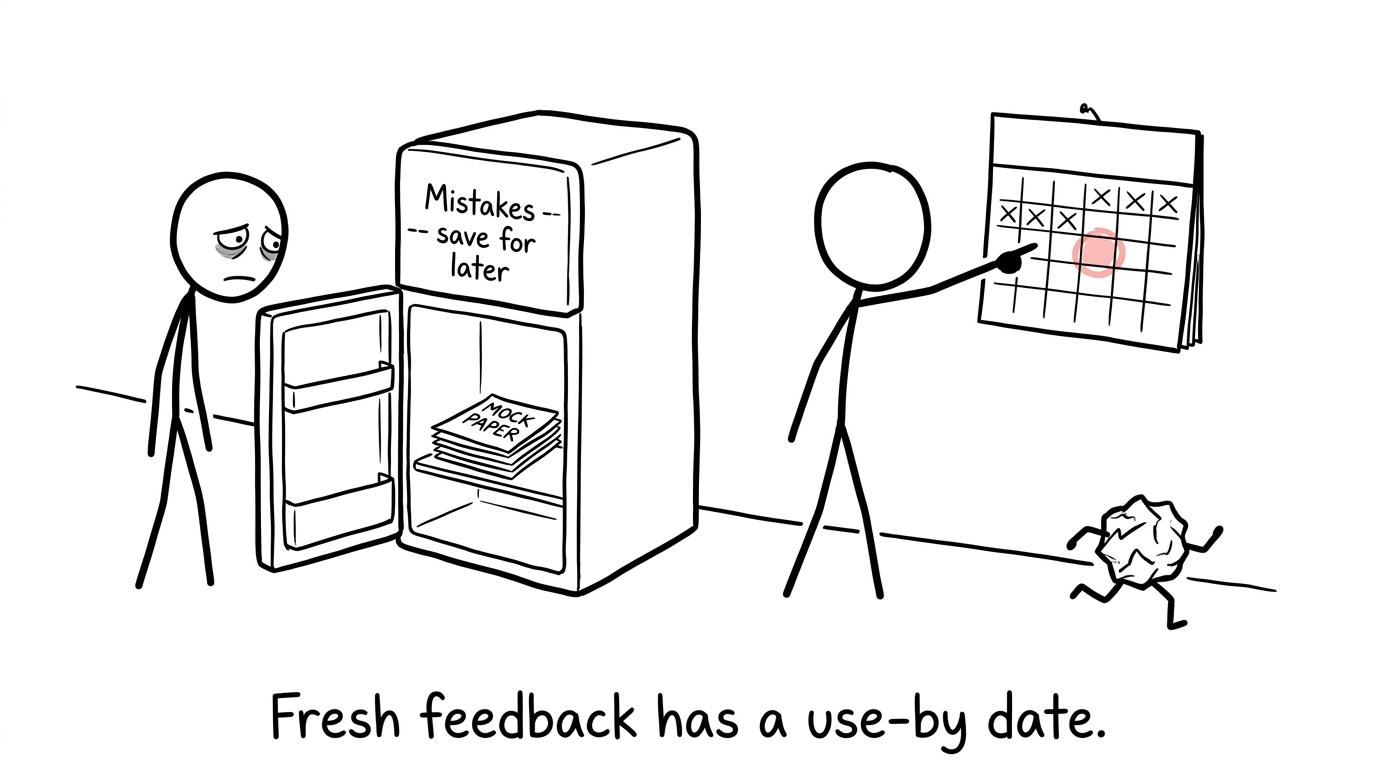 A student stores mock mistakes in a revision fridge while one escapes
What reviewing immediately gives you
Straight after a mock, the decisions behind your answers are still relatively accessible. You may remember that you confused two nutrients, overlooked a command word or rushed a calculation. That context makes diagnosis easier.
A prompt review also limits the chance of rehearsing an incorrect idea. If you wrote that denaturation is the same as coagulation, for example, you do not want to repeat that claim across several revision sessions. The same applies in maths: an incorrect rule for negative indices or an unreliable rearrangement method becomes harder to remove when it is repeatedly practised.
However, immediate review has limits. After a demanding paper, concentration may be low and disappointment may distort your judgement. You might label every error “careless” because that feels less threatening than admitting a knowledge gap. Or you may copy the mark scheme without understanding why the answer earns the marks.
That is why the first review should be short and diagnostic. It is triage, not the entire treatment.
What waiting a few days actually costs
A short delay does not automatically damage learning. In fact, a later attempt can be useful because some forgetting makes retrieval more demanding. The problem is waiting before you have identified and corrected the mistake.
You lose the memory of your reasoning
Several days later, you may see a wrong answer but no longer remember why you chose it. Was the underlying fact missing? Did you misunderstand the wording? Were you running out of time? Without that information, your repair becomes less precise.
Misconceptions remain active
An uncorrected answer can continue to feel familiar. Familiarity is persuasive: the more often an idea comes to mind, the more correct it can seem. Prompt comparison with a mark scheme, teacher feedback or a reliable solution gives the misconception less time to become your default response.
Your revision plan stays vague
Until the paper is analysed, “revise Food and Nutrition” is still one enormous task. Reviewing turns it into manageable actions such as food safety, functional properties, nutritional application or extended evaluation.
Maths works in the same way. “Revise algebra” is difficult to begin; “practise changing the subject when the required variable appears twice” is actionable. The GCSE maths revision hub helps you move from a broad weakness to board-specific lessons, questions and papers.
The emotional barrier can grow
Putting the mock aside may provide temporary relief, but avoidance often makes the paper feel more important. A brief, factual review reduces it to what it really is: evidence about a performance on one day, followed by a list of things you can improve.
A two-stage mock review that works
Stage one: diagnose while the paper is fresh
Give yourself a break after the mock, then complete a calm first pass. Use the mark scheme and any teacher annotations. For every lost mark, choose the most accurate category:
- Knowledge: you did not know or could not recall the required fact.
- Application: you knew the content but did not connect it to the situation.
- Analysis or evaluation: your answer lacked a developed chain of reasoning, comparison or judgement.
- Question reading: you missed a command word, restriction or piece of data.
- Communication: the answer was too vague, lacked specialist vocabulary or omitted working.
- Timing: you rushed, left the question blank or spent too long elsewhere.
This classification reflects how GCSE Food Preparation and Nutrition assesses more than recall. Across exam boards, students are expected to demonstrate knowledge and understanding, apply it, and analyse or evaluate relevant aspects of food and nutrition. Exact paper structures differ between AQA, OCR and Eduqas, so use the specification and mark scheme for your board.
Do not rewrite the whole paper yet. Write one sentence explaining each significant error and one next action. The action must be specific enough to complete.
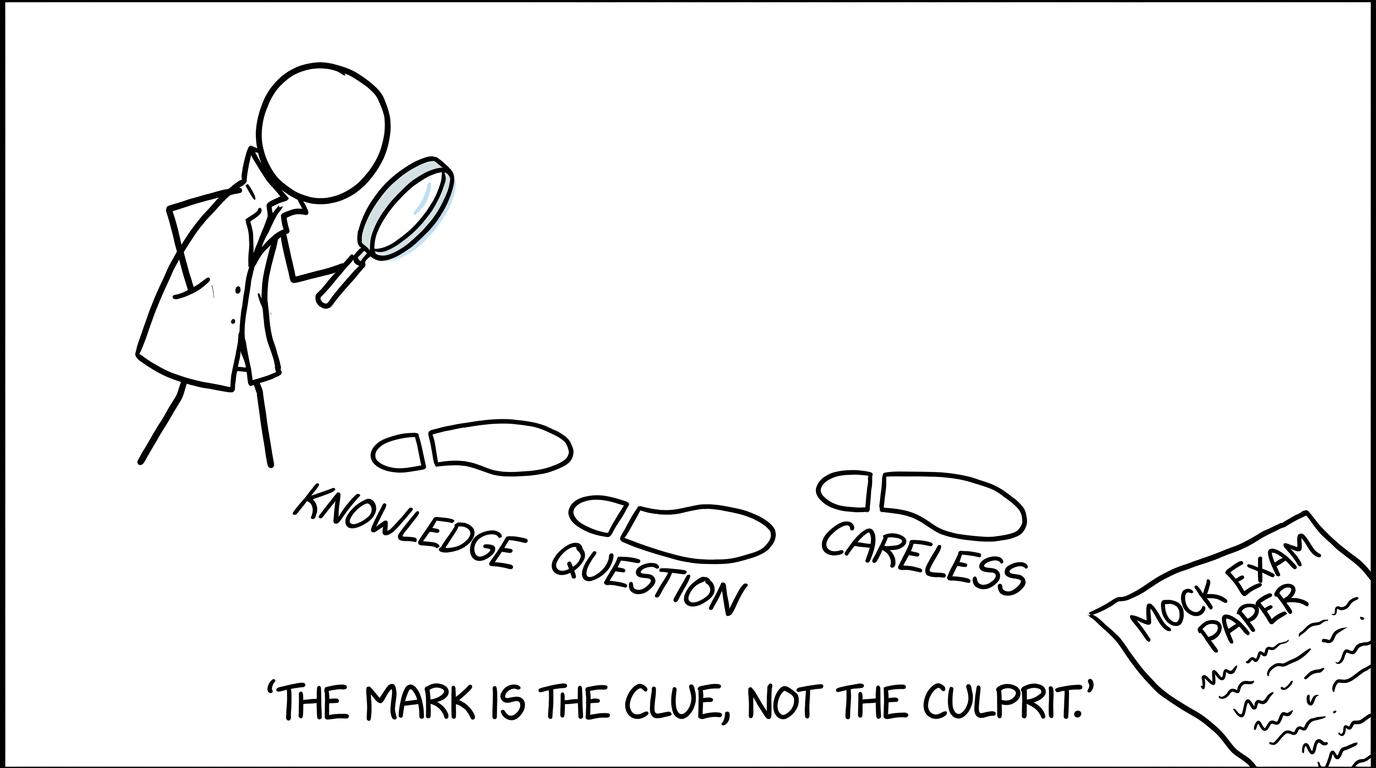 A stick-figure detective investigates the real cause of a mock mistake
Stage two: repair after a short gap
Return when you are rested, usually the next day or within a couple of days. Start closed-book. Try to explain the corrected knowledge or outline the answer structure from memory before opening notes.
Then repair the gap:
- revisit the relevant lesson or class material;
- reduce the correction to a short principle rather than a copied paragraph;
- answer a small set of related questions;
- check against the mark scheme;
- schedule another retrieval attempt.
For maths students, this is easy to organise through MathsGenie. The AQA GCSE Maths revision area and OCR GCSE Maths revision area connect board-specific resources with questions and papers. If a full paper feels excessive, Edexcel GCSE Maths mini tests provide shorter checks.
Retest rather than reread
When you revisit the mistake, cover the corrected response. If you can only understand the answer while looking at it, the learning is not yet secure.
Use the original question after a short delay, then switch to an unfamiliar question testing the same idea. The original checks correction; the unfamiliar question checks transfer. Government guidance on retrieval and spaced practice similarly emphasises returning to knowledge after gaps and checking responses accurately, rather than relying on passive rereading.
Treat the mark scheme as information, not a script
A mark scheme shows what earns credit, but copying it word for word can create an illusion of progress. Ask instead:
- What knowledge did the question require?
- Which command word determined the response?
- What was the minimum clear answer that earned the mark?
- How would the answer change in a different context?
- What should I notice sooner next time?
Longer Food and Nutrition responses often lose marks because statements remain undeveloped. A student may name a consequence without explaining the food science, nutritional effect or relevance to the named person. The repair is not “write more”. It is “build a clearer chain of relevant reasoning”.
In maths, mark schemes reveal method marks as well as final answers. MathsGenie’s guide to using AQA GCSE Maths past papers properly explains how to separate misunderstanding, forgotten method and accuracy errors. Edexcel students can follow the equivalent past-paper review process.
Build a mistake log you will actually use
A mistake log should make the next revision decision easier. Record:
- the topic and question;
- the marks lost;
- the error category;
- a one-sentence diagnosis;
- the repair activity;
- the retest date;
- whether the error returned.
Keep entries brief. If maintaining the log takes longer than correcting the knowledge, the system has become the work.
Look for repeated causes across subjects. Misreading “evaluate” in Food and Nutrition and overlooking “show that” in maths may share the same root problem: beginning before identifying what the question demands. Repeated unit errors may reveal a checking habit rather than a single topic weakness.
A one-month GCSE maths revision plan can help place these repairs into a wider routine of retrieval, topic practice and timed papers.
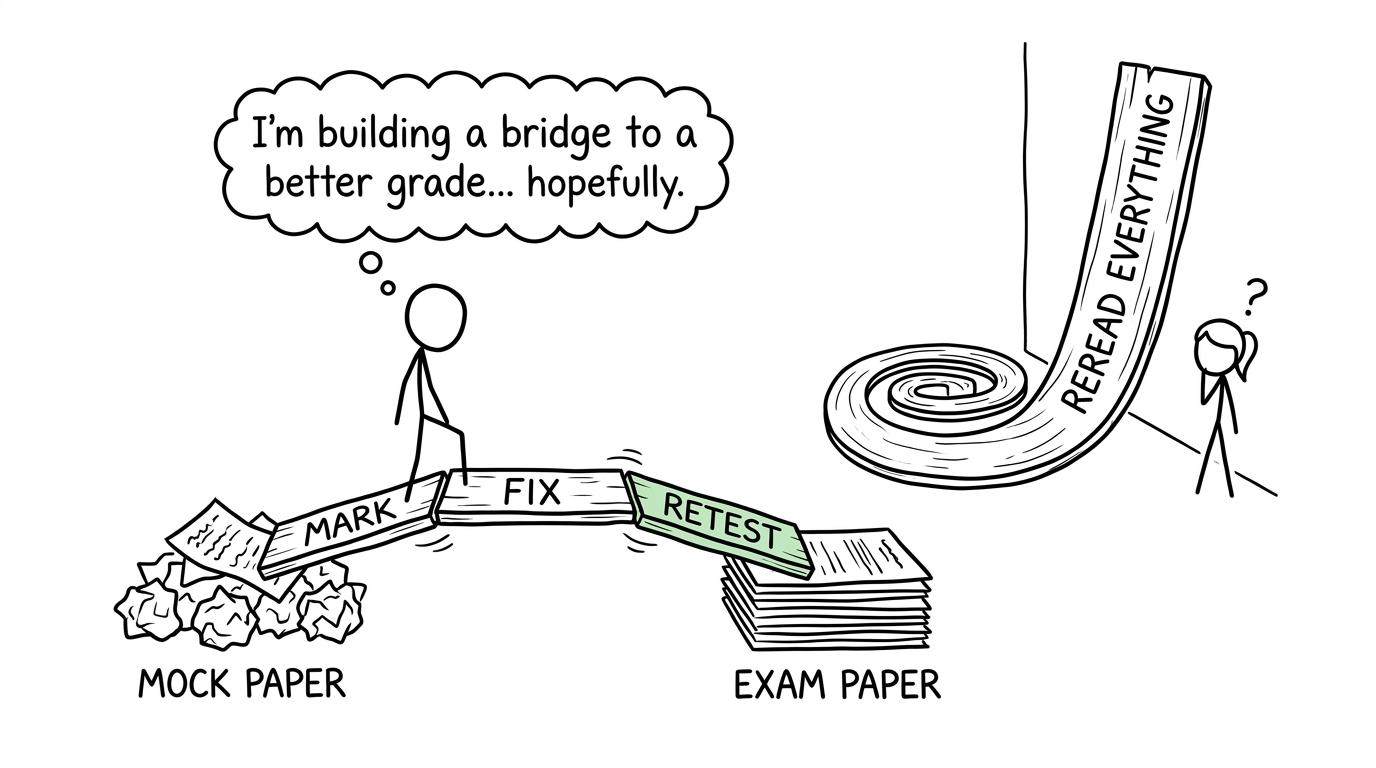 A student builds a bridge from mock paper to exam paper using mark, fix and retest
Common mistakes when reviewing a mock
Waiting for motivation
A review does not need to feel appealing. Begin with ten calm minutes: identify the three largest sources of lost marks and stop. A small review today is more useful than an elaborate plan that never begins.
Calling every error careless
“Careless” describes the result, not the cause. Replace it with a precise diagnosis: misread the unit, skipped a keyword, entered the value incorrectly or failed to check whether the answer was reasonable.
Correcting without practising
Writing the right answer underneath the wrong one is editing, not necessarily learning. Close the notes and retrieve the correction. Then use another question.
Revising the whole topic
One weak question does not always mean the entire topic is weak. Isolate the smallest missing component first. This keeps the repair efficient and makes progress visible.
Reattempting too soon
If you redo a question immediately after reading its answer, short-term recognition may carry you through. Leave a gap before the closed-book attempt, then test the same skill again later.
Chasing a better score without studying the errors
Another mock may produce another number, but it does not automatically repair the first paper. Past papers diagnose; targeted practice repairs. Once the repair is secure, GCSE predicted papers can provide fresh exam-style testing nearer the examination.
Turn the mock into your next set of marks
Review the paper promptly, but do not expect one sitting to complete the learning. Use the first pass to capture your reasoning and stop misconceptions. Use the next few days to repair specific gaps. Then retest from memory after enough time has passed for the answer to require genuine retrieval.
That rhythm, mark, diagnose, fix, wait, retest, works for GCSE Food Preparation and Nutrition, foundation and higher tier maths, and eventually A Level revision too. The subject changes. The learning loop does not.
Make MathsGenie your free revision base: use revision lessons to rebuild understanding, practice questions and mini tests to repair weak skills, and past papers, predicted papers, mark schemes and video solutions to test whether the repair survives exam conditions. Open the GCSE maths revision hub, choose the weakness your latest mock exposed and turn one lost mark into your next useful action.