Review Mock Mistakes GCSE Bengali: Now or Later?
Review mock mistakes GCSE Bengali with a two-stage plan: correct errors promptly, then retest after a short delay to strengthen recall before your exams.
A marked mock can feel heavier than the paper it is printed on. You see the lost marks, remember the questions that went wrong and feel tempted to put the whole thing away until the disappointment fades.
If you want to review mock mistakes GCSE Bengali, the best answer is not simply now or later. Review the paper briefly on the same day, or as soon as it is returned, so that you understand each error while the experience is still fresh. Then revisit the same skills a few days later without relying on your corrections. The first review fixes the misunderstanding; the delayed attempt tests whether the fix has lasted.
That two-stage method also works especially well for GCSE maths. A mock only becomes useful when its mistakes influence what you practise next.
The short answer: review now, retest later
Use this checklist after a Bengali, maths or another GCSE mock:
- Pause first if emotions are high. A short break is sensible; avoiding the paper for a week is not.
- Mark or inspect it promptly. Identify why each mark was lost while you can still remember your thinking.
- Write one specific correction. Record what you should do differently, not merely the right answer.
- Practise the weak skill. Use a new question or task rather than repeatedly reading the correction.
- Retest after a few days. Attempt the skill without notes to see whether you can retrieve it independently.
- Revisit repeated weaknesses later. Add them to your revision planner rather than assuming one correction has solved them.
Research on feedback does not support a universal rule that every kind of delayed feedback is bad. Both immediate and delayed feedback can help, and spacing can strengthen later retrieval. However, feedback must be understood and acted upon. If waiting means forgetting your reasoning, losing the paper or never completing the review, the theoretical benefit of delay disappears.
The safest practical strategy is therefore prompt diagnosis followed by spaced retrieval.
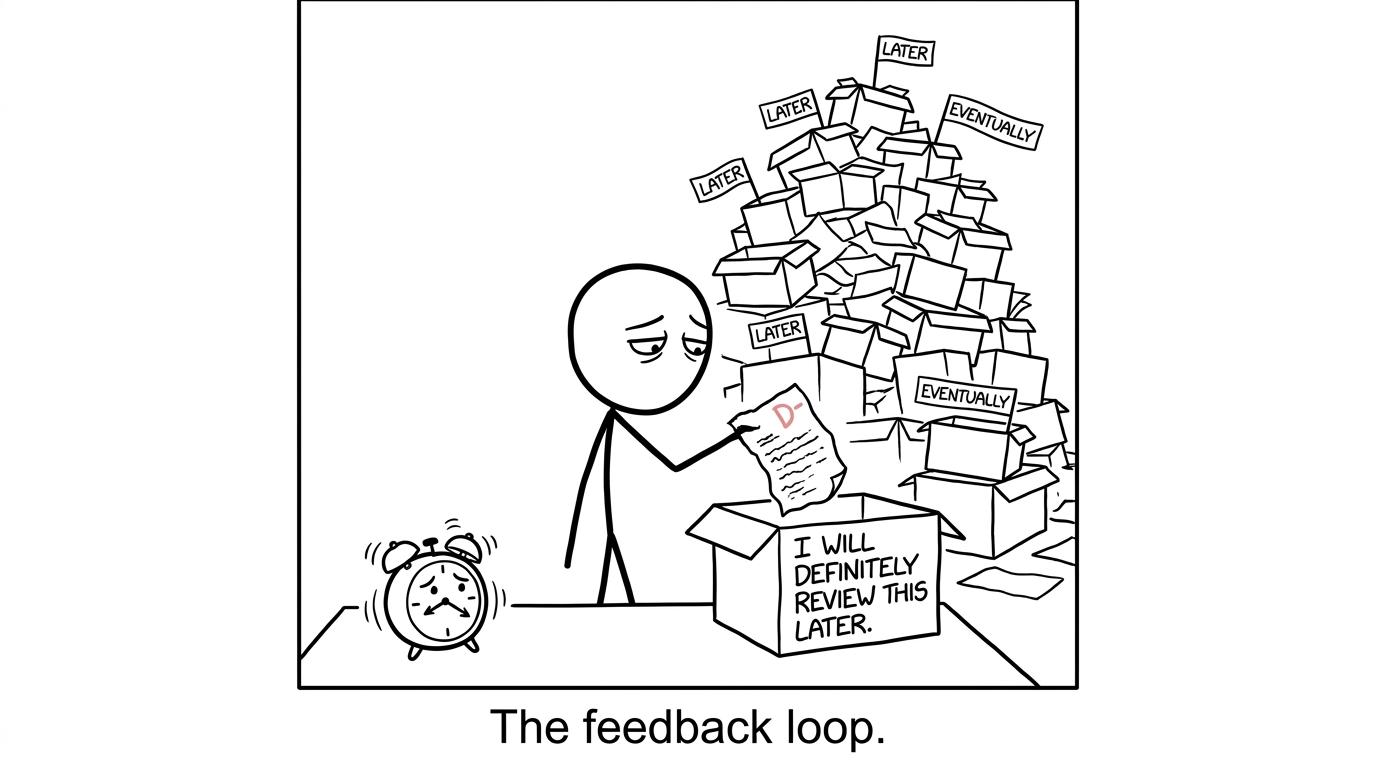 A student discovers that the box labelled for later review has become a mountain of forgotten mock papers
What reviewing immediately gives you
Soon after a mock, you can often remember more than you realise: why you chose an answer, which instruction confused you and where time pressure changed your approach. That information is valuable because the same incorrect answer can have several causes.
In a Bengali language mock, a lost mark might come from:
- misunderstanding a word or phrase;
- missing a detail in a reading or listening passage;
- using inaccurate grammar or spelling;
- failing to address part of the task;
- producing an answer that was too vague for the mark scheme;
- running out of time before checking the response.
Your precise papers and assessed skills depend on the qualification followed by your school. Some students use Bengali as a broad search term while their qualification documentation may use Bangla. Always check the specification, paper title and mark scheme supplied by your school or awarding body rather than assuming every course has the same format.
The same diagnostic principle applies to maths. An incorrect answer could indicate missing knowledge, a weak method, an arithmetic slip, a misread instruction or poor time management. The MathsGenie guide to using past papers properly explains why the paper itself is assessment; the improvement happens during the work that follows.
Prompt review also prevents a plausible but incorrect idea from settling into memory. Feedback is most useful when it is specific, focused on the task and followed by an opportunity to improve. Simply seeing a cross is not enough.
Why waiting a little can still help
There is one problem with correcting everything immediately: familiarity can pretend to be learning.
When the teacher’s annotation, mark scheme or corrected sentence is directly in front of you, the answer feels obvious. But recognition is easier than independent recall. You need another attempt after some time has passed to discover whether you can produce the method or language yourself.
A delay creates useful difficulty. A few days later, the original answer is no longer sitting in short-term memory. Retrieving the correction takes effort, and that effort provides better evidence about what you know.
This is why the strongest routine contains two different events:
The correction session
Complete this on the day you receive the paper, or within about a day where practical. Work out what happened, consult the mark scheme or teacher feedback and record a clear next action.
The retrieval session
Return to the skill after roughly two or three days. Hide the correction and complete a fresh task. For Bengali, that might mean applying the same grammar point, retrieving vocabulary or answering a similar comprehension prompt. For maths, use a different question on the same topic.
Maths students can build this rhythm with the GCSE maths revision hub, which brings together free revision lessons, exam questions, worksheets and board-specific resources for Edexcel, AQA, OCR and Eduqas.
What the delay actually costs you
Waiting is not automatically harmful. The cost depends on what happens during the gap.
You forget the reasoning behind the error
A mark scheme tells you what earned marks, but it cannot always tell you why you made your choice. After several days, you may remember neither the uncertainty nor the shortcut that led you astray. Your review then becomes less diagnostic.
Avoidance becomes easier
A short planned delay can create spacing. An unplanned delay often becomes procrastination. Tomorrow turns into the weekend; the weekend becomes the next mock. At that point, the paper has measured your weaknesses without helping you change them.
Weaknesses remain in your revision plan
Every day spent practising familiar material instead of the skill exposed by the mock has an opportunity cost. If the paper showed that you repeatedly misread instructions or could not start a topic, your next revision session should respond to that evidence.
The guide to finding your weakest GCSE topics offers a useful approach for turning lost marks into a focused practice list.
Incorrect habits may be repeated
If another lesson, homework task or practice paper uses the same skill before you have corrected it, you may repeat the same process. This matters in maths, where one faulty step can affect several connected topics, and in languages, where an inaccurate grammatical pattern can appear across many answers.
The real cost of delay is therefore not a fixed number of marks. It is the loss of useful context, timely practice and certainty that the review will happen at all.
How to review a GCSE Bengali mock effectively
Do not copy every correct answer. Investigate the mistakes that reveal something reusable.
Start by sorting lost marks into four groups:
- Knowledge: vocabulary, grammar or content was not known securely.
- Interpretation: the passage, question or command word was misunderstood.
- Execution: you knew what to do but wrote it inaccurately or incompletely.
- Timing: the response was rushed, unchecked or unfinished.
Then write a short action beside each significant error. Useful actions are concrete: learn a small vocabulary set, ask why a response missed the marking requirement, practise one grammatical structure, or complete a similar task under a time limit.
Your teacher’s feedback and the official materials for your qualification should remain the authority for Bengali-specific marking. MathsGenie’s role is to help you apply the same disciplined review cycle to maths. If a mock reveals several maths gaps, use the GCSE maths topics by board and tier to locate the relevant content for Foundation or Higher.
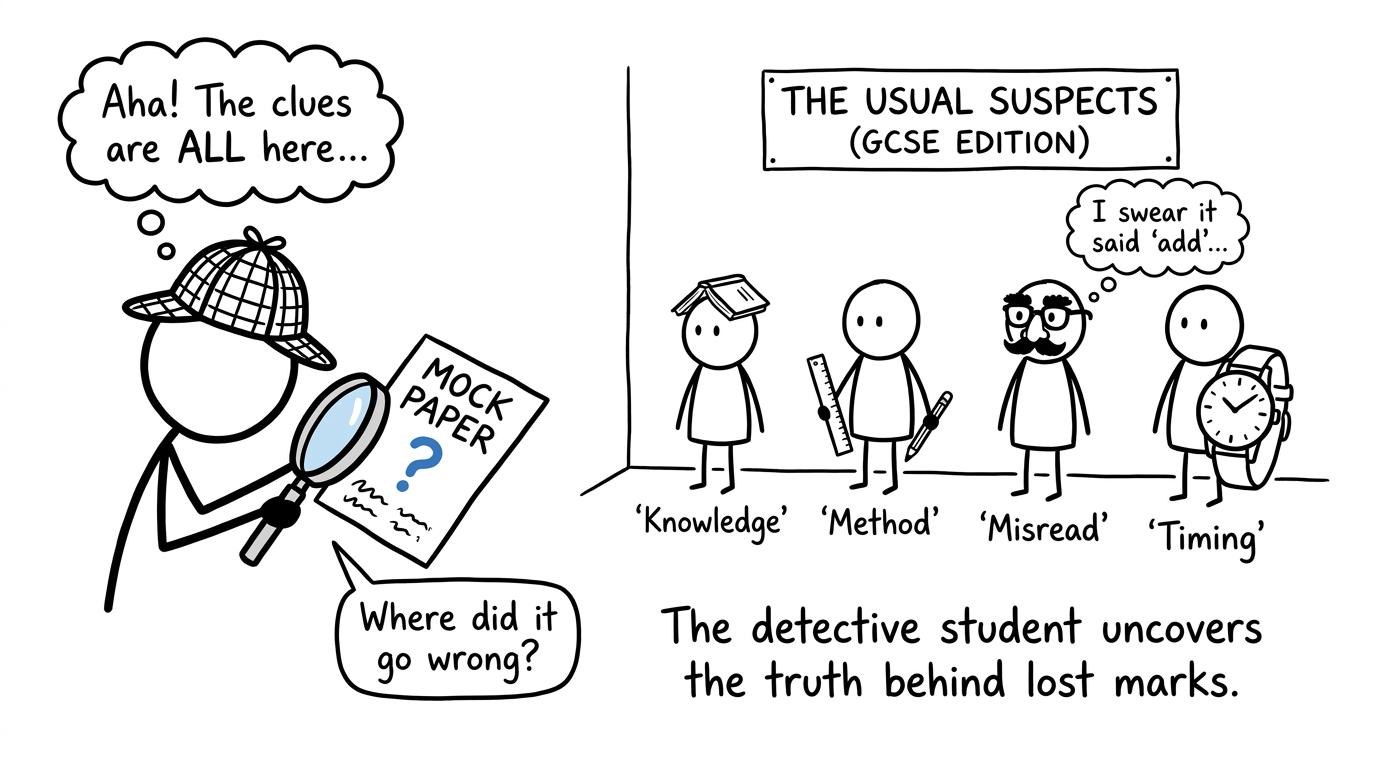 A mock-paper detective interviews Knowledge, Method, Misread and Timing as possible suspects
Turn corrections into a repeatable revision loop
A good error log is short enough to use. For each important mistake, record:
- the paper and question;
- the skill being tested;
- why the mark was lost;
- the correction or better approach;
- when you will retest it.
Keep the explanation precise. Statements such as careless mistake or revise more do not tell you what to change. Identify the action: read every instruction twice, show intermediate working, check units, retrieve a particular word family or leave time to review the final response.
For maths, compare your working carefully with the mark scheme. The guide to using GCSE mark schemes shows how to classify lost marks and convert feedback into practice. If you are taking Edexcel, the Edexcel GCSE maths past papers include papers organised by series, with mark schemes and worked support where available.
After correcting a topic, schedule it again. The MathsGenie plan for stopping forgotten maths content combines immediate marking with later retrieval. This distinction matters: reviewing tells you what went wrong; retesting tells you whether you have changed it.
When it is sensible to wait before reviewing
Immediate review should not mean forcing yourself through a paper while upset, exhausted or defensive. If the result has shaken you, take enough time to become calm and objective. That may mean reviewing later that day or the following morning.
It is also sensible to wait when:
- your teacher has not finished explaining the mark scheme;
- you need clarification about how an answer was assessed;
- you are too tired to process detailed feedback properly;
- the mock is immediately followed by another examination and rest is the better priority.
Set a specific review time before putting the paper away. A planned delay has an endpoint. Avoidance does not.
For busy weeks, the 20-minute GCSE maths revision routine can help you fit short correction and retesting sessions around other subjects.
Common mistakes when reviewing mock papers
Focusing only on the total mark
The score is the least detailed part of the feedback. Two students with the same mark may need completely different revision. Look at where and why marks disappeared.
Reading corrections without attempting anything
A corrected response can feel familiar without becoming retrievable. Close the notes and produce a fresh answer, explanation or method.
Correcting every question in one exhausting session
Prioritise repeated errors and high-value gaps. A manageable list is more likely to lead to action than pages of copied solutions.
Waiting for motivation
Book the review session while the mock is still in front of you. The GCSE revision timetable guide can help turn intentions into specific sessions.
Retaking the identical task too soon
An immediate redo checks whether you followed the correction. A different task a few days later checks whether you learnt the skill. You need both forms of evidence.
Make the mock earn its place in your revision
A mock result is not a verdict. It is a map drawn under exam conditions. Review it promptly enough to preserve the story behind each mistake, then wait briefly and test whether the correction survives without support.
For Bengali, use your teacher, qualification specification and relevant mark scheme to guide subject-specific corrections. For GCSE maths, start with the free MathsGenie GCSE revision resources. Use revision lessons to rebuild weak methods, practice questions and mini tests to check individual skills, and past papers or predicted papers to test them under pressure. Mark carefully, use video solutions where available and place every unresolved weakness into your revision planner.
Correct now. Retrieve later. Then let the next paper show you what has changed.