Review Mock Mistakes: GCSE Art and Design Timing
Review mock mistakes GCSE Art and Design advice: capture feedback immediately, repair work after a short pause, then retest to prevent repeated errors.
A returned mock can feel heavier than the paper it is printed on. You see the mark first. Then the comments. It is tempting either to repair everything immediately or to close the folder and wait until the disappointment has faded.
If you are searching for review mock mistakes GCSE Art and Design advice, the best answer is a combination: capture and classify the feedback straight away, but leave demanding corrections until later that day or the next day. Then revisit the same weakness after a further gap.
This approach also works particularly well for GCSE maths. Immediate review preserves the details of your decisions; a delayed reattempt tests whether you have genuinely learnt from them. Waiting several days before doing anything usually costs useful information, while trying to correct an entire mock when tired can turn feedback into punishment.
The short answer: review now, repair soon, retest later
Use this three-stage routine:
- Immediately or on the same day: read the feedback, identify where marks were lost and write one precise next action.
- Later that day or the following day: correct the highest-priority weaknesses while you are rested.
- After a gap of roughly two to seven days: attempt a similar task without relying on the correction.
The first review is diagnostic. The second stage is repair. The final stage is proof.
For GCSE maths, you can build this cycle around the free GCSE maths revision hub, where revision lessons, topic questions, papers and solutions sit together. Art and Design needs a different kind of correction, but the underlying question is identical: did the feedback change what you can do independently?
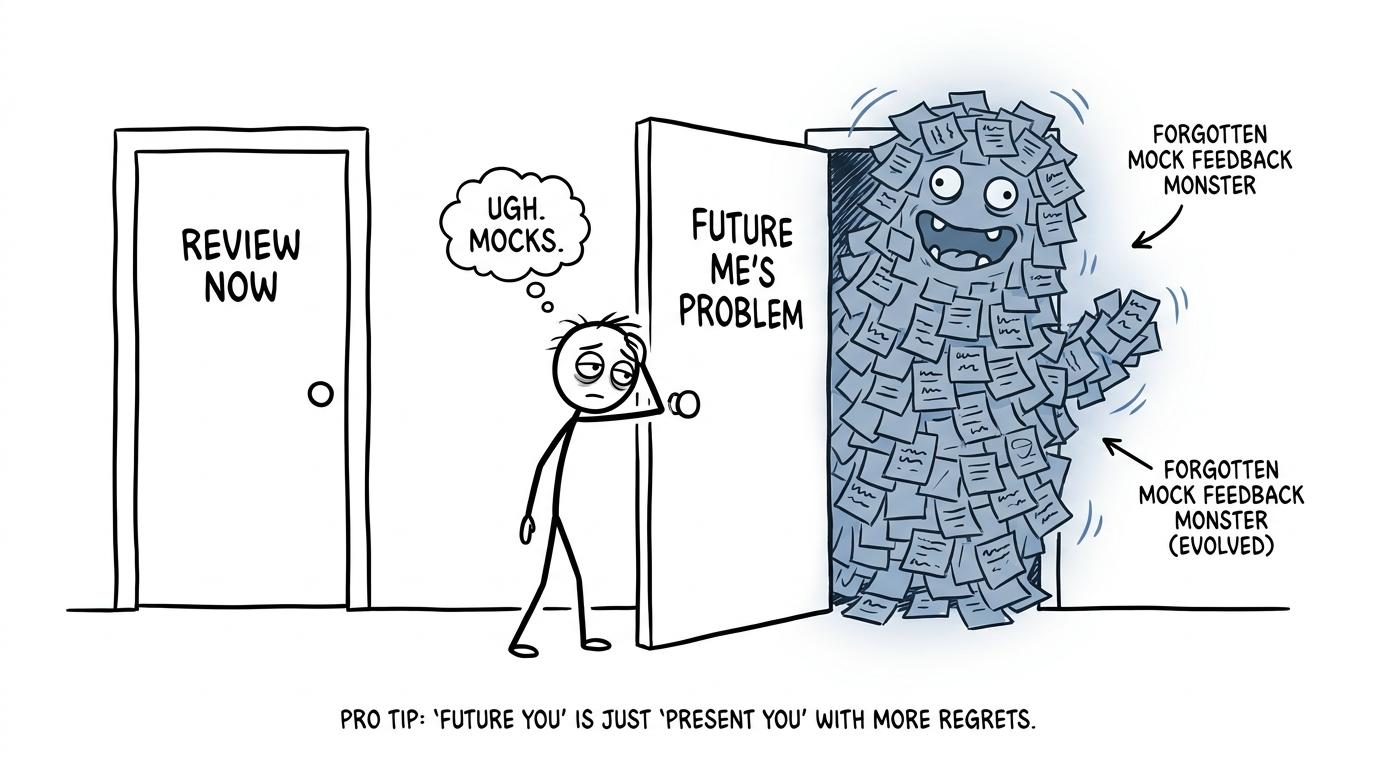 A student choosing between reviewing now and leaving a growing feedback monster for the future
Why immediate review is useful
A mock records more than your subject knowledge. It captures decisions made under pressure: where you hesitated, what you misunderstood and which parts consumed too much time.
Straight after the mock, those decisions are still relatively easy to reconstruct. In Art and Design, you may remember why you selected a particular source, stopped refining an experiment or rushed the final response. In maths, you may remember that you could not recognise the topic, misread a condition or knew the method but ran out of time.
That context fades. A mark alone cannot recover it.
Immediate review is therefore not about completing every correction. It is about preserving evidence. Ask:
- What was I trying to do?
- Where did my approach stop working?
- Was the problem knowledge, interpretation, technique or time?
- What specific action would improve this?
Research on feedback and metacognition supports giving learners clear opportunities to evaluate their performance and decide what to do next. Feedback is most useful when it redirects action. Simply reading a comment or looking at a total mark is not enough.
Why a short delay can improve the correction
There is an important distinction between reviewing feedback and reattempting the task.
You should normally review promptly. But a short pause before the full correction can be useful, especially after a long mock. Fatigue makes students more likely to copy an answer, accept a teacher comment without processing it or make another careless decision.
A later reattempt also introduces retrieval. Instead of following a correction that remains visible, you must bring the idea back to mind. Evidence used in current teacher guidance supports spaced practice and retrieval over repeated rereading, although there is no universal perfect interval for every task or learner.
That is why the practical rule is flexible: pause long enough to think clearly, but not long enough to lose the diagnostic detail.
For maths, MathsGenie's guide to using GCSE past papers properly follows the same broad rhythm: mark, diagnose, repair and reattempt. The exam board may be Edexcel, AQA, OCR or Eduqas, but the learning cycle remains useful across specifications.
What delay actually costs you
Waiting is not automatically harmful. A planned gap can help. An unplanned gap usually creates three costs.
You forget why the mistake happened
Several different problems can produce the same wrong answer. You might have lacked the method, misunderstood the wording, rushed the calculation or omitted evidence. After a week, those causes can blur together.
The result is generic revision. You revise “algebra” instead of the precise skill that failed, or decide your sketchbook needs “more detail” without identifying which assessment objective is underdeveloped.
Feedback loses urgency and meaning
Teacher feedback is clearest when you can connect it to the decisions visible in the work. If you postpone the review, the comment can start to feel like an isolated instruction rather than evidence about your process.
This is especially important in GCSE Art and Design, where the four assessment objectives focus on developing ideas, refining work, recording ideas and observations, and presenting a personal and meaningful response. These objectives are equally weighted at 25%25\%25% each across GCSE specifications. A vague promise to “improve the portfolio” is less useful than identifying the exact objective and evidence requiring attention.
The same error may be repeated
The largest cost is not forgetting the mock. It is practising the mistake again.
In maths, an uncorrected misconception can travel into homework, mini tests and another past paper. That is why a quick diagnostic matters. MathsGenie's guide to finding your weakest GCSE topics explains how to label lost marks by their cause rather than treating the total score as the whole story.
A practical review routine for Art and Design
Begin with the assessment objective rather than the grade. Across AQA, Edexcel, OCR and Eduqas GCSE Art and Design specifications, work is assessed through AO1, AO2, AO3 and AO4.
For each significant piece of feedback:
- Name the assessment objective. Is the weakness in investigation, refinement, recording or the realised response?
- Locate the evidence. Identify the page, experiment, annotation, source connection or outcome involved.
- Translate the comment into an action. “Develop this” is not yet a plan. Decide what will be investigated, compared, tested or recorded.
- Check with your teacher before making major changes. Art coursework and supervised assessment have rules, so follow your centre's instructions about what may be amended and when.
- Schedule the action. Small changes can be completed soon; larger experiments may need materials, drying time or teacher guidance.
Do not mistake adding more pages for improving the evidence. More work is not necessarily more purposeful work. The question is whether the addition makes your thinking, refinement or intentions clearer.
A practical review routine for GCSE maths
Maths mocks usually provide cleaner opportunities for independent correction. Start by sorting every lost mark into one of four categories:
- Knowledge gap: you did not know or recognise the required method.
- Process error: you knew the topic but applied a step incorrectly.
- Reading error: you missed a condition, unit or command word.
- Performance error: timing, presentation or checking caused the loss.
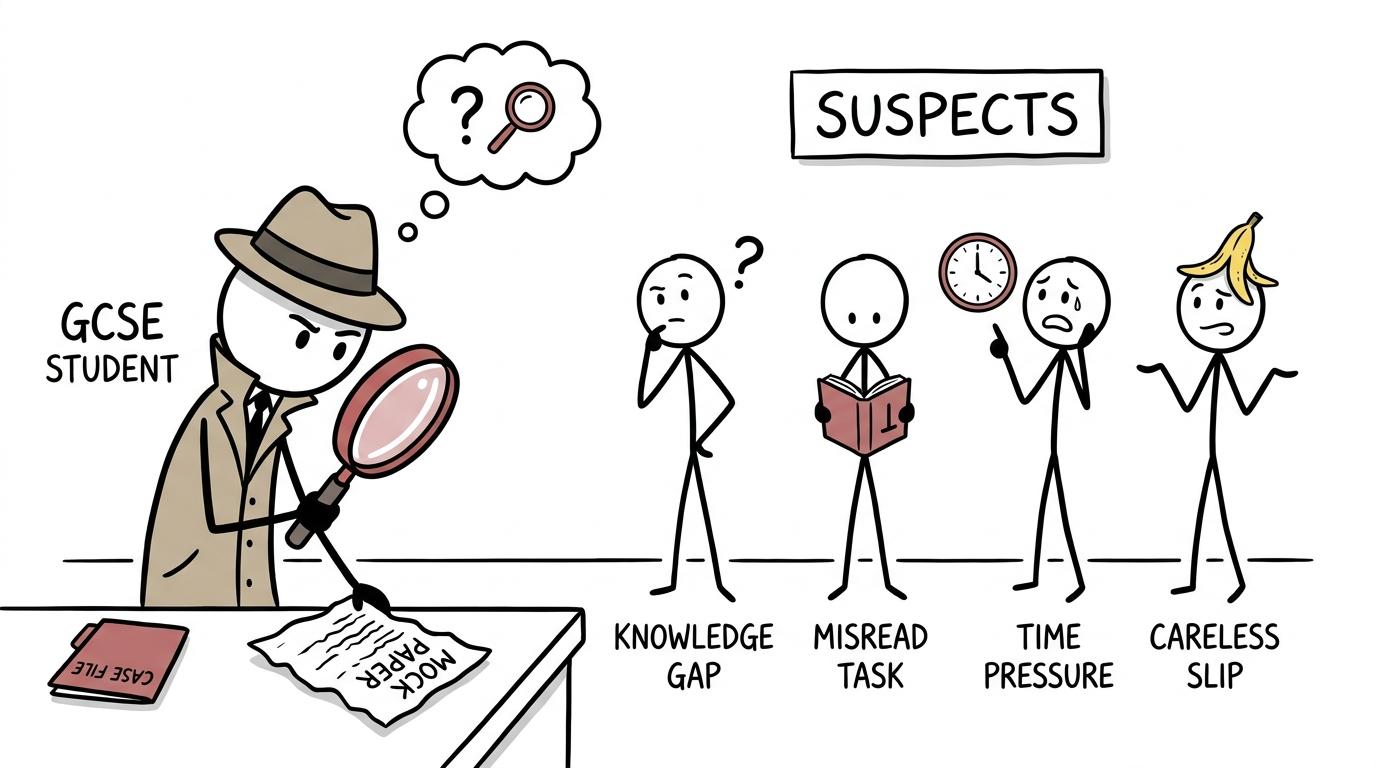 A mock-paper detective interviewing four different types of mistake
Then choose only the most important two or three repairs. Use a revision lesson to rebuild the method, complete focused practice questions and check the mark scheme or video solution. If a full paper feels too large, Edexcel GCSE maths mini tests provide shorter opportunities to test specific skills.
Finally, reattempt a fresh question without notes. Looking at the correct solution can create familiarity, but familiarity is not the same as independent recall. The MathsGenie guide to stopping GCSE maths content from being forgotten shows how active recall, spacing and exam-style questions can be combined.
How long should you spend on the first review?
The first review should be brief enough that you will actually do it. Around 151515 to 252525 minutes is often sufficient to capture the important information from a maths mock. An Art and Design review may take longer because feedback can refer to a connected sequence of research, experimentation and development.
Use this checklist:
- Record the mark without judging yourself by it.
- Highlight repeated comments or repeated lost-mark patterns.
- Select up to three priorities.
- Write the next physical action for each priority.
- Put the repair and retest into your revision plan.
A sustainable routine beats a heroic correction session that you never repeat. MathsGenie's 20-minute GCSE maths revision routine is useful when school days are crowded, while the one-month GCSE maths revision plan helps place mock corrections inside a wider schedule.
Common mistakes when reviewing mock feedback
Correcting everything in one sitting
This turns review into endurance. Prioritise errors that recur, affect important skills or prevent you from beginning questions. Lower-value corrections can be scheduled later.
Copying instead of retrieving
Copying a model answer or teacher correction may make the page look complete without changing what you can produce alone. Close the solution before the reattempt.
Treating every lost mark as a knowledge gap
Some losses come from timing, notation, units, interpretation or insufficient evidence. The repair must match the cause.
Waiting for motivation
A defined action is more reliable than a mood. Write “complete one mini test and mark it” rather than “revise maths”. The same applies in Art and Design: name the experiment, source or annotation requiring attention.
Focusing only on the grade
The grade summarises performance; it does not prescribe the next move. Improvement comes from changing a method, decision or habit.
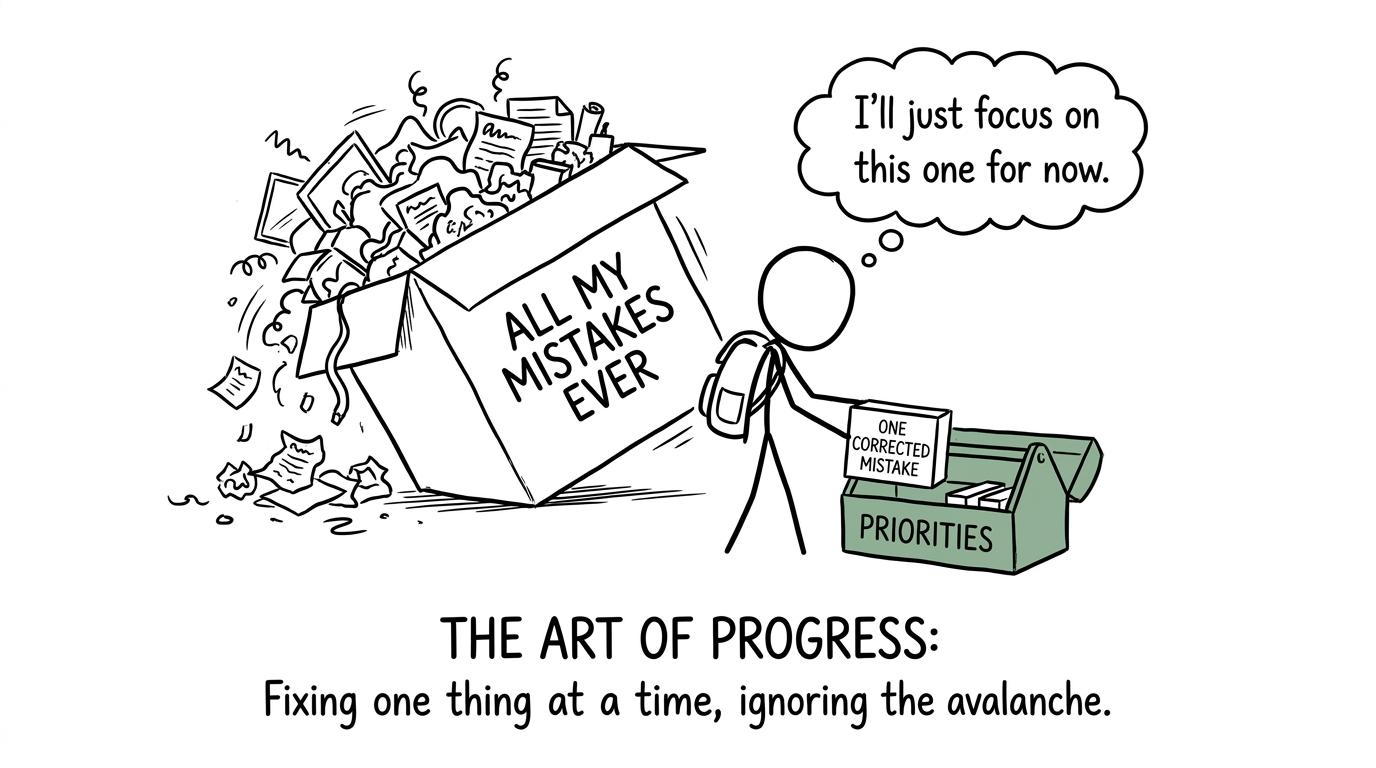 A student choosing one useful correction while a huge box of unsorted mistakes collapses nearby
Turn the mock into your next revision plan
A mock is most valuable after it has finished. The paper gives you evidence that ordinary revision cannot: it shows what remained available under time pressure.
Review the evidence promptly. Make the demanding correction when rested. Then return after a gap and prove that the mistake has changed. If another full paper is appropriate, the guide to when to start GCSE past papers can help you move from short diagnostic tasks to realistic exam practice.
For maths, make MathsGenie your next step. Open the free GCSE revision hub, choose the correct exam board and tier, and use revision lessons to repair understanding. Follow with practice questions and mini tests, then test the improvement through past papers or predicted papers. Mark schemes and video solutions will show where your method still needs attention.
Do not wait several days to discover what the mock was trying to tell you. Capture the lesson now, repair it soon and retest it later. That is how a disappointing mark becomes useful.