

Retake GCSE Art and Design After Sixth Form
Retake GCSE Art and Design after sixth form through a college or private exam centre. Understand portfolios, assessment, entry rules and costs.
Leaving sixth form can make an unfinished qualification feel strangely final. Your old timetable has disappeared, teachers have moved on, and the artwork in your portfolio may be sitting in a folder at home. But it is usually possible to retake GCSE Art and Design after sixth form. The difficult part is not permission or age. It is finding a college or approved exam centre willing to supervise, authenticate, mark and submit the practical assessment.
Unlike a written GCSE, Art and Design cannot normally be retaken by simply booking an exam desk for one afternoon. Most specifications involve a portfolio and an externally set assignment, so the centre must take responsibility for your work over time.
The short answer and your first checklist
You can normally resit GCSE Art and Design after leaving school by enrolling on a suitable college course or entering through an approved centre as a private candidate. Before paying anything, confirm:
- the exam board and exact Art and Design title you need
- whether the centre teaches the course or only accepts private candidates
- whether your previous portfolio result can be carried forward
- what new work you must complete
- how the centre will supervise and authenticate your work
- where you will complete the supervised practical session
- the centre's internal entry deadline and total fees
- whether access arrangements can be provided
The most important question is not simply, “Do you take private candidates?” Ask instead: “Can you accept a private candidate for this exact GCSE Art and Design specification, including all non-exam assessment requirements?”
That extra detail matters. A centre may accept private candidates for written subjects such as maths while declining subjects with portfolios, practical work or internally assessed components.
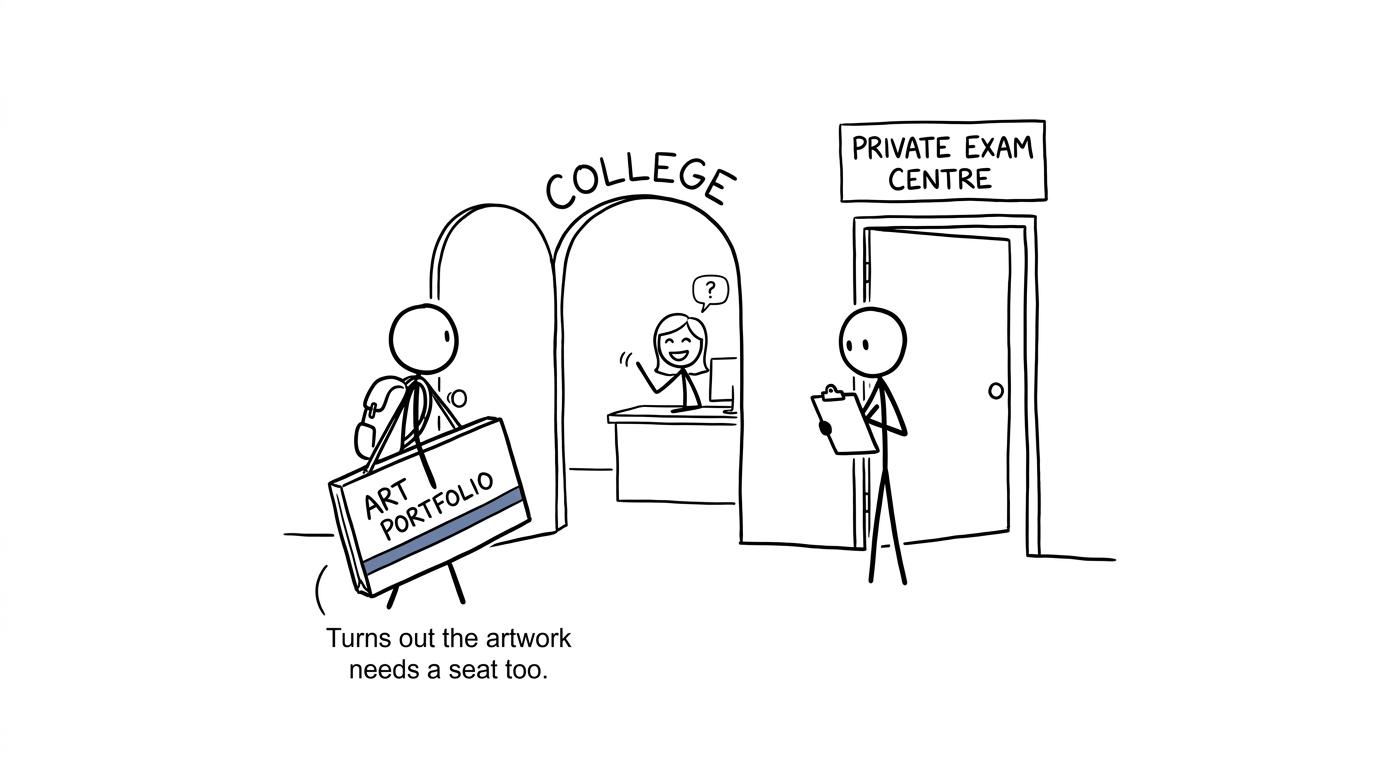 A student carrying an enormous portfolio towards college and private exam centre doors
Why an Art and Design retake is different
GCSE Art and Design is largely assessed through non-exam assessment, often shortened to NEA. Across major specifications, the qualification commonly has two broad parts:
- a portfolio developed during the course
- an externally set assignment with preparation followed by supervised practical work
For example, current AQA and OCR specifications divide the qualification into a portfolio worth 60%60\%60% and an externally set component worth 40%40\%40%. Their supervised periods are typically 101010 hours. However, you must check the specification for your board, title and intended exam series rather than assuming every board operates identically.
Your centre does more than provide a room. It may need to:
- approve or help establish an appropriate starting point
- supervise enough of your work to establish that it is yours
- authenticate the completed submission
- mark the components using the board's assessment criteria
- standardise marking where required
- store work securely
- arrange the supervised practical period
- submit marks and make work available for moderation
This explains why finding a centre can take longer than finding one for GCSE maths. The centre accepts a substantial academic and administrative responsibility.
Colleges and private exam centres
Retaking through a college
A further education or adult education college is often the most practical route because it may provide teaching, studio facilities, materials and regular supervision. You may join a GCSE course or another programme that includes an appropriate Art and Design qualification.
Ask the admissions team whether the course leads to the precise GCSE you need. “Art course” can refer to several qualifications, including vocational awards that are not GCSE Art and Design.
A college route may suit you if you need:
- structured teaching and feedback
- access to specialist equipment
- regular authenticated working sessions
- help rebuilding a portfolio
- a timetable that keeps the project moving
Course availability varies locally. Funding also depends on your age, prior qualifications, residency, location and the programme itself. In England, the automatic funding rules surrounding GCSE English and maths do not simply apply to Art and Design. Do not assume the retake will be free; ask the provider for an individual eligibility and fee assessment. Arrangements can differ in Wales and elsewhere in the UK.
Entering as a private candidate
A private candidate studies without being enrolled full-time at the centre making the entry. According to current JCQ guidance, private candidates must enter through an approved UK school, college or other approved establishment. Awarding organisations do not take entries directly from individual candidates.
The centre sets its own acceptance policy, fees, evidence requirements and internal deadlines. For Art and Design, it must also be willing and able to deal with the NEA. Some private exam centres only offer written examinations, so a listing that says “GCSE entries available” is not enough.
Private entry may suit someone who is self-taught, works with an independent tutor or uses distance learning. However, studying remotely does not remove the centre's need to supervise and authenticate the submission. Expect to attend in person at agreed stages and for the supervised component.
What happens to your previous portfolio?
Do not assume that old marks or artwork transfer automatically. Retake rules vary by awarding organisation and specification.
Some specifications may allow a recent NEA component result to be carried forward. Others require all components to be taken again. Even where carrying forward is permitted, the centre must use the correct entry option and may need information from your previous result.
Current OCR guidance, for example, allows eligible retaking students to carry forward a recent component result or retake a component. Eduqas guidance for its GCSE states that all components must be retaken. Rules and qualification availability can change, so obtain written confirmation for your exact board and series before making plans.
If you still have your old artwork, keep it safe but do not alter or resubmit it without guidance. Ask your former school:
- which exam board and specification title you followed
- your candidate and centre details
- your component marks, if available
- whether it still holds your portfolio
- when the work can be collected
A final GCSE grade alone may not tell a new centre what can be transferred.
 An exam officer humorously authenticating a student's artwork
How to find and question a suitable centre
Start with local further education colleges, adult learning providers, your former school and centres listed through the JCQ private candidate service. Contact exams officers rather than relying only on a general reception answer.
Your first message should include:
- your age and location
- the qualification and intended exam year
- your previous exam board and Art and Design title
- whether this is a retake
- whether you want to carry forward a component
- whether you need tuition, facilities or entry only
- any access arrangements you previously received
Ask for a written breakdown of charges. The total could include an awarding organisation entry fee, centre administration, assessment, moderation preparation, supervised sessions, tuition, materials and late-entry charges. There is no single national private-candidate price because centres set their own fees and offer different levels of support.
Contact centres early. Official awarding-body deadlines are not the same as centre deadlines; a centre may close applications months earlier so that it can verify your identity, plan supervision and complete the required administration.
Planning Art alongside GCSE maths revision
Retaking Art and Design can coincide with maths exams, employment or another course. The danger is not always workload. It is invisible workload: portfolio tasks expand quietly until every evening feels occupied.
Put every known Art milestone into one calendar, including centre visits, review sessions and the supervised assignment. Then protect several smaller maths sessions each week. Maths responds well to frequent retrieval, while an art portfolio often benefits from longer creative blocks.
Use the GCSE maths revision hub to select material for your board and tier. If you need a realistic weekly structure, adapt the GCSE maths revision timetable around your studio sessions rather than waiting for a completely free week.
When time is tight, diagnose before revising. The guide to finding your weakest GCSE topics helps turn lost marks into a short priority list. Edexcel students can use GCSE maths mini tests for contained practice between portfolio sessions.
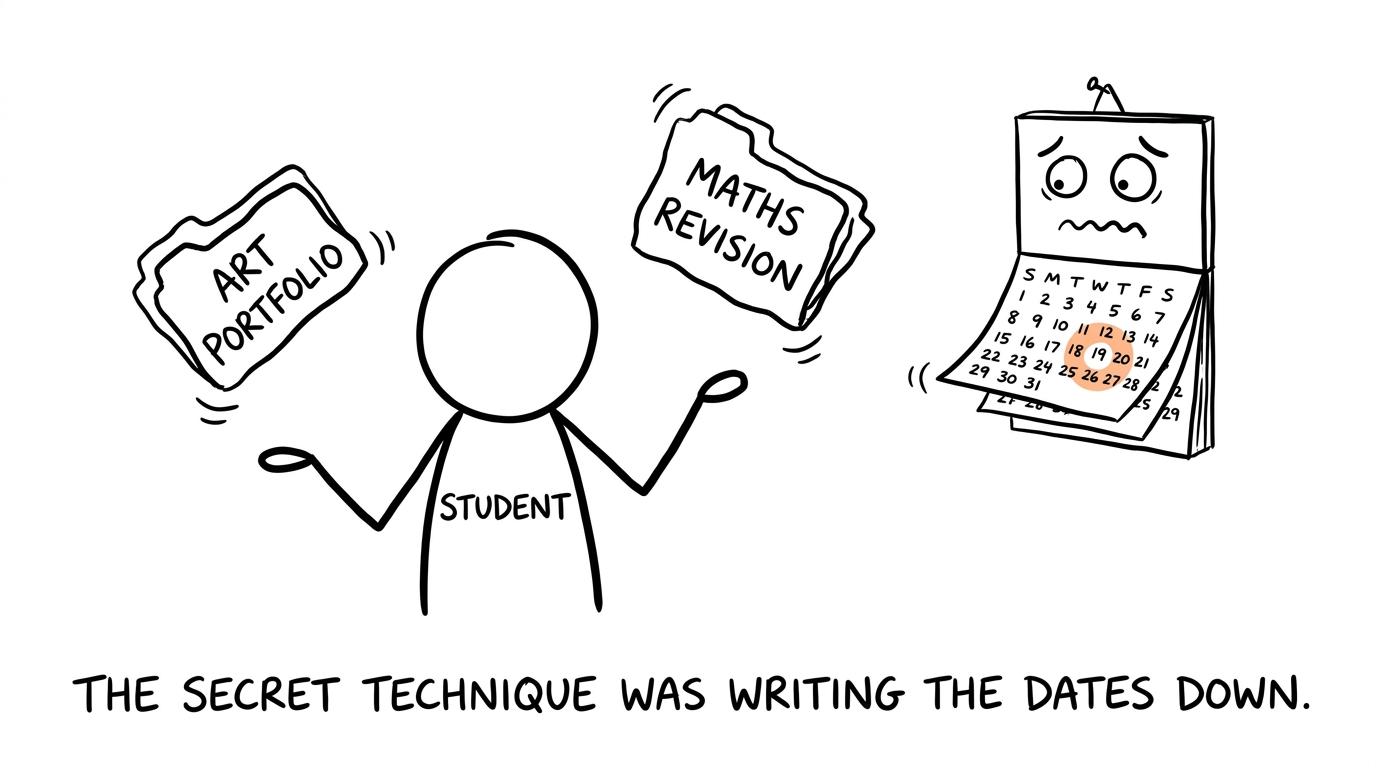 A student juggling an art portfolio and maths revision while a calendar panics
Common mistakes when arranging the retake
Assuming any exam centre can offer Art
Written-exam entry and Art NEA provision are different services. Confirm that the centre can supervise, authenticate, mark and submit every required component.
Choosing the wrong qualification
Fine Art, Photography, Textile Design, Graphic Communication and Art, Craft and Design may have separate titles or entry codes. Match the new entry to your intended qualification and any component you hope to carry forward.
Starting unsupervised work before agreeing the process
A centre must be confident that submitted work is your own. Work produced without an agreed supervision and authentication process may be unusable, however strong it is.
Assuming the old portfolio mark will transfer
Carry-forward arrangements depend on the specification and entry route. Ask the new centre to verify eligibility with the awarding organisation.
Leaving access arrangements until the practical session
Tell the centre when you first enquire. It will need evidence and time to determine and arrange appropriate support under the current rules.
Letting the retake consume every subject
A portfolio rewards sustained attention, but so does maths. Keep using GCSE maths past papers or the appropriate board collection, then review errors with mark schemes. The article on using mark schemes as a revision coach explains how to turn each mistake into a specific next step.
Your next step
A GCSE Art and Design retake after sixth form is possible, but it must be organised around the assessment rather than treated as a simple exam booking. Identify the exact specification, locate a centre that supports its NEA, confirm what can be carried forward, and obtain the complete timetable and price in writing.
Once the administrative uncertainty is removed, the work becomes more manageable. You know where the portfolio belongs, who will authenticate it and when each stage must be ready.
Keep your maths preparation equally clear. Use MathsGenie's free revision lessons and practice questions to repair individual topics, GCSE predicted papers to rehearse unfamiliar questions, and the MathsGenie resources collection for papers, mini tests, mark schemes and video solutions. One qualification may be visual and the other numerical, but progress in both comes from the same habit: make the next task specific, complete it, check it and return tomorrow.











